
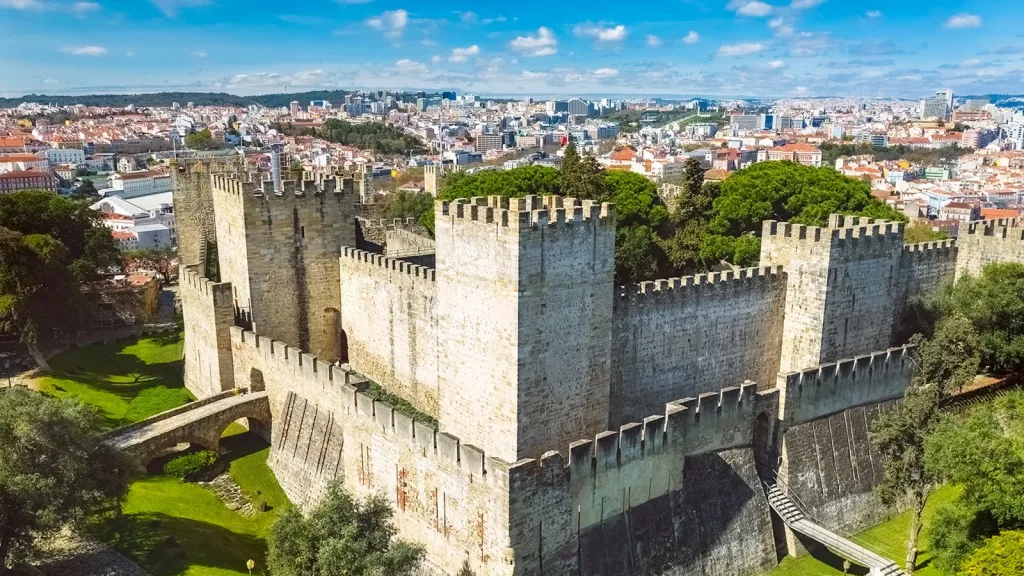

The 1755 Lisbon earthquake destroyed 85% of the city. São Jorge Castle, sitting on the same hill since 985 AD, came through largely intact — which tells you something about how it was built, and by whom.
Most visitor guides cover the view from the battlements and the ticket price. They skip the archaeology, the legend of the man who held a gate open with his body, and the tower that once held every important document in the Portuguese kingdom.
This guide covers the full history — Moorish origins, the 1147 siege, the royal palace years, the royal archive that gave the national archive its name — as well as what is actually inside the walls today: 11 towers, a Camera Obscura, an archaeological excavation, a museum, and approximately 40 peacocks. Plus practical information for 2026: tickets, hours, crowd timing, and how to connect the castle to the rest of Alfama.
I have brought clients to this castle hundreds of times since 2013. The view draws everyone up the hill. What surprises them is usually the Ulisses Tower — the one that stored Portugal’s royal archives for three centuries before anyone thought to build a separate building for them.
The History of São Jorge Castle
São Jorge Castle is not one building with one history. It is a hill that has been fortified, captured, rebuilt, and repurposed across twelve centuries — by Moors, Portuguese kings, and a northern European crusader fleet that was technically on its way somewhere else.
985 AD — Moorish fortification.
The castle as a military structure dates to 985. Hisam II, Caliph of Córdoba, ordered the walls built; construction was supervised by the statesman Almanzor. Archaeological evidence beneath the current castle reveals earlier occupation — Iron Age, Roman, and Visigothic — on the same hilltop.
1147 — The Siege of Lisbon.
Afonso Henriques, Portugal’s first king, had been trying to take Lisbon since 1142. He finally succeeded in October 1147, after a 17-week siege, with the help of northern European crusaders — English, Norman, Flemish, and German forces — who had stopped in Lisbon while sailing to the Second Crusade. The siege became the only significant military success of that crusade, which otherwise collapsed at Damascus.
1255 — Royal alcáçova.
When Lisbon replaced Coimbra as the capital of Portugal in 1255, King Afonso III made São Jorge Castle his royal residence. The hill became the administrative and military heart of the new capital.
14th–17th century — Torre do Tombo.
The Ulisses Tower served as Portugal’s royal archive — the Torre do Tombo — from the 14th century. Every important treaty, charter, and land grant in the kingdom was stored here until the archive was moved to its own building. The documents now reside in the Arquivo Nacional Torre do Tombo, still named after this tower.
1755 — The earthquake.
The Great Lisbon Earthquake (magnitude ~8.5–9.0, 1 November 1755) destroyed 85% of the city and triggered fires and a tsunami. São Jorge Castle survived with limited damage. The hill’s position — high above the low-lying areas most affected by the earthquake and flood — and the thickness of the Moorish walls explain why.
The castle has outlasted seven centuries of Portuguese monarchs, a catastrophic earthquake, and approximately 4 million tourist selfies. The peacocks appear unbothered by all of it.
1938 — Restoration.
The Estado Novo regime under Salazar commissioned an extensive reconstruction of the castle between 1938 and 1940, restoring towers and battlements to a more “medieval” appearance. Historians note the restoration was partly political — a symbol of national heritage for a nationalist government.
When clients ask which is older — this castle or Belém Tower — I tell them the hill was fortified five centuries before Belém Tower was built.
The Martim Moniz Legend
Every major city has a founding myth. Lisbon’s involves a man who held a castle gate open with his body so the city could fall.
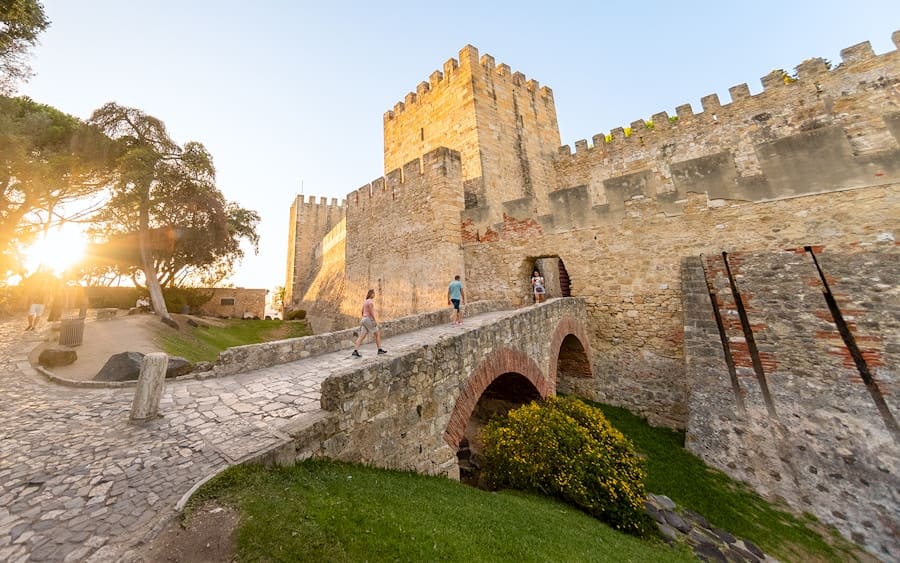
According to the legend, during the 1147 siege a Portuguese knight named Martim Moniz saw Moorish defenders beginning to close the castle gates as Christian forces approached. He blocked the gate with his own body, buying enough time for fellow soldiers to reach the entrance. He was killed in the act. The gate where this happened was named Porta de Martim Moniz in his honour. A bust of Martim Moniz remains in a niche above the gate today.
The historical record is ambiguous. A 1258 document — a century after the siege — mentions the Gate of Martim Moniz, confirming the name existed. The Nobiliário of Pedro Afonso, Count of Barcelos, records only that it was “said” Martim Moniz died there. Historian Pedro Gomes Barbosa concluded the episode “lacks tactical meaning,” since the city surrendered rather than fell through a gate assault.
What is not in dispute: the square in central Lisbon named Praça Martim Moniz bears his name, and the Gate of Martim Moniz is still marked on the castle walls.
Lisbon has named a major metro square after a man whose historical existence is debated. This is not unusual for medieval city founders.
What You Can See Inside
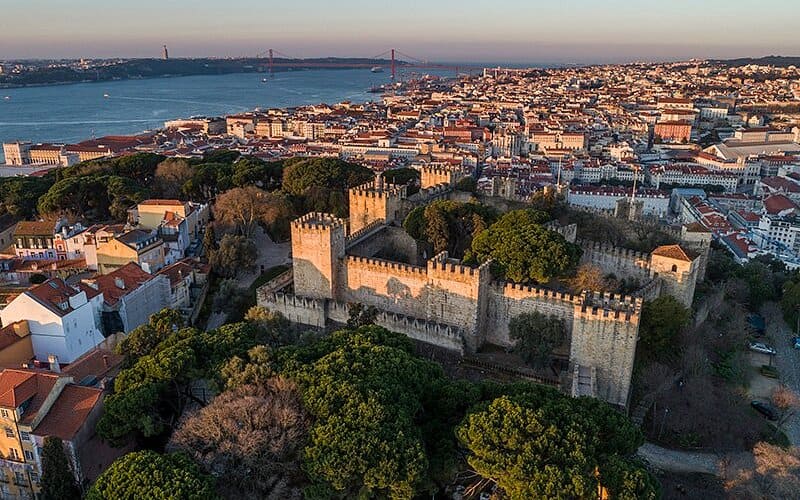
The standard ticket covers more than a viewpoint. Inside the walls: 11 towers, a museum, gardens, and approximately 40 peacocks. The Camera Obscura and the archaeological excavation site require the separate “Discovering the Castle” guided tour (€4.50).
Battlements and Towers
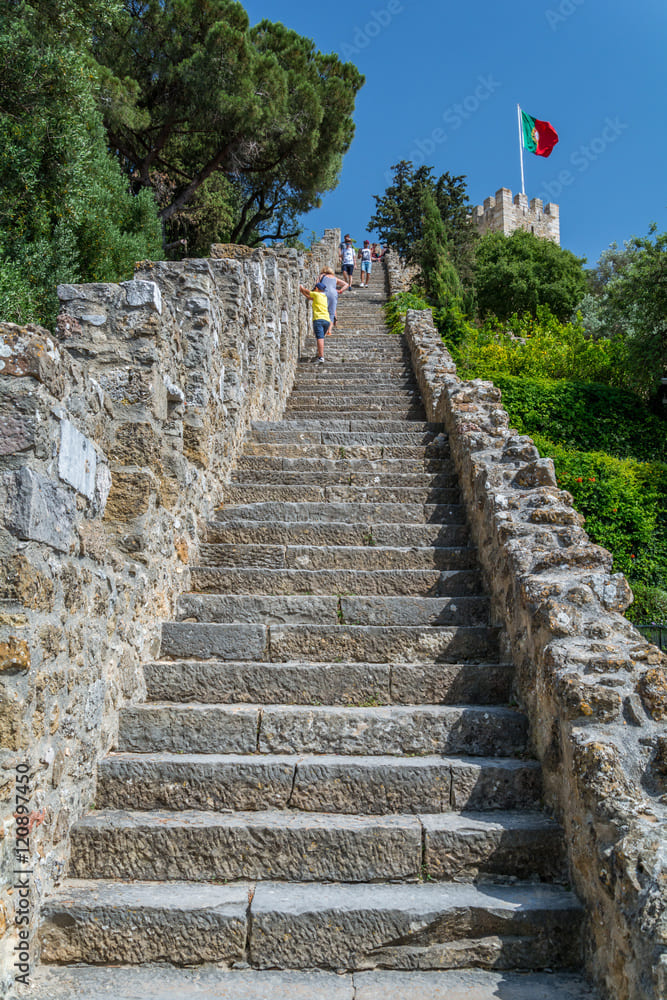
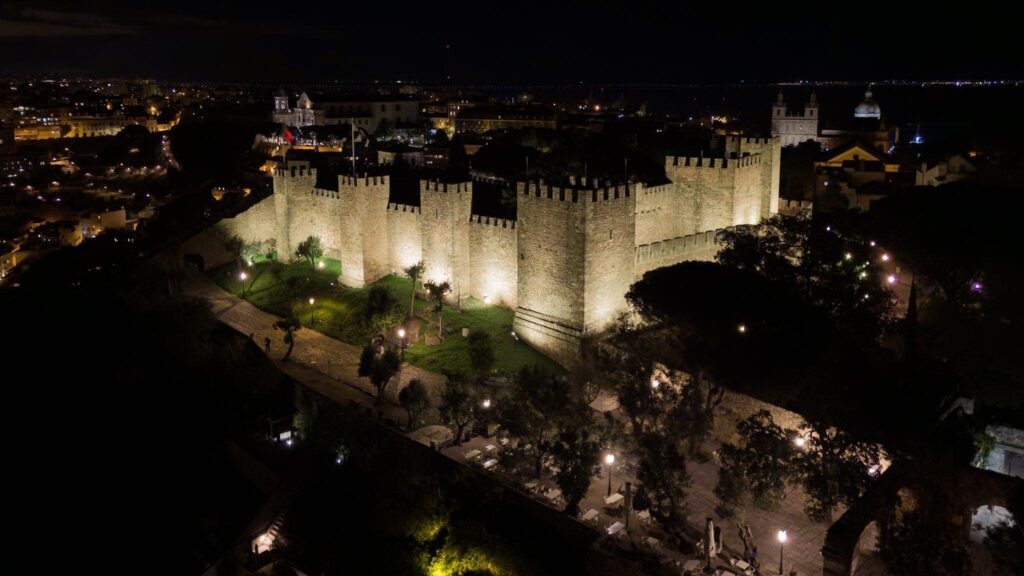
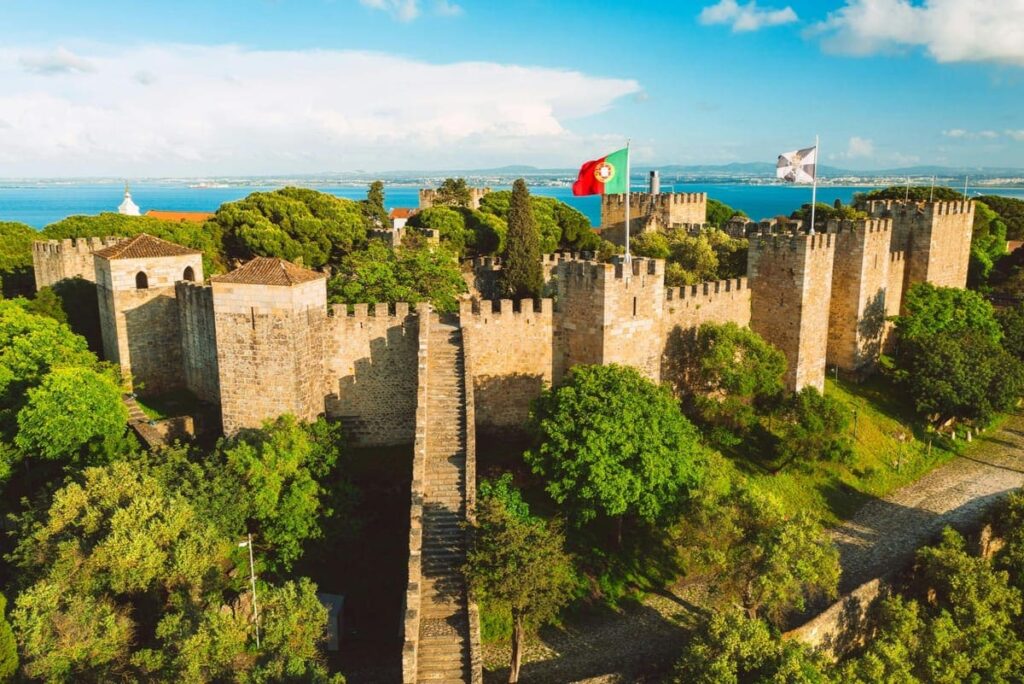
The inner castle is enclosed by 11 towers connected by narrow walkways along the top of the battlements. Walking the full perimeter gives views across Lisbon — the Tagus River, the dome of the Panteão Nacional, Alfama’s terracotta rooftops, and the Ponte 25 de Abril to the west.
Most visitors focus on the main tower platforms; fewer walk the full circuit, which takes 20–25 minutes.
The Peacocks
Around 40 peacocks roam the castle grounds. They are descended from birds first brought to Portugal from India during the 15th-century Age of Discovery. They display seasonally (spring to early summer) and are present year-round.
They are not behind barriers. Keep a reasonable distance — they can be aggressive if approached at close range, particularly the males. This is not a petting-zoo situation.
Gardens and Terrace
The landscaped area within the castle walls contains olive and pine trees, benches, and shaded areas.
The main terrace (Casa do Leão terrace) offers one of the widest viewpoints in the castle. The Casa do Leão restaurant is inside the walls — reservations are recommended if you plan to eat there.
The Camera Obscura
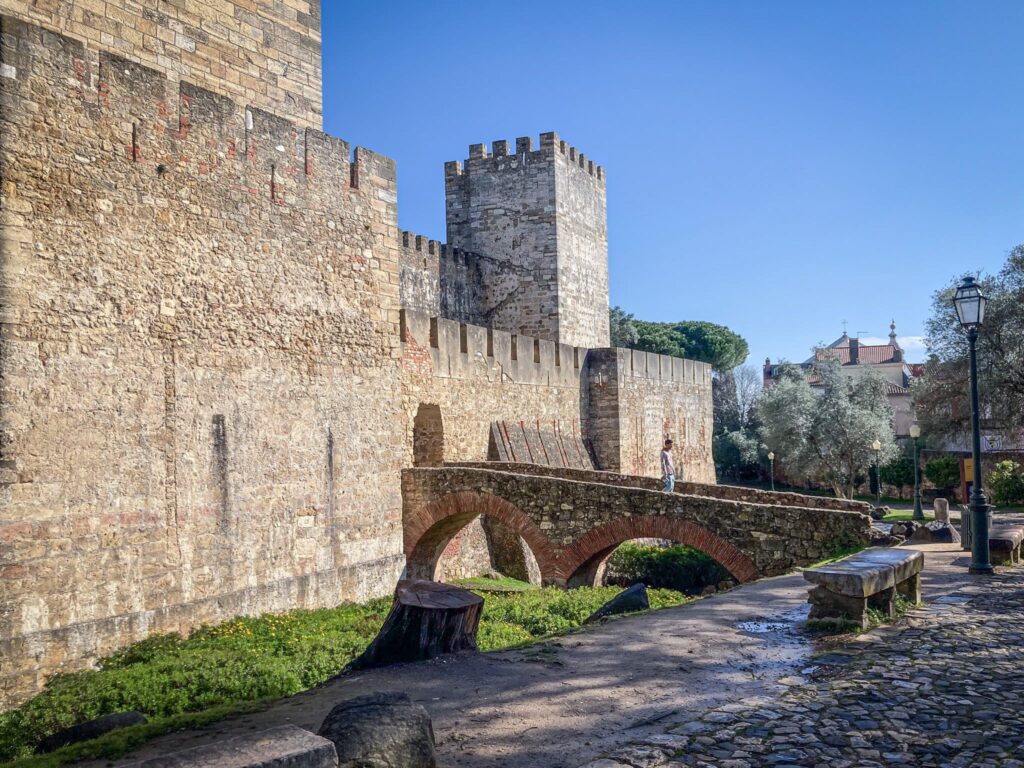
The Ulisses Tower contains something most visitors walk past: an optical device that projects a live, moving, 360° image of Lisbon onto a table-sized screen. It works on the same principle as the original cameras — lenses and mirrors, no electricity required.
The Camera Obscura uses a system of lenses and mirrors to capture light from outside and project a real-time panoramic image of the city onto a concave white dish inside a darkened room. The image rotates as the device turns, covering the Tagus, the Alfama rooftops, the squares below, and moving traffic.
It is the same optical principle used before photography: a room (camera) made dark (obscura) with a small aperture to project outside light inside.
Access is via the “Discovering the Castle” guided tour (€4.50 per person, castle ticket not included). Tours run approximately 11:00–16:00, subject to weather conditions. Book at the castle on arrival — places are limited.
The Archaeological Site
Beneath the current castle, excavations have exposed a Moorish neighbourhood that was buried for 800 years.
Since the 1990s, archaeological work near the castle keep has uncovered the physical remains of the Moorish city that existed here before 1147: streets, house foundations, and everyday objects including pottery, tools, and coins.
The excavation site is accessible through the “Discovering the Castle” guided tour (€4.50 per person, not included in the standard ticket).
The permanent exhibition inside the castle museum — included in the standard €17 ticket — displays artefacts from all periods on the hill: Iron Age pottery, Roman amphorae, Visigothic metalwork, Moorish ceramics, and medieval Portuguese objects.
The stratigraphy visible in the excavation walls shows the sequence of civilisations — each built on top of the previous one.
Practical Information: Tickets, Hours and Getting There
Tickets (2026)
- General admission: €17
- Ages 13–25: €8.50
- Over 65: €14
- Under 12: Free
- Online booking: via BOL (Bilheteira Online) — the only authorised platform. Booking online skips the ticket desk queue.
Hours
- March–October: 09:00–21:00
- November–February: 09:00–18:00
- Closed: 1 January, 1 May, 24 December, 25 December, 31 December
Crowd timing
July and August: queue at the ticket desk reaches 30–60 minutes between 10:00 and 14:00. Arrive at opening (09:00) or book online.
Shoulder season (April–June, September–October): 15–30 min wait without online booking.
November–March: minimal queues.
Getting there
- Tram 28: historic route stops at the Castelo stop — the tram itself is crowded in summer (buy a day pass, not a single fare)
- Bus 737: less crowded than tram 28, runs from Praça da Figueira
- Walking from Baixa: ~25 minutes uphill through Alfama. The climb is steep — comfortable footwear required
- Taxi / Uber: can drop you at the castle entrance
Visit duration: 1.5–2 hours for castle + battlements walk + museum. Add 45–60 min if joining the “Discovering the Castle” guided tour (Camera Obscura + archaeological site, €4.50 extra).
Tram 28 is slower than walking in July. It is also considerably more photogenic than walking in July, which is why both options remain popular.
How to Combine the Castle with Alfama
The castle is the highest point of Alfama. Coming down from it gives you the neighbourhood in a logical sequence — downhill.
After the castle, descend into Alfama on foot. Suggested sequence:
Portas do Sol miradouro — 5 minutes from the castle exit. Wide terrace with views over lower Alfama and the Tagus. Usually less crowded than the castle battlements.
Santa Luzia miradouro — 2 minutes further. Smaller, with azulejo panels on the exterior wall depicting old Lisbon and the 1147 siege.
Museu do Fado — Largo do Chafariz de Dentro, 1. Portugal’s national fado museum. UNESCO recognised fado as Intangible Cultural Heritage in 2011. Opens 10:00, closed Mondays. Ticket €5.
Feira da Ladra flea market — Campo de Santa Clara, Tuesdays and Saturdays. 10 minutes from the castle on foot.
I always walk clients down through Alfama after the castle rather than up to it. Uphill before 9:30, downhill after 11:00 — less congestion both ways.
Visit Lisbon’s Monuments with a Private Guide
São Jorge Castle is part of every full Lisbon tour we operate. The castle, Belém, Alfama, the fado districts — seeing them separately, on public transport and in peak queues, is a different experience from covering the same ground with a guide who knows when to arrive at each one.
- Lisbon Private Tour — Full day in Lisbon: castle, Belém, Alfama, Baixa. Depart 08:30 to reach the castle at opening.
- Best Solution Tour — Half-day with Alfama and Castelo district focus and half-day in Sintra. Good option if you are combining Lisbon with a Sintra day.
- Best Day Trips from Lisbon — If you have already done the castle and want to see beyond the city.
FAQ
How much does São Jorge Castle cost to enter?
What are the opening hours for São Jorge Castle?
How do I get to São Jorge Castle from central Lisbon?
How long does a visit to São Jorge Castle take?
What is the Camera Obscura inside São Jorge Castle?
Is São Jorge Castle worth visiting?
When is the best time to visit São Jorge Castle?
What is the legend of Martim Moniz at São Jorge Castle?
Are there peacocks at São Jorge Castle?
Can I skip the ticket queue at São Jorge Castle?

Founder & Director of Yellow Cab TT Tours. Guiding in Portugal for 20+ years.
Founded Yellow Cab TT Tours in 2013. 3,372 five-star reviews on Tripadvisor.