
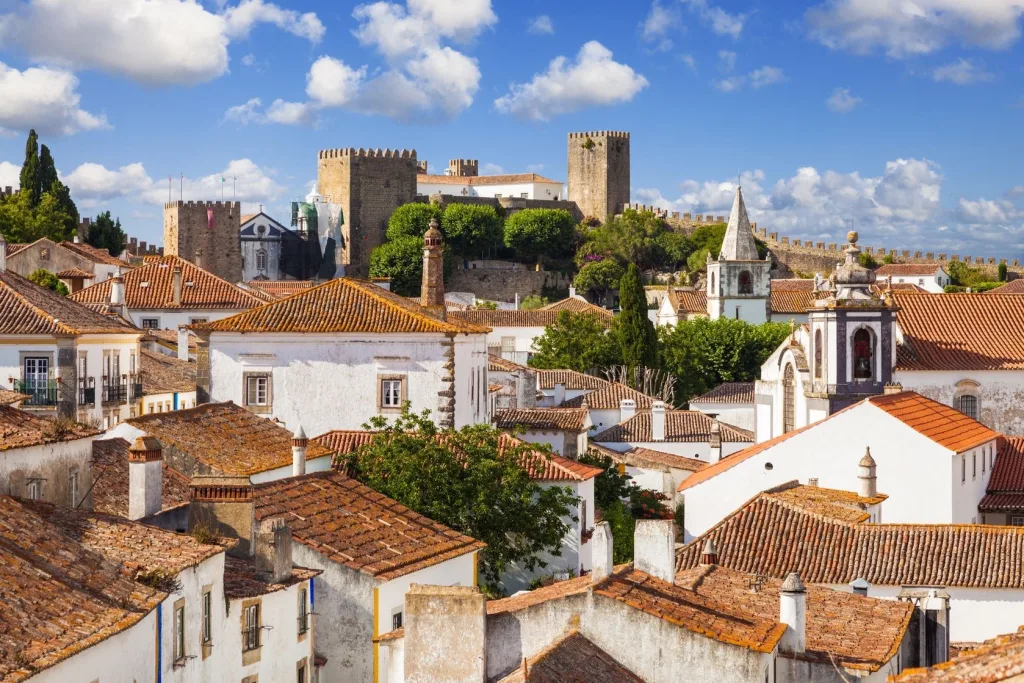

Most people spend two hours in Óbidos, buy a chocolate cup of ginja on Rua Direita, walk a section of the medieval walls, and leave. That is a reasonable use of two hours. It is also roughly 40% of what the town contains.
Óbidos sits about 80 km north of Lisbon on a hilltop enclosed by 1,565 metres of walkable limestone rampart. The walls were originally Moorish — built during the 8th century, captured by the first King of Portugal in 1148 — and the town has been under continuous habitation ever since. In 1282, King Dinis I gave it to his wife as a wedding present. The gesture set a tradition: for the next three centuries, successive Queens of Portugal received Óbidos as part of their royal dowry. The town collected churches, paintings, and patronage accordingly.
None of this is particularly well explained on Rua Direita, where the main activity is choosing between ginja vendors.
I have been bringing clients to Óbidos since 2013, usually as part of a longer Silver Coast day from Lisbon. What follows is what I actually tell people before we get there — the context that turns a pleasant stroll into something with a bit more substance.
The Walls — and How to Walk Them
The walls of Óbidos are the reason to come. Not because they are the tallest or the best-preserved medieval fortifications in Portugal — they are not — but because they are fully walkable in their entirety, free of charge, and they give you a view of the town and the surrounding Silver Coast landscape that is impossible to get from street level.
The perimeter is 1,565 metres. At a steady pace with stops, that is 40–50 minutes. The pathway is narrow — in places, about 80 cm — and most sections have no handrail on the outer edge. Heights reach 13 metres. This is not a problem for most people, but if you are travelling with young children or have difficulty with heights, a partial walk (the section from Porta da Vila northwest toward the castle) gives you the best views with the least exposure.
The walls were built on Moorish foundations from the 8th century and expanded significantly under King Dinis I in the late 13th and early 14th centuries. They survived the 1755 Lisbon earthquake structurally intact — an unusual distinction, given that the earthquake destroyed or damaged most of the significant masonry in central Portugal. The aqueduct north of town also survived. Historians attribute this partly to Óbidos’s distance from the epicentre and partly to the quality of the original construction.
Practical note: the rampart access points open at the main gate and at several points around the perimeter. There is no ticket. The surface is uneven stone; footwear with grip is worth bringing.

Porta da Vila: The Entrance Nobody Looks at Properly
Almost everyone enters Óbidos through the Porta da Vila — the main arched gate at the south end of the walled town. Almost everyone looks forward through the arch and starts walking up Rua Direita. The correct move is to stop inside the arch and look at the walls.
The interior of the Porta da Vila is entirely covered in 18th-century azulejo tiles — blue and white, depicting scenes from the Passion of Christ. The tiles were added after the 1755 earthquake, not as earthquake repair but as a separate act of religious patronage. The gate itself survived the earthquake. The tilework was a deliberate artistic commission, completed in the decades following 1755.
The quality of the azulejos inside the Porta da Vila is comparable to what you would pay to see in Lisbon’s churches and museums. Here it is on a public gate, no ticket required, and the majority of visitors walk straight through it in thirty seconds. I have lost count of how many times I have watched a group stop, take a photo of the arch from outside, then walk through without looking up.

The Castle of Óbidos
The castle sits at the north end of the walled town, above and behind the main street. Moorish in origin, it was captured in 1148, reinforced by King Dinis I in the late 13th century, and received its rectangular keep — the tall tower visible from outside the walls — during the reign of King Fernando I in the 14th century.
In 1951, the castle was converted into a pousada — a state-run heritage hotel — making it one of the first such conversions in Portugal. The interior is reserved for guests. Rooms are built into the medieval towers; the hotel has 17 rooms total. It books out months in advance in summer, and the prices reflect its position as one of the more unusual places to sleep in Portugal.
The castle exterior and towers are visible from the walls and from the street below. For non-guests, the most useful view is from the rampart walk approaching from the south: you see the keep in proper context above the lower walls, with the surrounding valley behind it.
One point worth noting: most visitors assume the castle is open to tour. It is not — not as a monument. If you want to go inside, you book a room. This catches a significant number of people off guard.

Igreja de Santa Maria — More Than a Church
Igreja de Santa Maria stands in Praça de Santa Maria, the main square inside the town. The site has been a place of worship since Visigothic times. The Moors used it; after the reconquest in 1148, King Afonso Henriques ordered a church built on the site. The current building dates primarily from the 16th century, rebuilt under King João III and Queen Catherine of Austria.
Three things inside the church are worth looking at specifically:
The azulejo panels. The lower interior walls are lined with blue and yellow tiles dated 1680–1690. These are among the most complete 17th-century tilework programmes in any church outside Lisbon — better preserved than most, and in a building that receives a fraction of the visitors of Lisbon’s tiled churches.
The altarpiece by Josefa de Óbidos. The altarpiece of Saint Catherine of Alexandria was painted by Josefa de Óbidos, baptised in Seville on 20 February 1630 and died in Óbidos on 22 July 1684. She produced approximately 150 paintings over her career and is considered the most significant female Baroque painter in 17th-century Portugal. The altarpiece inside Santa Maria is the only work by Josefa still displayed in its original location. Every other painting of hers has moved — to museums, to private collections, to other churches. This one stayed.
The royal wedding of 1444. On 22 August 1444, King Afonso V, aged ten, married his cousin Infanta Isabel, aged eight, inside this church. Dynastic marriages at those ages were standard in 15th-century Portugal; the detail is jarring by modern standards and historically accurate. The marriage went on to have political consequences for the next two decades of Portuguese rule.
The church is free to enter. It closes for lunch (typically 12:30–14:00, though hours vary seasonally — check the door).

The Aqueduct
The Aqueduto da Usseira is not inside the walled town — it approaches from the north and is most visible from the road arriving from Caldas da Rainha. It runs from a spring near the village of Usseira to the town walls, a mix of elevated stone arches and underground channels, reaching heights of up to 20 metres at its tallest points.
Queen Catherine of Austria commissioned it around 1570, personally funding the construction by selling her landholdings around Óbidos — an act consistent with the Vila das Rainhas tradition of queens investing directly in the town. It was classified as a Property of Public Interest in 1962.
Most visitors do not notice it unless they are arriving by car from the north, or specifically looking for it. It is not signposted from inside the town. If you are approaching Óbidos from Caldas da Rainha on the N8, you will see the arches on your left before you reach the main gate. Worth slowing down.

Ginja de Óbidos: What It Is and What to Know
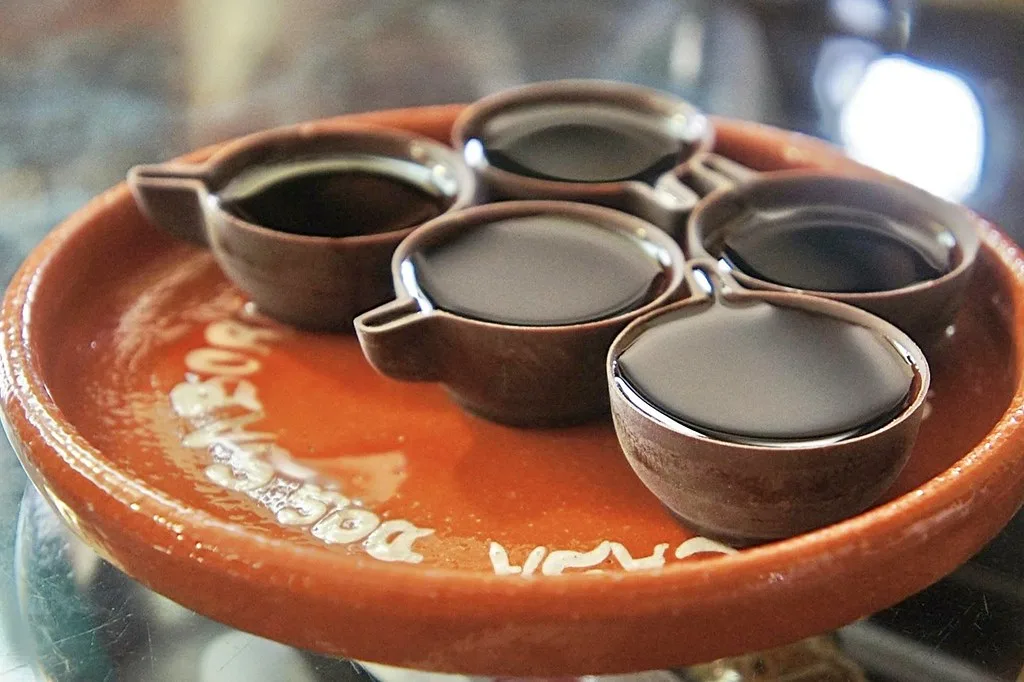
Ginja is a liqueur made from ginja berries — a variety of morello cherry (Prunus cerasus) — grown in the Sobral da Lagoa valley within the municipality of Óbidos. The resulting liqueur is dark red, moderately sweet, with enough tartness to prevent it from being cloying. It is approximately 20% ABV.
The specific tradition of serving it in a small dark chocolate cup was introduced in 1987 by a local producer named Dário Pimpão. The chocolate cup has since become the standard — almost every vendor along Rua Direita uses it — and the cup is meant to be eaten after the drink. The combination works. It is not a tourist gimmick retrofitted onto an existing product; it was a deliberate development by a specific person at a specific time, and it stuck.
A note on vendor selection: there are a dozen ginja vendors on Rua Direita and they all sell essentially the same product. Price differences exist — vendors near the gate tend to charge €1.50–2.00, while those further along the street sometimes sell for €1.00–1.50. The selection criteria most worth applying are freshness of the chocolate (visible dryness or bloom on old cups is a bad sign) and whether the vendor stores the cups at room temperature or in a cool space. A warm chocolate cup does not hold the liquid well.
Ginja de Óbidos has PDO (Protected Designation of Origin) status within Portugal. The commercially bottled version is available in supermarkets across the country; the fresh version in a chocolate cup is specific to Óbidos.
The Medieval Market
Every July, Óbidos hosts the Mercado Medieval — approximately ten days of programming inside and around the castle walls recreating 14th-century life. In 2026, the dates are 16–26 July, daily from 17:00 to midnight. The programme includes jousting tournaments, troubadour performances, fire-eaters, falconry displays, and a craft and food market selling period-style products.
The event draws visitors from across Portugal and from Spain, France, and the UK. During the Medieval Market, accommodation in and around Óbidos books out weeks in advance. The walled town itself becomes significantly more crowded than at any other point in the year.
Tickets: €6 adults, €5 children (6–12), free under 5. Check details at mercadomedievalobidos.pt. Dates shift slightly year to year within July.
If you are planning a visit to Óbidos purely for the town — the walls, the church, the castle exterior — July during the Medieval Market is the worst timing from a crowd perspective. If you are going specifically for the market, it is one of the better medieval recreation events in the Iberian Peninsula, and the castle backdrop is genuinely well-suited to it.

When to Visit Óbidos
| Period | Conditions |
|---|---|
| March–May | 15–20°C, low crowds, surrounding landscape green from winter rain |
| June | Warming up (20–25°C), busier weekends, Medieval Market preparation |
| July | Peak season, 25–30°C, Medieval Market (town at maximum activity) |
| August | Peak crowds, 25–30°C, hottest month; castle hotel requires advance booking from March |
| September–October | 20–25°C, noticeably quieter than summer, walls and castle exterior accessible |
| November–February | 8–14°C, very few visitors; some restaurants and shops reduce hours |
Óbidos is compact. Most visitors cover the principal sights — Porta da Vila, Rua Direita, Igreja de Santa Maria, castle exterior, rampart walk — in 2–3 hours. A half-day (3–4 hours) allows a relaxed visit with lunch inside the walls.
The town is most visited on weekend mornings from April through October, when day-trippers from Lisbon arrive mid-morning. Weekdays, and any time before 10:00, the streets are significantly emptier. If you have flexibility, a Tuesday or Wednesday morning in May is as good as Óbidos gets.

How to Get to Óbidos from Lisbon
By car
~80 km via A8 motorway north from Lisbon, then A15 toward Óbidos/Caldas da Rainha. Journey time approximately 1 hour in normal traffic. Paid parking is available just outside the Porta da Vila; no private vehicles enter the historic centre. The riverside parking at Belém fills by 10:00 on weekends — same principle applies here.
By bus
The Rápida Verde express service (operated by Rodojejo) runs from Lisbon’s Campo Grande terminal directly to Caldas da Rainha, with onward connection to Óbidos. Total journey approximately 1h 15min–1h 30min. A single ticket costs approximately €8. The bus is practical for a solo day trip; for a family or group with luggage it becomes complicated by the connection.
By train
Comboios de Portugal runs services from Lisboa Oriente or Lisboa Santa Apolónia to Caldas da Rainha (approximately 1h 30min). A local bus or taxi connects to Óbidos town centre, 7 km away. Total door-to-door approximately 2 hours. This is the slowest option.
On a private tour from Lisbon
Óbidos is most commonly visited as part of a Silver Coast day combining it with Nazaré (22 km north of Óbidos). Batalha Monastery — UNESCO World Heritage Site since 1983, 37 km further north — is frequently added as a third stop. Fátima (52 km from Óbidos) completes the route for a full-day itinerary. On a private tour, transfer time between stops is 20–40 minutes each; the full four-destination route from Lisbon runs 10–11 hours.

Visit Óbidos and the Silver Coast with a Guide
Óbidos works best as part of a longer day. The drive from Lisbon north through the Silver Coast connects it naturally with Nazaré — the cliffs, the canyon-driven surf, the funicular up to Sítio — and with Batalha Monastery if time allows. On a private tour, the route fits a full day without feeling rushed. On a group tour, Fátima and Batalha anchor the morning, and Óbidos closes the route in the afternoon.
- Nazaré & Óbidos Private Tour — Private day tour from Lisbon. Nazaré coast in the morning, Óbidos walls in the afternoon. Return to Lisbon by early evening.
- Nazaré, Óbidos & Sintra Private Tour — Combines the Silver Coast with the Sintra palaces. A long day; suited to clients with a single free day who want maximum geographic range.
- Fátima, Batalha & Nazaré Group Tour — Group tour that includes an Óbidos stop on the return route. Fixed departure times from Lisbon.
- Full itinerary: Fátima, Batalha, Nazaré and Óbidos in one day — If you want to plan the route yourself before deciding on a tour.
FAQ
How far is Óbidos from Lisbon?
Is Óbidos worth visiting?
Can you walk on the walls of Óbidos?
What is Ginja de Óbidos?
How much does ginja cost in Óbidos?
Is the Castle of Óbidos open to visit?
Who was Josefa de Óbidos?
When is the Medieval Market of Óbidos?
Why is Óbidos called the Town of the Queens?
How long do you need in Óbidos?

Founder & Director of Yellow Cab TT Tours. Guiding in Portugal for 20+ years.
Founded Yellow Cab TT Tours in 2013. 3,372 five-star reviews on Tripadvisor.