

The Torre de Belém stood in the Tagus estuary for over 500 years without anyone caring much whether the queues were long. Then tourism happened. By 2024 the tower was admitting more than 400,000 visitors a year through a 16th-century doorway designed for a different kind of traffic — soldiers and customs officials, not tour groups and selfie sticks.In April 2025 the government closed it for restoration. The first major structural overhaul since 1998 cost €1 million and took thirteen months. On 26 May 2026 it reopened with a new timed-entry system: a maximum of 60 visitors every 30 minutes, 900 per day total. The lioz limestone exterior, which had darkened with two decades of river humidity and exhaust, was cleaned back to something closer to its original colour.
Belém is part of every Lisbon tour I run. The tower from the riverbank, the monastery five minutes away, the custard tart bakery that has been there since 1837 — the sequence is the same, and it still works.
This guide covers what the tower actually is, why it was built where it was, what you will see inside across its four levels, and how the new entry system changes the visit in practice. I have taken clients to Belém hundreds of times. The tower is never the longest stop of the day — but it is the one most people mention afterwards.
What Is Belém Tower and Why Was It Built There?
The Torre de Belém was constructed between 1514 and 1519 on the orders of King Manuel I. The location was specific: the north bank of the Tagus estuary, at the point where the river meets the Atlantic. Every Portuguese ship leaving for India, Brazil, or the African coast passed this point. The tower was built to control that passage.
Its original functions were military and administrative: a coastal fortification to defend against naval attack, a customs checkpoint for cargo arriving from overseas, and a ceremonial gateway — the last structure sailors saw leaving Portugal and the first they recognised returning. It was named Torre de São Vicente de Belém after the patron saint of Lisbon.
The tower’s position in the river has shifted over the centuries. When it was built, it stood in the water; today it sits at the riverbank, because the 1755 earthquake and subsequent development changed the silting patterns of the Tagus. Visitors sometimes expect to wade to it. They do not need to.
The building was listed as a UNESCO World Heritage Site in 1983, alongside the Jerónimos Monastery 500 metres to the northeast. Together they represent the fullest surviving expression of Portugal’s Age of Discoveries in stone.
Later in its history, from 1580 to 1830, the tower served as a prison — a detail most guides mention briefly and then pass over. The cells in the lower bastion, below the waterline at high tide, were used for political prisoners during both Spanish occupation and the Napoleonic period. The tower is considerably less picturesque from the inside of those rooms. Most travel photographs are taken from the outside, which is probably not a coincidence.

The Architecture: Manueline Style and What to Look For
Manueline — sometimes called Portuguese Late Gothic — is an architectural style that emerged during the reign of Manuel I (1495–1521) and lasted roughly one generation. It applied maritime and navigational motifs to Gothic structural forms: twisted ropes in stone, armillary spheres, the Cross of the Order of Christ, coral, and nautical instruments carved into doorways, windows, and balustrades.
The Torre de Belém is the most complete surviving example of Manueline architecture applied to a military building. Its designer was Francisco de Arruda, a military architect who had previously worked on Portuguese fortifications in Morocco — an influence visible in the Moorish-style sentry boxes on the tower’s corners, which are unusual in a European context.
The exterior rewards slow attention. The rope motifs on the balustrades are not decorative in the generic sense — they reference the actual rigging of the ships that financed the building. The armillary sphere, Manuel I’s personal emblem, appears repeatedly. The Cross of Christ, emblem of the Order of Christ that funded much of Portugal’s maritime expansion, dominates the battlements.
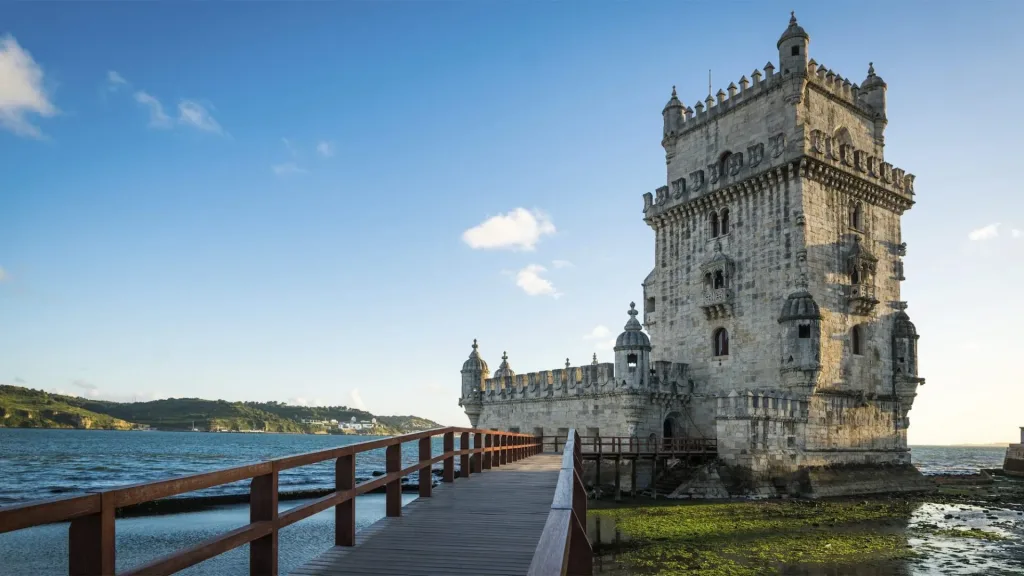
The tower has four main levels above the bastion: the Governor’s Room (ground floor of the tower proper), the Audience Room, the King’s Room, and an open terrace at the top. The staircase connecting them is narrow enough that visitor flow is managed in one direction. This is part of why the new 60-person-per-slot system matters — it is not a large building.
One dry humor moment: the tower was described by 16th-century chroniclers as a formidable military asset. Contemporary military historians note that it would have been of limited strategic effectiveness against the artillery of the period. It was, however, very well positioned for collecting customs duties.
Inside the Tower: Four Levels
The restoration completed in May 2026 cleaned and stabilised the interior stonework, which had accumulated significant humidity damage over two decades. The director of the monument, Margarida Donas Botto, described the result as the tower “shining inside and out” — a phrase that is accurate in the literal sense: the lioz limestone, when clean, is noticeably pale against the Tagus.
Bastion (ground level): The lowest section, partially below the original waterline. Used as storage and later as prison cells. The casemates — arched chambers built into the walls — are visible here. This is the section most associated with the tower’s less celebrated history.
Governor’s Room: First floor of the tower proper. The main reception space, with windows overlooking the river on three sides. The views across the Tagus from this level are the best inside the building.
Audience Room: Second floor. Notable for the carved stonework around the windows, which shows the full range of Manueline decorative vocabulary in a contained space.
King’s Room: Third floor. Smaller, with an elaborate loggia on the river side. The balcony here is the one that appears most frequently in photographs taken from boats.
Terrace: The uppermost level, open air. 360-degree views of the Tagus, the 25 de Abril Bridge, and the Belém waterfront. On clear days the Arrábida hills are visible to the south. This is where most visits end, and where most visitors spend the most time.
The full visit takes 30–40 minutes at a normal pace, which is accurate. The building is not large. What takes time is the staircase — narrow, steep, and single-file — and the terrace, where people tend to stop longer than they planned.

The Rhinoceros and Other Hidden Details
In 1515, Sultan Muzaffar II of Gujarat sent King Manuel I a live Indian rhinoceros as a diplomatic gift. The animal arrived in Lisbon that June — the first rhinoceros seen in Europe since Roman times. Manuel I sent it on to Pope Leo X as a gift. The ship sank en route in 1516. The rhinoceros drowned.
Before it left Lisbon, the animal was observed and drawn. Albrecht Dürer produced his famous woodcut of it in 1515, based on a written description and sketch, without having seen the animal himself. Dürer’s rhinoceros — anatomically imprecise, with a small horn on its back that rhinoceroses do not have — became the standard European reference image for the species for the next two centuries.
The carved rhinoceros at the base of one of the western turrets of the Torre de Belém is among the earliest three-dimensional representations of the animal in European art. It is small and easy to miss. Most visitors walk past it. It is worth finding: a real animal carved by someone who may have actually seen it, at roughly the same moment Dürer was producing an image based on a description alone — and getting the horn placement wrong in a way that remained the authoritative European version for 200 years.
Other details worth noting: the armillary sphere above the main entrance, which was Manuel I’s personal symbol and appears on the Portuguese flag to this day; the pelican carved in the same area, a symbol of Christ in medieval iconography; and the Venetian-influenced loggia on the river side, which sits oddly within a Portuguese military tower but reflects the cosmopolitan nature of Lisbon’s trade connections in 1516.
Practical Information: Tickets, Hours and the New Entry System
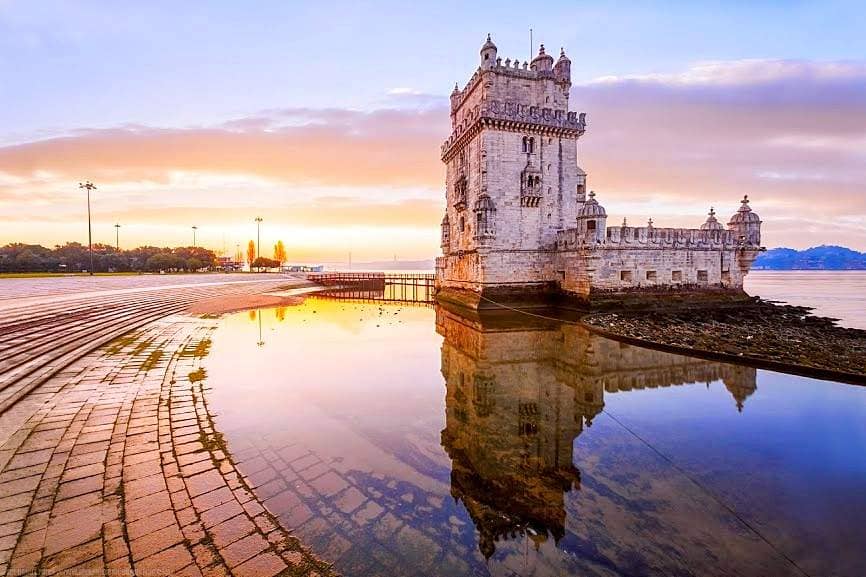
The Torre de Belém closed for restoration in April 2025 and reopened on 26 May 2026 following a €1 million conservation project — the first major work on the building since 1998. The exterior stonework was cleaned and the interior was stabilised.
New entry system (from 26 May 2026):
The previous system allowed up to 150 visitors inside at once, with no time-slot management. Queue times regularly exceeded one hour. The new system limits entry to 60 visitors every 30 minutes, with a daily cap of 900 admissions. Timed slots can be booked online or purchased at the Jerónimos Monastery ticket office.
| Detail | Info |
|---|---|
| Opening hours | 09:30–17:30 (last entry 17:00) |
| Ticket price | €15 (adult) |
| Daily capacity | 900 visitors |
| Slot size | 60 visitors / 30 min |
| Booking | Online or at Jerónimos Monastery |
| Closed | Mondays and public holidays |
Queue reality before vs after: Under the old system, arriving at 11:00 on a summer Saturday meant a queue of 60–90 minutes. Under the new system, the maximum theoretical wait is around 20 minutes if a slot is sold out and you are buying on the day. Booking online in advance eliminates the queue entirely. This is a material improvement and the main operational change worth knowing about.
The ticket includes access to all four levels and the terrace. There is no separate charge for any part of the building.
How to Get to Belém
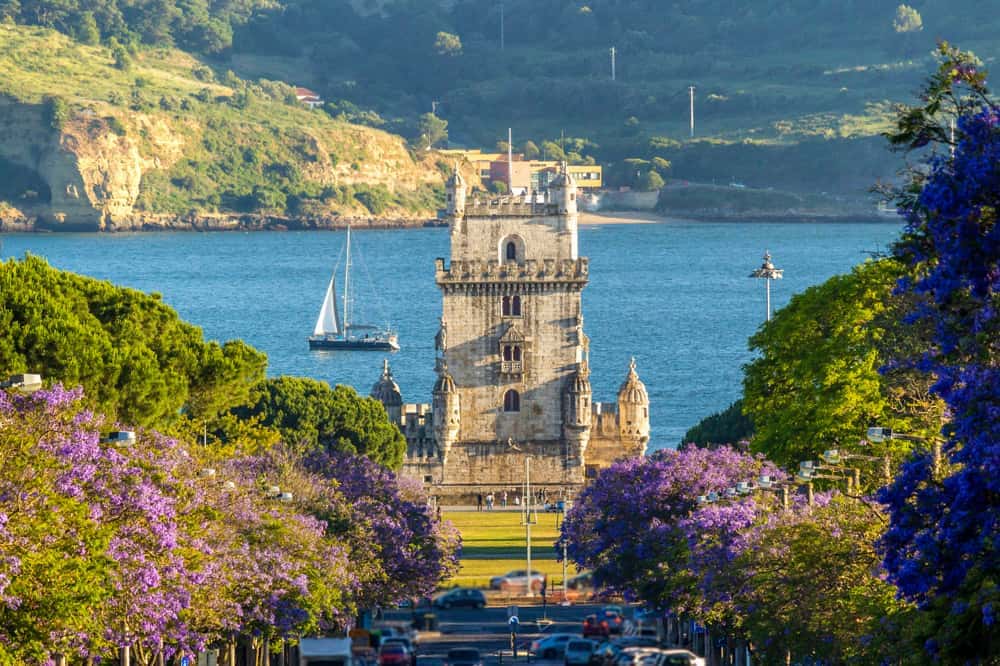
Belém is approximately 6 km west of Lisbon’s historic centre. It is not walkable from the Baixa in any reasonable definition of “walkable.”
Tram E15: Runs from Praça da Figueira in Baixa directly to Belém. Journey time approximately 25–30 minutes. The tram stops directly in front of the tower. This is the most used route and the most crowded in summer.
Bus 728: Runs from Marquês de Pombal via Alcântara to Belém. Less scenic, faster.
Train (Cascais line): From Cais do Sodré station to Belém station (Cascais direction), two stops. Journey approximately 10 minutes. The train is faster than the tram and significantly less crowded. From Belém station it is a 10-minute walk along the riverfront to the tower.
Private vehicle: Parking exists along the Belém waterfront but fills early in summer (before 10:00 on weekends). The drop-off point for a private tour is directly at the tower entrance.
The Jerónimos Monastery is a 5-minute walk from the tower. The Monument to the Discoveries is 500 metres west. Belém is a district worth spending half a day in rather than arriving specifically for the tower and leaving.

Visit Belém with a Private Guide
Belém is one of the standard stops on every Lisbon private tour we run. The tower, the monastery, the waterfront, the custard tart bakery — the neighbourhood contains a full morning’s programme within walking distance. A private tour handles transport from the city centre, covers the logistics, and gets you to the tower early enough to avoid the peak entry times.
- Lisbon Private City Tour — Alfama, Belém, Bairro Alto, Mouraria and Baixa in one day. Pickup from your hotel.
- Best of Lisbon & Sintra — Lisbon highlights including Belém combined with Sintra palaces and Cabo da Roca in one full day.
FAQ
Is Belém Tower open in 2026?
How much does it cost to visit Belém Tower?
How long does a visit to Belém Tower take?
What is Manueline architecture?
Is Belém Tower worth visiting?
What is the rhinoceros at Belém Tower?
Can you see inside Belém Tower?
What else is in Belém besides the tower?
Is Belém Tower accessible for visitors with mobility issues?
How far is Belém Tower from Jerónimos Monastery?

Founder & Director of Yellow Cab TT Tours. Guiding in Portugal for 20+ years.
Founded Yellow Cab TT Tours in 2013. 3,372 five-star reviews on Tripadvisor.