
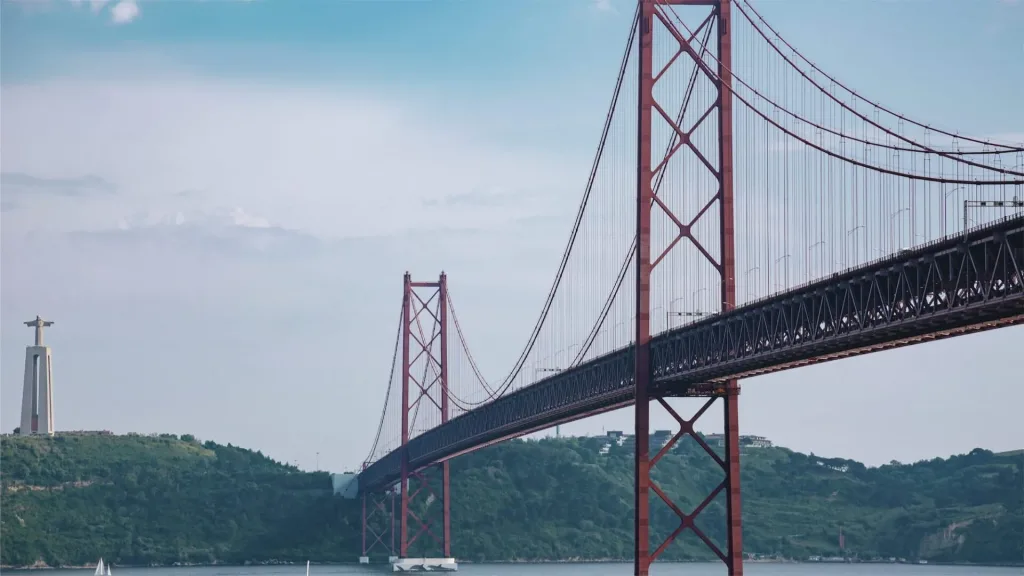

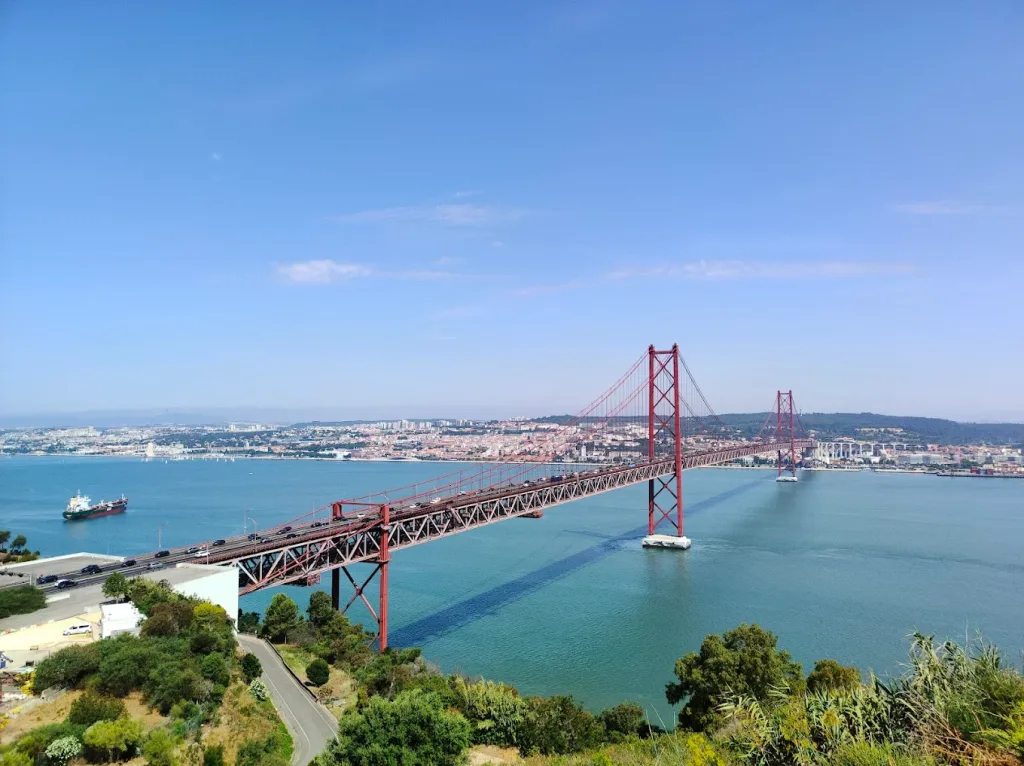
Most visitors to Lisbon see the 25 de Abril Bridge exactly once — from a viewpoint in Alfama or Belém, as a red shape in the background of a photo of something else. Almost nobody crosses it. It’s Lisbon’s only road bridge south, it looks close enough to San Francisco’s Golden Gate that people assume it’s a copy, and most private city tours never touch it, because everything they cover sits on the north bank.
We’re one of the few operators whose standard Lisbon day actually drives across it — because our tour includes the Cristo Rei statue on the other side, in Almada, and there’s only one practical way to get there by road. So we’ve spent a fair amount of time on this bridge, not just looking at it.
Here’s what it actually is: why it resembles the Golden Gate (the resemblance isn’t a coincidence, but it’s not a copy either), what it survived getting built, what changed its name in 1974, and the one small detail about it that’s currently different from what most articles about it will tell you.
Why It Looks Like San Francisco’s Bridge
The resemblance to the Golden Gate Bridge isn’t accidental, and it isn’t a copy either — it’s closer to a sibling relationship.
The 25 de Abril Bridge was built by the American Bridge Company, a subsidiary of United States Steel, the same firm that built San Francisco’s Oakland Bay Bridge. The design itself came from Steinman, Boynton, Gronquist and London of New York, working with the Tudor Engineering Company of San Francisco.
Both Lisbon’s bridge and the Golden Gate are painted the same International Orange, chosen for both bridges for the same practical reason: visibility in fog, which the Tagus estuary and San Francisco Bay both produce regularly.
What the resemblance doesn’t extend to is size.
The 25 de Abril Bridge runs 2,277 metres end to end, with a main span of 1,013 metres — genuinely shorter than the Golden Gate’s 2,737 metres. A few sources get this backwards and describe the Lisbon bridge as the longer of the two; it isn’t, by a comfortable 460 metres.
I’ve had clients ask if the similarity means someone just reused old blueprints.
It doesn’t — the underlying engineering approach (long-span suspension design, tuned for the specific geology and seismic risk of the site) is shared, but the two bridges were designed for two different bodies of water and two different fault patterns.
The paint and the silhouette are what people recognise. The engineering underneath is bespoke to each site.
Built to Survive an Earthquake Four Times Worse Than 1755
Lisbon does not build bridges casually after 1755, and this one shows it.
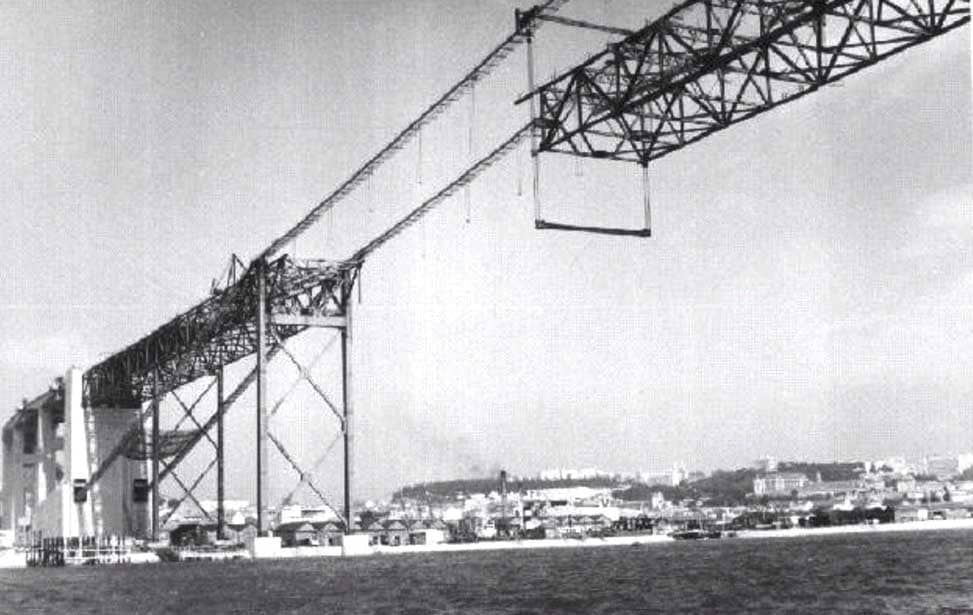
The south tower’s foundations reach roughly 79 metres below the water line, driven into solid bedrock — deep enough that shifting river sediment isn’t a structural concern.
The bridge was engineered to withstand an earthquake four times as strong as the one that levelled much of the city in 1755, and to handle wind speeds up to 200 km/h, factoring in the same category of Atlantic storm that regularly hits this stretch of coast.
The deck itself is designed to move: thermal expansion and contraction across the seasons can shift parts of the structure by more than a metre, and the bridge is engineered to accommodate that movement without stress-cracking.
None of this is visible from a passing car — it’s the kind of over-engineering that only becomes obvious when you know a bridge this size sits in one of Europe’s more seismically active regions, a few kilometres from a fault system that has already levelled the city once.

From a Dictator’s Name to a Revolution’s Date
Construction started on 5 November 1962 and finished 45 months later — six months ahead of schedule — with the bridge opening to traffic on 6 August 1966.
At opening, it carried the name Ponte Salazar, after António de Oliveira Salazar, the dictator who ordered it built as part of the infrastructure programme of his Estado Novo regime.
The name didn’t survive the regime.
On 25 April 1974, a nearly bloodless military coup — the Carnation Revolution — ended Salazar’s Estado Novo for good.
The bridge was renamed 25 de Abril shortly afterward, and the date has stuck for over fifty years since.
It’s one of a small number of Portuguese landmarks whose name is a direct, unambiguous political statement rather than a saint, a king, or a geographic feature.
What’s Actually on the Bridge
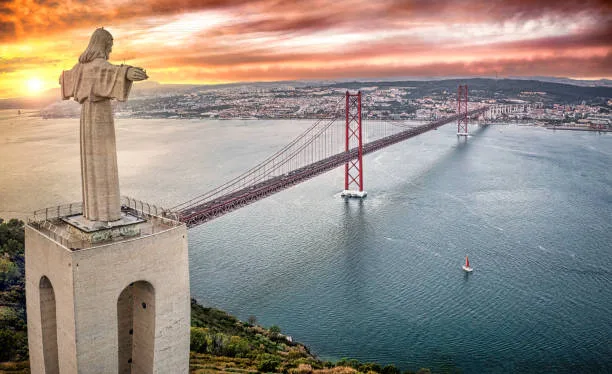
The bridge carries two entirely different kinds of traffic on two separate levels.
The upper deck has six road lanes; the lower deck carries a double-track electrified railway line, added in 1999 — 33 years after the bridge itself opened, since the original 1966 structure was road-only.
The current toll is €2.25, charged northbound only — you pay entering Lisbon from Almada, not leaving it, which surprises drivers expecting a toll in both directions.
The rate went up again on 1 January 2026, part of an annual inflation-linked adjustment applied to both Tagus crossings.
Several older online guides still quote €1.80 or €2.10 — tolls here move up every January, and it’s worth checking current pricing rather than trusting a specific number in an article that might be a year old, including this one by the time you read it.
What the bridge does not have, despite the assumption some visitors arrive with, is any pedestrian or cyclist access.
There’s no walkway, no bike lane, no way to cross on foot.
If you want to be on the bridge rather than just driving over it, there’s exactly one option, and it doesn’t involve crossing at all.
Lisbon has a second river crossing, further east, and the two get confused constantly: the Vasco da Gama Bridge, opened in 1998 near Parque das Nações, is the newer and considerably longer of the pair — 17.2 km against this bridge’s 2,277 metres, most of that length low-level viaduct rather than suspension span.
If a photo online shows a long, low, cable-stayed bridge rather than the tall orange suspension towers, it’s Vasco da Gama, not this one.
Pilar 7: The One Way to Actually Stand on It
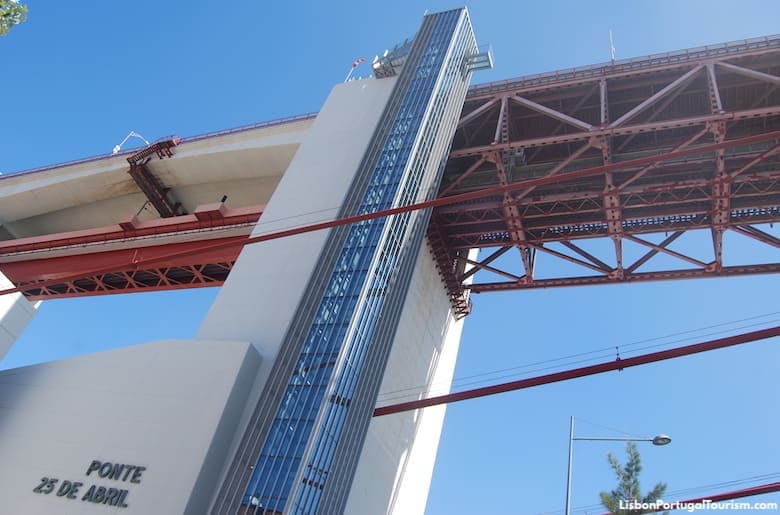
Pilar 7 is a visitor attraction built inside one of the bridge’s Lisbon-side support pillars — part historical exhibit about the bridge’s construction, part viewing platform with a glass floor roughly 80 metres above the water, giving you a direct look down through the structure itself rather than just a view of it from outside.
As of this writing, the experience’s elevator is under repair, meaning access to the viewing platform is via stairs only — 372 of them.
None of the competitor articles reviewed for this piece mention the current maintenance status, which matters if you’re planning around an elevator ride rather than a stair climb.
Check current status before booking.
Why We Actually Drive Across It
Most private Lisbon tours are built entirely around the north bank — Alfama, Baixa, Belém — because that’s where nearly everything most visitors want to see actually is.
The bridge shows up in the background of half those stops and gets crossed by almost nobody.
Our standard Lisbon day is built differently: it includes Cristo Rei, the Christ the King monument on the Almada side, which means we drive across this bridge as a matter of course, not as a special add-on.
Clients get the two things most tours skip entirely in the same afternoon — the crossing itself, six lanes above a river with a railway running underneath, and the view back at Lisbon from across the water, with the bridge in the foreground of a skyline most visitors only ever see from the other direction.
Cross the Bridge, Not Just Photograph It
Most Lisbon tours point at this bridge from a viewpoint.
Ours drives across it — Cristo Rei on the south bank is a standard stop, not an optional detour.
- Private Lisbon City Tour → Alfama, Baixa, Belém, the 25 de Abril Bridge crossing, and Cristo Rei in one 8-hour day. From €285/vehicle.
FAQ
Why does the 25 de Abril Bridge look like the Golden Gate Bridge?
Is the 25 de Abril Bridge longer than the Golden Gate Bridge?
When was the 25 de Abril Bridge built?
Why was the bridge renamed?
How much is the toll to cross the bridge?
Can you walk or cycle across the 25 de Abril Bridge?
What is Pilar 7?
Does the bridge carry trains as well as cars?
How strong was the 25 de Abril Bridge built to be?
Do Lisbon tours cross the 25 de Abril Bridge?
Is the 25 de Abril Bridge the same as the Vasco da Gama Bridge?

Founder & Director of Yellow Cab TT Tours. Guiding in Portugal for 20+ years.
Founded Yellow Cab TT Tours in 2013. 3,372 five-star reviews on Tripadvisor.