

In 1755, an earthquake and subsequent fires destroyed most of Lisbon. The city was rebuilt — on a grid. Straight streets, uniform buildings, Enlightenment geometry. The Marquis of Pombal had the rubble cleared and a new Lisbon built in under a decade.Alfama did not need to be rebuilt. The earthquake struck hardest on the flat ground near the river. Alfama, sitting on the hill, survived. The result is that the oldest neighbourhood in Lisbon is also the most intact: the same winding alleys, the same hillside layout, the same basic street plan that the Moors designed in the 8th century and that no earthquake or city planner has managed to change.
This guide covers what Alfama is, why its streets look the way they do, how fado was born here, which miradouros to visit and why, and what you need to know before arriving.
What Alfama Actually Is
How Alfama Got Its Name — and Its Streets
The Moors and the Street Plan
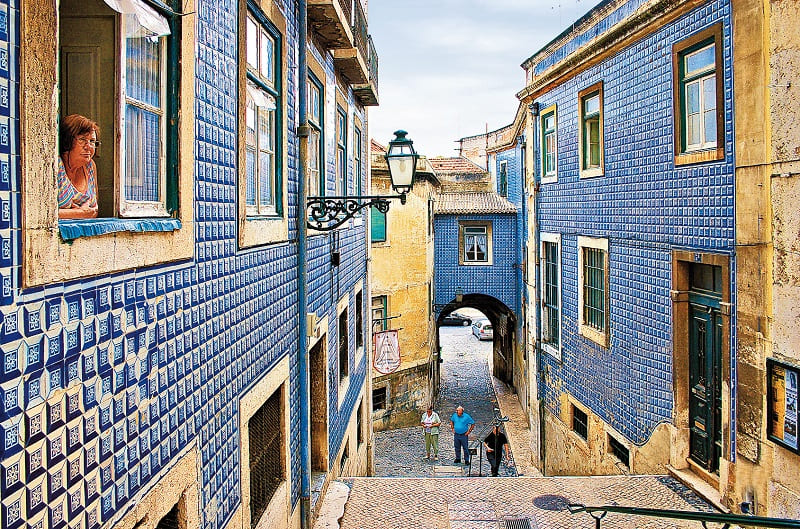
The Moors arrived in the Iberian Peninsula in 711 and captured Lisbon — then called Olissipo by the Romans — in 714. They controlled the city for over four centuries. During this period, Alfama became a densely populated residential quarter built according to Islamic urban planning principles: narrow streets to create shade, winding alleys to slow invaders, no straight lines that would expose the city to prevailing winds off the Tagus.
The street plan that results from these principles has an immediate practical advantage: it is nearly impossible to navigate quickly. Medieval raiders found this useful for defense. Modern tourists find it useful for photography. The effect is the same either way — you slow down, you look at walls, you turn a corner and find something you were not expecting.
The Reconquista of 1147
In 1147, Dom Afonso Henriques, the first king of Portugal, captured Lisbon from the Moors with the help of Crusaders who had stopped in the Tagus estuary on their way to the Holy Land. The assault on Castelo de São Jorge is commemorated in the azulejo tile panel on the wall of the Igreja de Santa Luzia, visible from the miradouro of the same name.
After the Reconquista, Alfama’s character changed gradually rather than abruptly. The Moorish residents were not immediately displaced; the neighbourhood kept its labyrinthine layout and much of its mixed population for generations. The name al-hamma became Alfama in Portuguese, the baths eventually disappeared, and the district slowly became what it is today: a working-class hillside quarter where the street plan is Islamic and the culture is Portuguese.
The Earthquake That Preserved Everything
On 1 November 1755, at approximately 09:40 in the morning — All Saints’ Day, when most of Lisbon was in church — a major earthquake struck the city. Subsequent fires burned for three to five days. The death toll is estimated at 30,000 to 40,000 people. The Baixa, Chiado, and riverside districts were destroyed.
Alfama survived. The hillside geology absorbed the earthquake differently from the alluvial ground near the river. The result is that while the rest of Lisbon was rebuilt on the rational grid of the Marquis of Pombal — straight streets, uniform facades, Enlightenment urban planning — Alfama retained the street layout that had been in place since the 8th century. The earthquake that reshaped Lisbon is also, paradoxically, the reason the oldest part of Lisbon still looks old.
Fado: Born in Alfama
What Fado Is
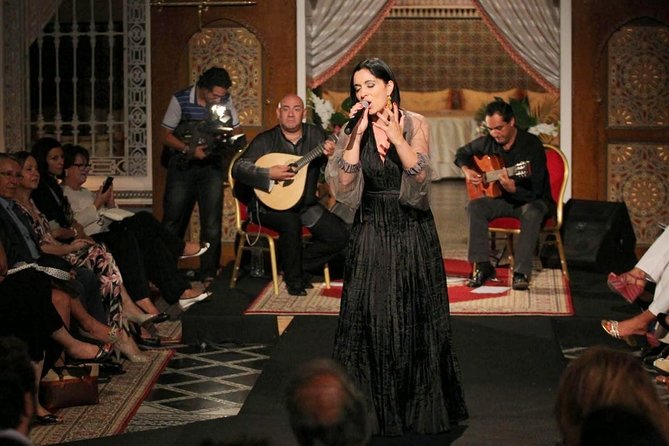
Fado is a Portuguese genre of urban song characterised by mournful melodies, 12-string Portuguese guitar, and lyrics dealing with fate, longing, and loss. UNESCO describes it as an “urban popular song of Portugal” and added it to the Intangible Cultural Heritage List on 27 November 2011.
The genre emerged in Lisbon in the early 19th century, drawing on Afro-Brazilian musical influences brought to the city via the colonial trade, local popular song traditions, and the particular social world of Alfama’s working-class port quarter. The word fado comes from the Latin fatum — fate — and the genre’s emotional register, known as saudade, is a Portuguese concept that translates roughly as a nostalgic longing for something or someone absent, which is a difficult emotion to describe precisely and an extremely easy one to recognise when you hear the music.
The most famous fado performer of the 20th century was Amália Rodrigues (1920–1999), who brought the genre international recognition. She was born at Rua de Martim Vaz — a street in the Pena district, just above Alfama — a fact that fado houses in the neighbourhood are careful to mention. Her concerts eventually drew audiences far beyond the hillside where she grew up.
Museu do Fado
The Museu do Fado (Fado Museum) is located at Largo do Chafariz de Dentro 1, in the lower part of Alfama. The museum opened on 25 September 1998, housed in a building that was formerly a pumping station for Lisbon’s water supply. The collections cover the history of fado from its origins in the early 19th century through to contemporary performers, including instruments, costumes, photographs, and audio recordings.
Adult ticket: €5. Students (13–25): €2.50. Seniors (65+): €4. Children under 12: free. Opening hours: Tuesday to Sunday, 10:00–18:00 (last admission 17:30). Closed Monday, 1 January, 1 May, 24–25 December, 31 December.
For a visitor who wants to understand what they are hearing in an Alfama restaurant before they hear it, the museum is an efficient 60–90 minutes. It is also one of the few places in the neighbourhood where you can be reasonably confident that the fado performance you are watching has something to do with the actual tradition rather than a commercial recreation of it — though the museum does not itself host live fado shows. For live fado in Alfama, the houses on Rua de São João da Praça and the surrounding streets are the right area; quality varies, and reservations are recommended.
The Miradouros: Where to Go for the View
Alfama has two main miradouros within a short walk of each other. They offer similar views from slightly different angles, and most visitors do both in the same visit.
Miradouro de Santa Luzia
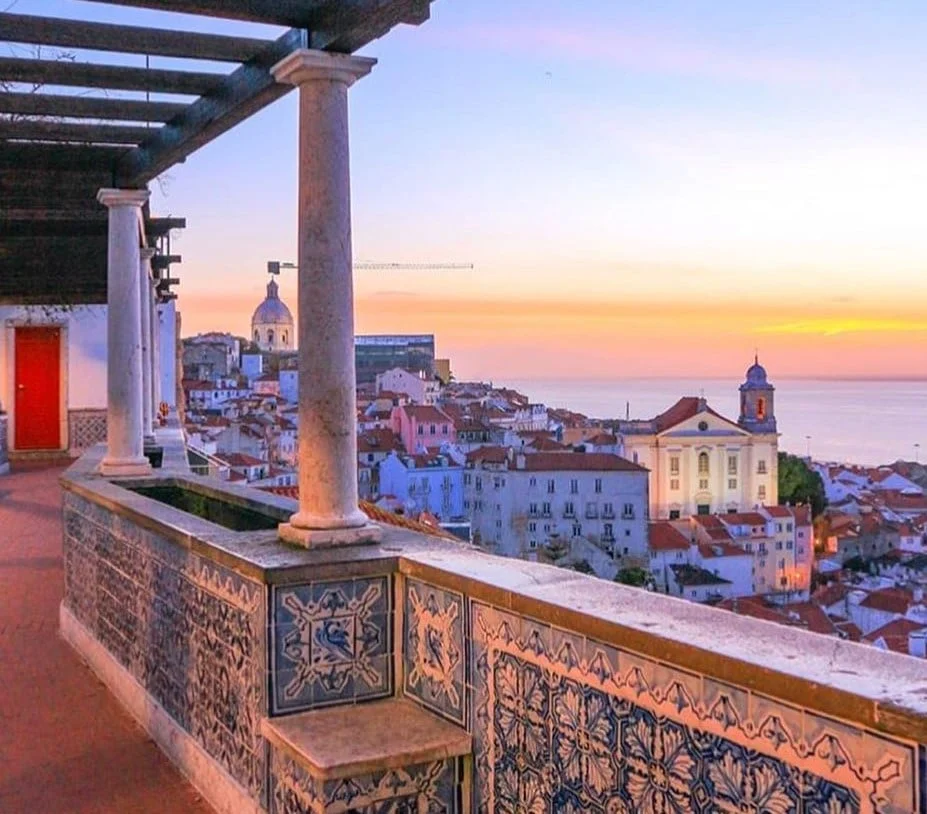
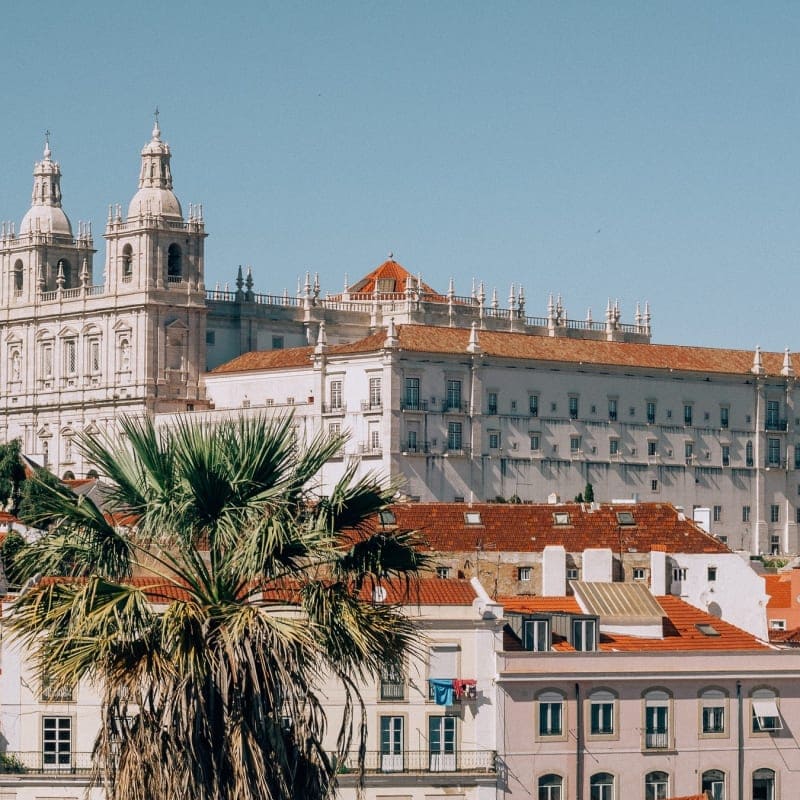
The Miradouro de Santa Luzia is a small terrace adjacent to the Igreja de Santa Luzia, one of Lisbon’s oldest churches. The terrace is partly covered by a pergola draped in bougainvillea, and the view looks south and east over the red-tile rooftops of Alfama toward the Tagus.
On the exterior wall of the church are two large azulejo tile panels: one depicting Praça do Comércio as it looked before the 1755 earthquake, and one showing the Christian assault on Castelo de São Jorge in 1147. Both panels are worth examining before you look at the view.
The terrace is smaller than Portas do Sol and more shaded. It tends to be slightly less crowded because tourists arriving from the tram stop at Portas do Sol often miss it. Arrive before 10:00 and you will likely have the terrace largely to yourself.
Miradouro das Portas do Sol
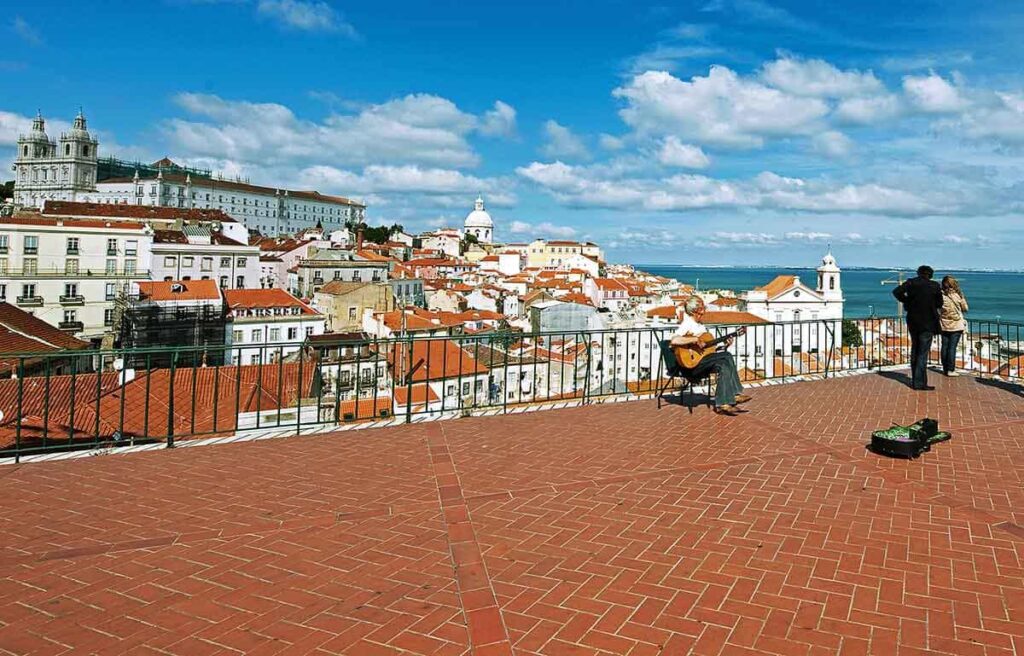
Portas do Sol — “Gates of the Sun” — is the larger and more photographed of the two viewpoints, a few steps east from Santa Luzia. It opens onto a wide esplanade with a statue of São Vicente, the patron saint of Lisbon, holding a boat with two ravens. The view takes in the full Alfama roofline, the dome of São Vicente de Fora, and the Tagus beyond.
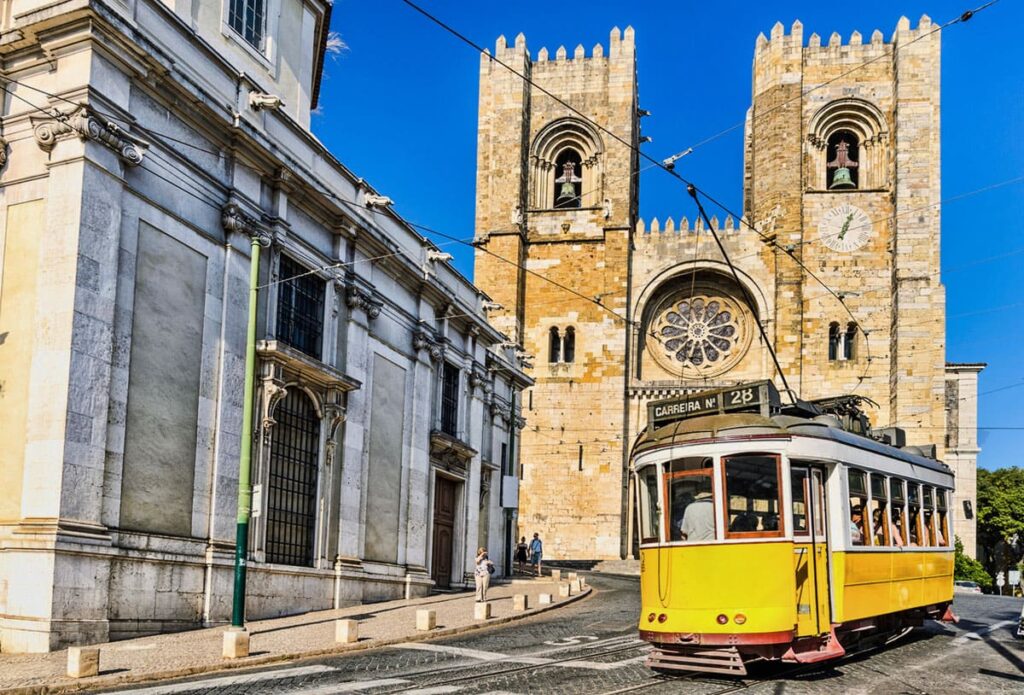
The esplanade has a café with outdoor seating. It is the terminal stop for tram 28 coming from Graça, which means it receives a continuous stream of tourists between 10:00 and 17:00. Early morning or late afternoon visits are noticeably different from midday visits — both in terms of light and in terms of available space.
I have seen clients stand at Portas do Sol at noon in July and spend most of their time in a photograph trying to keep other tourists out of the frame. The same clients, at 09:00, had the view essentially to themselves. The light is better in the morning anyway.
What Else to See in Alfama
Castelo de São Jorge
Castelo de São Jorge occupies the highest point of the Alfama hill and has been continuously fortified since at least the 2nd century BC — though the current structure reflects Moorish construction from the 10th and 11th centuries, with significant restoration work carried out in the 20th century. Dom Afonso Henriques took the castle in 1147; Dom Manuel I received Vasco da Gama here after his return from India; Gil Vicente performed the first documented Portuguese-language theatre play within its walls.
The castle is a National Monument (declared 1910). Adult ticket: €17. Youth (13–25): €8.50. Seniors (65+): €14. Children under 12: free. Lisboa Card holders: free. Opening hours: 09:00–21:00 (1 March–31 October) / 09:00–18:00 (1 November–28 February). Closed 1 January, 1 May, 24–25 December, 31 December. Inside, the castle complex includes 11 towers, a museum, and the Torre de Ulisses, which houses a camera obscura projecting a live 360-degree image of Lisbon. The main attraction for most visitors is the wall walk, which offers unobstructed views over the city in every direction.
The castle is the most visited paid attraction in Alfama and, in peak season, queues form at the entrance gate by 10:00. Our Lisbon tours arrive by 09:00 for this reason.
Igreja de São Vicente de Fora
São Vicente de Fora — “Saint Vincent Outside the Walls” — is a Mannerist monastery and church. It;s located near National Panteon. The original foundation was established by King Afonso Henriques in 1147; the present building was commissioned by King Filipe I (Philip II of Spain, ruling Portugal as Philip I) and built between 1582 and 1629, making it one of the earliest examples of Mannerist architecture in Portugal. The name de Fora — “outside” — refers to its original position outside the medieval city walls.
The church’s two cloisters are lined with 18th-century azulejo tile panels illustrating scenes from La Fontaine’s Fables — an unusual decorative choice for a church that is otherwise unreservedly serious in its architecture. The monastery also houses the pantheon of the House of Braganza: the Portuguese royal family is buried here, from João IV (died 1656) through to the last generation of the monarchy before the Republic was proclaimed in 1910.
Adult ticket: €8. Youth (under 25): €4. Seniors (65+): €6. Children under 12: free. Opening hours: 10:00–18:00 (1 November–30 June) / 10:00–19:00 (1 July–31 October). Free entry for residents in Portugal on the first Sunday of each month (proof of address required).
The Streets Themselves
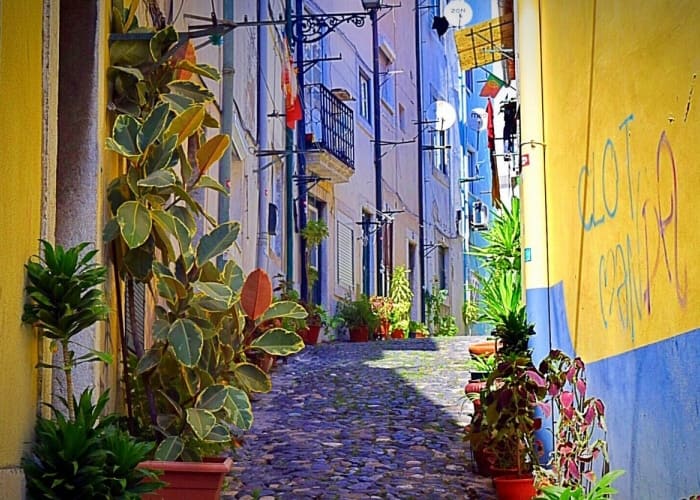
The streets of Alfama are not organised around specific attractions. They are the attraction. The steepest alleys in the neighbourhood — particularly Beco do Carneiro and the lanes behind Largo das Portas do Sol — give access to parts of the hillside where residential life continues largely as it has for generations: laundry across the alleys, cats on windowsills, the occasional resident with no particular interest in tourism.
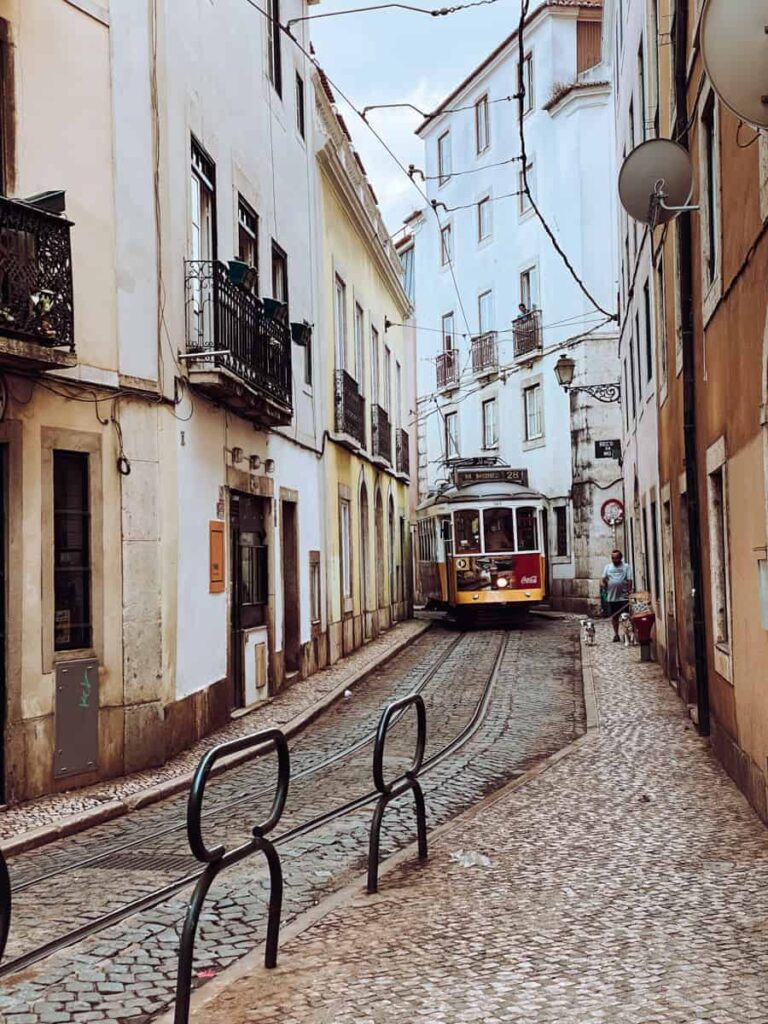
The lower part of Alfama, near Largo do Chafariz de Dentro (where the Fado Museum is), is the most accessible on foot. The upper part, near the castle, involves consistent uphill walking. Most visitors walk up and take tram 28 or tuk-tuk down.
When to Visit Alfama
Morning (before 10:00): The best time. Miradouros are uncrowded. Light comes from the east and hits the tile facades directly. The castle queue is short. Some fado restaurants are setting up; the neighbourhood sounds like a neighbourhood rather than a tourist attraction.
Midday to 15:00: Peak tourist traffic. Tram 28 arrives at Portas do Sol every few minutes; the miradouros are full. The castle queue can reach 30–40 minutes in July and August.
Late afternoon (after 16:00): Crowds thin slightly as groups return to city centre. Light turns golden. Fado houses open for dinner service from approximately 19:30.
June 12–13 — Santo António: The Feast of Saint Anthony is Lisbon’s largest street festival. Alfama is the epicentre: the neighbourhood fills with sardine grills, music, and people from early evening through to 04:00. It is not a quiet visit, but it is an accurate picture of what Alfama is when it is celebrating itself.
Year-round: Alfama is open every day. There is no entry fee for the neighbourhood itself. The castle and São Vicente de Fora are the only paid sites.
Explore Alfama on a Private Tour from Lisbon
Our Lisbon private tours include Alfama as a core stop. We arrive before 09:30, which means the miradouros are accessible without the midday crowds and the castle does not require a long queue. The tour also covers Belém, the historic city centre, and other districts depending on the itinerary.
If you want to combine Alfama with the wider city, our tours are designed exactly for that: a full day covering Lisbon’s history, architecture, and the practical context that makes the monuments make sense.
| Tour | Includes | Details |
|---|---|---|
| Lisbon Private Tour | Alfama · Belém · Baixa · Chiado · custom stops | Private vehicle, hotel pickup |
| Best of Lisbon Tour | Full-day Lisbon, Cascais, Cabo Roca, Sintra | Private vehicle, hotel pickup |
FAQ
What is Alfama known for?
Is Alfama safe to visit?
How do I get to Alfama?
What is the best miradouro in Alfama?
Where was fado born?
What is the Museu do Fado and is it worth visiting?
How long does it take to visit Alfama?
Can I see fado live in Alfama?
Is Alfama on the Lisbon private tour itinerary?

Founder & Director of Yellow Cab TT Tours. Guiding in Portugal for 20+ years.
Founded Yellow Cab TT Tours in 2013. 3,372 five-star reviews on Tripadvisor.