

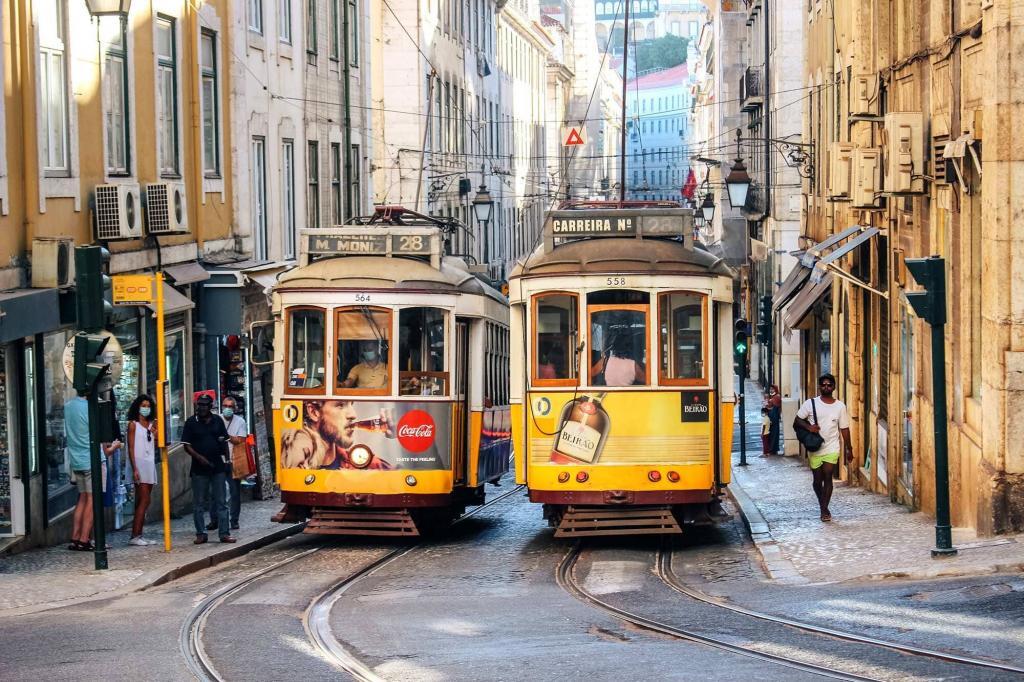
Tram 28 is the most photographed public transport line in Portugal, the most crowded tram in Lisbon, and the single highest-risk spot for pickpocketing in the city. These three facts are not a coincidence — they are the same fact from three different angles.
The tram works as a tourist attraction precisely because it runs through streets that no modern vehicle can navigate. The same tight corners and steep gradients that make the route visually interesting make the carriages difficult to monitor and easy to work in a crowd. Between Martim Moniz and the Sé, in peak summer, standing room only is not a description of an unfortunate exception — it is the standard operating condition.
None of this should stop you from riding it. But almost everything you need to know before you board is information that most guides bury in the sixth paragraph. This article puts it in the first five minutes.
I walk the Tram 28 route with clients more often than I ride it. At 3 km/h you can stop at Portas do Sol for as long as the view warrants. On the tram, that stop is 40 seconds. My recommendation for most people: ride it once, early, from Campo de Ourique — then walk back through Alfama and see what you actually came to see.
Why the trams are from the 1930s — and have to stay that way
Lisbon introduced electric trams in 1901. Line 28 didn’t open until 1914 — thirteen years later, not because anyone was slow, but because this specific route required solving a geometry problem that took time.
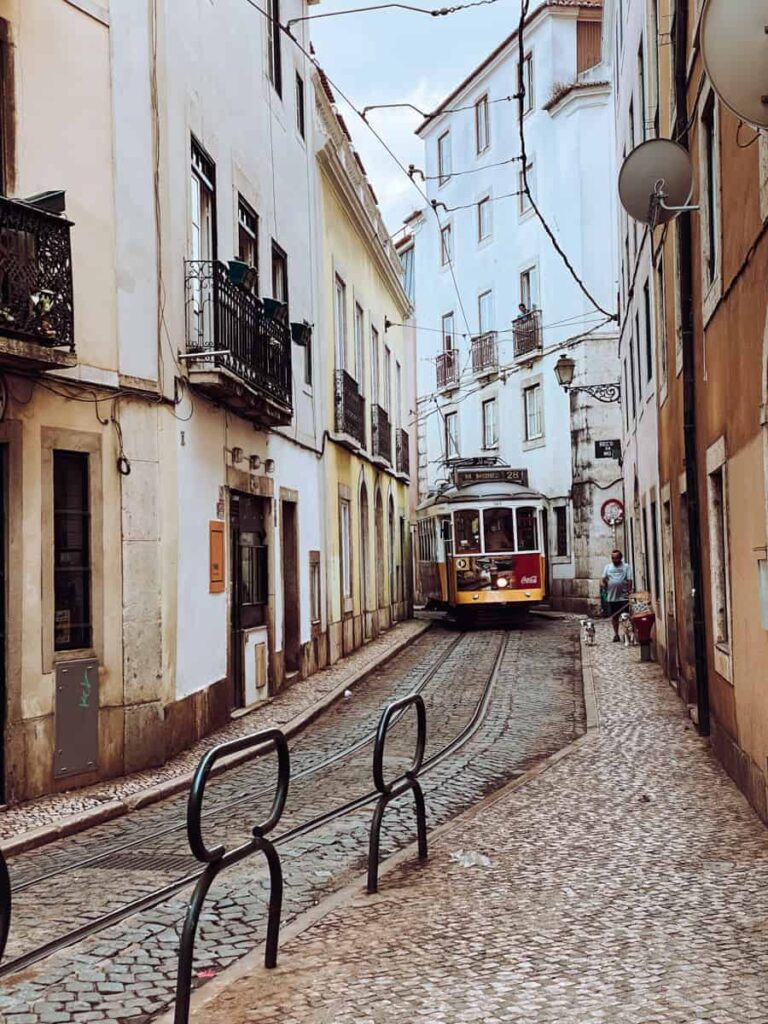
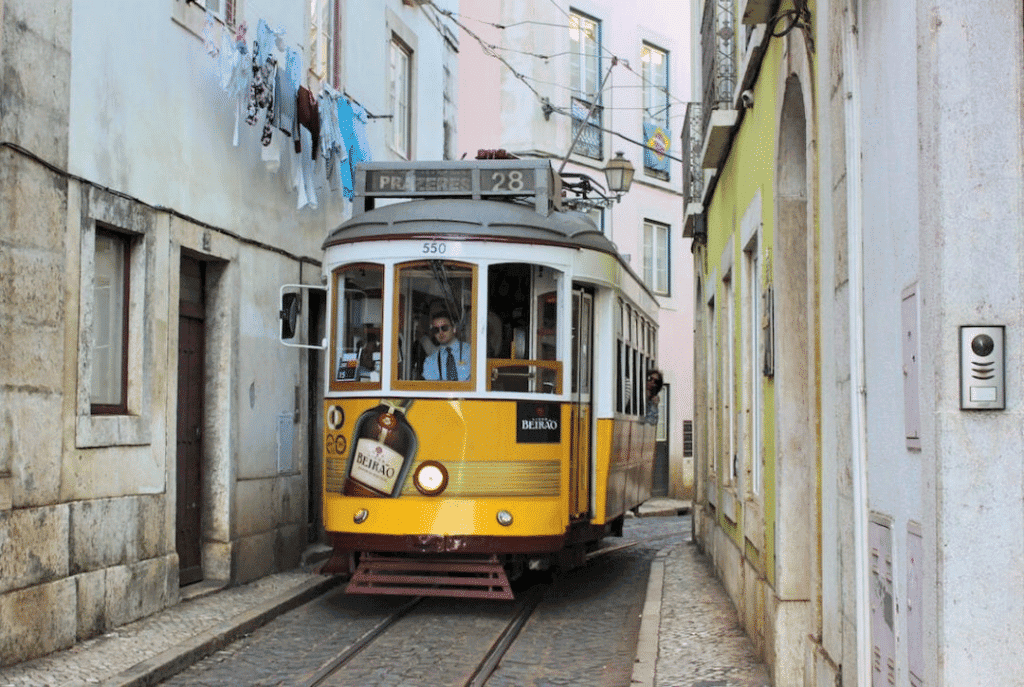
The streets through Alfama and Graça were built in the medieval period, for pedestrians and donkeys. They are narrow, steeply graded, and turn at angles that modern urban planning would not permit. The Remodelado trams currently running on Line 28 are 2.4 metres wide. That is the maximum width that clears the walls in certain sections of the route. Not by much.
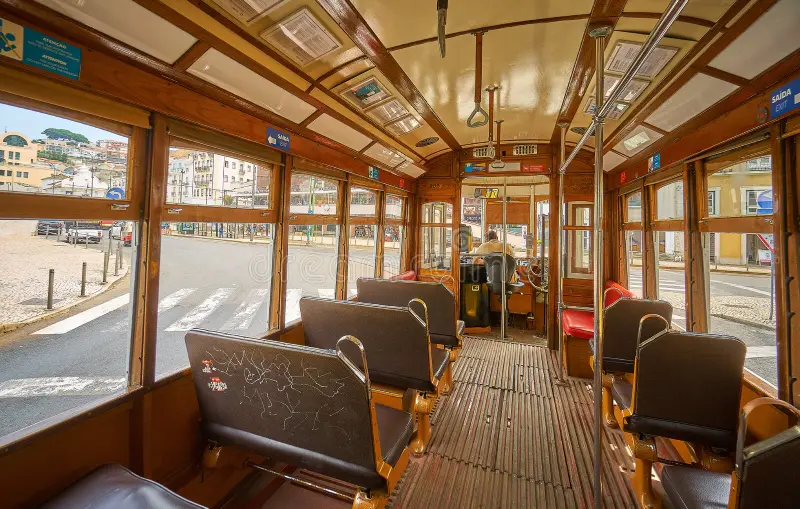
The Remodelado fleet was designed in the 1930s, inspired by J.G. Brill American streetcar models. The name means “remodelled” — in the 1990s they received new brakes, motors, and electrical systems. The wooden interiors, brass fittings, and 2.4-metre body width were not changed, because they cannot be changed without changing the route, and the route cannot be changed without demolishing medieval Alfama.
This is why Lisbon does not replace the trams on Line 28 with modern vehicles. Modern Carris articulated trams are longer, wider, and have a turning radius that would require 30 metres of clearance in places where the street provides twelve. The 1930s vehicles are not running for nostalgia. They are the only vehicles capable of completing this route.
Approximately 4.6 million passengers a year use Line 28. The majority are commuters, not tourists. This is a working public transport line that happens to run through the most visited part of the city.
The Route: Three Sections, Very Different Characters
The full route runs 7.2 kilometres from Largo do Martim Moniz in the east to Largo dos Prazeres in Campo de Ourique in the west. End to end takes 45 to 50 minutes.
East section — Graça and Alfama:
The tram climbs from Martim Moniz through Graça to the Miradouro da Graça viewpoint, then descends sharply through the Sé de Lisboa and into Alfama. This is the section every photograph shows. The streets narrow until passengers near the open windows can see the walls passing at arm’s reach.
It is also the section where the tram is most crowded and most difficult to move through if you need to exit.
Middle section — Baixa and Chiado:
After Alfama, the route crosses the lower city and climbs toward Chiado via Calçada do Combro. Flatter, faster, significantly less scenic. Most tourist passengers get off somewhere between the Sé and the Bica funicular stop.
West section — Estrela and Campo de Ourique:
The tram climbs again to the Basílica da Estrela and continues into Campo de Ourique, a quiet residential neighbourhood that most tourists never reach.
The western terminus at Largo dos Prazeres sits beside a cemetery that has been open to visitors since 1833 and is, in my experience, never crowded.
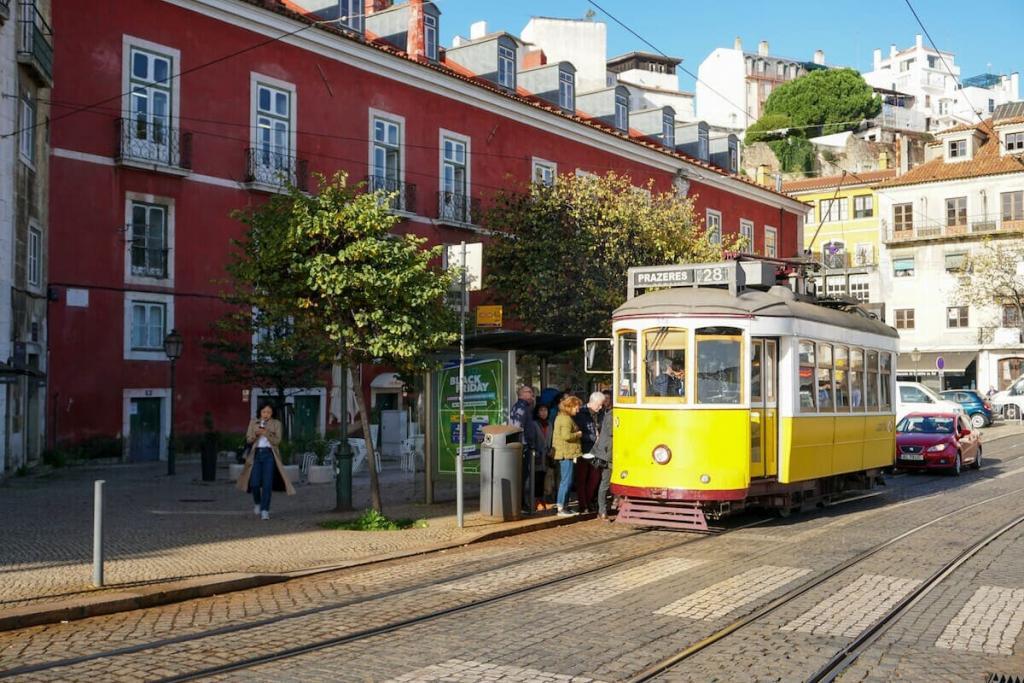
The route: three sections, very different characters
The full route runs 7.2 kilometres from Largo do Martim Moniz in the east to Largo dos Prazeres in Campo de Ourique in the west. End to end takes 45 to 50 minutes.
East section — Graça and Alfama
The tram climbs from Martim Moniz through Graça to the Miradouro da Graça viewpoint, then descends sharply through the Sé de Lisboa and into Alfama.
This is the section every photograph shows.
The streets narrow until passengers near the open windows can see the walls passing at arm’s reach. It is also the section where the tram is most crowded and most difficult to move through if you need to exit.
Middle section — Baixa and Chiado
After Alfama, the route crosses the lower city and climbs toward Chiado via Calçada do Combro.
Flatter, faster, significantly less scenic.
Most tourist passengers get off somewhere between the Sé and the Bica funicular stop.
West section — Estrela and Campo de Ourique
The tram climbs again to the Basílica da Estrela and continues into Campo de Ourique, a quiet residential neighbourhood that most tourists never reach.
The western terminus at Largo dos Prazeres sits beside a cemetery that has been open to visitors since 1833 and is, in my experience, never crowded.
Key stops: what’s worth getting off for
Largo do Martim Moniz
- Eastern terminus.
- The square is named after a knight from the 1147 siege of Lisbon, who allegedly held a castle gate open with his body. Historians are sceptical.
- The square has a market and a metro station.
- Board here if you are starting east — but in summer, the tram may already be full by the second stop.
Miradouro da Graça
- The viewpoint over Alfama rooftops, the castle, and the Tagus.
- Less visited than Portas do Sol because it requires a slightly longer walk from the tram stop.
- The angle includes the full silhouette of São Jorge Castle in a way that Portas do Sol does not.
- Worth a specific detour.
Sé de Lisboa
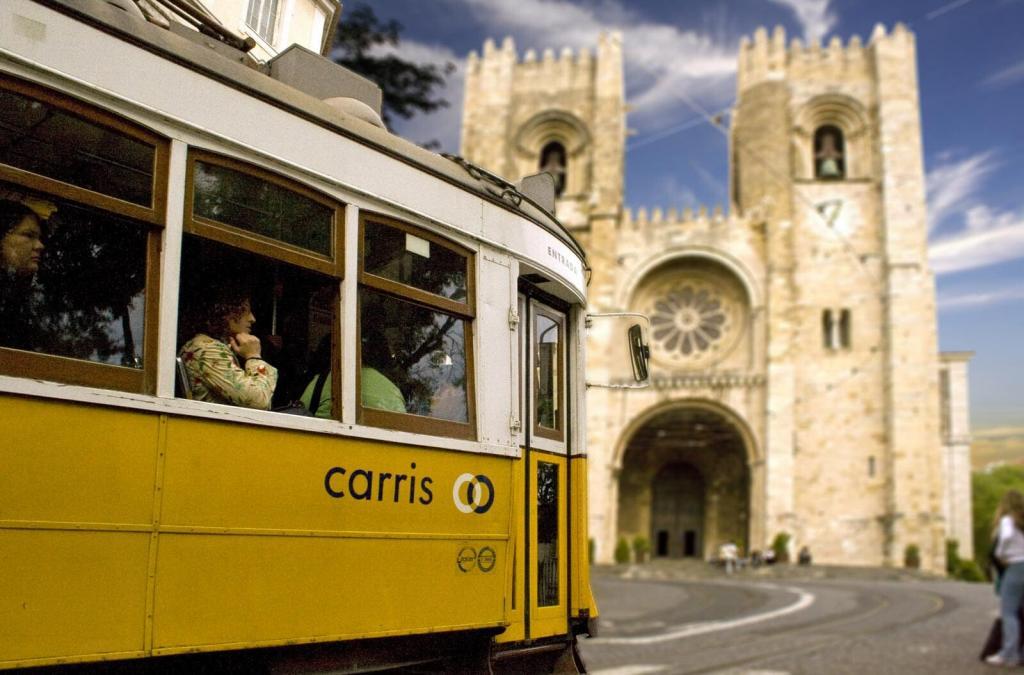
- Romanesque-Gothic cathedral founded in 1147, the same year as the siege.
- The tram passes within a few metres of the façade.
- You will not absorb a 12th-century cathedral from a moving vehicle at tram speed.
- Get off, spend ten minutes, catch the next one.
Portas do Sol
- The viewpoint most people recognise from photographs.
- The tram passes through rather than stopping specifically here.
- If you want to stay for more than 40 seconds, get off and rejoin the line.
Basílica da Estrela
- Neo-Baroque church completed in 1790, facing a garden square.
- The tram stops directly in front.
- The interior is several degrees cooler than the street in summer.
- That is a practical observation, not a poetic one.
Largo dos Prazeres
- Western terminus, beside the Cemitério dos Prazeres.
- The cemetery opened in 1833 following a cholera epidemic and contains the elaborate 19th-century mausoleums of some of Lisbon’s most prominent families.
- It is open to visitors, free to enter, and consistently empty.
- The contrast with Martim Moniz, 7.2 kilometres and 50 minutes earlier, is considerable.
Tickets and how to pay
- On board: €3.30 — the tourist default, and the most expensive option per journey.
- 1-hour Carris/Metro network ticket: €1.90 — valid on tram, metro, and buses within one hour. The correct choice if you are using public transport elsewhere in the city that day.
- 24-hour pass: €7.25 — worth it if you plan to use the metro or other tram lines.
- Lisboa Card: includes tram access at no extra cost.
The on-board inspector sells tickets on request. Do not expect change for large notes.
Ticket machines at the Martim Moniz and Campo de Ourique termini accept cards. The machines at intermediate stops are less reliable.
When to go and the one boarding strategy that actually works
Between approximately 10:00 and 18:00 in July and August — and on most summer weekends in June and September — the carriages from Martim Moniz are standing room only by the second stop. This is not a worst-case scenario. It is the routine condition.
Two approaches work.
Board at Campo de Ourique
The western terminus at Largo dos Prazeres has no visible queue and you board at origin with a seat. Ride east through Estrela, Chiado, Alfama, and Graça to Martim Moniz.
The 45-minute journey is the same; the crowd arrives toward you rather than meeting you at the door.
How to get there
- Metro to Rato station (10 minutes’ walk)
- Bus 773
Go before 09:00 or after 18:00
Early morning the tram carries commuters. After early evening the tourist volume drops sharply.
In shoulder season — October, November, March, and April — the 10:00–18:00 window is manageable even if not comfortable.
Best time overall
Midweek mornings in May or early June are the best combination of reasonable hours and light crowd.
The pickpocket situation, stated plainly
Line 28 is consistently identified by Lisbon police and tourism authorities as the highest-risk location in the city for pickpocketing. Not one of the highest — the highest.
Organised teams work the Martim Moniz to Alfama stretch. The method is distraction during the boarding surge, or extraction while the tram navigates tight bends and passengers are occupied with balance. Backpacks worn on the back are the primary target because the wearer cannot see or feel them being opened. Phones held at open windows for photographs are secondary.
The practical response: bag on the front, phone in a zipped interior pocket, wallet in a front trouser pocket. These precautions are not specific to Tram 28 — they apply in any densely crowded environment in any major city. The reason Tram 28 comes up in this context specifically is that standing crowds in a moving vehicle where you cannot easily turn around or monitor your own belongings create conditions that are harder to manage than a static tourist queue.
Ride it aware of this, not afraid of it. The distinction matters.
Tram 28 vs Bus737 vs Walking vs Private Tour: an honest comparison
Clients ask this regularly and deserve a direct answer.
| Tram 28 | Bus 737 | Walking Alfama | Private Lisbon Tour | |
|---|---|---|---|---|
| Cost | €3.30 | €2.00 (Viva Viagem) | Free | From €150/vehicle |
| Queue in summer | 20–40 min | Minimal | None | None |
| Route | Fixed | Fixed | Anywhere you want | Fully custom |
| Stops mid-route | No | No | Anywhere | Stop as long as needed |
| Pickpocket risk | High in peak hours | Low | Low | Minimal |
| Context | None | None | None | Guide explains what you’re seeing |
| Duration | 45–50 min | 35–40 min | 2–3 hours | 4–8 hours across the city |
These are not the same product at different price points. The tram is a 50-minute corridor ride. Bus 737 covers much of the same ground without the queue — if you want to get through Alfama efficiently, the bus makes more sense. Walking gives you the neighbourhood itself rather than a window onto it. A private tour is a full day across the city built around your interests.
I take clients on Line 28 occasionally as one element of a longer day — not as the main event, not in peak hours, and only when the client specifically wants the tram experience rather than just the Alfama views.
The honest reason to choose the tram over the bus is one thing: the tram itself — the sound, the incline, the yellow carriages on narrow streets. If that is what you want, it is worth the wait.
Explore Lisbon with a Private Guide
Alfama, Graça, the Sé, Portas do Sol, Estrela — these are the places Tram 28 passes through. On a guided day, we walk the same territory at a pace that lets you actually look at what you came to see. The Sé de Lisboa deserves more than 40 seconds at tram speed. So does Portas do Sol.
Private Lisbon City Tour — Baixa, Chiado, Alfama and the viewpoints at your pace. Departs from your accommodation.
Sintra and Cascais Full Day — If you have Lisbon planned and want a full day outside the capital.
FAQ
What is the Tram 28 route in Lisbon?
How much does Tram 28 cost in 2026?
What time does Tram 28 start and finish?
When is the best time to ride Tram 28?
Is pickpocketing a real problem on Tram 28?
Why does Tram 28 use old trams?
How many stops does Tram 28 have?
Can I use the Lisboa Card on Tram 28?
When was Tram 28 inaugurated?
Is it worth riding Tram 28 as a tourist?

Founder & Director of Yellow Cab TT Tours. Guiding in Portugal for 20+ years.
Founded Yellow Cab TT Tours in 2013. 3,372 five-star reviews on Tripadvisor.