


Sintra is a municipality of approximately 59,000 residents, 28 kilometres northwest of Lisbon, with five national palaces, one Moorish castle, a 16th-century cork-lined convent, and 30 kilometres of Atlantic coastline within its municipal boundaries. The UNESCO Cultural Landscape of Sintra designation, awarded in 1995, covers the town’s historic centre, five palace complexes, and the Serra de Sintra natural park.
In a normal year, Sintra receives more than 4 million visitors. Most arrive on the direct train from Lisbon Rossio Station — 40 minutes, EUR 2.55. Most go to Pena Palace. Most arrive after 10:30. And most spend the first 40 minutes of their Sintra day in a queue that could have been avoided by taking the 08:00 train instead of the 09:15.
This guide covers what Sintra’s five palaces actually offer, with verified 2026 prices and honest crowd assessments — plus the Moorish Castle, Cabo da Roca, and how to plan a day that works.
Sintra at a glance:
- Pena Palace — 1842–1854 — price EUR 20 (Palace + Park) — depend very high
- Quinta da Regaleira — 1904–1910 — price EUR 20 — depend high
- Moorish Castle — 8th–9th century — price EUR 12 — depend low-moderate
- National Palace of Sintra — 14th–16th century — price ~EUR 12 — depend moderate
- Monserrate Palace — 1858–1865 — price EUR 12 — depend low
- Cabo da Roca — no entry fee — depend moderate
Pena Palace
Key Facts and Tickets
Pena Palace was built between 1842 and 1854 by King Ferdinand II (Ferdinand of Saxe-Coburg and Gotha), German-born consort of Queen Maria II of Portugal. The architect was Wilhelm Ludwig von Eschwege (1777–1855), a German engineer. The palace was built on the ruins of a Hieronymite monastery originally commissioned by King Manuel I in 1503 and largely destroyed by the 1755 Lisbon earthquake.
The exterior is painted in yellow (royal apartments wing) and red (monastery wing). It sits at approximately 500 metres elevation on the Serra de Sintra and is visible from the Lisbon coast on clear days
Palace + Park — Adult (18–64) | EUR 20.
Palace + Park — Youth (6–17) / Senior (65+) | EUR 18.
Palace + Park — Family (2 adults + 2 youth) | EUR 65.
Park Only — Adult | EUR 12.
Book at parquesdesintra.pt.
Interior entry is timed in 30-minute slots — book a specific slot when purchasing, not just general admission.
What to See
The interior was left exactly as the royal family left it on October 5, 1910 — the day the Portuguese revolution ended the monarchy and the family left for exile. They left behind furniture, textiles, and the contents of every room. The state has maintained the interior in this condition.
Key rooms: the Triton Arch (carved limestone gateway, 1840–1860, Manueline style); the Cloisters and Chapel of the original 1503 monastery (containing an alabaster altarpiece from Bruges, c. 1520); the King’s Bedroom; the Arab Room (walls and ceiling covered in geometric Moorish azulejo tiles, 1850s); and the Kitchen (original 19th-century wood-burning range and copper cookware).
The Pena Park covers 200 hectares and contains the Chalet of the Countess of Edla (built 1869 for Ferdinand II’s second wife, an American opera singer) and Cruz Alta at 529 metres — the highest point in the Serra de Sintra.
When to Arrive
The 09:30 interior slot is the one to book. The main visitor wave reaches Pena Palace between 10:30 and 14:00. Arriving after 11:00 means walking through crowded corridor-sized rooms. The terrace — which does not require a timed-entry slot — is accessible at any time during park hours.
For the complete history, interior room descriptions, and step-by-step crowd timing: Full Pena Palace guide: history, architecture and visitor information.

Quinta da Regaleira
Key Facts and Tickets
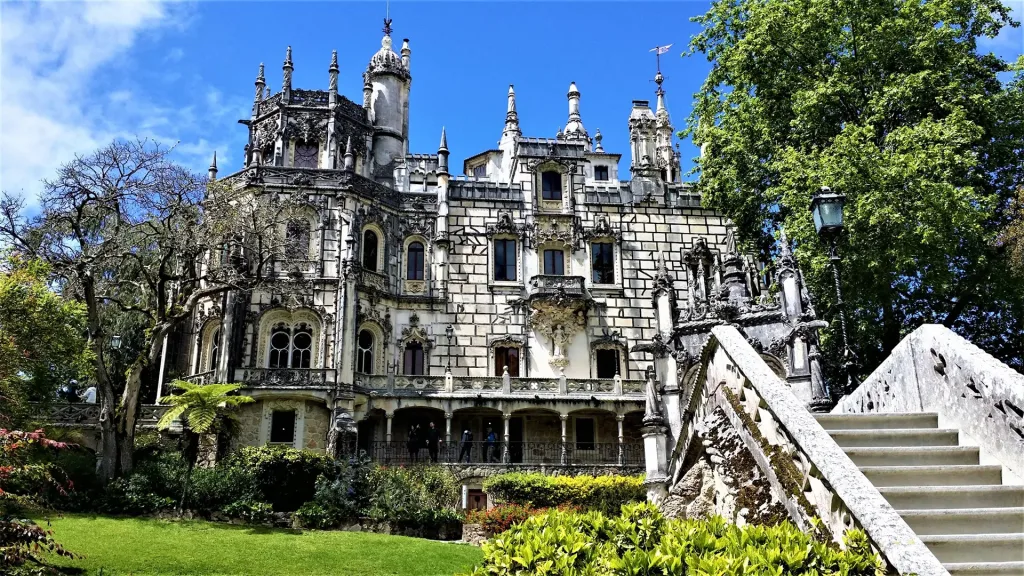
Quinta da Regaleira is a palace and garden estate of approximately 4 hectares, located in Sintra’s historic centre — 700 metres from the train station. It was built between 1904 and 1910 for António Augusto Carvalho Monteiro (1848–1920), a Brazilian-Portuguese millionaire known as “Monteiro dos Milhões.” The architect was Luigi Manini (1848–1936), an Italian opera set designer.
Price (2026) | Adult (18–64) | EUR 20.
Youth (6–17) / Senior (65+) | EUR 15.
Child (under 5) | Free. Family (2 adults + 2 youth, max 4) | EUR 60 | Book at regaleira.pt.
The Initiation Well and Tunnels
The estate’s defining feature is the Initiation Well (Poco Iniciático): not a water well, but an inverted tower descending 27 metres underground, with a spiral staircase of nine circular landings referencing the nine circles of Hell in Dante’s Inferno. At the base, a Templar cross is set into the stone floor. An underground tunnel connects the base to six other points in the garden, including a Gothic chapel, a lake, and the Poco Imperfeito (the lesser-visited second well).
On the Templar connection: the Knights Templar were dissolved by the Council of Vienne in 1312. Quinta da Regaleira was built 598 years later. The Templar and Masonic symbolism throughout the estate was an artistic and esoteric choice by Carvalho Monteiro, not evidence of historical Templar occupation.
Guide note on the well: enter from the top, not from the tunnel entrance at the bottom. The descent through the nine landings is the experience. Arriving at the base through a tunnel and then climbing up reverses the intended sequence and is significantly less satisfying. For the complete guide to the Initiation Well, the second well, tunnel navigation, and the Templar myth: Full Quinta da Regaleira guide.
The Moorish Castle
Key Facts and Tickets
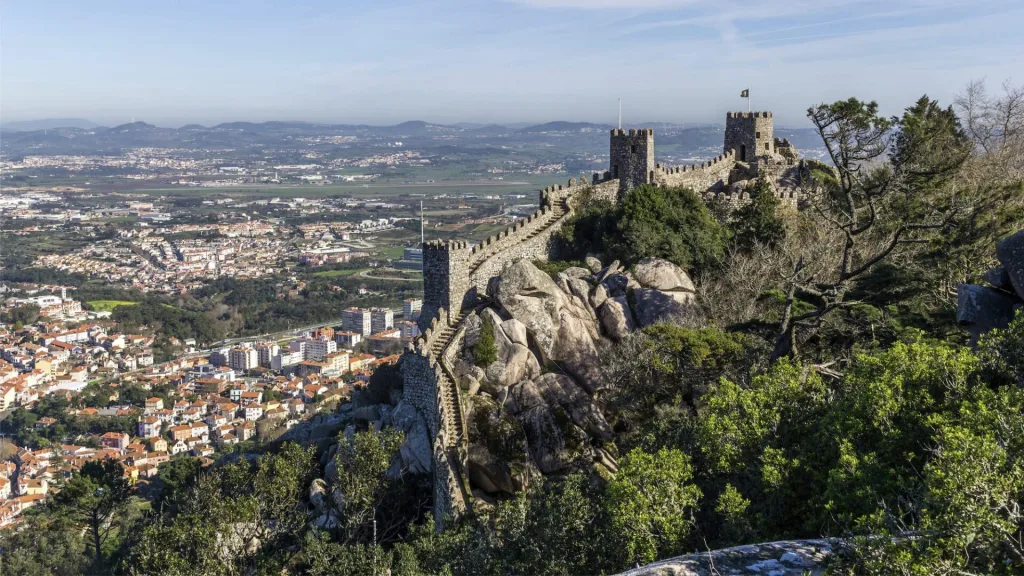
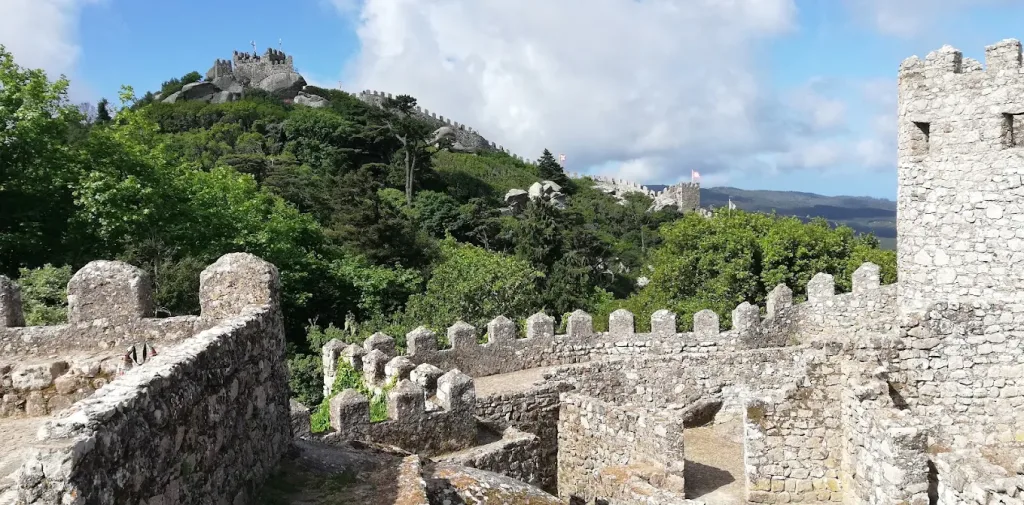
The Moorish Castle (Castelo dos Mouros) was built in the 8th and 9th centuries during Moorish occupation of the Iberian Peninsula. Its walls — 450 metres of granite ramparts connecting five towers at 471 metres elevation — are among the best-preserved examples of Moorish military architecture in Portugal.
The castle was captured in 1147 by King Afonso I of Portugal (Afonso Henriques), during the same military campaign that took Lisbon. Archaeological excavations in 1979 found funerary tombs from the 13th century within the walls. King Ferdinand II — the same monarch who built Pena Palace — undertook a partial restoration in the 19th century.
Price (2026) | Adult (18–64) | EUR 12. Youth (6–17) / Senior (65+) | EUR 10. Walk-up tickets available. Verify prices at parquesdesintra.pt.
The Rampart Walk
The full parapet walk connects all five towers along the ridge: 450 metres, 30–40 minutes at a normal pace, with views across Sintra town, the Atlantic, Cascais Bay, and directly across to Pena Palace. The Moorish Castle receives approximately one-fifth the visitors of Pena Palace. You can walk the full parapet without stopping.
The walk from the Moorish Castle to Pena Palace via the park footpath takes 15 minutes — which means you can visit both in sequence without returning to Sintra station and queuing for Bus 434 a second time.
For the full military history and physical difficulty guide: Full Moorish Castle guide.
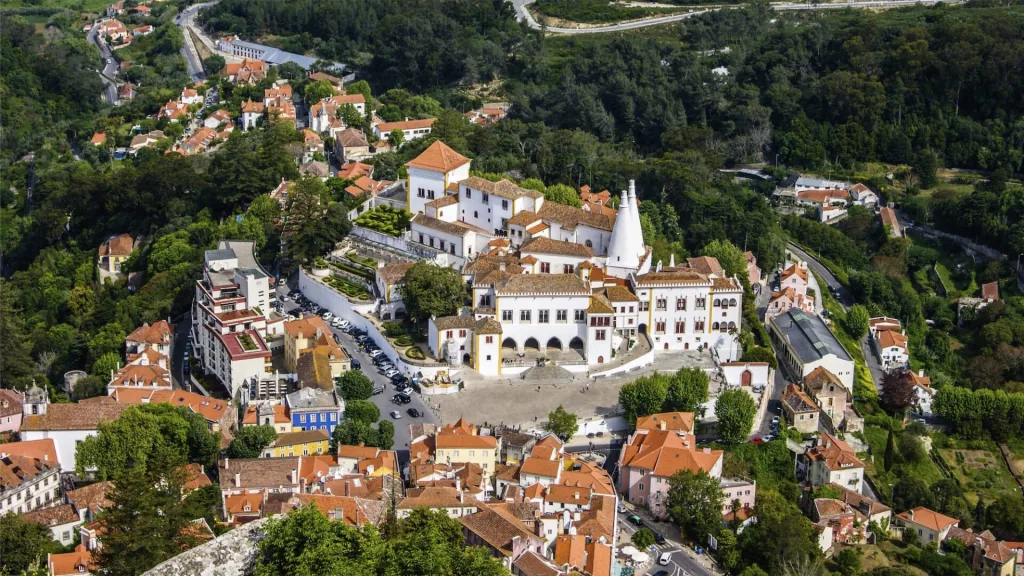
National Palace of Sintra
What to See Inside
The twin conical chimneys — 33 metres tall, visible from across Sintra town — are the palace’s most distinctive exterior feature. They are not decorative. They are the ventilation system for a working royal kitchen, built in the 16th century and now the most photographed kitchen exhaust ducts in Portugal.
Interior rooms:
Sala dos Cisnes (Room of the Swans): the ceiling is painted with 27 swans, each wearing a golden collar. Painted under King Joao I in the early 15th century. The swans are a heraldic reference to the House of Lancaster — João I had English connections through his marriage to Philippa of Lancaster.
Sala dos Brasoes (Room of Coats of Arms): the ceiling dome displays 72 coats of arms of Portuguese noble families, completed approximately 1515 under King Manuel I. After a conspiracy against the king in 1515, eight of the crests were turned face-down — they remain reversed to this day.
Sala das Pegas (Room of the Magpies): ceiling painted with magpies, each holding a rose and the motto “Por bem” (For good reason). Painted under King Joao I as a response to court gossip — the specific story involves the king being caught kissing a lady-in-waiting and issuing this motto to end the commentary.
Sala dos Arabes (Arab Room): azulejo tilework from the 15th century, among the oldest tilework in Portugal. The National Palace of Sintra — the oldest and most historically layered of the five palaces, covering six centuries of actual court life — receives fewer visitors than Pena Palace despite being in the town centre, requiring no bus, and costing approximately EUR 8 less to enter. The reason is that it does not photograph as dramatically, which means it appears less frequently in travel content. This is useful information for anyone who would rather spend 40 minutes looking at rooms than queuing to enter them.

Monserrate Palace and Gardens
Key Facts and Tickets
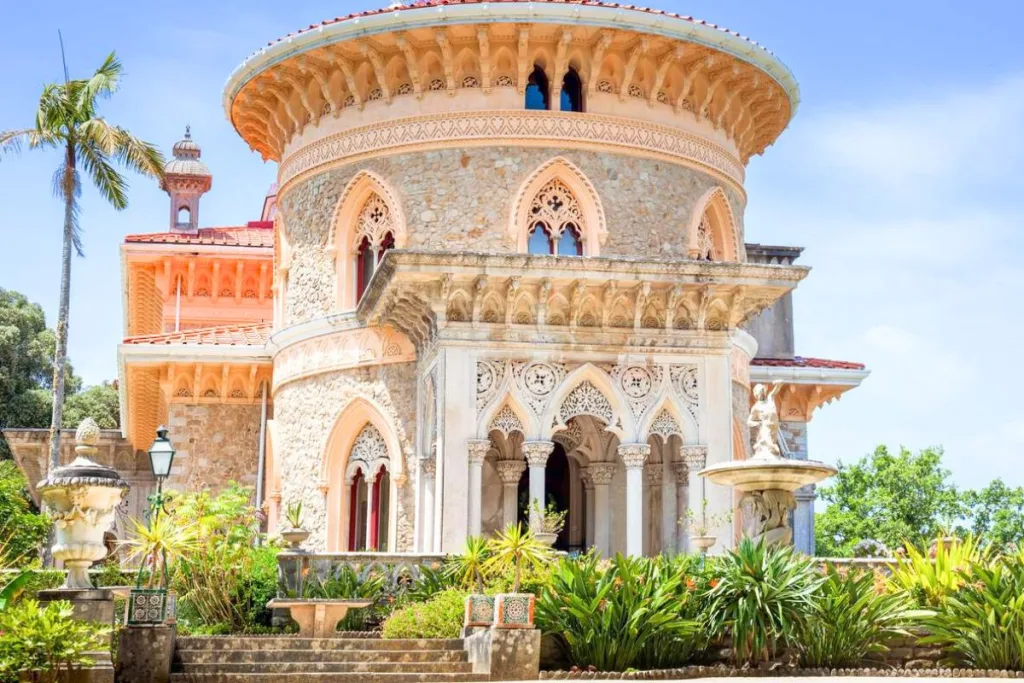
Monserrate Palace is the least visited of Sintra’s five palaces and the one with the most unusual architecture. The site was originally a Crown property. The English writer William Beckford rented it in 1793–1799 and had an initial structure built. The current palace was commissioned in 1856 by Francis Cook (later 1st Viscount Monserrate), an English textile merchant who had purchased the property. Construction ran from 1858 to 1865; the architect was James Thomas Knowles (1831–1908), a London architect. The architectural style is a deliberate and unusual combination: Neo-Gothic (pointed arches, tracery), Neo-Moorish (horseshoe arches, geometric ornament), and Mughal Indian (carved domes, decorative stucco). The three-dome facade takes about 20 minutes to absorb at close range. There is no comparable building in Portugal and very few in Europe.
Park and Palace (prices):
- Ticket for adults (18 – 64 years) – 12 €.
- Ticket for youths (6 – 17 years) – 10 €.
- Ticket for seniors (over 65 years) – 10 €.
- Family ticket (2 adults + 2 youths) – 33 €.
The palace is managed by Parques de Sintra.
The gardens cover approximately 30 hectares, designed using plant species from four continents. The fernery in the lower garden is one of the most complete Victorian-era collections in Portugal. Monserrate Palace attracts approximately one-tenth the visitors of Pena Palace, 5 kilometres away, with equally complex architecture and 30 hectares of garden. The reason is largely that Monserrate is not yellow and red.
Getting there: Bus 435 from Sintra station (approximately 15 minutes).
Cabo da Roca and the Sintra Coastline
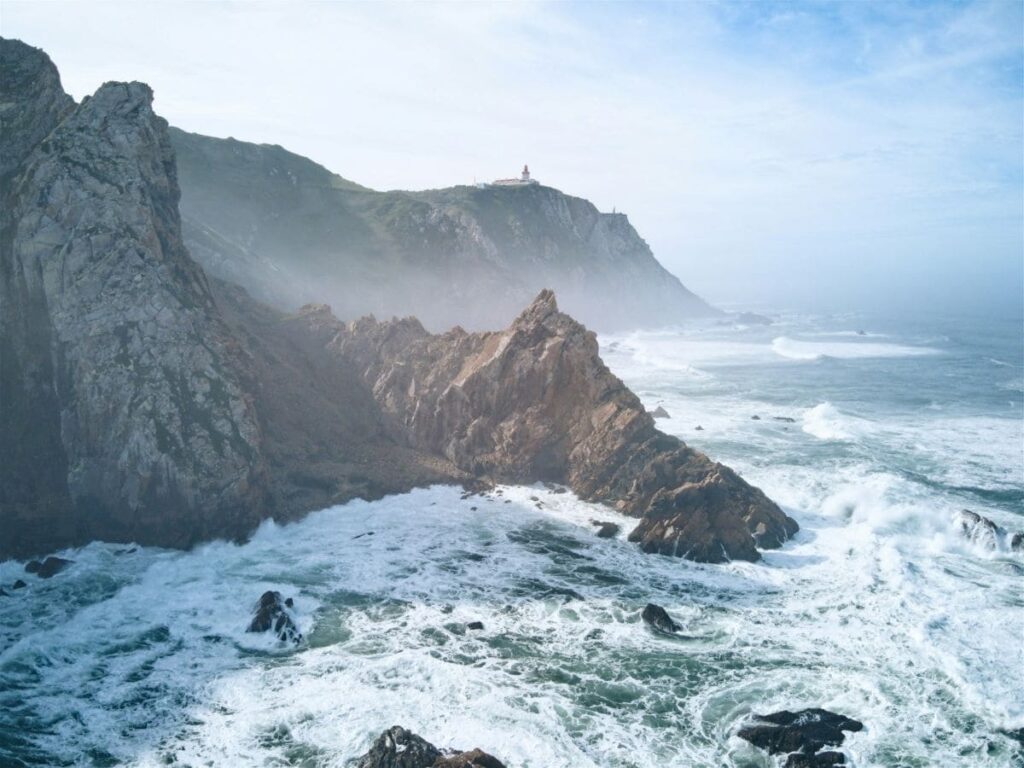
Cabo da Roca is the westernmost point of mainland Europe, at 38.78°N, 9.50°W, at 140 metres above the Atlantic. The lighthouse was first built in 1772; the current lighthouse dates from 1898. There is no admission charge. A shop sells certificates confirming you have stood at the westernmost point of mainland Europe. The certificate costs EUR 7. The wind is free.
From Sintra town, Cabo da Roca is approximately 14 kilometres by road. Bus 1624 (Carris Metropolitana) runs from Cascais to Cabo da Roca (closest stop is 15-20 minutes walking from Cabo Roca) to Sintra. Journey from Sintra: approximately 35–40 minutes. Verify current schedule at carrismetropolitana.pt. The Atlantic coast within the Sintra-Cascais Natural Park:
Praia do Guincho: 9 kilometres from Cascais, a 7-kilometre beach exposed directly to the Atlantic, with consistent wind and surf. Part of the Sintra-Cascais Natural Park. Water temperature: 14–18°C year-round (cold by most standards). Popular with windsurfers and kitesurfers. Lifeguards in summer at the main section.
Praia da Ursa: accessible only on foot via a steep 1-kilometre path from the clifftop above (approximately 20–30 minutes descent). No facilities, no lifeguards. 100-metre cliffs, sea stacks. Not suitable for swimming — exposed Atlantic with strong currents. Worth the descent for the geology and isolation if you have the time and fitness.
Praia Grande and Praia das Macas: north of Sintra town, served by bus from Sintra station. Calmer conditions suitable for swimming in summer.
Getting to Sintra and Getting Around
Train from Lisbon to Sintra
Linha de Sintra (CP — Comboios de Portugal) departs from Rossio Station (Estacao do Rossio) in Lisbon’s Baixa district. Journey time: 40 minutes. Frequency: every 20–30 minutes. Single ticket: EUR 2.55. Return: EUR 5.10.
Note: Rossio Station is a CP suburban station, not connected to the Metro network. Do not look for it on the Metro map. The nearest Metro station is Rossio Metro (Green Line), a 2-minute walk from the CP station entrance.
For all five transport options (including car, taxi, Uber, private tour, and the airport route): How to Get from Lisbon to Sintra: all options compared.
Getting Around Sintra by Bus
Bus 434 (Carris Metropolitana): Sintra Station → Historic Centre → Moorish Castle → Pena Palace (circular route).
Single: approximately EUR 3. Day pass: approximately EUR 7.50.
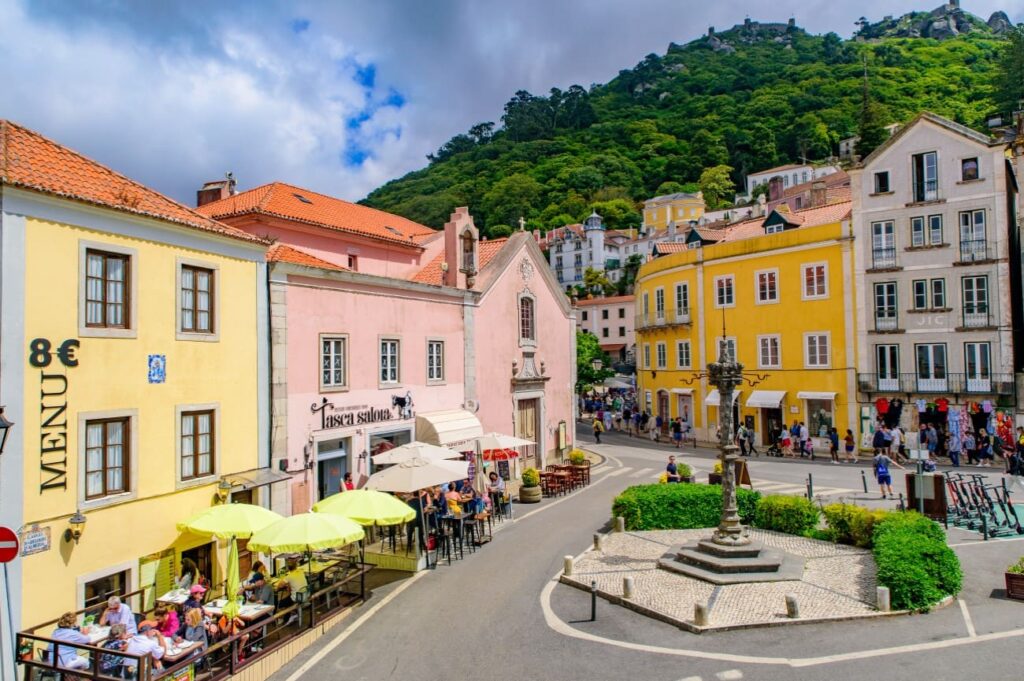
- Historic Centre stop: for Quinta da Regaleira (500m walk), lunch options .
- Moorish Castle stop: direct castle access.
- Pena Palace stop: park entrance (separate EUR 3.50 shuttle to palace itself).
In July and August, the Bus 434 queue at Sintra station starts before 10:00. Board at the Historic Centre stop (shorter queue) or arrive by 09:15.
Walking: Quinta da Regaleira and National Palace are 10–15 minutes from the train station. Moorish Castle and Pena Palace require Bus 434 or a 40-minute uphill walk. Moorish Castle to Pena Palace: 15-minute footpath through the park.
One Day in Sintra: Two Realistic Itineraries
I am going to describe two itineraries that actually work — not the theoretical version where you arrive at 09:30 feeling fresh and leave at 18:00 having seen everything.
The most common question I get when planning a Sintra day: “Can we fit Pena Palace and Quinta da Regaleira in one day?” Yes — but the answer depends entirely on what time you start.
Itinerary A — Quinta da Regaleira and Pena Palace
- 08:00 | Depart Lisbon Rossio Station (train) or 08:30 hotel pickup (private tour).
- 09:00–09:30 | Arrive Sintra — walk to Quinta da Regaleira (10 min).
- 09:30–12:00 | Quinta da Regaleira: Initiation Well, tunnels, palace, garden (2.5 hours).
- 12:00–12:45 | Lunch in Sintra town centre.
- 13:00 | Bus 434 from Historic Centre stop to Pena Palace (15 min).
- 13:15–16:00 | Pena Palace interior (13:30 timed-entry slot, book in advance) + terraces + park.
- 16:30 | Bus 434 back to Sintra station.
- 17:15 | Train to Lisbon Rossio.
Cost per adult (not including lunch): Train return EUR 5.10 + Bus 434 day pass EUR 7.50 + Quinta da Regaleira EUR 20 + Pena Palace EUR 20 = EUR 52.60.
Itinerary B — Moorish Castle and National Palace
- 08:30 | Depart Lisbon (any departure).
- 09:30–11:00 | Moorish Castle: full rampart walk (1.5 hours).
- 11:00–11:15 | Walk from Moorish Castle toward Sintra town via Bus 434.
- 11:30–12:30 | Lunch.
- 13:00–14:30 | National Palace of Sintra: Sala dos Cisnes, Sala dos Brasoes, Arab Room (1.5 hours).
- 15:00 | Train back to Lisbon.
Cost per adult: Train return EUR 5.10 + Bus 434 single EUR 3.00 + Moorish Castle EUR 12 + National Palace ~EUR 12 = approximately EUR 32.
Itinerary B: lower cost, no advance booking required, significantly fewer crowds. The trade-off is that it misses Pena Palace and Quinta da Regaleira. Most visitors prioritise Itinerary A. For a second visit to Sintra, or for visitors specifically interested in medieval and early-modern history, Itinerary B is better value.
When to Visit Sintra
Best Time to Visit Sintra
January–February
Temperature: 12–15°C, frequent rain.
Crowds: Very low.
Notes: No queues; palace interiors accessible without waiting.
March
Temperature: 14–17°C, improving conditions.
Crowds: Low.
Notes: A good option for visitors looking to avoid crowds.
April–May
Temperature: 17–22°C, mild and pleasant.
Crowds: Moderate to high.
Notes: Often considered the best months to visit, combining excellent weather with manageable visitor numbers.
June
Temperature: 20–25°C, mostly dry.
Crowds: High.
Notes: Recommended if you start early in the day (around 09:30).
July–August
Temperature: 25–28°C, dry.
Crowds: Very high.
Notes: Advance booking is essential. Arrive by 09:30 to minimise waiting times or be prepared for queues.
September
Temperature: 23–26°C, warm.
Crowds: High.
Notes: Post-summer conditions remain pleasant, while visitor numbers begin to decline gradually.
October
Temperature: 18–22°C, occasional rain.
Crowds: Moderate.
Notes: One of the recommended months thanks to comfortable temperatures and fewer visitors.
November–December
Temperature: 13–16°C, rain likely.
Crowds: Low.
Notes: Suitable for visiting palace interiors, although coastal attractions and castle walls can be less enjoyable during wet weather.
Sintra Microclimate: What Visitors Should Know
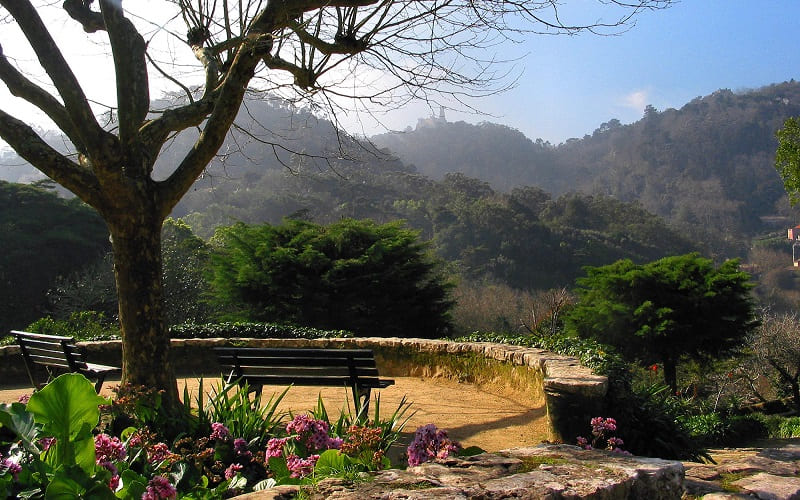
The Serra de Sintra experiences significantly more rainfall and mist than Lisbon due to its approximately 500-metre elevation and direct exposure to Atlantic weather systems. During summer, temperatures in Sintra are typically 5–8°C cooler than Lisbon, making it a refreshing escape from the city’s heat. This difference is particularly noticeable in July and August, while it becomes less relevant during the cooler months.
Before planning outdoor visits to attractions such as the Moorish Castle or Cabo da Roca, always check weather forecasts specifically for Sintra, rather than relying solely on forecasts for Lisbon.
Our Sintra Tours from Lisbon
Yellow Cab TT Tours has operated Sintra day tours from Lisbon since 2013, under RNAAT licence No. 119/2013. Our departure time of 08:30-09:00 places groups at Sintra’s first monuments before the Bus 434 queue builds at the train station.
Palace and monument tickets are purchased separately at official websites (parquesdesintra.pt, regaleira.pt). For a broader overview of Sintra’s geography, history, and UNESCO status: Sintra destination guide.


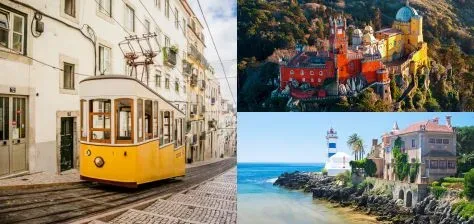
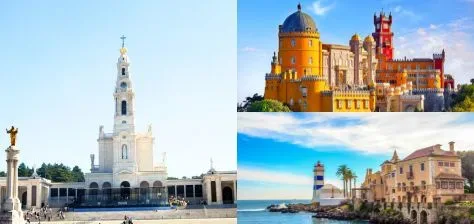

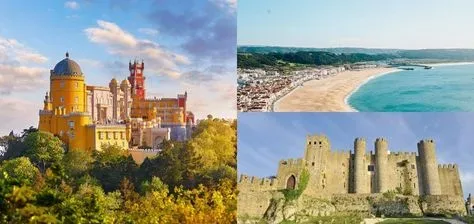
Private Sintra Panoramic 4x4 Tour

FAQ — Visiting Sintra
What are the best things to do in Sintra?
The five main palace monuments: Pena Palace (1842–1854, EUR 20, royal interiors and 200-hectare park), Quinta da Regaleira (1904–1910, EUR 20, 27m Initiation Well and underground tunnels), National Palace of Sintra (14th–16th century, ~EUR 12, oldest palace in Portugal), Moorish Castle (8th–9th century, EUR 12, 450m granite ramparts), and Monserrate Palace (1858–1865, EUR 12, neo-Gothic/Moorish/Indian gardens). Beyond the palaces: Cabo da Roca (westernmost point of mainland Europe, free) and the Sintra-Cascais Natural Park coastline.
Can I visit Sintra in one day?
Yes, with a maximum of two monuments. Quinta da Regaleira (2.5 hours) + Pena Palace (2.5 hours) is the most popular combination and fills a full 6-hour day including transit time within Sintra. Attempting all five palaces in one day is not realistic. For a two-monument day that avoids the worst crowds: Moorish Castle + National Palace of Sintra (lower ticket cost, no advance booking, fewer visitors).
Which Sintra palace is best?
It depends on the priority. Pena Palace (EUR 20): most complete experience — exterior, royal interiors, park. Requires advance booking of timed-entry slot. Quinta da Regaleira (EUR 20): best for the Initiation Well and interactive garden exploration. National Palace (~EUR 12): most historically layered, covering six centuries of court life with preserved interiors. No advance booking needed. Moorish Castle (EUR 12): best for medieval history and views; open-air only. Monserrate (EUR 12): most architecturally unusual, quietest.
How much does a day in Sintra cost?
One monument: train return EUR 5.10 + Bus 434 day pass EUR 7.50 + one ticket (EUR 12–20) = approximately EUR 25–33 per adult. Two monuments (Quinta da Regaleira + Pena Palace): train + bus + EUR 20 + EUR 20 = approximately EUR 53 per adult, not including food. Private tour from Lisbon: from EUR 56/person (tour price); monument tickets purchased separately.
Do I need to book Sintra tickets in advance?
Yes for Pena Palace interior timed-entry slots — book at parquesdesintra.pt with a specific date and 30-minute entry time. Yes for Quinta da Regaleira in peak hours April–October — book at regaleira.pt. Not required for the Moorish Castle, National Palace, or Monserrate, though weekend booking is recommended. Walk-up availability for Pena Palace interior in July–August is limited.
How do I get from Lisbon to Sintra?
Train from Rossio Station (Lisbon) to Sintra: 40 minutes, EUR 2.55 single. Trains run every 20–30 minutes. Rossio is a CP suburban station — not connected to the Metro network. From Sintra station, Bus 434 (Carris Metropolitana) covers Quinta da Regaleira’s area, Moorish Castle, and Pena Palace. Full guide with all five transport options: How to Get from Lisbon to Sintra.
What is the UNESCO Cultural Landscape of Sintra?
The Cultural Landscape of Sintra was inscribed on the UNESCO World Heritage List in 1995. The inscription covers the Sintra historic centre, four palace complexes (Pena, Quinta da Regaleira, Monserrate, and the National Palace), the Moorish Castle, the Capuchin Convent, and the Serra de Sintra natural park. The designation recognises the combination of natural landscape (granite hillside, Atlantic forest) with the density of architectural monuments built over 600 years.
Is Sintra worth visiting from Lisbon?
Yes. Sintra is 40 minutes from Lisbon by train, EUR 2.55 single. The UNESCO Cultural Landscape contains more national monuments per square kilometre than any other municipality in Portugal. The main risk is not the quality of the sites but poor timing: arriving after 10:30 at Pena Palace in peak season means spending a significant part of the day in queues. Plan around a 09:30 start.
How many palaces are in Sintra?
Five within the municipality: Pena Palace (1842–1854), Quinta da Regaleira (1904–1910), National Palace of Sintra (14th–16th century), Monserrate Palace (1858–1865), and Queluz National Palace (18th century, technically in the adjacent Queluz district rather than the Sintra historic centre). Within the UNESCO Cultural Landscape: four palace complexes (Pena, Quinta da Regaleira, National Palace, Monserrate) plus the Moorish Castle and Capuchin Convent.
Can I visit Sintra without a car?
Yes. The train from Lisbon Rossio Station runs every 20–30 minutes and takes 40 minutes. From Sintra station, Bus 434 covers Quinta da Regaleira’s area, Moorish Castle, and Pena Palace. The National Palace of Sintra is a 10-minute walk from the station. Cabo da Roca is accessible by Bus 1624 from Cascais. A car is useful only for Monserrate independently and for some coastal beaches; all main monuments are accessible by public transport.
What is the best time of year to visit Sintra?
April to June and September to October: best balance of weather (17–26°C), manageable crowd levels, and ticket availability. July and August: maximum crowds, advance booking essential for Pena Palace and Quinta da Regaleira, arrive by 09:30. January to March: very low crowds and low waiting times at all monuments — trade-off is higher chance of rain and mist. The Serra de Sintra microclimate is 5–8°C cooler than Lisbon and receives more rain year-round.
Planning a day trip to Sintra? We pick up from your hotel in Lisbon or Cascais → WhatsApp us: +351 965 856 169 → Or use the contact form.

Founder & Director of Yellow Cab TT Tours. Guiding in Portugal for 20+ years.
Founded Yellow Cab TT Tours in 2013. 3,372 five-star reviews on Tripadvisor.