
Évora & Lisbon Private Tour: Roman Temple, Chapel of Bones & Belém
See the Best of Évora and Lisbon in Just One Day
- (Private Tour with Vehicle and Driver/Guide just for you!)


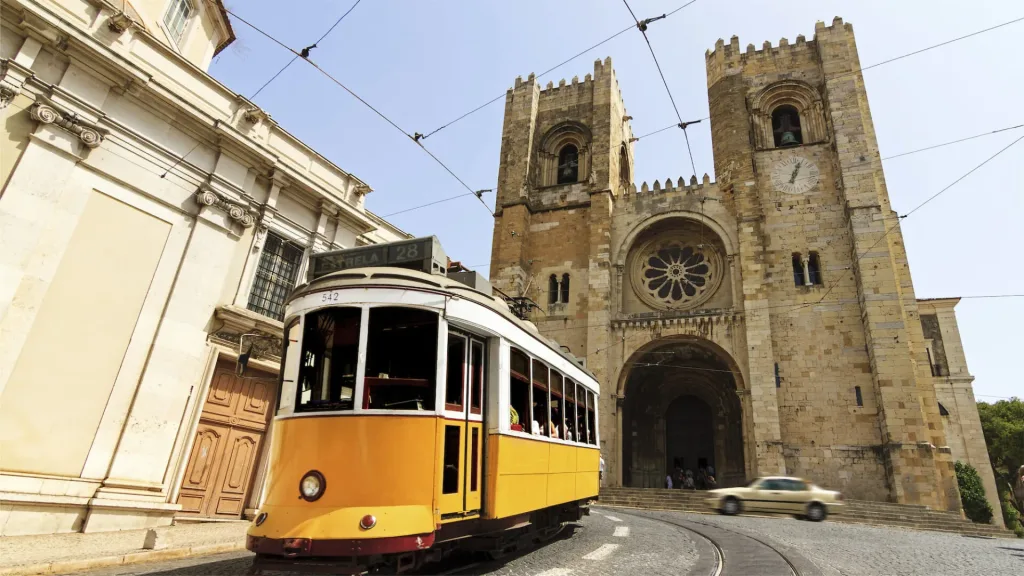
8 Hours
Private
Max. 8px/Van
Hotel or apartment pickup in Lisbon, Sintra, Cascais, Estoril, or anywhere along the coast
Roman Temple, Chapel of Bones, Belém & Alfama
From €350 per private vehicle (see pricing below)

Tour at a Glance
- Duration: 8 hours.
- Departure: Suggested 08:30–09:00 – hotel or apartment pickup in Lisbon, Sintra, Cascais, Estoril, or anywhere along the coast.
- Return: ~17:00–17:30 to your pickup location.
- Distance: Approximately 300 km total (around 140 km Lisbon → Évora + return + Lisbon city driving).
- Group Size: 1–8 passengers (private vehicle, your group only).
- Languages: English, Portuguese, Spanish, French.
- Highlights: Roman Temple, Chapel of Bones, Cathedral of Évora, Alfama, Belém.
- Not Included: Monument tickets and meals.
- Tripadvisor Rating: 5.0/5 based on 3,387 reviews (company-wide).
- License: RNAAT 119/2013.
Tour Overview
Most private day tours from Lisbon go to Évora – or to Belém and Alfama. This one does both, which is the reason it starts at 08:30.
Évora is 140 km southeast of Lisbon via the A6 motorway – approximately 90 minutes each way. The historic centre, designated a UNESCO World Heritage Site in 1986, contains a 1st-century Roman temple, a cathedral begun in 1186, a 17th-century bone chapel built from approximately 5,000 human remains, and one of the oldest universities in Portugal (founded 1559). All within 10 minutes’ walk of each other. After the Évora section, the route returns to Lisbon for Alfama – the city’s Moorish-origin district that survived the 1755 earthquake — and Belém, where Jerónimos Monastery (1501, UNESCO 1983) and the Belém Tower (1514–1521, UNESCO 1983) stand on the Tagus waterfront.
Two UNESCO cities, one private vehicle, eight hours. The tour is designed for travellers who want both the Alentejo interior and the Atlantic capital without a second day.
Why Travellers Choose This Tour
- Two UNESCO World Heritage cities in one day – Évora (1986) and the Belém zone of Lisbon (1983) are both on the list; covering both on a single itinerary saves a full day of travel.
- The route competitors skip: Chapel of Bones (approximately 5,000 human remains) + Roman Temple (1st century AD, Corinthian columns) + Jerónimos Monastery (1501) — the three most requested sites across both cities, in sequence.
- Company-wide 5.0/5 on 3,387 Tripadvisor reviews – Travelers’ Choice Best of the Best 2025.
- 08:30-09:00 departure: the early start is essential – reaching the Chapel of Bones before 11:00 avoids the longest queues; returning to Lisbon for Belém after 15:00 avoids the peak midday visitor wave.
- RNAAT licence 119/2013. Operating since 2013. Languages: EN, ES, FR, PT.
Tips for Visiting Évora
- Jerónimos Monastery in Belém: advance tickets save 30–60 minutes. The Belém stop arrives in the mid-to-late afternoon, when morning queues at Jerónimos (€18/person) have cleared. Even so, in July–August, same-day tickets can mean a 30-minute wait. If entering Jerónimos is a priority, book at patrimoniocultural.gov.pt before the tour.
- One day, two cities: decide your priority in advance. If the Chapel of Bones is the must-see, say so when booking – the guide can extend the Évora stop. If Belém is the priority, the Évora visit will focus on the Roman Temple and Praça do Giraldo rather than spending time inside every monument. The itinerary adjusts; the transport schedule does not.
What You Can See
Praça do Giraldo & Évora Historic Centre
Évora’s historic centre is called a “museum-city” by UNESCO – not because of its size (approximately 100 hectares), but because every major period of Portuguese history from the 1st century AD to the 18th century left a standing structure within 10 minutes’ walk of the same central square.
Praça do Giraldo is named after Geraldo Sem Pavor (Gerald the Fearless), the Portuguese commander who led the Christian reconquest of Évora from Moorish forces on 1 January 1166. The square is flanked by arcaded buildings from the 16th and 17th centuries. At its eastern end stands the Church of Santo Antão, completed in 1557. The marble fountain at the centre – installed in 1570 – was designed at the terminus of the Água de Prata Aqueduct, the first time clean running water reached this point after 33 years of construction.
Évora was Portugal’s second most important city during the 15th century, serving as the permanent court of Kings Afonso V, João II, and Manuel I. The University of Évora, founded by the Jesuits in 1559, was one of the first in Portugal. The city’s relative decline after 1580 – when the Portuguese crown passed to Spain and the court moved permanently to Lisbon – left the 15th and 16th-century urban fabric largely intact, which is the primary reason UNESCO inscribed the entire historic centre in 1986 rather than individual monuments.
The Água de Prata Aqueduct (Silver Water Aqueduct), built between 1532 and 1537 under King João III, carried water 18 km from the São Susana spring into the city. Sections of the aqueduct run directly through the historic centre, with arches incorporated into later buildings – one of the clearest examples of how medieval Évora was built around Roman infrastructure.
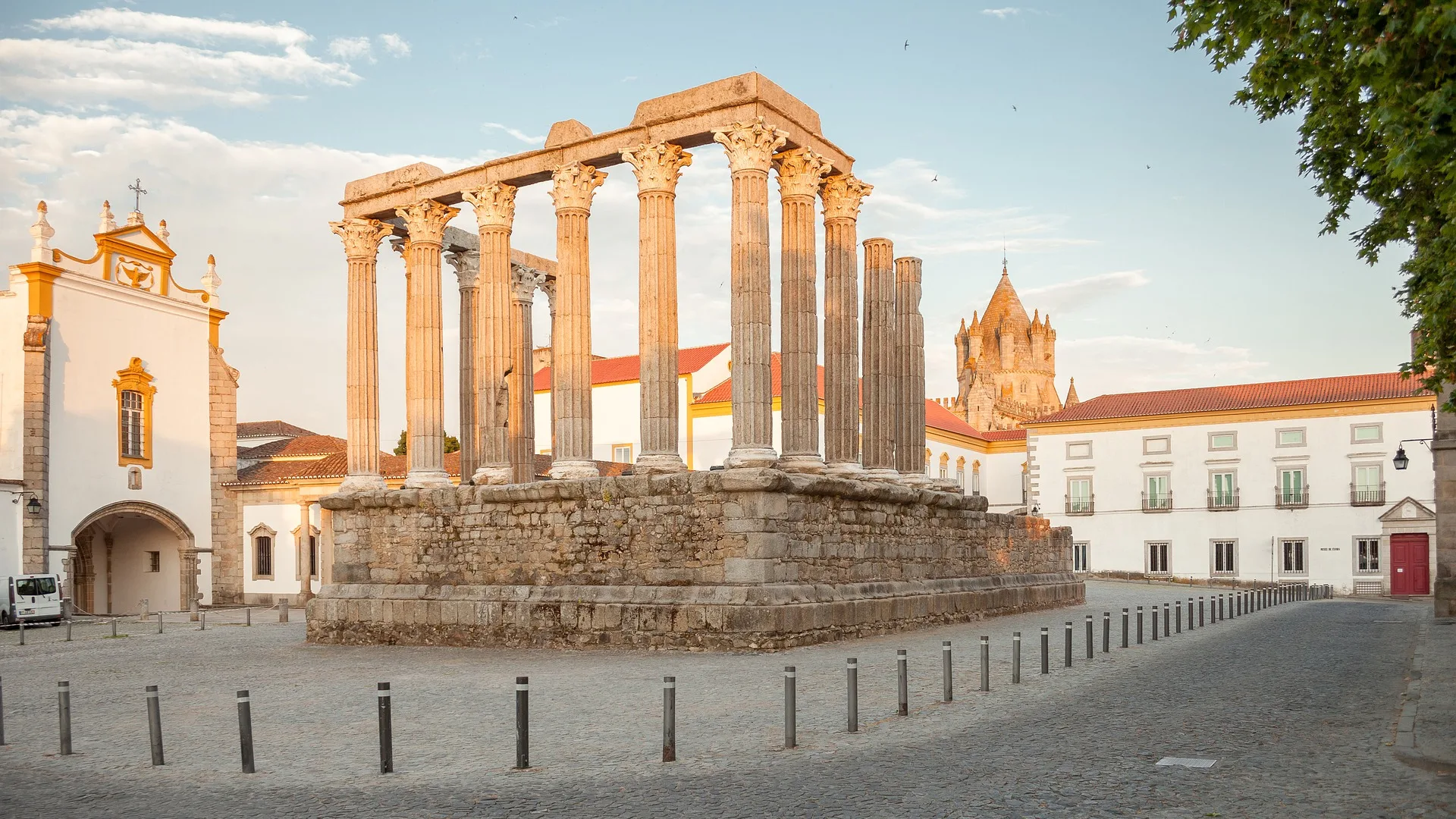
Roman Temple of Évora
The Roman Temple of Évora has been standing for approximately 2,000 years. For roughly 500 of those years – from the 14th century until 1836 – it served as the city’s main public slaughterhouse. That function is the primary reason it survived.
The temple was built in the 1st century AD on the site of the Roman forum (the city was then called Liberalitas Julia). It is universally known as the “Temple of Diana” – a name assigned by a Portuguese priest in the 17th century that has no archaeological basis. Current scholarly consensus attributes the dedication to the Imperial Cult, possibly to the deified Emperor Augustus, though no inscription confirming this has been found.
14 Corinthian granite columns survive, each composed of several drums topped with capitals decorated with acanthus leaves. During the 14th century, the spaces between the columns were filled with stone and the structure was converted into a fortified tower. When the tower’s military function ended in the 19th century, archaeologists removed the medieval additions and restored the visible Roman form. Restoration was completed in 1871. The temple is a National Monument and central to the 1986 UNESCO World Heritage inscription.


Cathedral of Évora – Sé de Évora
The Cathedral of Évora is the oldest cathedral in Portugal with two towers on its western facade – and both towers are different heights, which reflects not an error but the reality of Gothic construction across multiple centuries.
Construction began in 1186, making it one of the oldest cathedrals in Portugal. The building shows three distinct phases: the original Romanesque structure (12th century, including the two asymmetric towers), a Gothic enlargement between 1280 and 1340 (cloisters, nave vaulting), and a complete rebuilding of the main chapel in Roman Baroque style between 1718 and 1746 under King João V, using polychrome marble comparable to the Jerónimos Monastery in Lisbon.
The rooftop terrace is accessible to visitors and provides views over the historic centre and the Alentejo plain. The cathedral museum holds one of Portugal’s most important ecclesiastical art collections, including medieval illuminated manuscripts and a 13th-century ivory statue of the Virgin. Entry to the cathedral and museum is not included in the tour price.
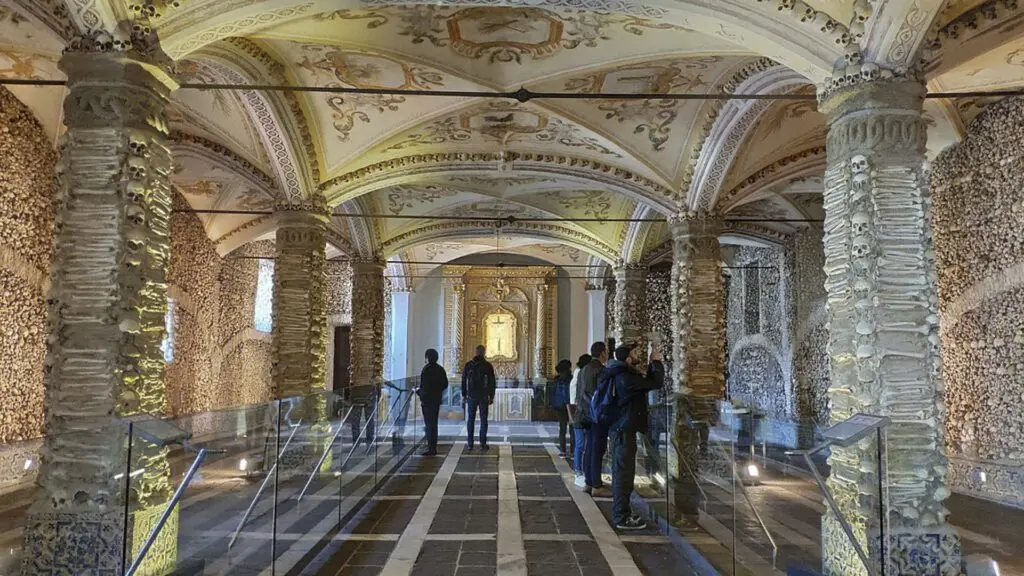
Chapel of Bones – Igreja de São Francisco
The Chapel of Bones was built by three Franciscan friars who looked at 42 overcrowded monastic cemeteries inside the city walls and decided the practical solution was to exhume the remains and put the bones in a room. Then write a warning above the door.
The chapel is located within the Church of São Francisco, a late-Gothic and Manueline church completed in the early 16th century. The bone chapel itself was constructed in the 17th century – both as a meditation space on mortality (memento mori) and as a logistical solution to the cemeteries problem. Land inside the walled city was scarce; 42 cemeteries occupied space needed for the living.
The walls, columns, and ceiling of the chapel are entirely lined with the bones and skulls of approximately 5,000 people. The inscription above the entrance reads: “Nós ossos que aqui estamos, pelos vossos esperamos” – “We bones that are here, for yours we wait.” Two mummified figures are suspended within the chapel. A forensic investigation completed in 2019 established that they are a woman and a girl – not the man and son of the long-repeated curse legend, which has no historical basis.
Alfama & Nossa Senhora do Monte
On the return to Lisbon, the route enters the only district of the city that survived the 1755 earthquake completely intact – because Alfama sits on schist and granite bedrock, while the rest of the city sat on alluvial soil that amplified the seismic waves.
The earthquake struck on 1 November 1755 (All Saints’ Day). Estimated magnitude: 8.7–9.0. The tsunami and fires that followed killed approximately 60,000–100,000 people across Lisbon, Setúbal, and the Algarve. Alfama survived structurally because its Moorish-origin streets and buildings were built directly on the hillside rock.
Nossa Senhora do Monte is the highest miradouro in Lisbon at 102 m above sea level, in the Graça district. The views from the terrace cover the full arc of the city – from the Expo 98 waterfront in the east to Belém in the west – and give context to the scale of the Pombaline reconstruction that followed the earthquake.
São Jorge Castle (exterior) is visible from this approach. The castle sits at 100 m altitude – the same reason Moorish rulers fortified the site in the 8th century and why King Afonso Henriques captured it in 1147 during the Siege of Lisbon, with the support of Flemish and English Crusaders.


Belém
The Belém stop arrives in mid-to-late afternoon, when the morning queues have cleared and the light on the Tower is at its best.
Belém, 6 km west of Lisbon centre, was the embarkation point of Portugal’s Age of Discovery voyages in the 15th and 16th centuries.
Jerónimos Monastery: Construction began in 1501 under King Manuel I. Manueline Gothic – the distinctive Portuguese style incorporating maritime motifs: twisted ropes, armillary spheres, coral formations in carved stone. Approximately 100 years to complete. UNESCO 1983. The church contains the tomb of Vasco da Gama (died 24 December 1524 in Kochi, India) and the tomb of the poet Luís de Camões (died c. 10 June 1580). Entry €18/person – book in advance if visiting inside in July–August.
Belém Tower (Torre de Belém): Built 1514–1521. Manueline style. Originally positioned on a small island in the Tagus; river silting connected it to the north bank over the following centuries. UNESCO 1983 (same inscription as Jerónimos).
Monument to the Discoveries (Padrão dos Descobrimentos): Unveiled in October 1960 on the 500th anniversary of the death of Henry the Navigator. 52 m tall. 33 figures. The compass-rose mosaic on the pavement (50 m diameter) was gifted by South Africa in 1960.
What’s Included
- 8 Hours Tour
- Private air-conditioned vehicle (up to 8 passengers)
- Hotel/apartment pickup and drop-off in Lisbon, Sintra, Cascais, Estoril, or anywhere along the Estoril Coast
- Mandatory Insurances
- Fuel, tolls, parking at all stops
Not included
- Lunch
- Tickets to Monuments
- Tips
Tour Prices
Prices are per vehicle, not per person.
Free cancellation up to 24 hours before departure. Cancellations within 24 hours are non-refundable.
Contact us and Book your Tour
Best Time of Year for This Tour
- March–May:
- Évora: 18–24°C · Lisbon: 16–22°C
- Best overall weather for the long day. Spring wildflowers visible across the Alentejo plains (especially March–April). Recommended booking: 1–2 weeks in advance.
- June:
- Évora: 25–30°C · Lisbon: ~12–13 June Festas de Lisboa
- Alfama has a festive atmosphere on the return leg. Évora starts getting hot — 08:30 departure is essential.
- July–August:
- Évora: 32–40°C · Lisbon: 28–32°C (peak crowds)
- Extreme heat in Évora; sun protection and light clothing required. Chapel of Bones is busiest before 11:30, so early schedule helps. Jerónimos Monastery should be pre-booked.
- September–October:
- Évora: 22–30°C · Lisbon: 20–26°C
- Crowds decrease. Excellent light conditions in Belém. Cork harvest season in the Alentejo begins.
- November–February:
- Évora: 10–16°C · Lisbon: 10–16°C (possible Atlantic rain)
- Quietest season. Évora is largely uncrowded on weekdays. Belém Tower and Jerónimos Monastery typically have minimal queues.
FAQ
Is this a private tour?
What is the difference between this tour and the Évora Only Tour?
Is the Cork Factory visit included?
Are entrance tickets included?
Is lunch included?
What time is pickup?
Is the tour suitable for people with limited mobility?
What languages does the guide speak?
What is the cancellation policy?
What Our Guests Say
You may also be interested in
Private Évora Day Tour from Lisbon
Évora only — 4 hours in the city, wine tasting available as add-on. From €330/vehicle.

Lisbon City Tour - Alfama, Belém & Cristo Rei
Full-day Lisbon exclusively: Parque das Nações (Expo 98), Alfama, Baixa, Cristo Rei and Belém.

Best Solution Tour - Lisbon, Sintra & Cascais
Lisbon city highlights + Sintra (UNESCO 1995) + Cascais coast + Cabo da Roca in one day. From €310/vehicle.
