Quinta da Regaleira, Sintra — completed 1910, 4-hectare estate with 27-metre Initiation Well

Quinta da Regaleira Sintra: Guide to the Initiation Well, Tunnels and Gardens

Fábio Mendes - Founder and CEO at Yellow Cab TT Tours - author
Author: Fábio Mendes · Founder & Director, Yellow Cab TT Tours
8 June 2026 · 17 min read
In 1892, António Augusto Carvalho Monteiro purchased a quinta on the edge of Sintra’s historic centre and set about designing a property unlike anything built in Portugal before or since.


Quinta da Regaleira is not a medieval estate. It is not a Templar fortress. It is a 4-hectare palace and garden complex completed in 1910, built by a Brazilian-Portuguese millionaire who was passionate about esotericism, Freemasonry, Templar symbolism, Rosicrucianism, Dante, and the natural sciences — and who had the resources to combine all of them into a single property in Sintra.


The result includes a neo-Manueline palace, a Gothic chapel, a 27-metre underground well with a spiral staircase, a network of tunnels connecting six points in the garden, and a second, lesser-known well that receives one-tenth the visitors of the first.


This guide covers the history, the symbolism, what to see, and how the Templar myth became attached to a building completed 598 years after the Knights Templar were dissolved.
Table of Contents

What Is Quinta da Regaleira?
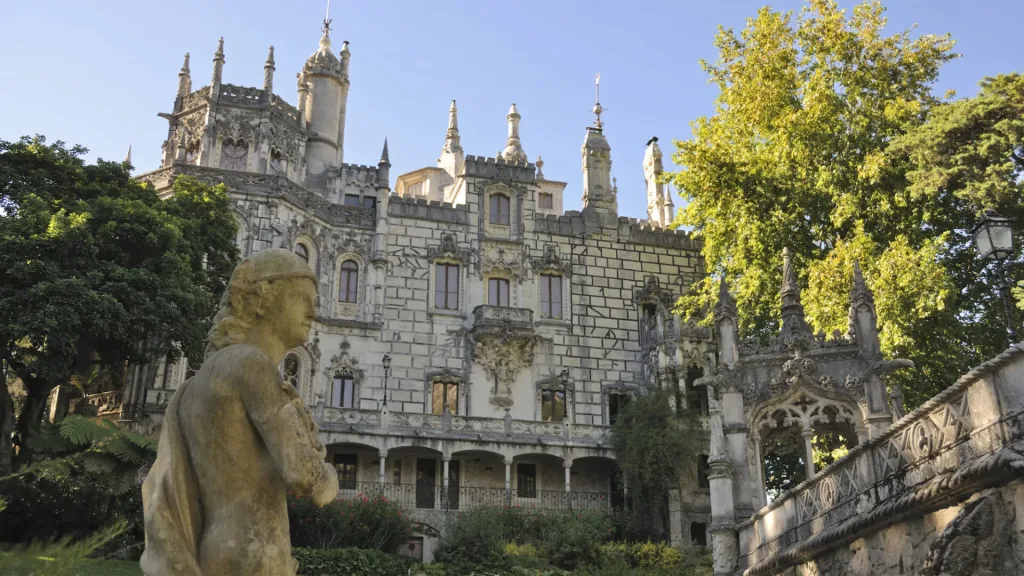
Quinta da Regaleira is a palace and garden estate of approximately 4 hectares located in the historic centre of Sintra, 500 metres from the National Palace of Sintra and 700 metres from Sintra train station.

The main structures: a neo-Manueline palace (4 floors, completed 1910), a Gothic chapel, the Initiation Well (27 metres underground), the Imperfect Well, a lake, a grotto, and approximately 1.5 km of garden paths connecting these elements.

UNESCO inscribed Quinta da Regaleira as part of the Cultural Landscape of Sintra in 1995. The Portuguese state classified it as a National Monument in 1997. It is currently managed by the Sintra Town Council (Camara Municipal de Sintra) and operated through the Regaleira Foundation.

Adult entry: €20. Youth (6–17) and seniors (65+): €15. Children under 6: free. Family (2 adults + 2 youth, max 4): €60. Prices valid from January 2026.
Quinta da Regaleira

The Man Who Built It: António Carvalho Monteiro

From Brazil to Sintra

António Augusto Carvalho Monteiro was born in Porto in 1848. His family had established a coffee and diamond trading business in Brazil; he inherited and expanded it, becoming one of the wealthiest Portuguese citizens of the late 19th century. His nickname — “Monteiro dos Milhões” (Monteiro of the Millions) — was earned, not invented.

He purchased the Quinta da Regaleira property in 1892, along with an existing 18th-century house. He demolished the house and commissioned an entirely new complex.

António Carvalho Monteiro was passionate about esotericism, rare books, entomology, and the natural sciences. He was also extremely wealthy, which made acting on these passions considerably easier.

He died in Sintra in 1920. The estate passed through several owners before being acquired by the Sintra municipality in 1997.

Luigi Manini: The Architect Who Designed for Theatre

The architect Carvalho Monteiro chose was Luigi Manini (1848–1936), an Italian born in Cremona. Manini worked primarily as a stage designer — his main career was as artistic director and chief set designer for the Teatro di San Carlo in Naples and later the Teatro Nacional de Sao Carlos in Lisbon.

Carvalho Monteiro hired him to design not just a palace but an entire symbolic landscape. Manini approached the commission as he would a theatrical production: he designed pathways to be experienced in a specific sequence, underground spaces that produce specific emotional effects, and visual surprises calibrated to appear at exact moments as visitors move through the garden.

The Initiation Well has nine spiral landings, referencing the nine circles of Hell in Dante’s Inferno. The symbolism was chosen by Luigi Manini, an opera set designer, which explains why the whole thing feels like a stage set — because it essentially is.

The construction took place between 1904 and 1910. Carvalho Monteiro and Manini worked together throughout, with Carvalho Monteiro directing the symbolic programme and Manini executing the architectural and spatial design.
António_Augusto_Carvalho_Monteiro

The Initiation Well: What It Is and What It Is Not

I have been to Quinta da Regaleira perhaps 300 times. The question I get at the Initiation Well, without fail, is: “Is this actually Templar?”

The Structure: 27 Metres, 9 Landings, One Cross

The Initiation Well (Poco Iniciático) is not a water well. It was never used to draw water. It is an inverted tower descending 27 metres underground, with a spiral staircase of nine circular landings.

The nine landings reference the nine circles of Hell in Dante Alighieri’s Inferno (written c. 1308–1320). The staircase is supported by carved stone columns with Gothic detailing. At the bottom, a Templar cross (cross pattee) is set into the stone floor. An underground tunnel connects the base of the well to six other points in the garden, including the chapel, the lake, and the Poco Imperfeito.

The well measures approximately 15 metres in diameter and descends to a depth of 27 metres below the garden surface. Two connecting tunnels lead from the base: one toward the chapel and one toward the grotto and lake system.

Enter the Initiation Well from the top, not from the tunnel entrance at the bottom. The descent through the nine landings is the experience — arriving at the bottom through a tunnel and then climbing up reverses the intended sequence and is significantly less satisfying.

The Templar Connection: Myth vs Fact

The most common question at the Well is whether it is actually connected to the Knights Templar. The short answer is no.

The Knights Templar were dissolved by the Council of Vienne in 1312, by papal bull issued by Pope Clement V. By 1314, the Grand Master Jacques de Molay had been burned at the stake in Paris. The Templar order ceased to exist as a functional institution in 1312.

Quinta da Regaleira was completed in 1910 — 598 years later.

What Carvalho Monteiro and Luigi Manini built was a property that uses Templar symbolism, Masonic ritual structure, Rosicrucian imagery, and Hermetic philosophy as decorative and spatial references — all fashionable among the European esoteric movements of the late 19th and early 20th centuries. The Templar cross at the base of the well is a symbolic reference, not evidence of Templar occupation.

Quinta da Regaleira is not a medieval building. It was completed in 1910 — the same year the Portuguese monarchy fell. It is younger than the Eiffel Tower.

For the actual history of the Knights Templar in Portugal — including why Portugal was the only country where they were not dissolved — check out our article “The Knights Templar in Portugal: History, Legacy and Where to See It Today”.

The Second Well: Poco Imperfeito

The Poco Imperfeito — the ‘Imperfect Well’ — is a few minutes from the Initiation Well and receives approximately one-tenth the visitors. It is not imperfect in any structural sense. The name refers to an incomplete initiation — the ritual sequence was interrupted before the candidate completed the descent.

The Poco Imperfeito is shorter than the Initiation Well and has a simpler staircase structure. It connects to the same underground tunnel network but at a different point. Most visitors walk past it entirely.
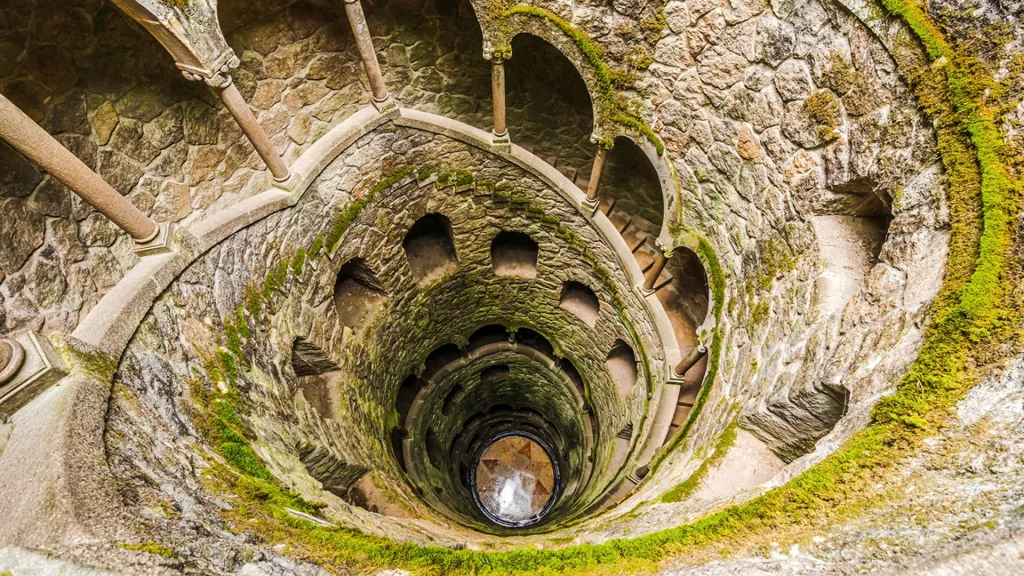
Initiation Well at Quinta da Regaleira, Sintra — 27-metre spiral staircase with 9 landings, built 1898–1910

The Underground Tunnels

What the Tunnels Connect

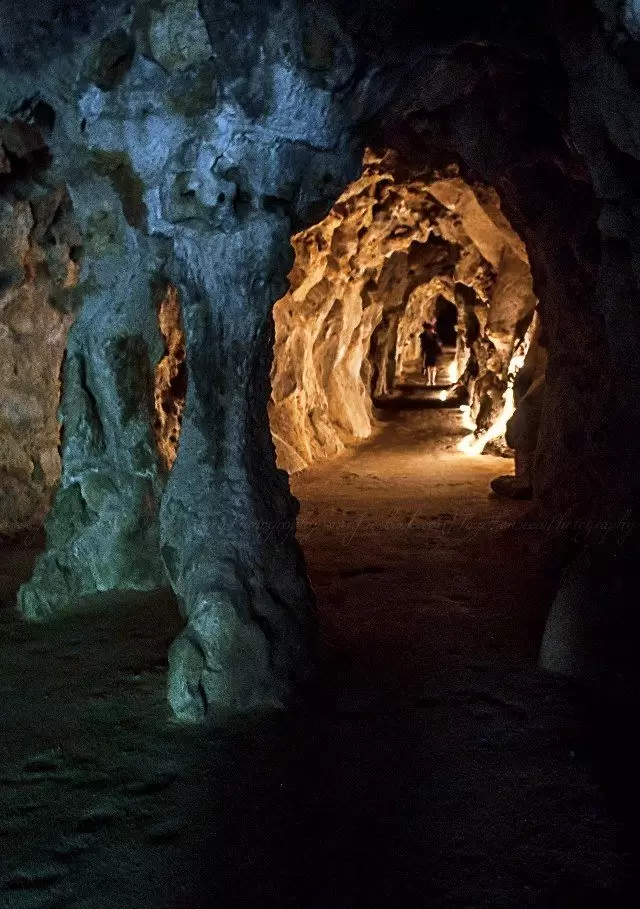
The tunnel network beneath Quinta da Regaleira connects six points: the base of the Initiation Well, the base of the Poco Imperfeito, the chapel, the lake area, the grotto, and a secondary garden exit. The tunnels are cut through the granite hillside and lined with rough stone.

The network was designed by Manini as part of the symbolic journey through the estate — the progression from underground darkness (the well base) toward the chapel (light, elevation) mirrors the initiatory structure of Masonic and Rosicrucian ritual.

How to Navigate the Network

The tunnels are accessible to all visitors and require no booking or separate ticket. They are unlit in most sections — carry a torch or use a phone light. The passages are approximately 1.5 metres high throughout; visitors over 1.8 metres will need to duck in places.

The recommended sequence: descend the Initiation Well → walk the tunnel to the grotto and lake → emerge at the garden level → walk to the chapel → return above ground.

The reverse route (entering the tunnel at garden level and ascending the well) works technically but loses the spatial logic of the design.
The tunnels are accessible to all visitors and require no booking or separate ticket. They are unlit in most sections — carry a torch or use a phone light. The passages are approximately 1.5 metres high throughout; visitors over 1.8 metres will need to duck in places. The recommended sequence: descend the Initiation Well → walk the tunnel to the grotto and lake → emerge at the garden level → walk to the chapel → return above ground. The reverse route (entering the tunnel at garden level and ascending the well) works technically but loses the spatial logic of the design.

The Palace and Chapel

The Exterior Symbolism

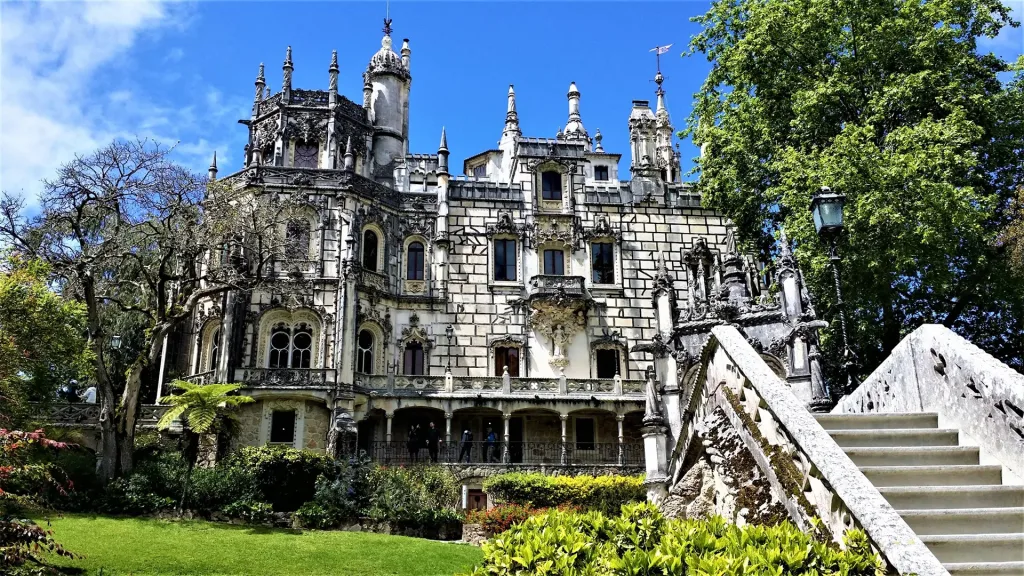
The palace is built in the neo-Manueline style — evoking the decorative vocabulary of 16th-century Portuguese maritime architecture (twisted ropes, armillary spheres, naturalistic stone carving) but constructed in 1904–1910. It is four storeys, incorporating Templar crosses, Masonic symbols, and Rosicrucian imagery into the carved stonework of the facade.

The decorative programme is dense: each element of the exterior — the windows, doorways, balustrades, and tower details — carries symbolic content from Carvalho Monteiro’s esoteric framework. Manini translated this programme into stone.

Inside the Palace

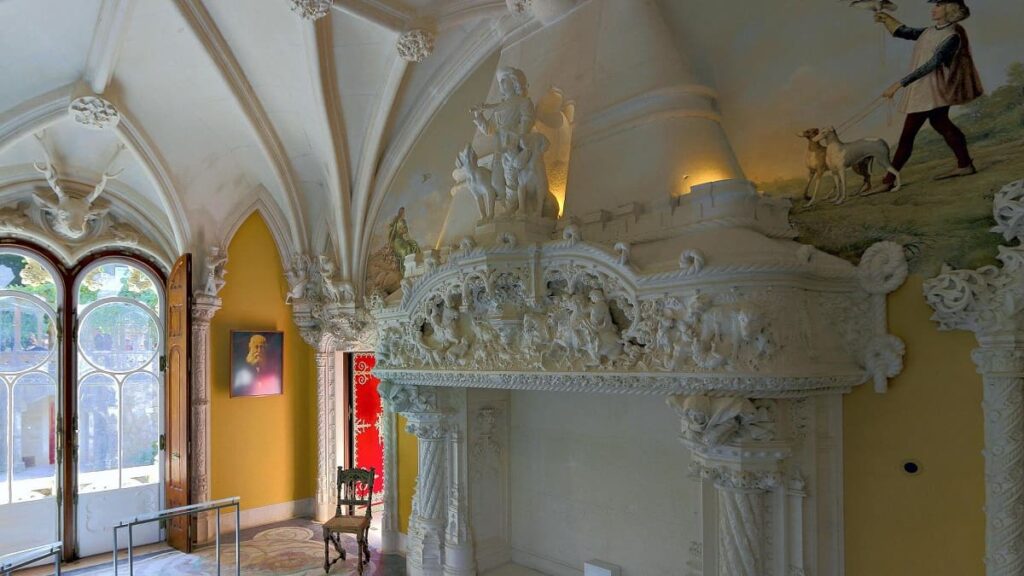
The palace interior is open to visitors and contains several decorated rooms with painted ceilings, period furniture, and decorative elements continuing the symbolic programme. The rooms are smaller than the exterior suggests — the building was designed primarily as a private residence for a single wealthy owner, not a royal palace.

The most-visited interior space is the upper gallery, which provides views across the garden and toward the Sintra hills. The chapel — a separate structure adjacent to the palace — contains religious imagery alongside esoteric decorative elements.
quinta da regaleira hunting room

The Gardens

The Garden Layout

The garden of approximately 4 hectares is laid out on a hillside, with multiple levels connected by stone steps, paths, and tunnels. The design is not symmetrical or formal in the European garden tradition — it is intentionally labyrinthine, with paths that dead-end, viewpoints that appear unexpectedly, and spaces that open without warning.

The garden contains grottos, artificial ruins, a lake, a cascade, a rose garden, a fernery, and approximately 1.5 km of walkable paths. The vegetation is mature — planted in 1904–1910 and now fully established, creating a dense canopy over most of the lower garden in summer.

The Lake and the Grotto

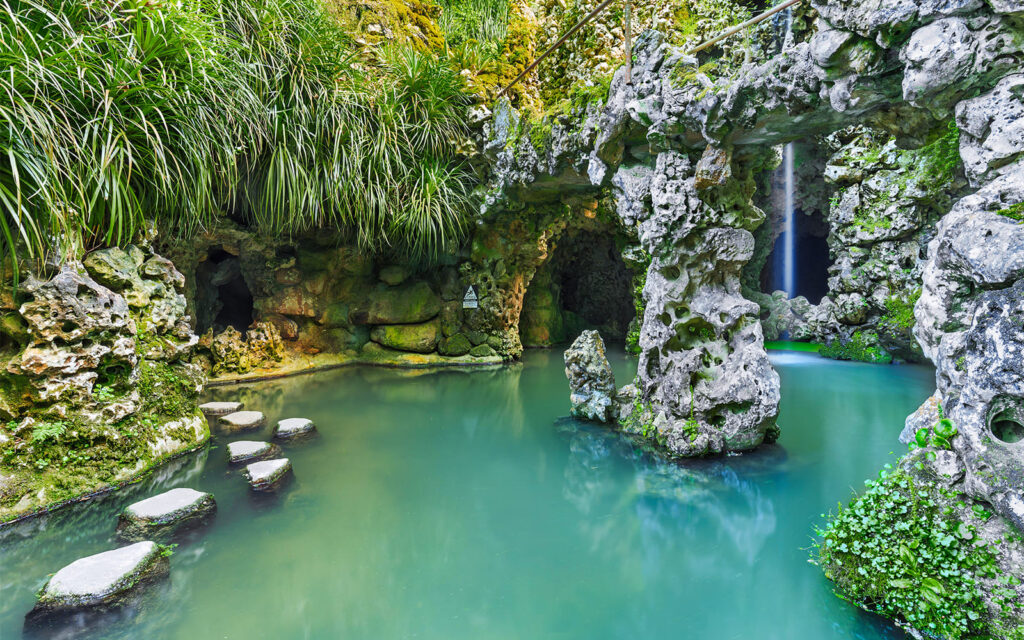
The lake at the lower level of the garden is artificial, created during construction. It is connected to the tunnel network; the exit from one of the main tunnels emerges through a gap in the grotto wall at lake level, emerging behind a waterfall (seasonal — most visible in winter and spring).

The grotto is built of rough-cut granite and contains a small artificial cave accessible by boat (seasonal, when available). The lake and surrounding garden area are among the least crowded sections of the estate in peak season, as most visitors concentrate on the Initiation Well and palace.

Practical Information

Tickets and Prices

  • Adult (18–64): €20
  • Youth (6–17): €15
  • Senior (65+): €15
  • Child (under 6): Free
  • Family (2 adults + 2 youth, max. 4 people): €60
  • Audio guide: €5
Source: regaleira.pt. Prices valid from January 2026.
Book in advance. Interior timed-entry slots for peak periods (10:00–14:00, April–October) sell out days ahead. Booking via regaleira.pt is recommended.

Opening Hours

Quinta da Regaleira is open daily. Hours vary by season — typically 10:30–18:00 (winter) to 10:00–19:30 (summer). 

How Long to Allow

A complete visit — palace interior, Initiation Well, Poco Imperfeito, tunnels, chapel, and garden — takes 2.5 to 3 hours. A focused visit covering only the well, tunnels, and palace exterior takes 1.5 to 2 hours.

The well itself generates significant queues at peak times (10:00–14:00 in summer). Arriving at 09:30 reduces waiting time at the well entrance to under 10 minutes; arriving at 12:00 may mean a 30–45 minute wait for the descent.

When to Visit

April–June and September–October are the best months: mild temperatures, full vegetation, lower visitor volumes than July–August.

July and August: maximum visitors. The well entrance queue is the main bottleneck — plan around it. Arrive at 09:30 or after 16:00.

Winter (November–March): significantly fewer visitors. The garden is less green but the well and tunnels are fully accessible. Some seasonal facilities may be closed.

Private Tours from Lisbon Including Quinta da Regaleira

Quinta da Regaleira is included in our Sintra day tours as a standard stop alongside Pena Palace. We depart Lisbon at 08:30-09:00 and reach Sintra by 09:30-10:00, which allows our groups to enter the Initiation Well before the main visitor wave.
See our Sintra destination guide for the full overview of Sintra, and our things to do in Sintra guide for all five main palaces compared.

FAQ

Quinta da Regaleira is a palace and garden estate of approximately 4 hectares in the historic centre of Sintra, 500 metres from the National Palace. It was built between 1904 and 1910 for António Augusto Carvalho Monteiro, a wealthy Brazilian-Portuguese millionaire, designed by Italian architect Luigi Manini. The estate includes a neo-Manueline palace, a Gothic chapel, the Initiation Well (27 metres underground), a second well, underground tunnels, a lake, and a grotto. It is a UNESCO World Heritage Site (as part of the Cultural Landscape of Sintra, 1995) and a Portuguese National Monument (1997).
No. The Initiation Well (Poco Iniciático) was never used to draw water. It is an inverted tower descending 27 metres underground, with a spiral staircase of nine landings referencing the nine circles of Hell in Dante’s Inferno. It was designed by Luigi Manini in 1904-1910 for ceremonial and symbolic purposes connected to Masonic and esoteric traditions. A Templar cross is set into the stone floor at the base.
No. The Knights Templar were dissolved in 1312. Quinta da Regaleira was built in 1904-1910 — 598 years later. The property uses Templar, Masonic, and Rosicrucian symbolism as decorative and spatial references, which was fashionable in European esoteric circles of the late 19th and early 20th centuries. The Templar cross at the base of the Initiation Well is a symbolic reference, not historical evidence.
The Initiation Well descends 27 metres underground through a spiral staircase of nine circular landings. The well measures approximately 15 metres in diameter. An underground tunnel connects the base to six other points in the garden, including the chapel, the lake, the grotto, and the Imperfect Well (Poco Imperfeito).
Adult entry (18-64) is EUR 20. Youth (6-17) and seniors (65+) pay EUR 15. Children under 6 enter free. A family ticket (2 adults + 2 youth, maximum 4) costs EUR 60. An audio guide costs EUR 5. Tickets must be booked in advance at regaleira.pt, particularly for peak hours (10:00-14:00, April-October). Prices valid from January 2026 — verify at regaleira.pt before visiting.
A complete visit — palace interior, Initiation Well, Poco Imperfeito, tunnels, chapel, and gardens — takes 2.5 to 3 hours. A focused visit covering only the well, tunnels, and palace exterior takes 1.5 to 2 hours. Allow additional time if the well has a queue (common between 10:00 and 14:00 in peak season).
Yes. The estate is fully accessible independently — the tunnels, wells, and garden paths are open to self-guided visitors included in the admission ticket. An audio guide (EUR 5) provides explanations of the symbolic programme. Guided tours with a specialist are available separately through regaleira.pt.
Arrive at 10:00 when the estate opens. The Initiation Well queue is minimal at this time. The main visitor wave arrives after 10:30. April to June and September to October offer the best combination of mild weather and lower visitor volumes. In July and August, plan to arrive at opening or after 16:00.
Quinta da Regaleira is 700 metres from Sintra train station — approximately 10 minutes on foot through the historic centre. It is the only major Sintra monument within walking distance of the station without a bus or shuttle.
Yes. With a 10:00 start, a realistic sequence is: Quinta da Regaleira (2 hours, 10:00-12:00) → lunch in Sintra town (30-45 min) → Bus 434 to Pena Palace (15 min) → Pena Palace and park (2.5 hours, 13:00-15:30) → return to Lisbon by 17:00-18:00. Book Pena Palace timed-entry in advance at parquesdesintra.pt (EUR 20 adult). On a private tour from Lisbon departing at 08:30-09:00, both sites fit comfortably within a standard 8-hour day.
Fábio Mendes - Founder and CEO at Yellow Cab TT Tours - author
Written by Fábio Mendes
Founder & Director of Yellow Cab TT Tours. Guiding in Portugal for 20+ years.
Founded Yellow Cab TT Tours in 2013. 3,372 five-star reviews on Tripadvisor.
Facebook
X
LinkedIn
Facebook
X
LinkedIn