
sintra moorish castle mouros

Moorish Castle Sintra: History, Walls and Visitor Guide

Fábio Mendes - Founder and CEO at Yellow Cab TT Tours - author
Author: Fábio Mendes · Founder & Director, Yellow Cab TT Tours
8 June 2026 · 14 min read
In the year 711, Moorish forces crossed the Strait of Gibraltar from North Africa and began the conquest of the Iberian Peninsula. Within seven years, they controlled most of what is now Portugal and Spain. The hilltop above Sintra, with its commanding views of the coast and the interior, became a strategic point.


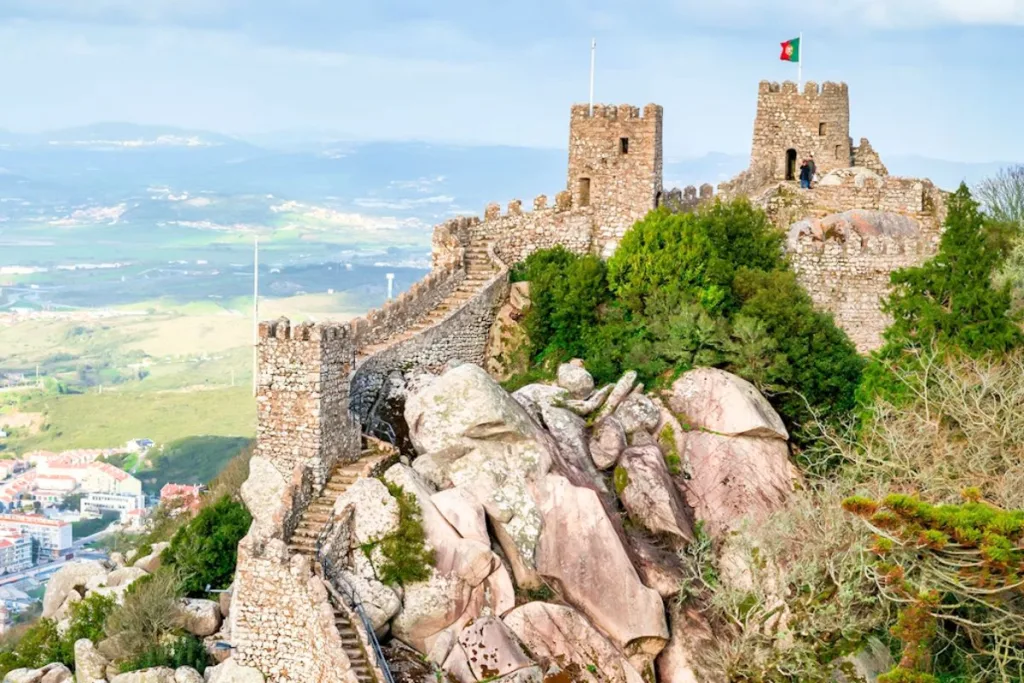
The Moorish Castle (Castelo dos Mouros) was built on that hilltop in the 8th and 9th centuries. Its walls — 450 metres of granite ramparts across five towers at 471 metres elevation — are among the best-preserved examples of Moorish military architecture in Portugal.


In 1147, Afonso I of Portugal captured the castle. The Moors had already left. The castle eventually fell into disrepair, was partially restored in the 19th century, and is today one of the monuments managed by Parques de Sintra.


It receives approximately one-fifth the visitors of Pena Palace, which is 15 minutes away by walking path. This makes it, by most practical measures, the better experience for anyone interested in medieval military architecture — you can walk the full parapet without stopping.
Table of Contents

1,200 Years on the Same Hill: A Brief History

The Moors Arrive in Iberia: 711 AD

The conquest of the Iberian Peninsula by Moorish forces from North Africa began in 711 AD, when a Berber army under Tariq ibn Ziyad crossed the Strait of Gibraltar and defeated the Visigothic king Roderic at the Battle of Guadalete.


Within a decade, Moorish forces controlled most of the peninsula. The northern territories — what would eventually become Portugal — were more sparsely held, with control exercised through a network of hilltop fortifications that provided both military control and visual communication across long distances.


The Serra de Sintra, a granite ridge rising steeply from the coast 25 kilometres northwest of Lisbon, was one of these strategic points. Its highest peak was occupied as a military position sometime in the 8th or 9th century.

The Castle Is Built: 8th–9th Century

The Moorish Castle was constructed in the 8th and 9th centuries during the period of Moorish occupation of the Iberian Peninsula. The construction used granite — the dominant local stone of the Serra de Sintra — to build walls that followed the natural contours of the ridge, linking boulders and cliff faces into a continuous defensive perimeter.


The original construction included five towers connected by curtain walls following the spine of the ridge for approximately 450 metres. The design is purely military — no ornamental features, no decorative stonework. The walls are between 1.5 and 2 metres thick throughout, with an internal walkable parapet.

The Reconquista: Afonso I Captures the Castle in 1147

The Reconquista — the Christian reconquest of the Iberian Peninsula from Moorish control — reached the Sintra area in 1147. Afonso Henriques, who had established himself as King of Portugal four years earlier (recognized by the papacy in 1143), launched a military campaign along the coast in that year.


The same campaign took Santarém in March 1147 and Lisbon in October 1147. The Siege of Lisbon — in which Crusader forces assisted the Portuguese — ended eight centuries of Moorish control of the city.


The Moorish Castle at Sintra surrendered voluntarily in 1147, after Afonso Henriques took Lisbon in the same military campaign. The Moors who held it apparently calculated that holding a hilltop fortress in a territory whose major city had just fallen was not a strategically compelling position.


The castle was not immediately of great strategic value to the Portuguese either. It was maintained as a military outpost for a period and then gradually abandoned as the frontier moved south and Sintra became a safe, settled territory.

Abandonment, Excavation, and Victorian Revival
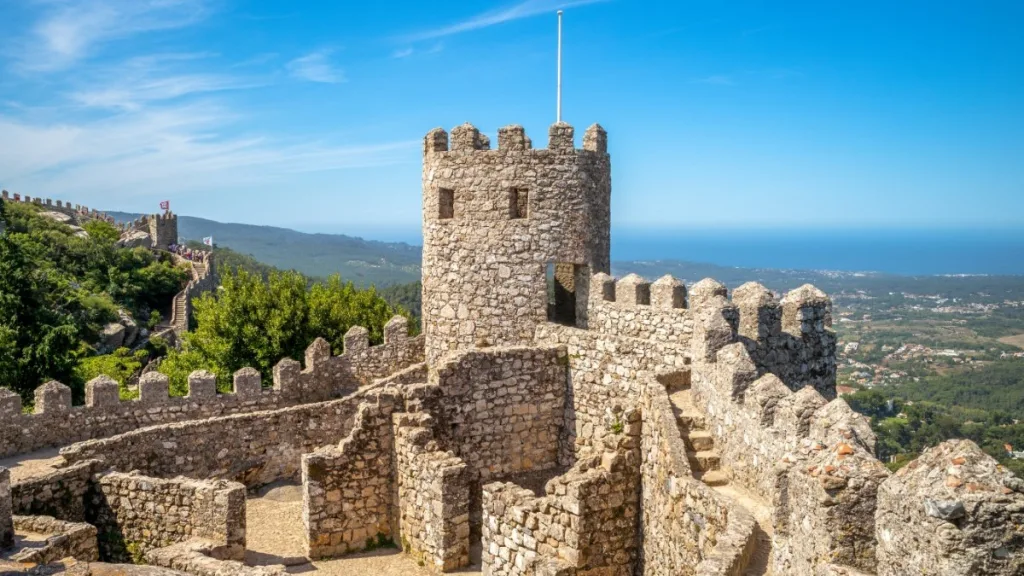
After the 15th century, the castle fell into progressive disrepair. The vegetation of the Serra de Sintra — dense forest sustained by the Atlantic microclimate — gradually reclaimed the walls. By the 18th century, the castle was largely ruined and overgrown.


Excavations begun in 1979 discovered the existence of medieval funerary tombs dating to the turn of the 13th century, providing evidence that the castle had a residential function in the decades following the Reconquista capture.


In the 19th century, King Ferdinand II — the same monarch who commissioned Pena Palace — undertook a partial restoration of the castle walls as part of his broader project to make the Sintra hilltop accessible and presentable. King Ferdinand II restored the castle in the 19th century — the same monarch who commissioned Pena Palace. Ferdinand appears to have had a strong preference for hilltop projects.


The castle is now managed by Parques de Sintra — Monte da Lua, the public company responsible for most of Sintra’s monuments.
Moorish Castle battlements above Sintra — built 8th–9th century, captured by Afonso Henriques in 1147, National Monument 1910

What to See at the Moorish Castle

I take clients to the Moorish Castle regularly, and the question I hear most often — usually asked from the second tower, looking across at Pena Palace — is: “Why didn’t we go there instead?”
The answer depends on what you are looking for.

The Castle Walls: 450 Metres of Ramparts

The main feature of the Moorish Castle is the parapet walk: 450 metres of walkable rampart connecting five towers along the Serra de Sintra ridge. The walk is fully accessible to visitors — there are handrails at the most exposed sections and the full circuit takes approximately 30–40 minutes at a leisurely pace.
The walls are original Moorish construction, though extensively restored. The granite masonry follows the natural contours of the hill, with sections that climb steeply between towers and sections that traverse exposed ridgeline. Footwear with grip is recommended; the stone is smooth and can be slippery when wet.
The castle walls face southwest and catch the Atlantic wind directly. In winter and on overcast days, they can be genuinely cold. A layer you did not think you needed in Lisbon that morning becomes relevant by the second tower.

The Towers: Five Viewpoints Along the Ridge

The five towers provide five different viewpoints across the Serra de Sintra, the Sintra coastline, and the interior. From different points along the parapet walk, the visible landmarks include:
  • Pena Palace (clearly visible from most of the rampart walk, 400 metres distant).
  • Sintra town and the National Palace chimneys.
  • Cabo da Roca on the coast (the westernmost point of continental Europe, on clear days).
  • The Atlantic to the west.
  • Cascais Bay to the south.

The Cistern and the Archaeological Site

Within the castle walls, a medieval cistern is visible — a water collection system that would have supplied the garrison. The cistern is original; its age spans the full period of the castle’s occupation.
The archaeological site where the 1979 excavations found 13th-century funerary tombs is also within the walls. The tombs date to the decades after the 1147 capture, indicating that the Portuguese garrison used the site for burials. The excavation area is visible but not accessible for close inspection.

Views from the Walls

The castle walls accessible without Pena Palace tickets create a category of visitor who comes for the view and discovers, somewhere between the third and fourth tower, that they are quite interested in medieval military architecture.
On clear days, the view from the castle walls is one of the most complete panoramas available in the Sintra region. The Pena Palace view is more photographed; the Moorish Castle view is wider.
Moorish Castle Views

Moorish Castle or Pena Palace: Which Should You Choose?

This is a question that comes up on almost every Sintra tour, usually about 20 minutes after arrival.

The Moorish Castle dates back to the 8th–9th century in its original construction, while the Pena Palace was built between 1842–1854, although its site originally housed a monastery from 1503. In terms of tickets, the Moorish Castle costs around €12 for adults, whereas Pena Palace is about €20 for the combined Palace and Park access.

Time-wise, the Moorish Castle typically requires 1–1.5 hours to visit, while Pena Palace needs around 2.5–3 hours if you include both the palace interiors and terraces. Crowd levels differ significantly: the Moorish Castle is usually quiet, while Pena Palace is very crowded, especially between 10:30 and 14:00.

The experiences are quite different. The Moorish Castle is entirely open-air, offering ancient defensive walls and panoramic views, but no interiors. Pena Palace, on the other hand, includes fully furnished royal state rooms and a strong architectural identity with its colourful exterior.

In terms of suitability, the Moorish Castle is best for those interested in military history, hiking, and panoramic viewpoints, while Pena Palace is better for architecture, royal history, and interior exploration. The Moorish Castle involves moderate physical effort with steep and exposed sections, whereas Pena Palace is less demanding thanks to maintained paths and shuttle access.

Booking requirements also differ: the Moorish Castle can generally be visited without advance booking, while Pena Palace requires advance reservation for interior entry.

The practical recommendation is straightforward. If you only have one day in Sintra and must choose one site, Pena Palace is usually the more complete experience due to its interiors, layered history, and visual impact. It is best to book the 09:30 interior time slot in advance to avoid peak crowds.

If you want to see both, a common itinerary is to start with Quinta da Regaleira around 09:30, have lunch in Sintra town, and then take Bus 434 to the Moorish Castle and Pena Palace in the afternoon. The two sites are connected by a 15-minute walking path through the park, so it’s possible to walk between them. From Pena Palace, you can take Bus 434 back down to Sintra station.

If you prefer fewer crowds and are more interested in military history than royal interiors, then the Moorish Castle is the better choice.

For a more detailed breakdown of Pena Palace, including its history, interior rooms, and strategies to avoid peak visitor times, refer to the Pena Palace visitor guide.

sintra pena palace

Practical Information

Tickets and Opening Hours

Ticket prices (2026):
Adult tickets (18–64) cost €12. Youth tickets (6–17) are €10, and senior tickets (65+) are also €10. A family ticket (2 adults + 2 youths) is €33. Check at parquesdesintra.pt.

Opening hours:
The site is open daily from 09:30 to 18:00, with last entry at 17:30 throughout the year.

Please note that the ticket office is closed between 12:00 and 13:00, although automatic vending machines remain available during this time. The castle is closed on December 25 and January 1. Seasonal variations may apply, so it is recommended to confirm current hours on parquesdesintra.pt.

Walk-up tickets are generally available, meaning advance booking is not mandatory. However, during peak season (especially weekends between April and October), advance booking is strongly recommended to avoid queues and ensure entry.

Getting There from Sintra Town

Bus 434 (Carris Metropolitana): Runs from Sintra station → Historic Centre → Moorish Castle → Pena Palace. The Moorish Castle stop is before Pena Palace on the route. Journey from Sintra station to castle: approximately 10–12 minutes. Verify Bus 434 stop name for Moorish Castle at carrismetropolitana.pt.

On foot from Sintra town: approximately 2 km uphill (30–40 minutes). The path passes through the Sintra National Park forest. Possible and pleasant in mild weather.

Walking from Pena Palace: a footpath connects Pena Palace to the Moorish Castle within the park — approximately 15 minutes. If visiting both, the most efficient sequence is: Moorish Castle first (Bus 434 or on foot), then walk to Pena Palace, then Bus 434 back to Sintra station.

Private cars: prohibited on the road leading to the castle. Use Bus 434 or park at Sintra town and walk.

How Long to Allow

1 to 1.5 hours covers the full parapet walk, all five towers, and the cistern and archaeological area. Allow 15 extra minutes if walking between the Moorish Castle and Pena Palace rather than taking Bus 434.

Physical Difficulty: What to Expect

The parapet walk is moderately demanding: the path from the castle entrance to the first tower involves a steep 5–8 minute uphill climb on irregular stone steps. The rampart itself is generally level between towers but has short steep sections where it rises to each tower.

Recommended: closed shoes with grip (not sandals). The castle walls can be windy and exposed. The full walk is approximately 450 metres at 471 metres elevation.

Not recommended for: visitors with significant mobility limitations (the uphill approach and tower steps are not wheelchair-accessible). Young children can manage the walk with adult assistance; allow extra time.

Visiting as Part of a Sintra Day Trip from Lisbon

The Moorish Castle is included in our Sintra day tours as an optional stop — its position between the Sintra town and Pena Palace on Bus 434 makes it a natural addition to any itinerary that includes Pena Palace.
For a broader overview of Sintra’s attractions, see Things to Do in Sintra.

FAQ

The Moorish Castle was built by Moorish forces — North African Berber and Arab populations who occupied the Iberian Peninsula after 711 AD — during the 8th and 9th centuries. The construction used local granite from the Serra de Sintra. It was captured by Afonso I of Portugal (Afonso Henriques) in 1147 during the same military campaign that took Lisbon.
The castle was built in the 8th and 9th centuries during the period of Moorish occupation of the Iberian Peninsula. Exact construction dates have not been established through historical records — the 8th-9th century range comes from archaeological and historical research. King Ferdinand II undertook a partial restoration of the structure in the 19th century.
The castle walls extend approximately 450 metres along the Serra de Sintra ridge, connecting five towers. The full parapet walk — from the entrance to the furthest tower and back — covers approximately 450 metres and takes 30–40 minutes at a normal pace.
Yes. The full parapet walk is accessible to visitors included in the standard €12 adult admission ticket. Handrails are in place at the most exposed sections. The walk requires moderate fitness — the approach from the entrance involves a steep uphill path, and short steep sections exist between towers. Footwear with grip is recommended.
Adult entry (18-64) costs €12. Youth (6-17) and seniors (65+) pay €10. A family ticket (2 adults + 2 youth) costs €33. Tickets are available at the gate without advance booking, though weekend booking is recommended in peak season. Verify prices at parquesdesintra.pt.
Yes, particularly for visitors interested in medieval military architecture, Sintra’s pre-Portuguese history, or panoramic views. It receives significantly fewer visitors than Pena Palace, making the experience less congested. The ticket price (€12) is lower than Pena Palace (€20). It is not suitable for visitors expecting a furnished palace interior — it is an open-air fortification.
Yes. A walking path of approximately 15 minutes connects the Moorish Castle to Pena Palace within the park. The most efficient sequence: take Bus 434 from Sintra station to the Moorish Castle stop (10-12 min), visit the castle (1-1.5 hours), walk to Pena Palace (15 min), visit Pena Palace and park (2.5 hours), take Bus 434 back to Sintra station.
Bus 434 (Carris Metropolitana) runs from Sintra station through the historic centre to the Moorish Castle and on to Pena Palace. Journey time from Sintra station to the Moorish Castle stop: approximately 10-12 minutes. On foot from Sintra town: approximately 2 km uphill, 30-40 minutes. Private cars are prohibited on the road leading to the castle.
Moderately. The approach from the castle entrance to the first tower involves a steep 5-8 minute uphill climb on irregular stone steps. The rampart walk between towers is generally level with short steep sections. The full walk covers approximately 450 metres at 471 metres elevation and takes 30-40 minutes. Suitable for visitors in normal fitness; not wheelchair-accessible. Carry water and wear closed shoes with grip.
The Moorish Castle (8th-9th century) is an open-air military fortification with 450 metres of walkable ramparts and no indoor spaces. Ticket: €12 adult. Pena Palace (1842-1854) is a royal palace with furnished state rooms, preserved interiors, and a 200-hectare park. Ticket: €20 adult, interior requires advance timed-entry booking. The Moorish Castle has fewer visitors and lower physical barriers; Pena Palace offers a more complete architectural and historical experience.
Fábio Mendes - Founder and CEO at Yellow Cab TT Tours - author
Written by Fábio Mendes
Founder & Director of Yellow Cab TT Tours. Guiding in Portugal for 20+ years.
Founded Yellow Cab TT Tours in 2013. 3,372 five-star reviews on Tripadvisor.
Facebook
X
LinkedIn
Facebook
X
LinkedIn