
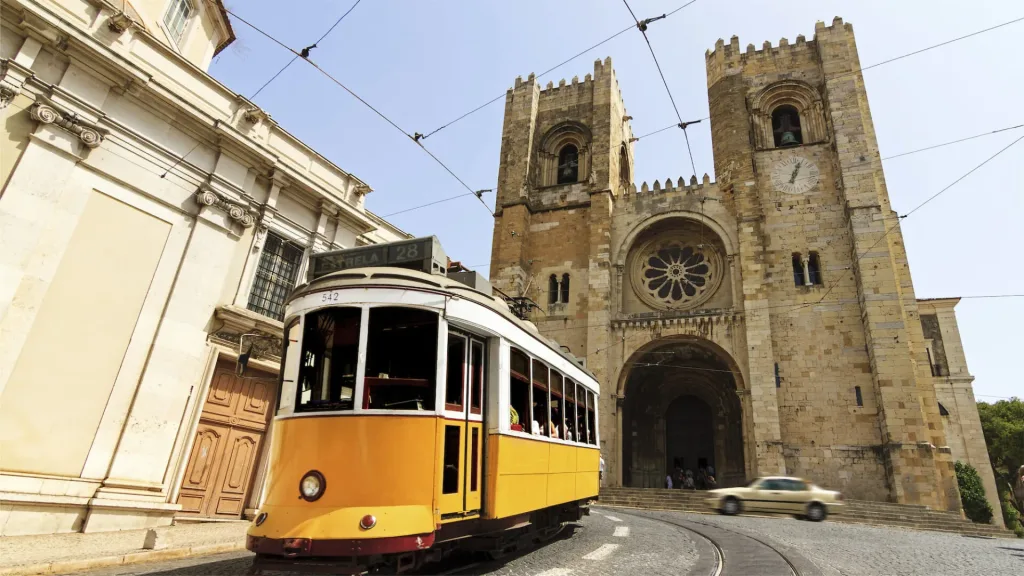

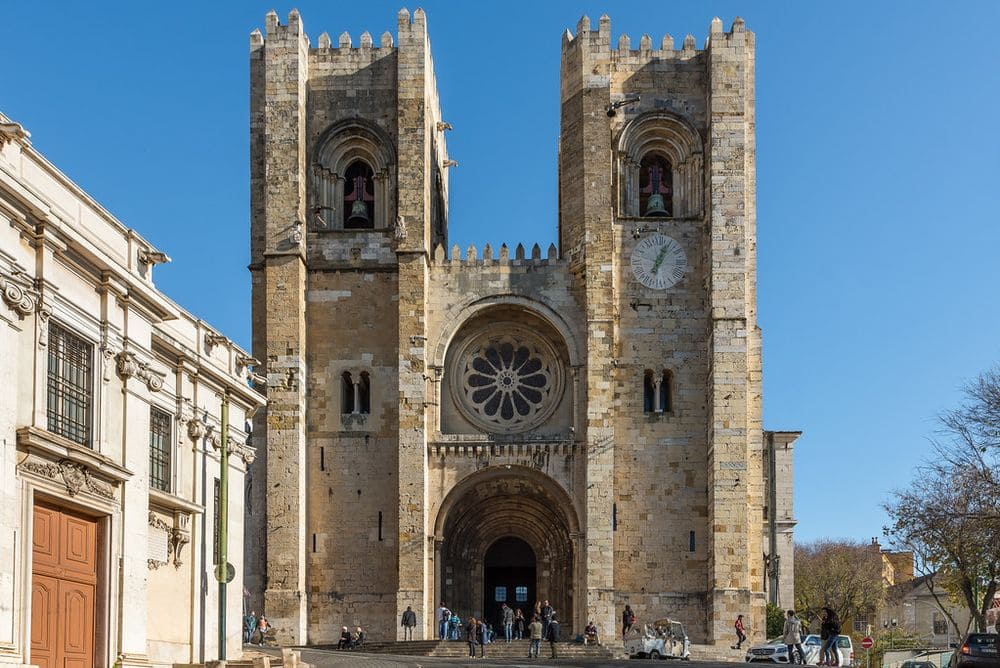
Lisbon Cathedral looks like a fortress because, for practical purposes, it was one. Construction started in 1147, within a handful of years of the Christian reconquest of Lisbon from Moorish rule, and the building that resulted has crenellated towers flanking its west front instead of the delicate stonework most people expect from a cathedral. That’s not a stylistic choice. A city that had just changed hands by siege builds its new cathedral to double as a strongpoint.
The building has been rebuilt, part-collapsed, and rebuilt again more times than most Lisbon landmarks. The 1755 earthquake brought down a tower and destroyed a royal burial chapel that had stood for four centuries. Two of its stories get repeated constantly and rarely get combined: the legend of the ravens that supposedly guarded a saint’s relics on the boat trip here in 1173 — and still show up on Lisbon’s coat of arms today — and the fact that one of Catholicism’s most recognisable saints was baptised at the font just inside the door.
Here’s what the building actually is, what the 1755 earthquake did and didn’t destroy, and what it costs to get inside in 2026 — a number that, oddly, several tourist websites still get wrong.
Why Lisbon’s Cathedral Looks Like a Fortress
Lisbon was captured from Moorish rule in 1147 during the Second Crusade, when Portuguese forces under King Afonso Henriques joined northern European crusaders who had stopped in the city on their way to the Holy Land. Shortly after the conquest, Gilbert of Hastings, an English crusader, became Lisbon’s first bishop, and construction of a new cathedral began almost immediately on the site of the city’s principal mosque—a pattern repeated in many Iberian cities following the Reconquista.
Gilbert remained bishop until his death in 1166 and was buried inside the cathedral whose construction he had helped initiate. His original tomb, however, has not survived—a fate shared by many medieval burials in buildings that have undergone centuries of rebuilding.
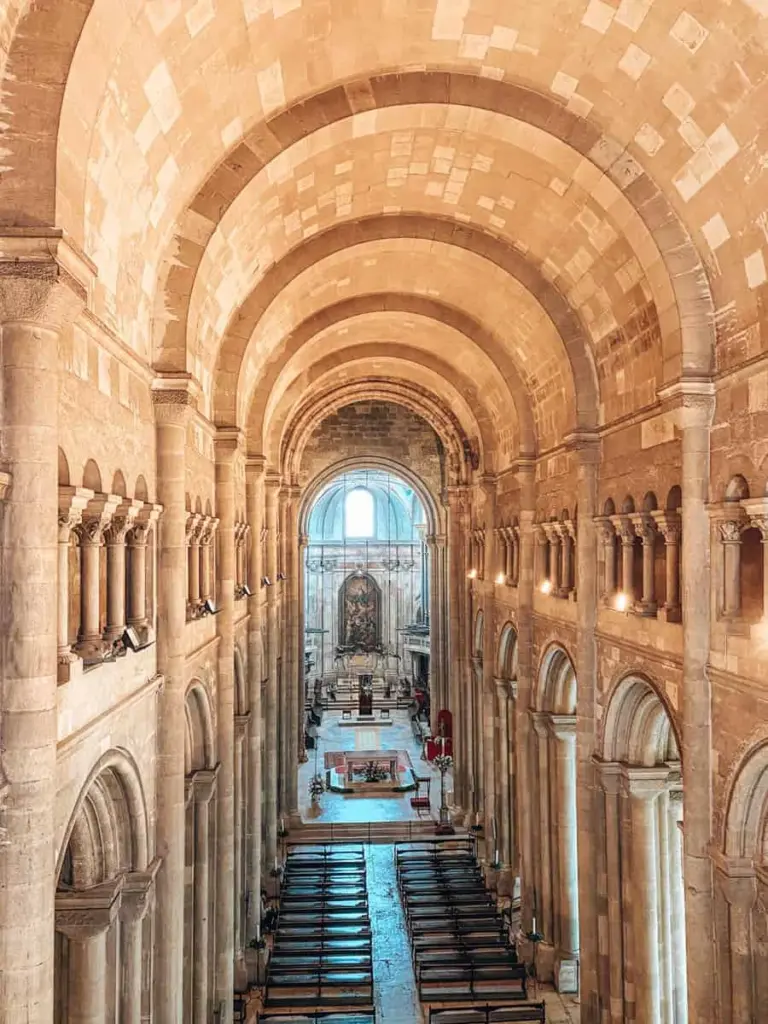
The cathedral was designed by Mestre Roberto, a French architect believed to have been of Norman origin, who also worked on the Cathedral of Coimbra. The similarities between the two buildings are unmistakable. Built in the Late Romanesque style, the cathedral follows a Latin cross plan with three naves, a triforium gallery above the side aisles, and a three-part apse. Most of the structure was completed by the early 13th century.
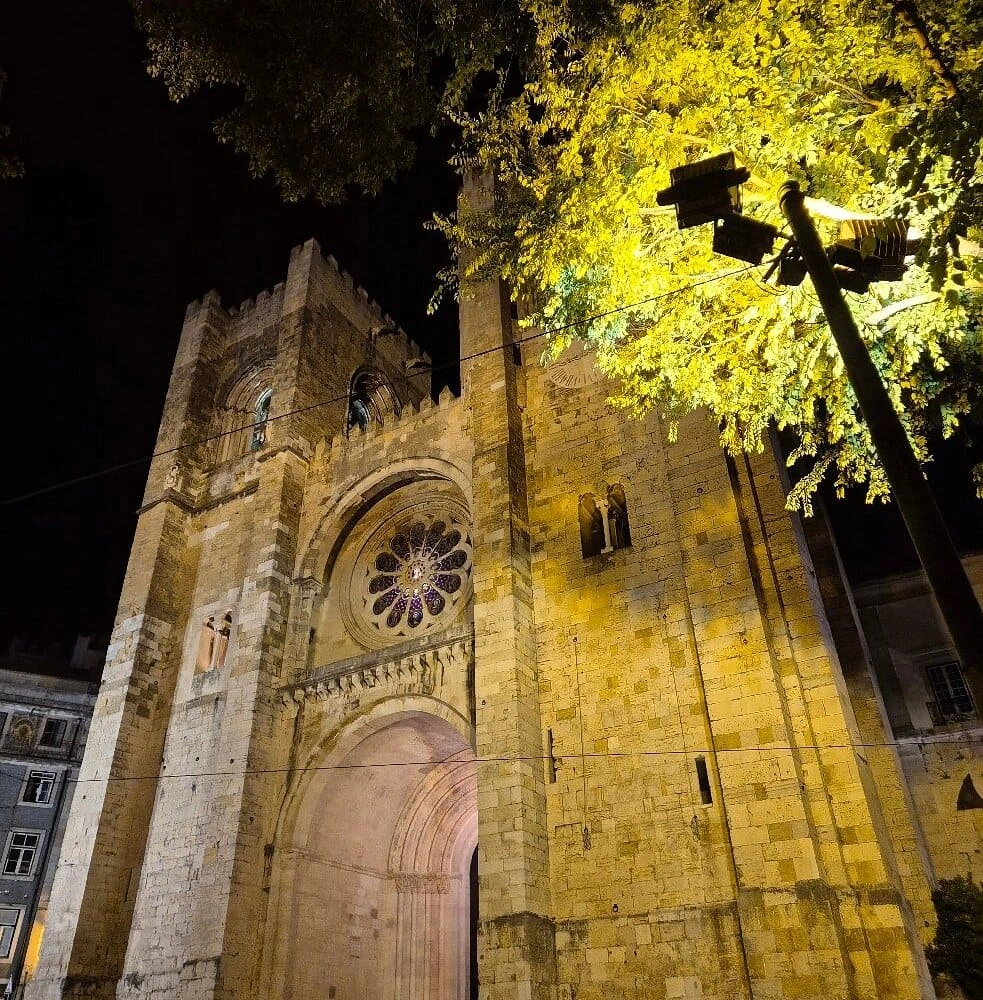
Its most striking feature is the west façade. The twin towers, massive stone walls, and crenellated parapet are not decorative references to military architecture—they are military architecture. The cathedral was built in a city that had only just changed political and religious control through warfare, and it was designed to serve as both a place of worship and a defensive stronghold if necessary.
I always point out the towers first. Many visitors arrive expecting the soaring Gothic elegance of other European cathedrals. Instead, Lisbon Cathedral looks remarkably like a fortified castle gate with a church attached. That impression is entirely accurate. It was built that way on purpose.
The Cloister, the Pantheon, and What’s Buried Underneath
The cathedral’s Gothic cloister was added in the late 13th century during the reign of King Dinis (1279–1325). The timing is worth noting because some guidebooks incorrectly date its construction to around 1261—almost two decades before Dinis became king.
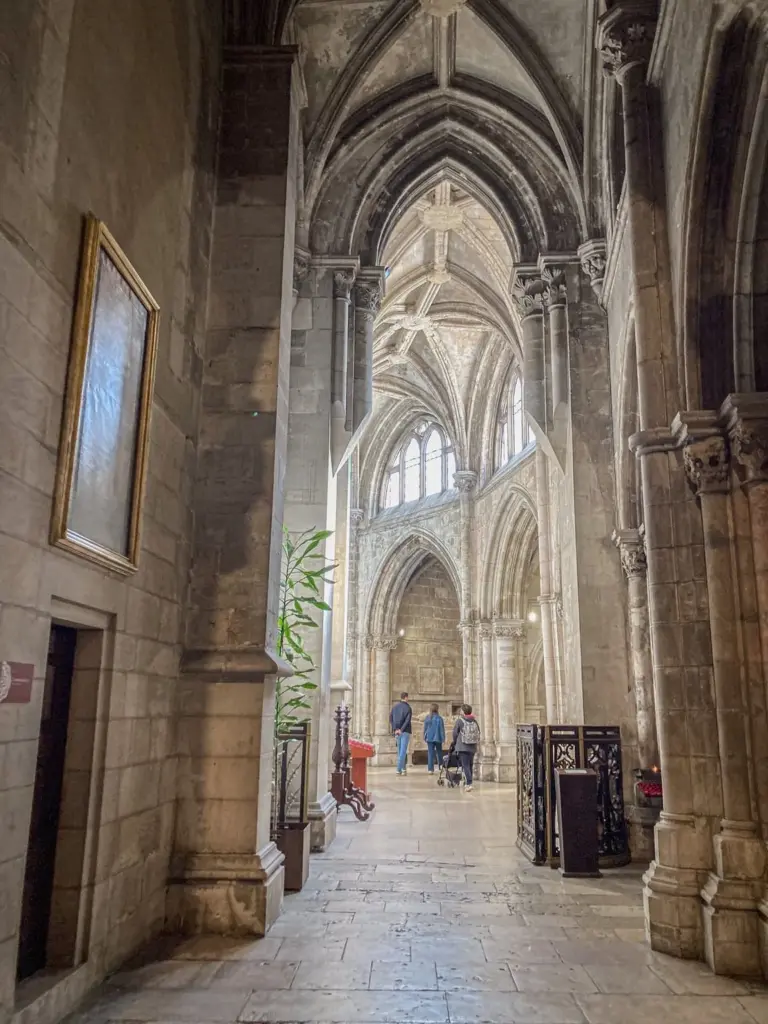
A generation later, King Afonso IV (1325–1357) commissioned a Gothic ambulatory around the main chapel. It served two purposes: allowing pilgrims to circulate around the relics of Saint Vincent of Saragossa and creating a royal pantheon for members of the Portuguese monarchy. It remains the only Gothic ambulatory of its kind in a Portuguese cathedral.
The 1755 Lisbon earthquake caused extensive damage to much of this medieval complex, but later archaeological excavations beneath the cloister revealed something even older. Below the present floor lie the remains of successive Roman, Visigothic, and Moorish structures, each built directly on top of the previous settlement.
Standing in the cloister today means looking through nearly three thousand years of continuous occupation. Few places in Lisbon illustrate the city’s layered history more clearly, with each civilisation quite literally constructing its future on the foundations of the one before.
The Ravens That Guarded a Saint
In 1173, King Afonso Henriques ordered the relics of Saint Vincent of Saragossa, a 4th-century Christian martyr, to be transferred from the Algarve to Lisbon. According to tradition, two ravens accompanied the ship throughout the journey. The legend tells that the birds had first guarded the saint’s body from scavengers after his martyrdom and continued their vigil as his relics travelled north to their new home.
The relics were eventually placed in the cathedral, where the Gothic ambulatory was later built to accommodate the growing number of pilgrims who came to venerate them.
The ravens became permanently associated with Lisbon itself. A ship flanked by two ravens still appears on the city’s official coat of arms, preserving the legend centuries after the events it commemorates. Even more remarkably, ravens were reportedly seen nesting around the cathedral towers until 1978, giving the story an unusually long connection to the site.
Although Saint Anthony is the figure most visitors associate with Lisbon today, Saint Vincent is the city’s original patron saint. His connection to Lisbon predates Saint Anthony’s popular devotion by centuries and remains embedded in the city’s symbols and history.
The Saint Baptised a Few Steps from the Door
Fernando Martins de Bulhões, the man the world now knows as Saint Anthony of Padua, was born in Lisbon on 15 August 1195 and baptised in Lisbon Cathedral, which by then had already stood for nearly fifty years.
He later joined the Franciscan Order, travelled to Italy, and eventually settled in Padua, where his preaching earned him recognition as one of the Catholic Church’s most revered saints. Although internationally known as Saint Anthony of Padua, he was, by birth, a Lisboeta.
Near the left side of the cathedral’s main entrance is the baptismal font traditionally associated with his baptism. The alcove is decorated with the blue-and-white azulejo tiles characteristic of later Portuguese church interiors—decoration added centuries after Saint Anthony’s lifetime, as azulejos were not yet a feature of Portuguese churches in the late 12th century.
Whether the stone font itself is the original one used in 1195 or a later replacement marking the traditional location remains uncertain. What is historically documented is the site of the baptism, and that is what the cathedral commemorates today.

What the 1755 Earthquake Actually Destroyed
The Great Lisbon Earthquake of 1 November 1755 caused severe damage to the cathedral. The south tower collapsed, the Gothic chancel and King Afonso IV’s royal pantheon were destroyed, and the roof over the nave gave way, taking several side chapels with it. Fires that swept through Lisbon after the earthquake caused additional destruction.
Reconstruction took place over several decades. The chancel was rebuilt between 1761 and 1785, while much of the remaining structural damage—including the collapsed tower—was repaired between 1769 and 1771 in the Baroque style that dominated 18th-century architecture.
That Baroque appearance, however, was largely temporary. In the early 20th century, architects Augusto Fuschini and António do Couto Abreu led an extensive restoration that removed most of the Baroque additions in an effort to recover the cathedral’s original Romanesque and Gothic character.
The rose window visible today was reconstructed during the 1930s using surviving fragments of the medieval original and depicts Christ surrounded by the Twelve Apostles. The restoration was completed in time for the cathedral’s reopening in 1940, although it had already been designated a National Monument in 1910.
The building visitors see today is therefore not a perfectly preserved medieval cathedral. It is the result of two major transformations: first rebuilt after the earthquake in the Baroque style, and later restored by deliberately removing much of that Baroque work to recover its medieval appearance.
Tickets and What You Actually See in 2026
Several travel websites still list outdated admission prices for Lisbon Cathedral. According to the cathedral’s official ticket information, the current adult ticket is €7, including access to the High Choir, the Cathedral Treasury Museum, and the cathedral’s interior, including the naves and ambulatory. Children aged 7–12 pay €5, while children under 6 enter free of charge.
Opening hours:
- June–October: Monday–Saturday, 09:30–19:00
- November–May: Monday–Saturday, 10:00–18:00
- Closed: Sundays and religious holidays
While the paid areas follow these opening hours, the nave remains open for prayer outside ticketed visiting times. The High Choir, Treasury Museum, and cloister, however, require an admission ticket during visiting hours.
Lisbon Cathedral is first and foremost an active place of worship rather than a museum. Visitors are expected to dress respectfully, with shoulders and knees covered.
The cathedral is located directly on Tram 28‘s route at the Sé stop, where the historic districts of Alfama and Baixa meet, making it one of the easiest landmarks in the city to combine with a walking itinerary through Lisbon’s historic centre.
Visit Lisbon Cathedral with a Private Guide
Lisbon Cathedral sits exactly where Alfama meets Baixa — one of the natural pivot points on a private Lisbon city day, connecting the cathedral, the Alfama viewpoints, and the Baixa grid without backtracking.
Private Lisbon City Tour → Alfama, Baixa, Chiado and the miradouros in one planned route, hotel pickup included.
FAQ
How much does it cost to visit Lisbon Cathedral?
When was Lisbon Cathedral built?
Why does Lisbon Cathedral look like a fortress?
What happened to Lisbon Cathedral in the 1755 earthquake?
What is the raven legend connected to Lisbon Cathedral?
Is Saint Anthony connected to Lisbon Cathedral?
What architectural styles does Lisbon Cathedral combine?
When was the Gothic cloister built?
How do I get to Lisbon Cathedral?
Is Lisbon Cathedral worth visiting?

Founder & Director of Yellow Cab TT Tours. Guiding in Portugal for 20+ years.
Founded Yellow Cab TT Tours in 2013. 3,372 five-star reviews on Tripadvisor.