
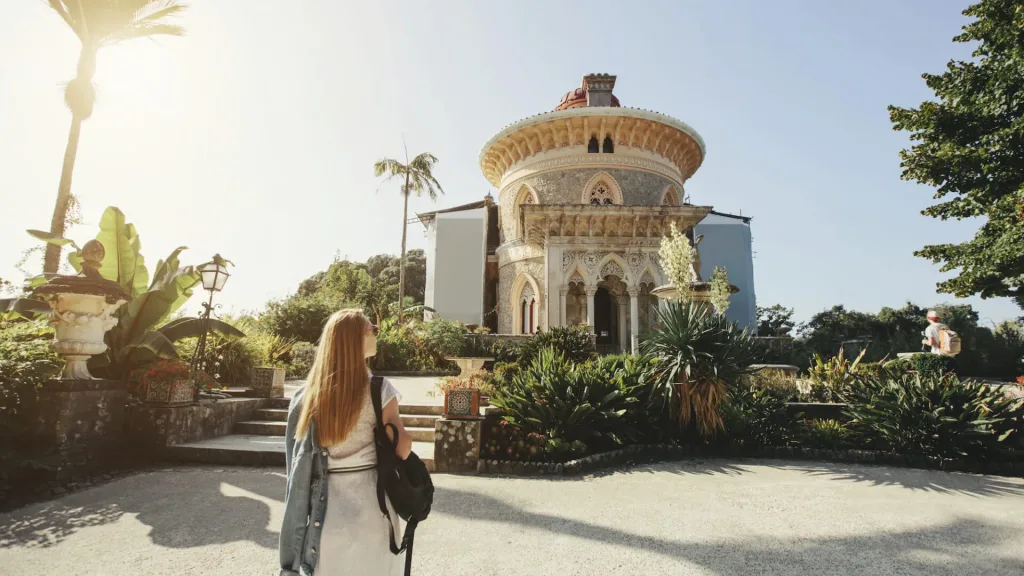

History
William Beckford and the First Monserrate (1793–1799)
The site at Monserrate has a history of English occupation before Francis Cook. William Beckford (1760–1844) rented the quinta in 1793 and remained there until approximately 1799. Beckford was an English writer — author of the Gothic novel *Vathek* (1786), written in French in three days according to his own account — and heir to one of the largest fortunes in England, built on Caribbean sugar plantations.
He had left England in 1783 under the weight of a scandal involving his relationship with William Courtenay, the young 10th Earl of Devon. The scandal had permanently closed English society to him. He settled at Fonthill Abbey in Wiltshire for some years, then moved to Portugal. He rented Monserrate, had a temporary structure built on the site, and spent six years developing gardens he described in his memoirs as among the finest he had encountered. Lord Byron visited Sintra in 1809 and mentioned the gardens — by then overgrown after Beckford’s departure — in Childe Harold’s Pilgrimage (1812).
Beckford left; the quinta reverted to its previous condition. Francis Cook purchased it in 1856.
Francis Cook and the
Current Palace (1856–1865)
Francis Cook (1817–1901) was an English textile merchant who became one of the wealthiest men in Victorian England and one of the major private art collectors of the 19th century. He purchased the Monserrate estate in 1856 and immediately commissioned an architect to replace the temporary Beckford-era structure with a permanent palace.
The architect was James Thomas Knowles (1831–1908), a London-based architect whose other works included The Grosvenor Hotel in London. Cook gave Knowles an unusual brief: design a palace that combined Gothic, Moorish, and Indian elements in a coherent architectural whole. Construction ran from 1858 to 1865.
Cook was later created 1st Viscount Monserrate — the Portuguese title was granted in recognition of his investment in the estate. He continued developing the gardens throughout the second half of the 19th century, importing plant species from across the British Empire, South America, and Asia.
The Architecture
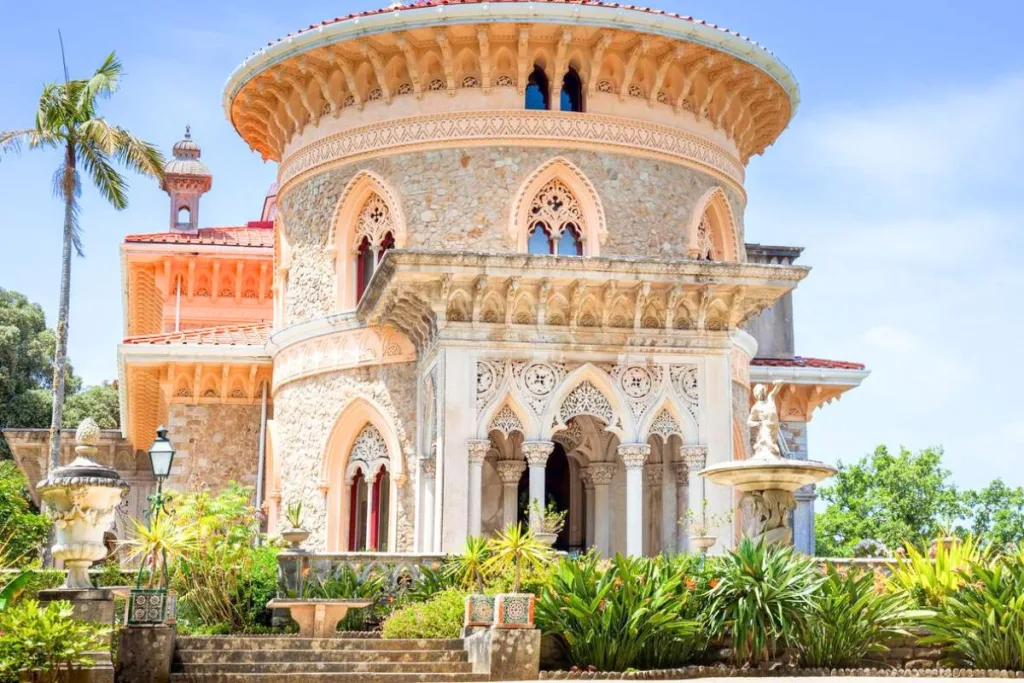
The three-dome facade of Monserrate Palace is the result of a deliberate architectural brief: combine neo-Gothic (lancet arches, tracery, stone carved ornament), neo-Moorish (horseshoe arches, geometric latticework, tilework panels), and Mughal Indian elements (bulbous carved stone domes, decorative stucco derived from Mughal tomb and mosque design).
The architectural style is a deliberate combination of three traditions with no natural connection to each other. The architect was a Londoner. The client was an English textile merchant. The result is a palace in Portugal that looks like nothing else in Portugal.
The central dome is the largest, flanked by two smaller domes. Carved stone panels cover the exterior walls in a pattern that shifts between Gothic tracery (upper sections) and Moorish geometric lattice (lower sections). At close range — standing directly in front of the entrance — the carved detail is dense enough to require sustained attention. The facade is most effectively viewed from the grassed lawn below the palace, at a distance of 50–60 metres, where all three domes are simultaneously visible and the proportions of the building are clear.
The interior contains a Manueline Cloister (a surviving fragment of the Beckford-era structure, rebuilt), several reception rooms with intact 19th-century decoration, and the Queen’s Terrace — a first-floor balcony with views across the Sintra park to the Atlantic. Interior visit: 15–30 minutes without queue; up to 45 minutes when busy.
2026 notice: Roof restoration is under way until approximately Q1 2027. Scaffolding covers part of the facade. The interior and gardens are fully accessible. For exterior photography, use the grassed lawn at approximately 50 metres — from this angle, the scaffolding is partially hidden by the facade’s projecting elements.
I take groups to Monserrate specifically because it is the Sintra palace that surprises people most. The most frequent question: “Why isn’t this more famous?” The answer is partly photographic — the building is pale stone rather than the Pena Palace’s yellow and red, and photographs less dramatically in standard travel content.
What You Can See Inside
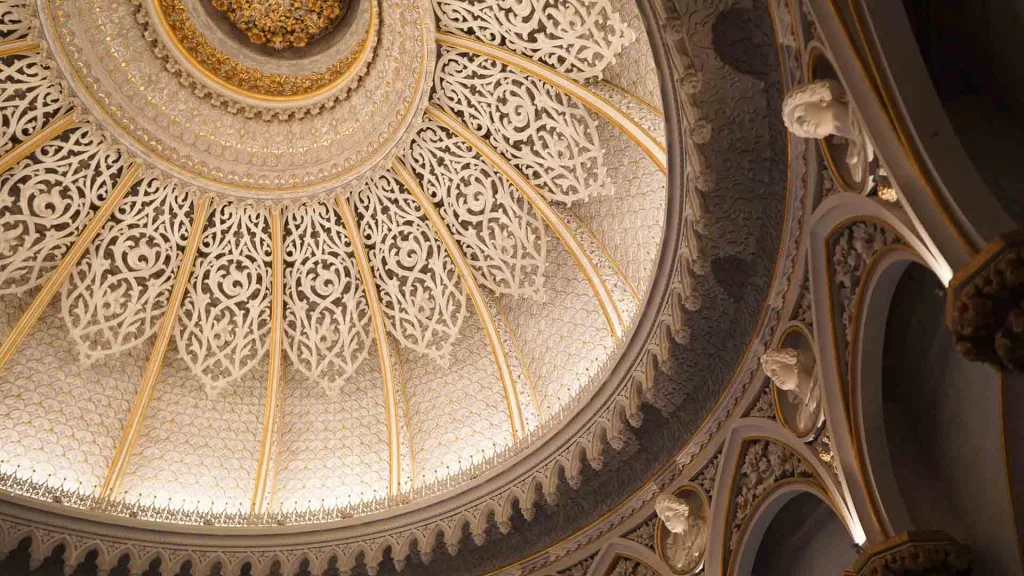
The palace interior tour follows a circuit of the main rooms, lasting 15 to 30 minutes at a normal pace:
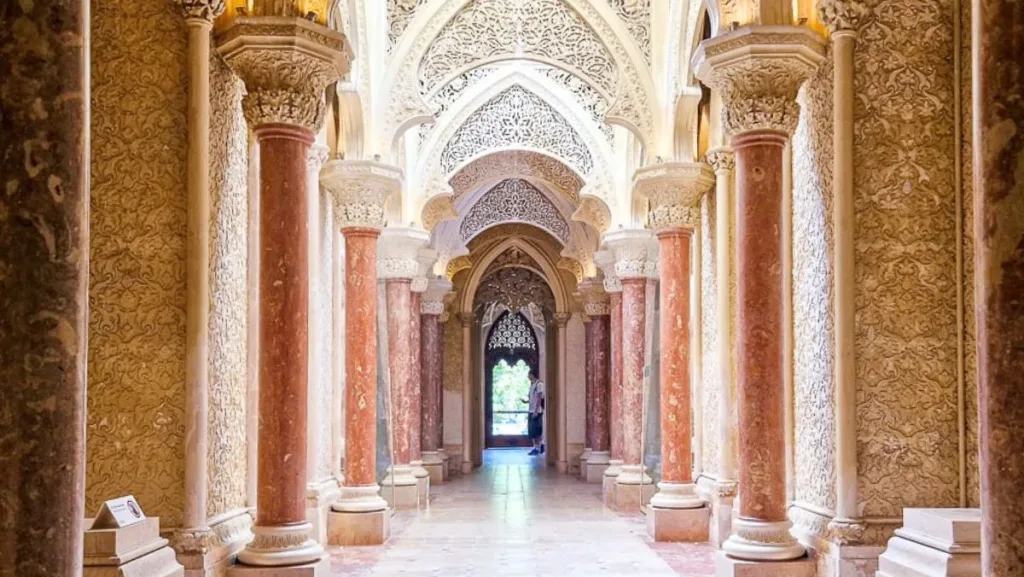
Manueline Cloister: a Gothic-style courtyard with carved stone arches, partly rebuilt from the Beckford era.
Reception rooms: 19th-century decoration with Moorish-patterned tile dados and plaster ceilings; the scale is modest compared to Pena Palace or the National Palace.
Queen’s Terrace: first-floor balcony with direct views across the park canopy to the hills of the Serra de Sintra and — on clear days — the Atlantic.
The interior is worth seeing but is not the primary reason to visit Monserrate. The architecture and gardens are the argument for making the journey from Sintra town.
The Gardens
The Monserrate park covers approximately 30 hectares and contains more than 3,000 exotic plant species collected between the 1850s and early 20th century. Francis Cook and his botanical consultants imported species from South America, the Himalayas, China, Japan, Mexico, Australia, and southern Africa, exploiting the Serra de Sintra’s unusually wet Atlantic microclimate to sustain plants that would not survive elsewhere in Portugal.
Mexican garden: palms, yuccas, agaves, and succulent species, concentrated in the lower section of the park near the entrance.
Japanese garden: bamboo, camellias (among the largest camellia collections in Portugal), and Himalayan rhododendrons that flower in March and April.
Fernery: the lower garden contains a Victorian-era fern collection — Chinese weeping cypress, tree ferns, and species collected from across the Pacific. The fernery is one of the most complete 19th-century fern collections remaining in Portugal.
Romantic ruin: a partially preserved Gothic chapel ruin, constructed as a deliberate “picturesque ruin” in the Romantic tradition — built to look like it had been there for centuries.
The gardens are generally navigated freely without a fixed route. Allow 60–90 minutes if you want to cover the main sections. In spring (March–May), the camellia and rhododendron flowering is the park’s visual peak.

Practical Information
Getting there: Bus 435 (Carris Metropolitana) from Sintra station — approximately 15 minutes. Verify current Bus 435 schedule at carrismetropolitana.pt before travelling; bus frequency is lower than Bus 434 to Pena Palace.
Alternatively: taxi or Uber from Sintra town centre (approximately 10-minute drive). Walking from Sintra town: approximately 50-60 minutes uphill.
Parking: available at the palace entrance for visitors arriving by car.
Tickets: purchased at the entrance. No advance booking required. The park ticket includes both gardens and palace interior.
Combination visits: Monserrate is best visited on its own or combined with the National Palace of Sintra (10 minutes from the station) on a day when you want to avoid Pena Palace crowds. The Moorish Castle and Monserrate are difficult to combine in one day by public transport; a private vehicle or tour is more efficient for that combination.
For all transport options from Lisbon: How to Get from Lisbon to Sintra.
Our Sintra Tours




Private Sintra Photo Panoramic 4x4 Tour (Land Rover)

FAQ
How much does Monserrate Palace cost?
How do I get to Monserrate Palace from Sintra?
Is Monserrate Palace open in 2026?
Who built Monserrate Palace?
How many visitors does Monserrate Palace receive?
How long should I spend at Monserrate Palace?
Is Monserrate Palace worth visiting?

Founder & Director of Yellow Cab TT Tours. Guiding in Portugal for 20+ years.
Founded Yellow Cab TT Tours in 2013. 3,372 five-star reviews on Tripadvisor.