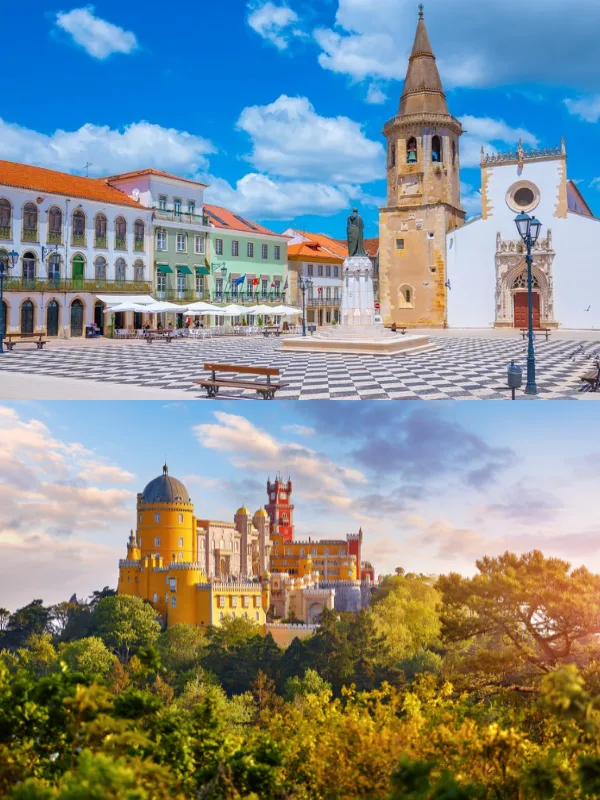
Lisbon to Tomar Day Trip: Convent of Christ & City Highlights (Private, Full Day)
- Private vehicle and local driver-guide exclusively for your group (up to 8 people).


8 Hours
Private
Max. 8px/Van
Hotel or apartment pickup in Lisbon, Sintra, Cascais, Estoril, or anywhere along the coast
Tomar, Convent of Christ, Lisbon, Downtown
From €350 per private vehicle (see pricing below)

Tour at a Glance
- Duration: 8 hours.
- Departure: Suggested 08:30–09:00 – hotel or apartment pickup in Lisbon, Sintra, Cascais, Estoril, or anywhere along the coast.
- Return: ~17:00–17:30 to your pickup location.
- Tour Type: 100% private — your group only.
- Group Size: Up to 8 passengers.
- Vehicle: Air-conditioned private van.
- Guide: Driver-guide available in English, Spanish, French, and Portuguese.
- Destinations: Tomar and Lisbon city highlights.
- Price From: €350 per vehicle.
- Tripadvisor Rating: 5.0/5 based on 3,387 reviews.
- License: RNAAT 119/2013.
- Cancellation Policy: Free cancellation up to 24 hours before departure.
Tour Overview
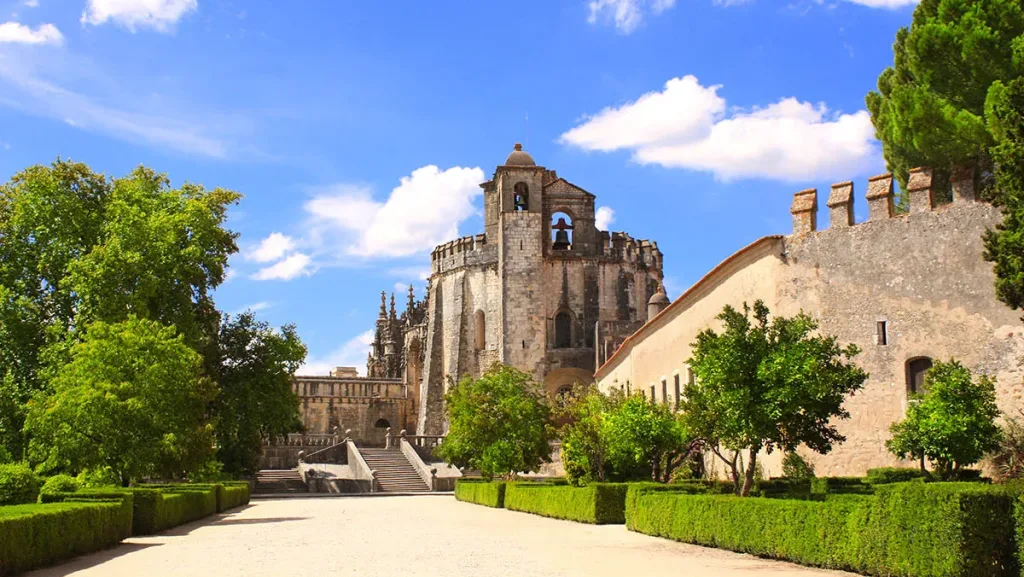
This Lisbon to Tomar day trip covers two UNESCO World Heritage Sites in a single 8-hour private tour: Tomar’s Convent of Christ founded by the Knights Templar in 1160, UNESCO-listed since 1983 – followed by Lisbon’s principal historic districts, monuments, and viewpoints in the afternoon.Tomar is 136 km north of Lisbon, approximately 90 minutes by road via the A1 motorway. The Convent of Christ stands on a hilltop above the town within the original 12th-century Templar castle enclosure. The complex spans nine centuries of Portuguese history, from the Templar military order through the Order of Christ that succeeded it in 1319, to the Manueline architectural additions of the early 16th century commissioned under King Manuel I.The Lisbon portion covers the Alfama district (Moorish origins, 8th–9th century), the Graça and Senhora do Monte viewpoints above the city, São Jorge Castle, the historic downtown rebuilt after the 1755 earthquake, and the Belém riverfront – where the Jerónimos Monastery (built 1502, UNESCO 1983) and Belém Tower (built 1514–1519, UNESCO 1983) mark the departure point of Vasco da Gama’s fleet to India in 1497. The 25 de Abril Bridge – completed 1966, main span 1,013 m, suspended 70 m above the Tagus — is visible at multiple points along the riverside route.This tour is 100% private: your group, your vehicle, your licensed driver-guide, your pace. It differs from the Tomar, Almourol & Santarém Tour – that itinerary focuses entirely on the Tomar area and does not include Lisbon city highlights.
Why Travellers Choose This Tour
- 3,387 verified reviews · 5.0 Tripadvisor -Travelers’ Choice Best of the Best 2025; highest-rated private tour operator from Lisbon on the platform.
- Only private tour that combines Tomar and Lisbon in one day – no other operator offers the Convent of Christ (UNESCO 1983, Knights Templar 1160) followed by Alfama, Belém, and the Lisbon monument circuit in a single private vehicle booking. The 136 km between Tomar and Lisbon is the return drive – the Lisbon afternoon uses time that would otherwise be motorway.
- RNAAT licence 119/2013. Languages: EN, ES, FR, PT. Operating since 2013.
Tips for This Tour
The Convent is free on Sundays and bank holidays until 14:00. Entry is waived until 14:00 on Sundays and Portuguese national holidays. A Sunday departure at 08:30 reaches the Convent well before 14:00 cut-off. Trade-off: higher Sunday visitor numbers. The guide will advise on the day.
Wear closed-toe shoes for the full day. The Convent involves stone staircases between 8 cloisters and uneven surfaces throughout. The Tomar town walk is on cobblestones. Alfama in the afternoon includes short walks on steep, narrow streets. Sandals are a persistent source of regret at the Convent cloisters.
What You Can See
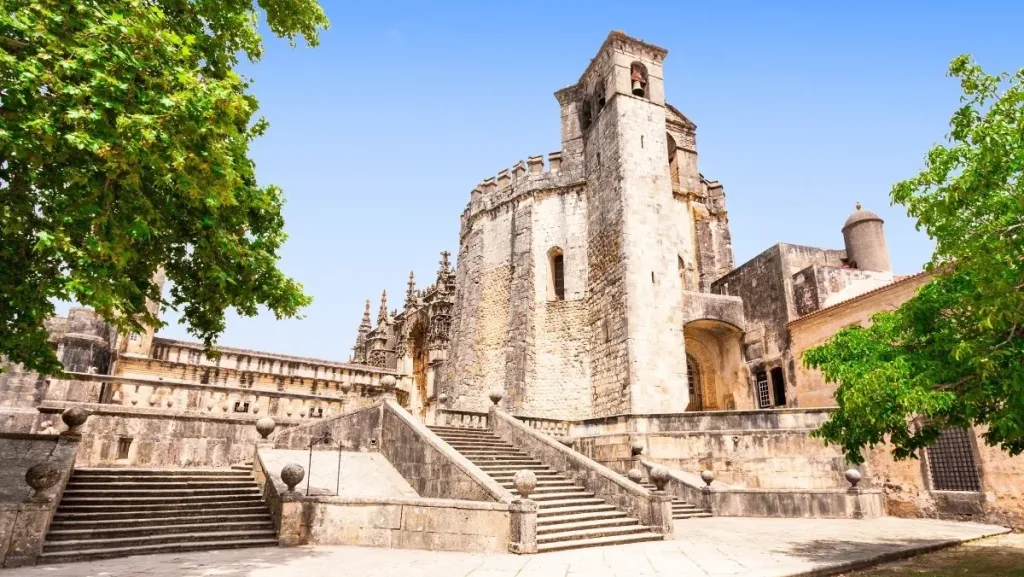
Convent of Christ – UNESCO World Heritage Site
The Charola – the 16-sided Templar rotunda at the core of the Convent of Christ – was built around 1162 and designed so that mounted knights could participate in Mass without dismounting. It is structurally unchanged from its 12th-century construction, decorated with 16th-century polychrome paintings and gilded stone added during the Order of Christ period.
The Convent was inscribed on the UNESCO World Heritage List in 1983 (site No. 265), recognised as a monument that evolved from a Templar military fortress into a royal religious complex over four centuries. It was founded in 1160 by Gualdim Pais – Grand Master of the Knights Templar in Portugal – following land donated by King Afonso Henriques in recognition of Templar military support during the Reconquista.
After the suppression of the Knights Templar across Europe in 1312, King Dinis I reorganised the Portuguese Templars as the Order of Christ in 1319. Prince Henry the Navigator served as Grand Master of the Order from 1420 until his death in 1460, using Tomar as the logistical base for Portuguese Atlantic exploration. The wealth from those voyages funded the Manueline additions to the Convent.
The Chapter Window (1510–1513): Designed by Diogo de Arruda on the western facade of the Chapter House – approximately 4 m wide and 7 m tall, carved in Manueline style. The programme incorporates: maritime motifs (coral, rope, armillary spheres); the Cross of the Order of Christ; cork oak roots; and human figures. Considered one of the most elaborate examples of Portuguese stone-carving.
Eight cloisters: spanning Romanesque to Mannerist periods, 12th to 17th century. A thorough visit takes 90–120 minutes.
Entry: €15/adult (museusemonumentos.pt). Open Oct–May 09:00–17:30; Jun–Sep 09:00–18:30. Free on Sundays and bank holidays until 14:00. Free under 12. Tickets bought on the day – no advance booking required.
Tomar Medieval Quarter
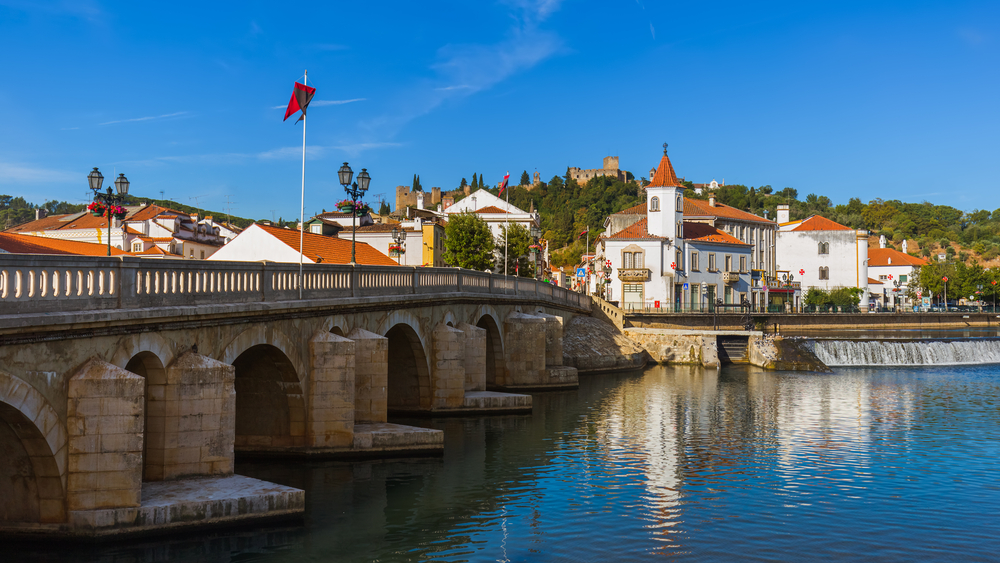
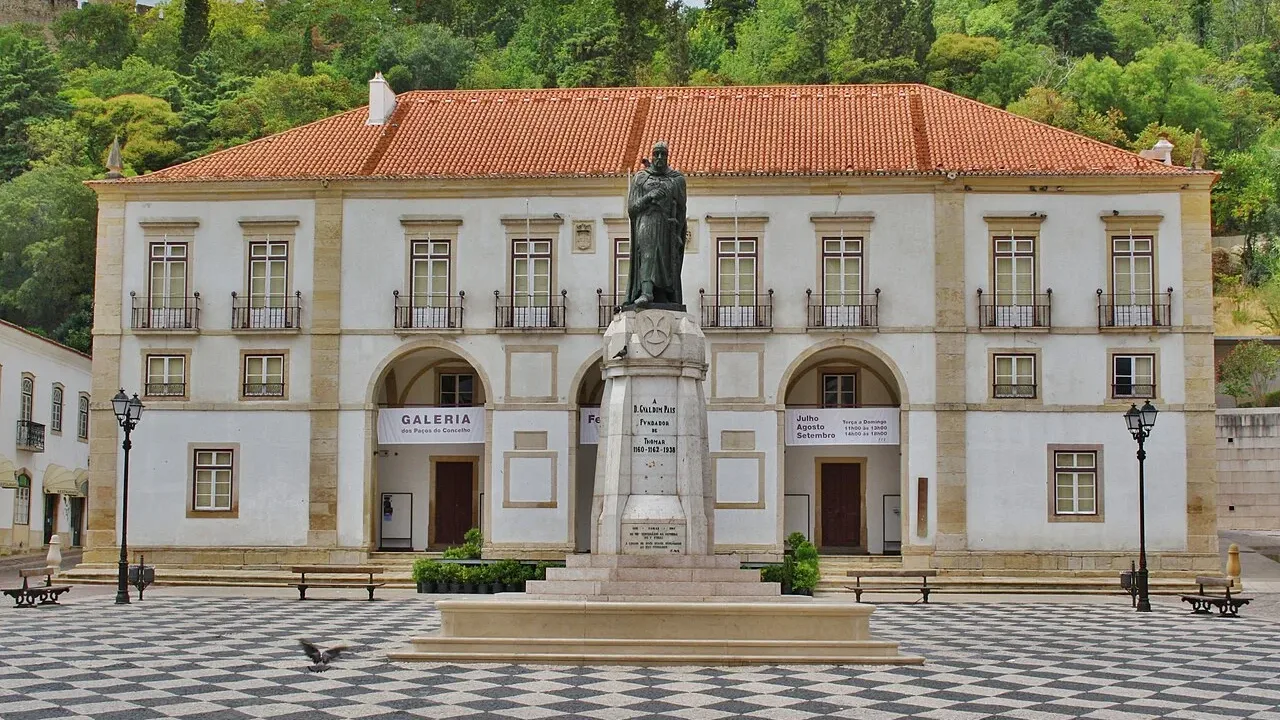
The town of Tomar (population 36,413, 2021 census) preserves one of the best-maintained medieval quarters in central Portugal. The grid-plan street layout was established by Gualdim Pais in 1160 and remains largely unchanged.
Igreja de Santa Maria do Olival – built from the late 12th century, served as the pantheon of the Knights Templar in Portugal. Fourteen Templar Grand Masters are buried here. The church is considered the architectural model for Templar religious buildings across Portugal.
Synagogue of Tomar (Sinagoga de Tomar) – built between 1430 and 1460, the only intact medieval synagogue in Portugal and one of the few surviving in the Iberian Peninsula. After the 1497 expulsion of Jews from Portugal, the building served successively as a prison, hay storage, and a chapel. Classified as a National Monument in 1921, it now houses the Abraham Zacuto Luso-Hebrew Museum.
Nabão River and Ilha do Mouchão – the town is bisected by the Nabão River. The 19th-century mill island is accessible by footbridge and used as a public park with river views toward the castle hill. Lunch in Tomar is scheduled into the itinerary – guide recommends based on group preference.

Alfama & Graça – Lisbon’s Oldest Neighbourhood
The 1755 Lisbon earthquake – estimated 8.5–9.0 magnitude, followed by tsunami and fire – destroyed 85% of the city. Alfama survived intact. The neighbourhood was built on solid bedrock rather than the alluvial sediment of the lower city, and it is the only pre-earthquake district still standing in its original form. Founded under Moorish rule between the 8th and 11th centuries, it retains its original street plan: narrow alleys (vielas), whitewashed walls with azulejo tile facades, and iron-railing balconies.
Fado – Portugal’s national music genre, inscribed by UNESCO as Intangible Cultural Heritage in 2011 – originated in Alfama in the early 19th century.
The Graça district, immediately above Alfama, is one of Lisbon’s oldest parishes (documented 1271). The Miradouro da Graça and the Miradouro da Senhora do Monte offer the broadest panoramic views of the city, the Tagus estuary, and the Cristo Rei statue (28 m figure on a 75 m pedestal, completed 1959) on the south bank.
Historic Lisbon: São Jorge Castle & Downtown
The archaeological record at Castelo de São Jorge runs seven layers deep – from Bronze Age occupation in the 2nd century BC through Iron Age, Roman, Moorish, and medieval Portuguese phases. The Moors held this hill from the 9th to the 11th century; in 1147, Afonso Henriques took it back with Crusader support, and the castle became the seat of the Portuguese royal court for the four centuries that followed.
The current castle covers 4.4 hectares with 10 towers, a moat, and the ruins of the medieval Paço Real (royal palace, abandoned after 1755). Excavations since 1996 have uncovered layers of occupation from the 7th century BC through the Islamic period.
The Baixa (Downtown) was rebuilt in a uniform grid by the Marquis of Pombal after 1755 using timber-frame cage construction – one of the earliest applications of earthquake-resistant engineering. Praça do Comércio covers 31,250 m² and served as the landing point for river arrivals until the 20th century. The equestrian statue of King José I (Machado de Castro, cast 1775) stands at the centre. Rua Augusta runs north under the triumphal arch completed in 1873.
Belém – Age of Discovery Monuments
On 8 July 1497, Vasco da Gama left from this exact stretch of riverbank on the first direct sea route from Europe to India. The voyage took 10 months and 28 days. The monuments at Belém – 6 km west of Lisbon city centre, where the Tagus widens toward the Atlantic – were built to mark that departure.
Jerónimos Monastery: Construction began 1502 under King Manuel I; completed 1601. UNESCO World Heritage Site (listed 1983, jointly with Belém Tower). The largest extant example of Manueline architecture. The south portal is 32 m tall. Vasco da Gama is buried in the church; Luís de Camões (1524–1580) was reinterred here in 1880. Open Tue–Sun.
Belém Tower: Built 1514–1519 by military architect Francisco de Arruda. UNESCO World Heritage Site. Built in the Tagus on a reef approximately 20 m from the north bank – ceremonial gateway, customs post, and defensive fortification. Reopened 27 May 2026 after restoration; timed entry in operation. Open Tue–Sun.
Monument to the Discoveries: Completed 1960 for the 500th anniversary of Henry the Navigator’s death. Height: 52 m. Henry leads at the prow; 33 figures behind – explorers, cartographers, navigators, artists of the Age of Discovery. The 50 m compass rose in the pavement was a gift from South Africa (1960).
Estrela Basilica & 25 de Abril Bridge
Queen Maria I built this church because of a vow. If God gave her a son, she would build him the finest neoclassical church in Portugal. The Basílica da Estrela was completed in 1790 – her son predeceased both her and the church. Queen Maria I is buried in the north transept; her remains were brought back from Brazil in 1821, five years after her death there. The dome reaches 65 m. It was the first neoclassical church built in Portugal.
The 25 de Abril Bridge was constructed between 1962 and 1966 by the American Bridge Company – the same firm that built the San Francisco–Oakland Bay Bridge. At completion it was the longest suspension bridge outside the United States. Total length: 2,277 m. Main span: 1,013 m. Clearance above the Tagus: 70 m at mid-span. The lower deck carries suburban rail (added 1999). Named after the Carnation Revolution of 25 April 1974, which ended 48 years of authoritarian rule in Portugal.


This tour is carefully crafted for a well-balanced and enriching day – but the pace and focus can adapt to your preferences.
The suggestions are ours, but the experience is yours.
Yellow Cab TT Tours – always at your service, with the quality our clients have come to expect.
What’s Included
- 8 Hours Tour
- Private air-conditioned van for your group (up to 8 passengers)
- Hotel/apartment pickup and drop-off in Lisbon, Sintra, Cascais, Estoril, or anywhere along the Estoril Coast
- Mandatory passenger insurance
- Fuel, motorway tolls and parking at all stops
Not included
- Meals and drinks
- Tickets to Monuments
- Tips
- Pickup outside Lisbon city centre (additional fee, confirmed at booking)
Tour Prices
Prices are per vehicle, not per person.
-
Up to 2 Pax €350
-
3 to 4 Pax €450
-
5 to 8 Pax €570
Cancellation up to 24 hours before departure. Cancellations within 24 hours are non-refundable.
Contact us and Book your Tour
Best Time of Year for This Tour
April–June (recommended): Temperatures 18–24°C in Tomar. Spring vegetation in the Nabão valley is at its best. Visitor numbers at the Convent are manageable – no queue on most weekday mornings. Cloisters and Chapter Window are best photographed in spring light.
July–August (peak): Temperatures 28–35°C in Tomar (inland, consistently warmer than Lisbon coast). The Convent’s stone courtyards retain heat by afternoon. Visitor numbers highest – the 10:30 morning arrival is the optimal window. Book 2–3 weeks in advance.
September–October (second recommended window): Temperatures 22–28°C, crowds reducing from August. Rich autumn light at the Convent and in Alfama. The Tomar Festa dos Tabuleiros – held every four years in July (next edition: 2027) – draws large local crowds to the town but does not affect Convent access.
November–March (low season): Temperatures 10–17°C. The Convent cloisters are atmospheric in winter light and mist; visitor numbers very low on weekday mornings. The Belém monuments are near-empty in January–February. Pack a warm layer – the open Convent courtyards and the Belém riverfront are exposed to Atlantic wind.
FAQ
Is the Convent of Christ entrance ticket included?
Is the tour price per person or per vehicle?
How far is Tomar from Lisbon?
What languages does the guide speak?
What is the cancellation policy?
Is lunch included?
Is lunch included?
Is this tour suitable for first-time visitors to Lisbon?
Do we walk a lot at the Convent of Christ?
Can we customise the itinerary?
Is this tour suitable for children?
What Our Guests Say
You may also be interested in
Tomar, Almourol & Santarém Tour
Tomar + Almourol Castle (river island, 1171) + Santarém (Pedro Álvares Cabral burial site). No Lisbon city circuit. From €330/vehicle.
Tomar & Fátima Tour
Convent of Christ + Fátima Sanctuary (6.2M pilgrims 2024, all sites free). No Lisbon city circuit. From €350/vehicle.

Private Tomar & Sintra Tour
Two UNESCO sites: Convent of Christ (No. 265, 1983) + Sintra Cultural Landscape (No. 723, 1995). No Lisbon city circuit. From €350/vehicle.