
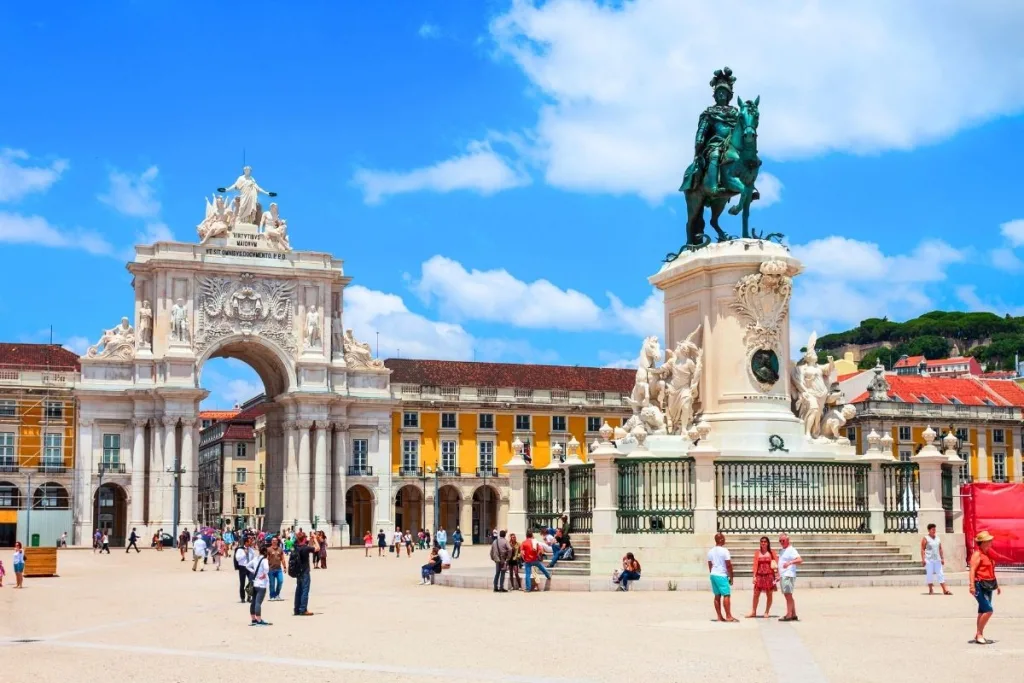

On 1 February 1908, King Carlos I of Portugal was shot dead in his own carriage in the middle of Praça do Comércio, in broad daylight, in front of his family. Today the same 30,600 m² of pavement is where cruise-ship passengers stop for a photo with the king’s bronze predecessor before walking under the arch for lunch. Both things happened in the same square, and neither one is a secret — most visitors just never hear the second.
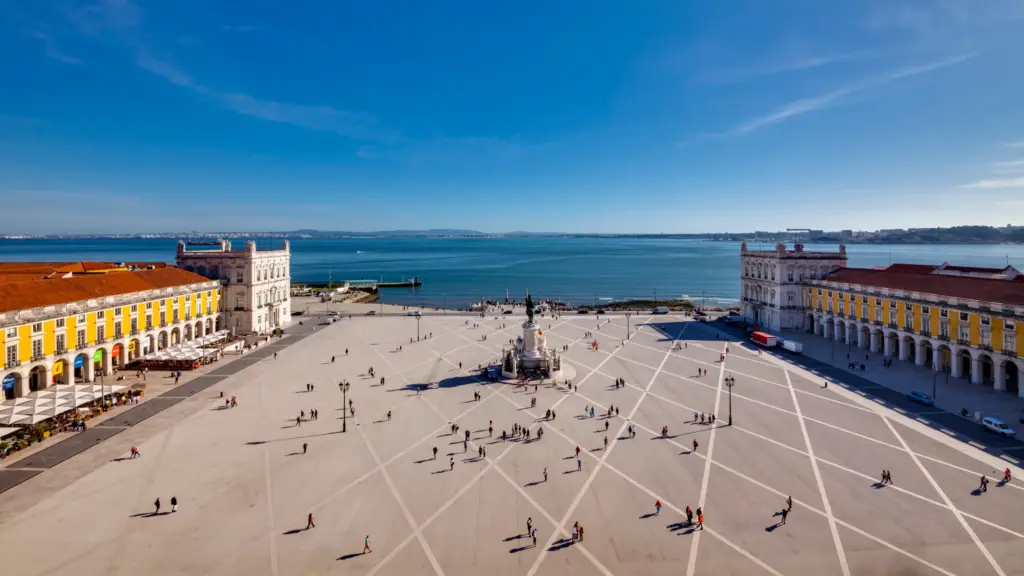
Praça do Comércio is Lisbon’s largest riverside square, built directly on the ruins of a royal palace that the 1755 earthquake reduced to rubble in a matter of minutes. What replaced it was a deliberate statement: not a new palace, but a square named for commerce, ringed with government buildings, and opened straight onto the Tagus.
This guide covers how the square came to exist, the statue and arch that dominate it — including how a statue this size was cast in a single pour in 1774, a genuine engineering feat for the period — the marble steps where monarchs once arrived by boat, the assassination that helped end Portugal’s monarchy two years before the square became a National Monument, how Lisbon still uses the square today, and what to know before visiting. I have been bringing clients through this square for over 20 years, and it is one of the few places in Lisbon where the history explains the layout instead of just decorating it.
What Praça do Comércio Is Today
Praça do Comércio measures 175 by 175 metres — around 30,600 m² — making it one of the largest squares in Portugal and, by most accounts, the largest royal square in Western Europe. You’ll often see it described online as “the second-largest square in Europe,” a claim that stems from a comparison with St Petersburg’s Palace Square but doesn’t hold up once larger squares in Eastern Europe are taken into account. The more precise claim is also the more defensible: Praça do Comércio is the largest royal square in Western Europe. Its southern side opens directly onto the Tagus River, a layout that was intentional: this was designed as a ceremonial gateway to the city rather than an enclosed plaza.
Government ministries and the Supreme Court now occupy the arcaded buildings on three sides. The west tower, Torreão Poente, houses the Museu de Lisboa’s city-history branch (€7.50, Tuesday–Sunday, 10:00–18:00; closed Mondays), covering roughly 3,000 years of Lisbon’s history, from its Moorish origins through the 1755 earthquake to the 1974 Carnation Revolution. Under the eastern arcade, Martinho da Arcada — open since 1782 — is one of Lisbon’s oldest cafés and was a favourite haunt of the poet Fernando Pessoa.
The square’s other permanent feature is visitors trying to photograph the king’s statue without anyone else in the frame. On a summer afternoon, that usually requires patience, an early start, or both.
Why the Square Exists: From Royal Palace to Rebuilding Statement
The square’s history begins with a palace that no longer exists, on a site that was deliberately transformed into something entirely different after the 1755 earthquake.
The Ribeira Palace, Casa da Índia and the Earthquake
In the early 16th century, King Manuel I built the Paço da Ribeira (Riverside Palace) on the Tagus waterfront, moving the royal residence from the hilltop Castelo de São Jorge down to the river. In 1500, he also founded the Casa da Índia to administer the Crown’s monopoly over the Asian spice trade. After 1503, it absorbed the older Casa da Guiné e Mina — the office overseeing trade with West Africa, originally established by Henry the Navigator in Lagos in 1443. From 1511 onwards, the Casa da Índia occupied the ground floor of the Ribeira Palace itself, placing the kingdom’s most valuable overseas trading operation quite literally beneath the royal apartments.
For more than two centuries, this waterfront was the administrative and commercial heart of the Portuguese Empire. Then, on the morning of 1 November 1755, everything changed.
The earthquake, followed by a tsunami and days of fires, destroyed the Ribeira Palace, the Casa da Índia and most of central Lisbon. Unlike the palace itself, the Casa da Índia was never recreated in its original form. Its customs functions were transferred to the Alfândega Grande, a new fire-resistant customs house built nearby on Rua da Alfândega. The disaster did more than level buildings — it erased both the royal residence and the administrative centre of Portugal’s global empire in a single morning.
Pombal’s Decision
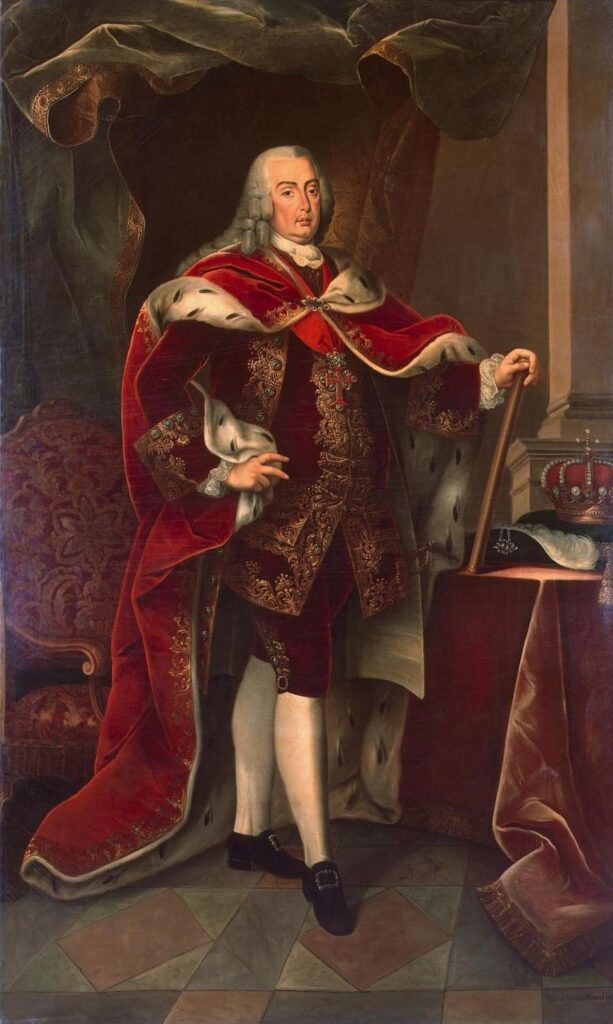
Sebastião José de Carvalho e Melo, the 1st Marquis of Pombal and chief minister to King José I, directed Lisbon’s reconstruction, appointing architect Eugénio dos Santos to redesign the devastated waterfront.
The most significant decision was political rather than architectural. Instead of rebuilding the royal palace, Pombal replaced it with a monumental public square devoted to commerce, bordered by government buildings and left open to the Tagus River as the city’s ceremonial entrance. The old name, Terreiro do Paço (“Palace Yard”), remained in popular use, while the official name — Praça do Comércio (“Commerce Square”) — reflected the purpose of the new Lisbon.
I often tell clients that this is the detail most people don’t expect: Lisbon’s best-known square exists because its royal palace was deliberately never rebuilt.
The Equestrian Statue of King José I
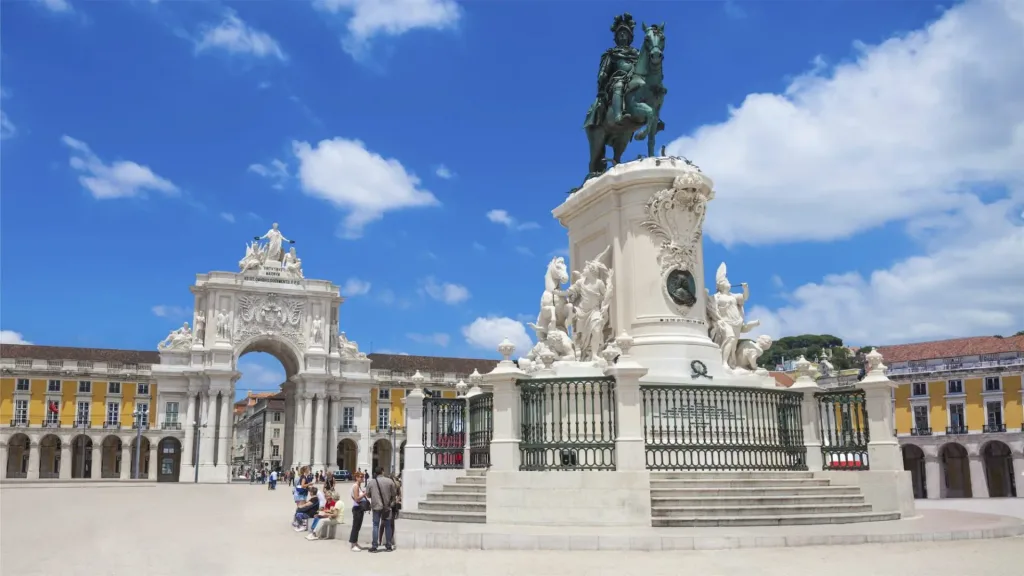
At the centre of the square stands a bronze equestrian statue of King José I — the first public statue in Portugal dedicated to a living person, and the first equestrian statue ever made in the country. It was sculpted by Joaquim Machado de Castro (1731–1822), the leading Portuguese sculptor of his generation, and took the better part of a decade to design and cast.
Machado de Castro depicted the king on horseback, crushing snakes underfoot — a conventional allegory for a monarch triumphing over his enemies. Which enemies, specifically, the sculpture leaves diplomatically unnamed, a decision that has aged rather well given how the following century of Portuguese royal history unfolded.
The statue faces the river, with its back to the Rua Augusta Arch and the Baixa behind it — the same direction from which ships, and eventually tourists, have always arrived.
Casting the Statue
The bronze was cast in a single pour on 15 October 1774 — a remarkable technical achievement that made it one of the first monuments of its size anywhere in the world to be produced that way rather than assembled from separately cast sections. A failed pour at that scale would have meant starting again from scratch; 18th-century foundry technology offered no practical way to salvage the work.
The completed statue was transported from the foundry to the still-unfinished square on 25 May 1775. Its official unveiling followed on 6 June 1775, deliberately timed to coincide with King José I’s 61st birthday. At the time, the surrounding Praça do Comércio was still very much a construction site.
The Pedestal and Its Reliefs
The statue stands on a pedestal designed by architect Reinaldo Manuel dos Santos, one of the key figures responsible for rebuilding Lisbon after the earthquake. Together, statue and pedestal rise 14 metres above the square.
The pedestal is decorated with four relief panels that most visitors pass without realising they tell a story. On the river-facing side, the Marquis of Pombal appears beneath the royal coat of arms — the king’s chief minister quietly included in a monument dedicated to his sovereign. The two side panels depict allegorical figures: Triumph with a horse, and Fame with an elephant. The rear panel, facing the Baixa, represents royal generosity towards a city in ruins, with Commerce personified as a figure opening a chest of money.
Taken together, the monument is more than a portrait of a king. It is an 18th-century political statement in bronze, presenting José I as the ruler who restored Lisbon after the earthquake, supported by the commercial wealth that the square itself was designed to celebrate.
Rua Augusta Arch: A Monument a Century in the Making
The arch framing Rua Augusta on the square’s north side looks, from a distance, like a single confident architectural gesture. It took more than a century to complete.
Eugénio dos Santos included an arch in his original 1759 reconstruction plan, although early designs described it more as a bell tower than the triumphal monument seen today. Its final form evolved gradually as construction stalled and priorities changed. By 1843, only the entablature — the horizontal upper section — had been completed, while the composite columns added in 1815 stood waiting for the rest of the structure.
A design competition held in 1843 was eventually won by architect Veríssimo José da Costa, who oversaw the monument’s completion. Sources differ on the exact finishing date: most architectural histories give 1875, while some reference works list 1873. Either way, the irony remains the same: the monument celebrating Lisbon’s recovery from the 1755 earthquake took well over a century to finish — far longer than it took the earthquake to destroy the city.
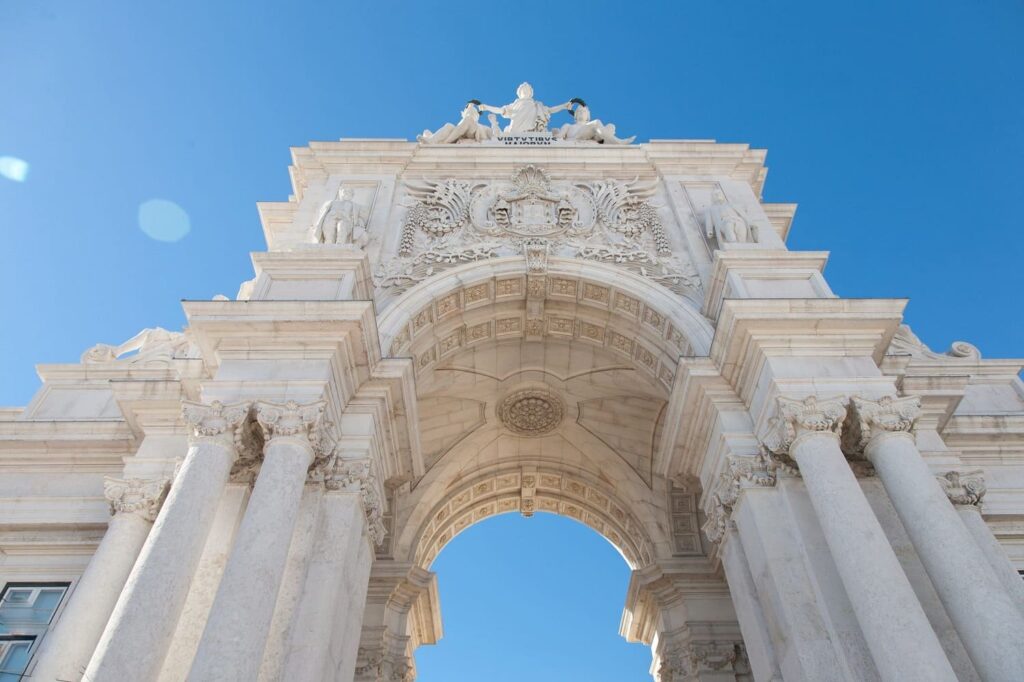
The completed arch features a clock and two levels of sculpture. At the top, Glory crowns Genius and Valour in a composition by the French sculptor Célestin Anatole Calmels. Below stand four figures from Portuguese history: Viriathus, Nuno Álvares Pereira, Vasco da Gama and the Marquis of Pombal, sculpted by Vítor Bastos.
Since 2013, visitors have been able to reach the rooftop viewpoint by elevator. Capacity is limited to 35 people at a time, making it one of the less crowded viewpoints in central Lisbon despite its location. Admission is €3.50. Opening hours are 10:00–19:00 daily (last entry 30 minutes before closing), with shorter hours during the Christmas period and closure on 25 December.
Cais das Colunas: Where Kings and Queens Stepped Ashore
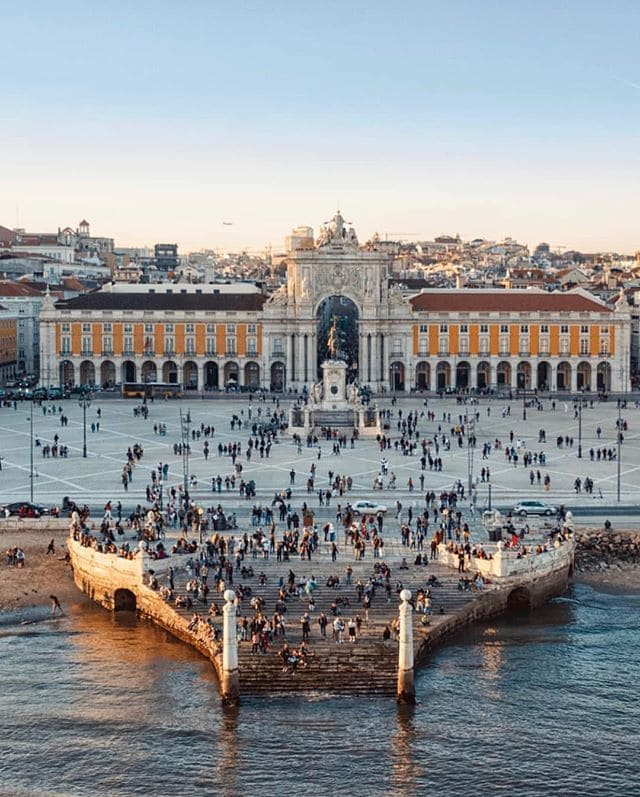
At the water’s edge, directly in front of King José I’s statue, a short flight of marble steps flanked by two columns marks what was once Lisbon’s ceremonial entrance. Designed by Eugénio dos Santos as part of the post-earthquake reconstruction, the columns were inspired by those traditionally associated with Solomon’s Temple, giving the riverfront an appropriately monumental gateway.
For centuries, this was where monarchs, ambassadors and other distinguished visitors arriving by ship first set foot in Lisbon. Before airports, the Tagus was the city’s front door, and Cais das Colunas served as its official reception point. Queen Elizabeth II came ashore here during her state visit to Portugal in 1957, one of the last occasions the landing stage fulfilled its original ceremonial role.
Today, most people pass by without realising the steps are a historic monument rather than simply a place to sit beside the river. They’re easy to overlook—but once you know what they were built for, they’re one of the square’s most evocative details.
The Assassination of 1908
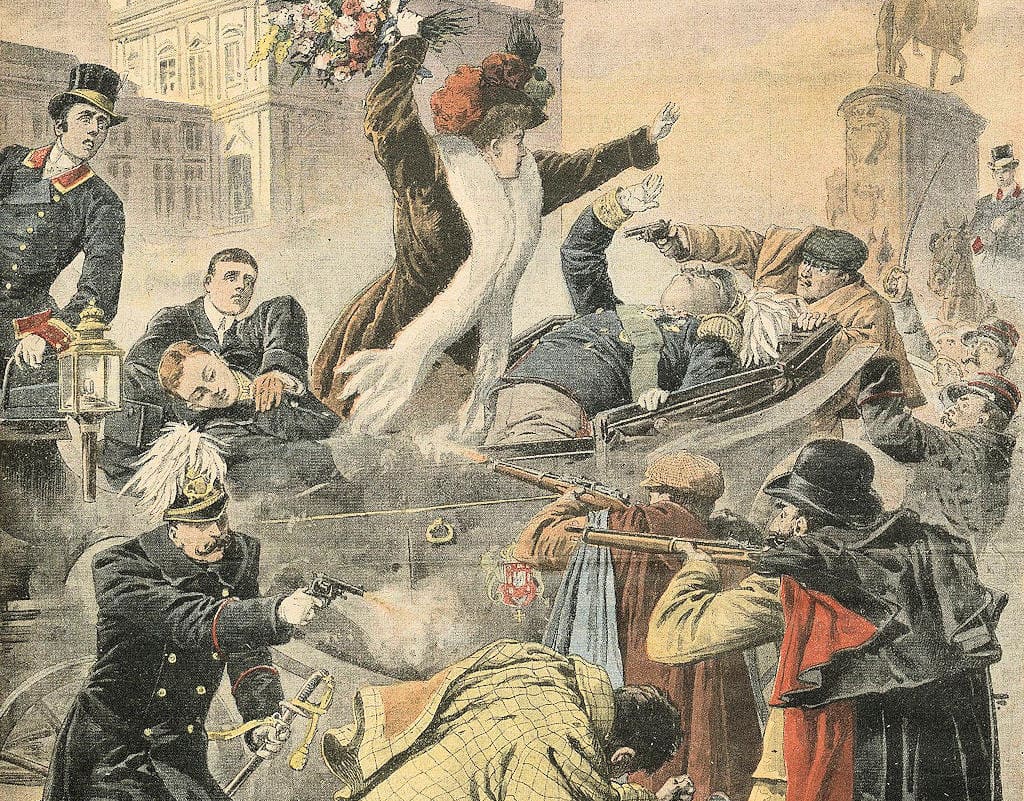
On 1 February 1908, the Portuguese royal family crossed Praça do Comércio—still commonly known as Terreiro do Paço—in an open carriage after returning from the royal residence at Vila Viçosa. As the carriage entered the square, two republican conspirators, Alfredo Luís da Costa and Manuel Buíça, opened fire. Buíça used a rifle hidden beneath his overcoat, while Costa fired at close range with a pistol.
King Carlos I was killed almost instantly, becoming the only Portuguese monarch ever to be assassinated. His eldest son and heir, Crown Prince Luís Filipe, was mortally wounded and died shortly afterwards. The younger prince, Manuel, survived despite being shot in the arm, while Queen Amélia reportedly struck one of the attackers with a bouquet in a desperate attempt to protect her family. Both assassins were killed at the scene by members of the royal escort.
Manuel succeeded as King Manuel II, but his reign lasted just two years and eight months. On 5 October 1910, the Republican Revolution abolished the Portuguese monarchy, forcing the young king into exile. In hindsight, the shots fired in Praça do Comércio marked the beginning of the monarchy’s final chapter. The square that had replaced the old royal palace as a symbol of Portugal’s renewal also became the place where the country’s centuries-old royal dynasty effectively came to an end.
How Lisbon Uses the Square Today
Praça do Comércio isn’t a historic monument that sits quietly between guided tours. It remains Lisbon’s principal public square—the place the city turns to whenever an event needs space, visibility and a backdrop worthy of the occasion.
Every winter, the square hosts Wonderland Lisboa, one of the capital’s largest Christmas events, with an ice rink, Ferris wheel, concerts, food stalls and a Christmas tree that rises around 30 metres above the centre of the square. On New Year’s Eve, thousands gather here to watch the fireworks over the Tagus, with recent celebrations also featuring large coordinated drone shows.
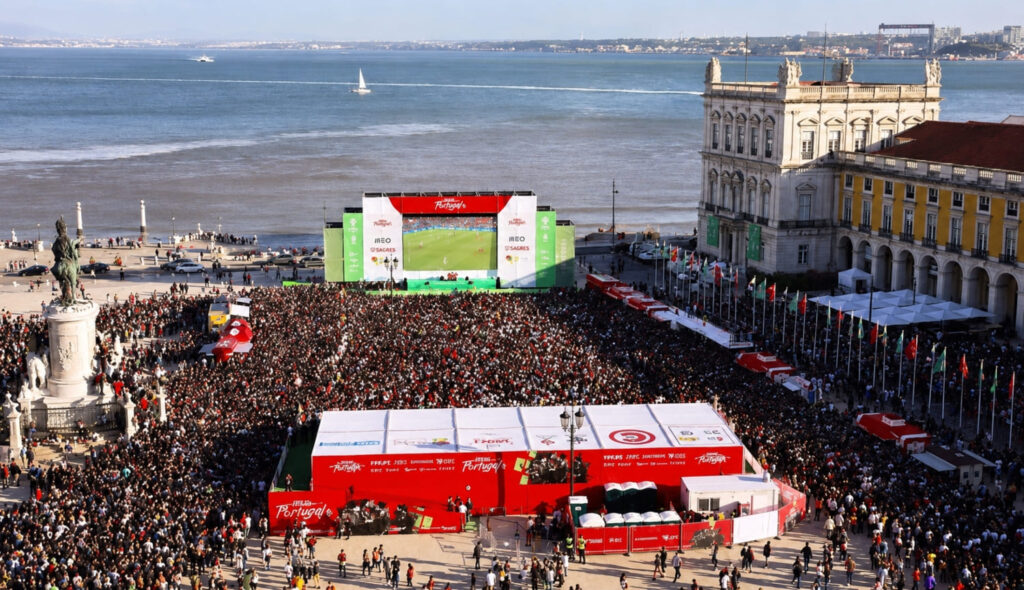
The square regularly serves as an open-air venue for national celebrations as well. When Portugal hosted UEFA Euro 2004, the tournament’s trophy tour was launched here with Portuguese football legend Eusébio. Since then, Praça do Comércio has repeatedly become one of Lisbon’s official fan zones during major football tournaments, its wide open space and riverside setting making it ideal for giant screens and public gatherings.
During major championships, the atmosphere reflects Lisbon itself. Portugal’s large international communities mean that supporters of several different countries often fill the same square. It’s perfectly normal to hear Portuguese, Brazilian, Cabo Verdean and visiting fans celebrating different teams—sometimes all during the same match. Few places in the city show Lisbon’s international character quite as clearly.
The square is also likely to play a role during the 2030 FIFA World Cup, which Portugal will co-host with Spain and Morocco. While the official plans have yet to be announced, Praça do Comércio has become the city’s default venue for large public celebrations, making it a natural candidate for tournament events once again.
Getting There and When to Visit
Metro: Terreiro do Paço station (Blue Line) opens directly onto the square, making it the easiest way to arrive by public transport.
Ferry: The Terreiro do Paço ferry terminal serves Barreiro, not Cacilhas. Ferries to Cacilhas depart from Cais do Sodré, about a 10-minute walk west along the waterfront. It’s an easy mistake to make—and one that leaves you in the wrong town on the opposite side of the Tagus.
Walking: Praça do Comércio marks the southern end of Rua Augusta and is around a 5–10 minute walk from both Rossio and Baixa-Chiado metro stations.
When to visit: If you want photographs without crowds, arrive before 09:30. The morning light is good for the arch and King José I’s statue, and the queue for the Rua Augusta Arch viewpoint is usually shortest. The square is busiest from late morning through mid-afternoon, when cruise passengers, walking tours and ferry traffic overlap. Late afternoon offers the best light looking south across the Tagus, especially around sunset.
The square is open 24 hours a day and has no admission fee. Only the attractions within it—such as the Rua Augusta Arch viewpoint and the Museu de Lisboa—have their own opening hours and ticket prices.
Visit Praça do Comércio on a Private Tour
Praça do Comércio is one of the highlights of our Lisbon private tours, alongside Baixa, Alfama and Belém. We usually visit the square early in the day, when it’s quieter, the light is ideal for photographs, and the queue for the Rua Augusta Arch viewpoint is often minimal.
| Tour | Includes | Details |
|---|---|---|
| Lisbon Private Tour | Praça do Comércio · Baixa · Alfama · optional custom stops | Private vehicle, hotel pickup |
| Best Solution Tour | Full-day Lisbon including Praça do Comércio, Belém and the historic centre | All major landmarks in one day |
FAQ
What is Praça do Comércio known for?
Praça do Comércio is Lisbon’s largest riverside square, built on the ruins of the Ribeira Palace after the 1755 earthquake destroyed it. It is known for the bronze equestrian statue of King José I (1775), the Rua Augusta Arch, and its role as the site of King Carlos I’s assassination in 1908.
Is Praça do Comércio free to visit?
Yes. The square itself is open public space with no entry fee and no closing time. Two attractions inside it charge admission: the Rua Augusta Arch viewpoint (€3.50) and the Museu de Lisboa branch in the west tower (€7.50).
What is the arch in Praça do Comércio called?
It is the Rua Augusta Arch (Arco da Rua Augusta), completed after 116 years of intermittent construction — most descriptive sources give 1875, though Wikipedia’s reference infobox states 1873. A rooftop viewpoint, accessible by elevator since 2013, costs €3.50 and is open daily 10:00–19:00, last entry 30 minutes before closing.
Why was the square renamed from Terreiro do Paço to Praça do Comércio?
After the 1755 earthquake destroyed the royal Ribeira Palace on this site, chief minister the Marquis of Pombal chose not to rebuild a palace. The square was redesigned around commerce and government buildings instead, and renamed accordingly. The older name, meaning “Palace Yard,” is still used informally by locals.
How do I get to Praça do Comércio?
Terreiro do Paço metro station (Blue Line) sits beneath the square. It is a 5–10 minute walk from Rossio or Baixa-Chiado. A ferry terminal on the square’s river side runs to Barreiro — not Cacilhas, which departs from Cais do Sodré instead.
What happened at Praça do Comércio in 1908?
On 1 February 1908, King Carlos I was shot and killed in the square, along with his heir Crown Prince Luís Filipe, by two gunmen in the crowd. His younger son survived and briefly reigned as Manuel II before the monarchy was abolished in 1910.
What is the statue in the middle of the square?
A bronze equestrian statue of King José I, sculpted by Joaquim Machado de Castro and cast in a single pour on 15 October 1774 — the first equestrian statue ever made in Portugal. It was unveiled on 6 June 1775, timed to the king’s 61st birthday, and depicts him on horseback crushing snakes, a common allegory for triumph over enemies.
How was the statue of King José I made?
The bronze was cast in a single pour, a technically demanding feat at this scale for 1774 — one of the first statues of its size anywhere cast this way. The pedestal, designed by architect Reinaldo Manuel dos Santos, carries four relief panels: the Marquis of Pombal beneath the royal arms, allegorical figures of Triumph and Fame, and a rear panel showing Commerce funding the city’s reconstruction.
What is Cais das Colunas?
Cais das Colunas is a set of marble steps and columns at the square’s riverfront, designed as Lisbon’s ceremonial entrance for visiting dignitaries arriving by boat. Queen Elizabeth II landed here during her 1957 state visit to Portugal.
Does Praça do Comércio have a Christmas market?
Yes. The square hosts Wonderland Lisboa, one of Lisbon’s largest Christmas markets, with an ice-skating rink, a Ferris wheel, and a large Christmas tree. It is also one of the city’s main New Year’s Eve fireworks-watching points.
Is Praça do Comércio a fan zone during the World Cup?
Yes. Since 11 June 2026, Lisbon City Council and the Portuguese Football Federation have run “Lisboa Football Arena” in the square — the city’s official 2026 FIFA World Cup fan zone, with free entry, giant screens, and match broadcasts through 19 July. Cabo Verde’s first-ever World Cup qualification has made the atmosphere especially mixed, with Portuguese, Cabo Verdean, and Brazilian fans in the crowd frequently cheering for each other’s teams.
How long does it take to see Praça do Comércio?
Walking the square, viewing the statue and arch, and taking photos takes 20–30 minutes. Adding the Rua Augusta Arch viewpoint takes another 30–45 minutes with the elevator queue. Adding the Museu de Lisboa branch inside the west tower adds roughly an hour.
Is Praça do Comércio part of a Lisbon private tour?
Yes. Our Lisbon private tours include the square as a core stop alongside the Baixa, Alfama, and Belém, typically visited early to avoid the midday cruise-ship and tour-group crowds.

Founder & Director of Yellow Cab TT Tours. Guiding in Portugal for 20+ years.
Founded Yellow Cab TT Tours in 2013. 3,372 five-star reviews on Tripadvisor.