
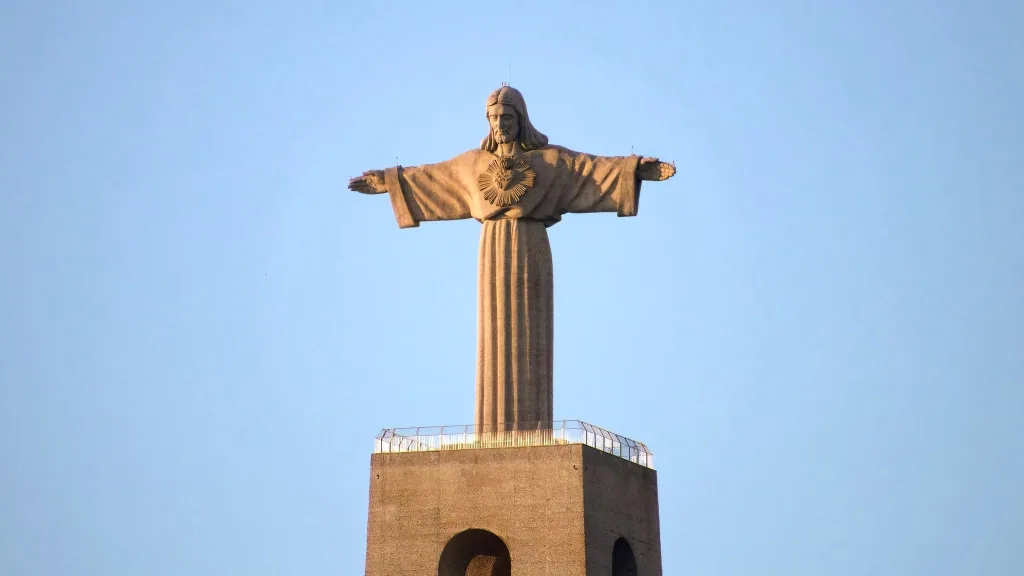

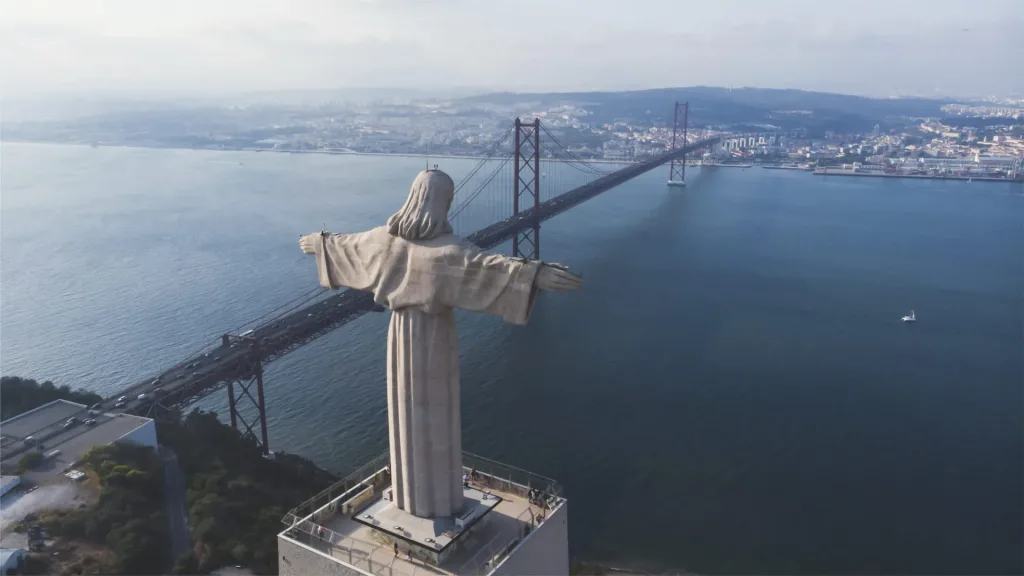
Every visitor to Lisbon eventually sees Cristo Rei — arms open, standing on the south bank of the Tagus, visible from half the city’s miradouros. Almost none of them go there. It’s a photo taken from across the river, filed under “things that look good in the background,” and left at that.
That’s a shame, because the statue itself is only the last chapter of a much longer story. Before construction ever started, Portuguese schoolchildren spent nearly two decades saving coins for it. Before that, a cardinal came home from Rio de Janeiro with an idea, and an entire country’s bishops made a wartime promise that, decades later, they kept in concrete and stone.
We’re one of the operators whose standard Lisbon day actually drives across the bridge to get here — it’s part of the same crossing that lets us reach the statue itself, not just admire it from the north bank. So we know this place beyond the postcard version.
Here’s the full history, the numbers most guides to this statue get wrong, and what it actually costs to go up.
Why a Trip to Rio Inspired a Lisbon Landmark
The idea didn’t originate on the ground in Portugal, and it didn’t originate in Rio either — it came from the air, on the way home from somewhere else entirely.
In October 1934, Manuel Gonçalves Cerejeira, then Patriarch of Lisbon, was flying back from the 32nd International Eucharistic Congress in Buenos Aires when his flight passed over Rio de Janeiro. Looking down at Christ the Redeemer, inaugurated on Corcovado only three years earlier, he was struck with the idea of building a Portuguese counterpart — not a copy, but a Portuguese answer to it, dedicated to the Sacred Heart of Jesus. He shared the idea with the Movement of the Apostolate of Prayer in 1936, and it stayed a proposal for several more years.
The idea became an official commitment in 1940, and the reasoning behind the timing says something about the moment. On 20 April that year, with most of Europe already at war, the Portuguese Episcopate met in Fátima and formally pledged to build the monument as a plea for the country to be spared direct involvement in the Second World War. Portugal did stay neutral throughout the conflict, and the promise was treated afterward as one worth keeping. Land for the site, on a hilltop across the Tagus in Almada, was acquired the following year, in 1941.
I’ve always found this detail undersells itself in most retellings: this wasn’t built as a generic religious monument. It’s a specific, dated national vow, made in wartime and fulfilled nearly two decades later.
The Children Who Helped Pay For It
Between the 1940 vow and the first stone being laid in 1949, the country needed to actually pay for the thing — and one of the more unusual fundraising efforts in Portuguese religious history did a meaningful part of that work.
The campaign was called “Pedras Pequeninas” — Little Stones — and it ran from 1939 to 1958, aimed specifically at schoolchildren. Posters and materials went out to parishes and schools across the country, and children were encouraged to save small coins throughout the year. Each 28 December — the Feast of the Holy Innocents — they brought their savings to their parish nativity scene in an organised procession, and the money was forwarded on to the monument’s national fundraising secretariat. It wasn’t a token gesture: the campaign raised a genuinely significant sum toward the total cost, entirely in small coins collected from children.
It’s an odd thing to stand at the base of a 110-metre monument and picture it partly funded by pocket money, but that’s a fair description of what happened here.
Ten Years, 40,000 Tonnes of Concrete
The first stone was laid on 18 December 1949 — not a random date. It marked the 50th anniversary of Pope Leo XIII’s 1899 consecration of humanity to the Sacred Heart of Jesus, the same devotion Cristo Rei is formally dedicated to.
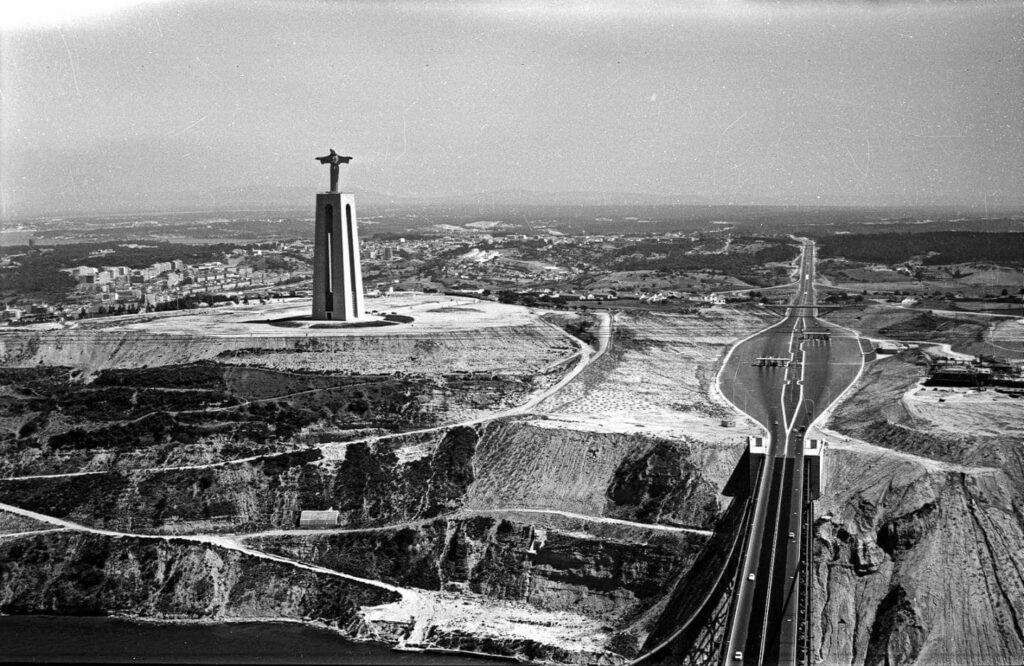
Actual foundation construction was contracted out in January 1952 to Empresa de Obras Públicas e Cimento Armado (OPCA), and from there the build ran for roughly a decade.
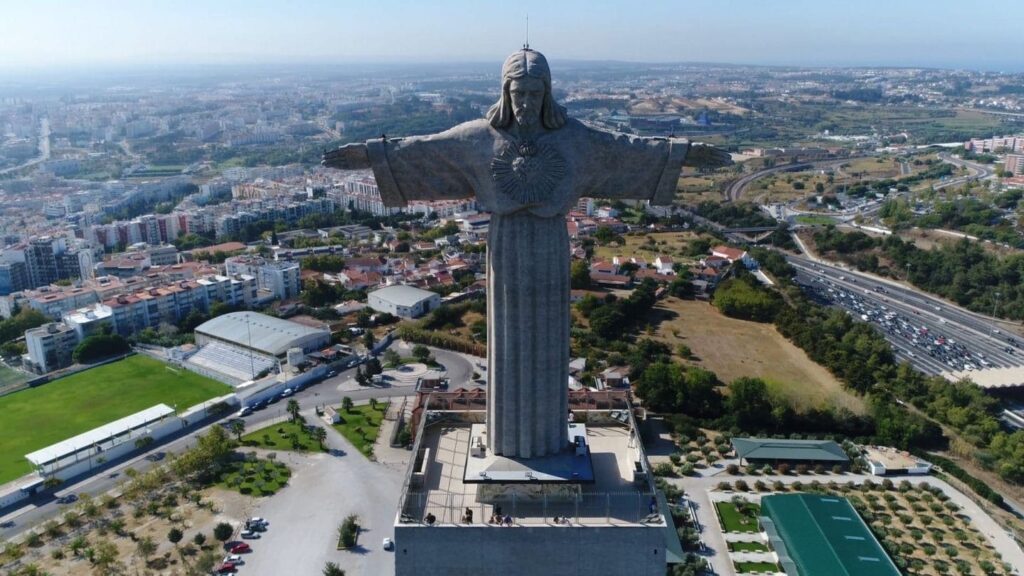
The finished structure used approximately 40,000 tonnes of concrete. Architect António Lino designed the pedestal; sculptor Francisco Franco de Sousa created the statue itself. Ten years after the cornerstone went in, the monument was ready.
Reinforced concrete in this quantity, on a hilltop, facing the Atlantic weather that regularly hits this stretch of coast, is not a casual engineering choice — it’s the same category of over-building Lisbon applies to most large structures raised after 1755, even a century and a half later.
Pentecost Sunday, 1959
The monument was inaugurated on 17 May 1959 — Pentecost Sunday, chosen deliberately for its significance in the Catholic calendar. Cardinal Cerejeira, the same man whose 1934 trip to Rio had started the whole project, performed the dedication ceremony 25 years after he’d first seen the monument that inspired it. The Cardinals of Rio de Janeiro and of Lourenço Marques (present-day Maputo) attended alongside him.
Estimates of the crowd that day commonly cite around 300,000 people — a genuinely enormous gathering for a country of Portugal’s size in 1959, though some retellings inflate the figure considerably higher. Whatever the exact headcount, it was, by any account, one of the largest public gatherings in Lisbon’s 20th-century history.
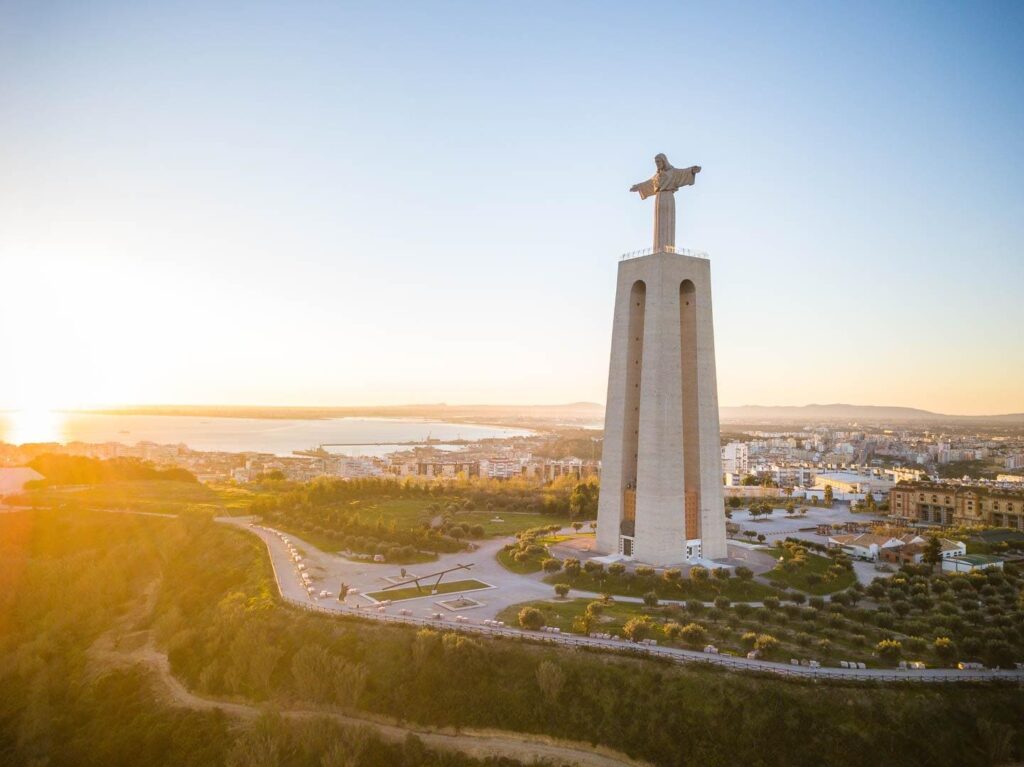
The Numbers Most Guides Get Wrong
The statue itself stands 28 metres tall. The pedestal beneath it rises a further 82 metres. Total height from the ground: 110 metres.
Those three numbers, taken together, are the single most commonly garbled fact about this monument — one widely read guide states the statue itself is 100 metres tall (it isn’t; that’s roughly the combined height of the statue and most of the pedestal), and another states the pedestal is 75 metres (also wrong — it’s 82).
For what it’s worth, the distance between the statue’s outstretched hands is also close to 28 metres — the same figure as its height, which is either a deliberate proportional choice or a coincidence nobody’s fully documented either way.
Why We Actually Take You There
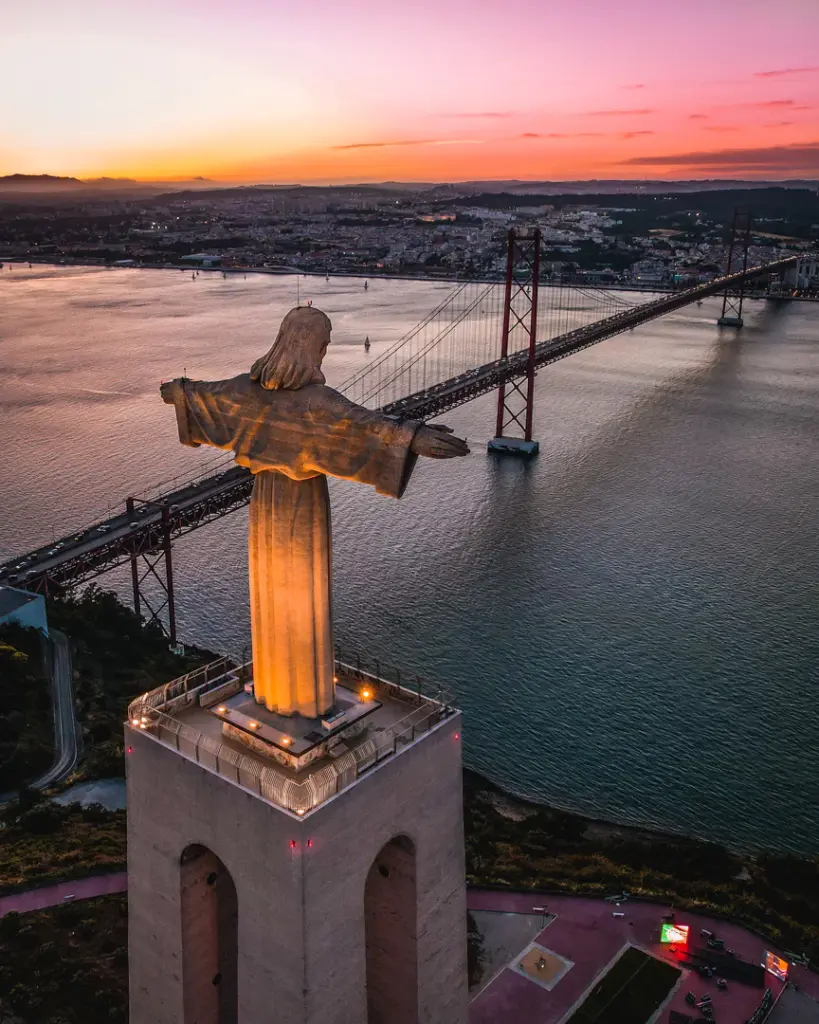
Most private Lisbon tours treat Cristo Rei as a photo op from the north bank — a good angle from a miradouro in Alfama or Belém, no crossing required. We do it differently: our standard Lisbon City Tour crosses the 25 de Abril Bridge and brings guests to the grounds here as a normal part of the day, not a special add-on.
The grounds are included at no extra cost; the elevator to the top is optional and billed separately (€10 per adult, €3 for children 8–12), and worth flagging when you book if reaching the observation platform matters to you.
Either way, you’re standing at the statue’s base rather than looking at it from a mile of water away — which is the entire point of making the crossing in the first place.
Stand at the Statue, Not Just Photograph It From Across the River
Most Lisbon tours point at Cristo Rei from the north bank. Ours crosses the bridge and brings you here.
- Private Lisbon City Tour → Alfama, Baixa, Belém, the 25 de Abril Bridge crossing, and Cristo Rei in one 8-hour day. From €285/vehicle.
FAQ
What is Cristo Rei in Lisbon?
Why was Cristo Rei built?
Did children really help pay for it?
How long did Cristo Rei take to build?
How tall is Cristo Rei?
How much does it cost to visit Cristo Rei?
What are the opening hours?
How do you get to Cristo Rei from Lisbon?
What can you see from the top of Cristo Rei?
Is Cristo Rei the same as Christ the Redeemer in Rio de Janeiro?
Does your Lisbon tour actually take you to Cristo Rei?

Founder & Director of Yellow Cab TT Tours. Guiding in Portugal for 20+ years.
Founded Yellow Cab TT Tours in 2013. 3,372 five-star reviews on Tripadvisor.