

At 09:40 on the morning of 1 November 1755, every church bell in Lisbon was ringing for All Saints’ Day. Within minutes, the ground shook for long enough that people could not stay standing, the candles lit for the holiday had started fires across the city, and a wave was already forming 200 kilometres out in the Atlantic that would arrive in the harbor before the fires had properly caught. By the time it was over, Lisbon had lost an estimated 30,000 to 40,000 people, and the map of the city center had to be redrawn from scratch.
Most guidebooks mention the earthquake in a single sentence next to Praça do Comércio and move on. That undersells what happened here — this is one of the few natural disasters in history that directly changed European philosophy, gave rise to the beginnings of modern seismology, and left behind a rebuilt city center you can still walk through block by block, following rules a Portuguese prime minister wrote in the weeks after the ground stopped moving.
We take clients past the physical evidence of this most days — the Baixa grid, the Carmo ruins, the square that used to be a royal palace. This article covers what happened on the day, why the death toll estimates still vary by source, how Lisbon was rebuilt to survive the next one, and where you can go see the actual scars of it, not just a plaque.
The Morning Everything Changed
All Saints’ Day, 1 November 1755, was one of the biggest religious observances of the year in a deeply Catholic city, which meant most of Lisbon was either at Mass or preparing for it when the ground started moving at roughly 09:40.
The earthquake’s epicenter sat far out in the Atlantic, about 200 km west-southwest of Cape St. Vincent and roughly 290 km southwest of Lisbon itself — the shaking had to travel a long way before it reached the city, and it was still severe enough on arrival to level stone buildings across the center. Seismologists estimate the magnitude at 8.5–9.0 on the moment magnitude scale — the range with the broadest scientific agreement today, since instrumentation obviously did not exist in 1755 and every estimate is reconstructed from written accounts and geological evidence rather than measured directly.
Contemporary accounts describe three distinct shocks over the span of several minutes, not one single jolt — long enough that people in the street reported being physically unable to remain standing. For a city built largely of unreinforced stone and timber, that duration mattered as much as the intensity. Buildings that might have survived one violent jolt didn’t survive three in a row.
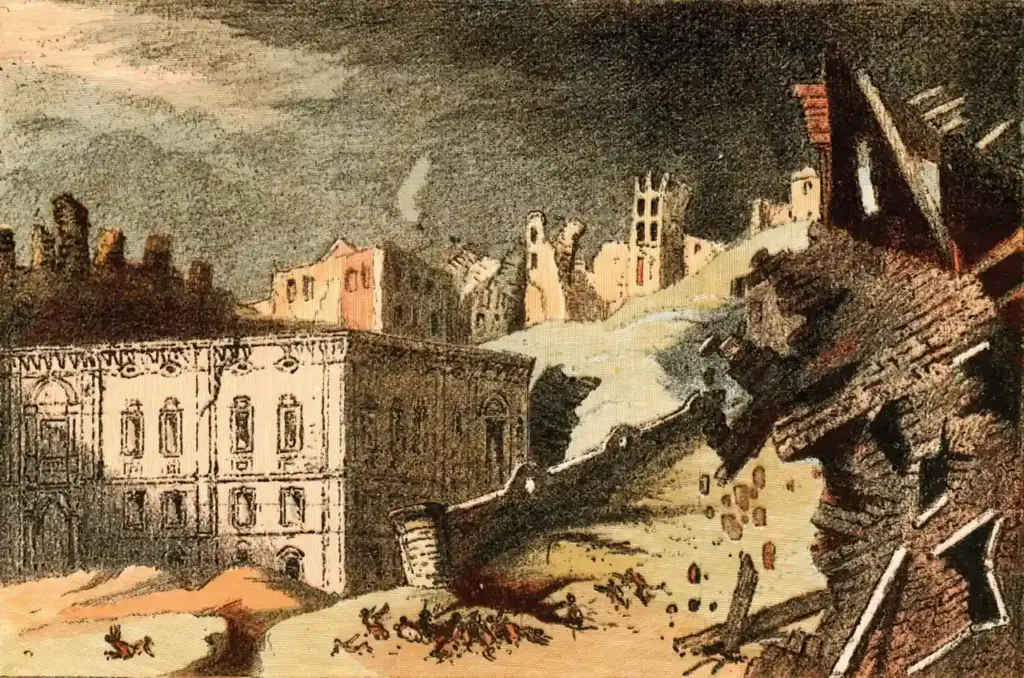
Lisbon Cathedral, the Royal Ribeira Palace on the riverfront (now the site of Praça do Comércio), the Carmo Convent, and São Vicente de Fora were among the major structures damaged or destroyed in this first phase alone — before the fire or the tsunami had even started.

Why the Death Toll Still Depends on Who You Ask
If you read five different sources on this earthquake, you’ll likely see five different death toll figures, and that’s not sloppy research — it reflects a genuinely unresolved historical question.
The most commonly cited range for Lisbon itself is 30,000 to 40,000 deaths, with a further estimated 10,000 in Morocco, where the tsunami and associated shaking also caused serious damage. Combined regional estimates run as high as 40,000–50,000, but there was no reliable census-style count possible in a city where entire parish records had just burned. Later historians reconstructed estimates from parish reports, foreign diplomats’ letters, and Pombal’s own post-disaster survey — which is a reasonably rigorous method for the 18th century, but still leaves a range rather than a single confirmed number.
I mention the range rather than picking one figure because that’s the honest answer: nobody alive today can give you an exact count, and treating any single number as definitive misrepresents how uncertain 18th-century disaster reporting actually was. What’s not in dispute is the scale — this remains one of the deadliest earthquakes in recorded European history, and at the time it was almost certainly the deadliest natural disaster most of Europe had ever heard about in real time, since Lisbon was a major trading and diplomatic hub with fast lines of communication to the rest of the continent.

The Fire That Followed the Candles, and the Wave That Followed the Fire
Timing made this disaster compound in a way most earthquakes don’t. It happened on the one day of the year when nearly every candle and votive lamp in the city was lit at once, for All Saints’ Day observances in churches and private homes alike. When the shaking knocked those candles and lamps over, the resulting fires had no shortage of fuel — wooden pews, festival decorations, dry timber roof structures — and no organized way to fight them, since the people who would have responded were dead, injured, or fleeing.
The fire grew into a firestorm and burned for approximately six days. Separately — and this is the detail people find hardest to picture — about 40 minutes after the ground stopped shaking, a tsunami arrived from the Atlantic and pushed up the Tagus into the harbor and downtown area. It came in three separate waves, with the first reaching an estimated 6 metres at Lisbon itself; wave heights recorded elsewhere in the Atlantic basin, including reports of around 20 metres at Cádiz in Spain, were considerably higher.
So within the space of about an hour, central Lisbon was hit by a major earthquake, followed by a rising fire, followed by a tsunami surging up the same riverfront the fire was consuming. Anyone who fled the fire toward the open ground of the waterfront — a reasonable instinct — ran directly into the tsunami’s path instead. It’s the kind of sequence that reads like exaggeration until you check each element against the historical record separately, and each one checks out.

The Man Who Rebuilt Lisbon: Pombal’s Response
The response fell to Sebastião José de Carvalho e Melo, chief minister to King Joseph I and later titled the 1st Marquis of Pombal, a man the established aristocracy had never fully accepted because of his more modest family background. The earthquake, oddly, is what let him consolidate real political power — his handling of the crisis was competent enough that it outmaneuvered the court factions that had spent years trying to sideline him.
The line usually attributed to Pombal in the immediate aftermath is some version of “bury the dead and feed the living” — whether or not it’s an exact quote, it captures the practical, unsentimental approach he took: mass burials at sea to prevent disease, price controls to stop opportunistic profiteering on food and building materials, and martial law to prevent looting in the ruins.
What sets Pombal apart from most disaster-era administrators of the period is what he did next. He sent a written questionnaire to parishes across Portugal asking specific, structured questions — the exact time and duration of the shaking, which direction buildings had collapsed, how many people had died, how the sea had behaved, how long the fires burned. That’s a systematic, evidence-gathering approach to a natural disaster more than a century before seismology existed as a formal discipline, which is why some historians credit Pombal, not a scientist, as an early forerunner of the field.
King Joseph I, for his part, reportedly never fully recovered from the fear of being inside a stone building again. He spent the rest of his reign living in tents and temporary wooden structures rather than returning to a walled palace — not a detail most guidebooks include, but one that says a lot about how deeply this event marked the people who lived through it, including the man at the top.

The Pombaline Cage: How Lisbon Was Built to Survive the Next One
Pombal’s reconstruction plan for the destroyed lower town — what’s now called the Baixa Pombalina — wasn’t just about clearing rubble and rebuilding. It was, for its time, a genuinely engineered response to the specific way buildings had failed.
The plan laid the new district out on a regular grid, with street widths fixed near 12 metres and building heights regulated across each block, partly for light and partly to prevent the kind of chaotic, cramped construction that had made the original medieval streets so lethal when they collapsed. But the real engineering innovation was inside the walls: a symmetrical wood-lattice frame called the “gaiola pombalina,” or Pombaline cage, built into the structure to absorb and distribute seismic force rather than letting rigid stone walls simply crack and fall. Firebreak walls between adjoining buildings were also built taller than the roof timbers, specifically to slow the kind of building-to-building fire spread that had turned one disaster into three.
Before any of this was actually built at scale, Pombal’s engineers tested scale models by having troops march in formation around them to simulate the vibration of an earthquake — a low-tech but genuinely empirical way of stress-testing a design before committing a rebuilt city to it. Structural historians studying the period have since assessed the Pombaline cage as the most advanced anti-seismic building technology in 18th-century Europe, developed and deployed faster than most of the continent would see anything comparable.
I always point this detail out to clients walking through the Baixa: the grid underfoot and the buildings on either side of you aren’t just “old Lisbon” in a generic sense — they’re a direct, dated engineering response to a specific catastrophe, built to a specification that was tested before it was trusted.
How One Earthquake Changed European Philosophy
It’s a strange thing for a natural disaster to end up in the history of philosophy, but the 1755 earthquake genuinely did, largely because of how it landed on Voltaire.
Voltaire used the earthquake in his 1759 novella *Candide* to go after Gottfried Leibniz’s philosophical claim that this is “the best of all possible worlds” — it’s hard to defend that position with a straight face against 30,000-plus deaths on a religious holiday, and Voltaire made that argument with characteristic bite rather than subtlety. Jean-Jacques Rousseau pushed back directly, arguing that the scale of the death toll had less to do with divine judgment and more to do with the simple fact that people were crammed into tall, dense buildings in a city center — a rare case of two major Enlightenment thinkers arguing openly with each other over the meaning of a single event.
Separately, and more quietly, a young philosopher in his early thirties named Immanuel Kant published three separate essays on the earthquake in 1756, trying to explain it through natural causes — shifting underground cavities and gases — rather than supernatural ones. It wasn’t a fully correct theory by modern standards, but it was a genuinely modern method: observe, gather reports, propose a mechanical cause. Some historians, including the critic Walter Benjamin, have pointed to these essays as an early foundation of both scientific geography and seismology as fields.
So a single morning in Lisbon ended up producing a satirical attack on optimism, a foundational argument about urban density and human suffering, and one of the first attempts at a scientific theory of earthquakes — from three of the most influential thinkers of the century, none of whom had ever set foot in Portugal.

Where to See the Earthquake’s Legacy in Lisbon Today
Most of what destroyed 18th-century Lisbon is, obviously, long gone. But a surprising amount of the aftermath is still standing, and it’s one of the more overlooked ways to actually understand the city rather than just photograph it.
The clearest physical evidence is the **Carmo Convent** ruins in Chiado — a roofless Gothic church, left without a rebuilt roof as a deliberate reminder of the disaster, now housing the Carmo Archaeological Museum inside what used to be the nave. Standing under open sky where a vaulted ceiling used to be is the single most direct way to grasp the scale of what happened here, more than any plaque or written account manages.
From there, walking down into the **Baixa Pombalina** puts you directly inside Pombal’s rebuilt grid — the regular street widths, the uniform building heights, the Pombaline cage construction hidden inside walls that still stand nearly 270 years later. **Praça do Comércio**, built over the ruins of the old Ribeira Palace, is the endpoint of that walk and the clearest single symbol of the city’s decision to rebuild as a functioning commercial and government center rather than restore a royal residence. Up in Alfama — one of the few districts that survived largely intact because it sat on more stable ground — the Santa Luzia azulejo tile panel shows the square as it looked before the earthquake, which is about as close as you can get to a side-by-side comparison without a time machine.
None of this requires a special detour. It’s the same ground most Lisbon walking routes already cover — the difference is knowing what you’re actually looking at.
Explore Lisbon’s Earthquake Legacy on a Private Tour
The 1755 earthquake reshaped Lisbon more than any other event in its history. Walking through Baixa, Praça do Comércio and the surviving streets of Alfama makes the city’s layout—and its history—far easier to understand than reading about it on a map.
Our private tours follow the areas most affected by the earthquake, with time to explain how the city was rebuilt and why modern Lisbon looks the way it does today.
| Tour | What’s Included | Details |
|---|---|---|
| Lisbon Private Tour | Baixa · Praça do Comércio · Alfama · Belém · optional custom stops | All you need to see in Lisbon |
| Best of Lisbon Tour | Full-day Lisbon, Cascais, Sintra in one day. | All major landmarks in one day |
FAQ
When exactly did the 1755 Lisbon earthquake happen?
The earthquake struck on Saturday, 1 November 1755 — All Saints’ Day — at approximately 09:40 local time.
How many people died in the 1755 Lisbon earthquake?
Estimates for Lisbon itself range from 30,000 to 40,000 deaths, with a further estimated 10,000 in Morocco. No exact figure exists because the disaster destroyed much of the record-keeping capacity of the city at the time.
What was the magnitude of the earthquake?
Seismologists estimate a magnitude of 8.5–9.0 on the moment magnitude scale. Since no instruments existed in 1755, all figures are reconstructed from written accounts and geological evidence.
Why did fires start across the city after the earthquake?
The earthquake struck on All Saints’ Day, when candles and votive lamps were lit in nearly every church and home for the religious observance. The shaking knocked many of them over, igniting fires that spread into a firestorm burning for roughly six days.
Was there really a tsunami in Lisbon?
Yes. About 40 minutes after the earthquake, a tsunami arrived from the Atlantic in three separate waves, reaching an estimated 6 metres at Lisbon and considerably higher at points elsewhere in the Atlantic basin, including reports of around 20 metres at Cádiz, Spain.
Who was responsible for rebuilding Lisbon after the earthquake?
Sebastião José de Carvalho e Melo, later titled the 1st Marquis of Pombal, directed both the emergency response and the reconstruction as chief minister to King Joseph I.
What is the "Pombaline cage"?
It’s the internal wood-lattice frame (“gaiola pombalina”) built into the walls of rebuilt Lisbon buildings after 1755, designed to distribute seismic force rather than let rigid stone walls crack and collapse. Structural historians rank it among the most advanced anti-seismic building methods in 18th-century Europe.
Can you still see damage from the 1755 earthquake in Lisbon today?
Yes — the Carmo Convent ruins in Chiado are the most visible surviving trace, a roofless Gothic church left standing open to the sky. The Baixa Pombalina district and Praça do Comércio are the direct results of Pombal’s post-earthquake rebuilding plan.
How did the earthquake affect European philosophy?
Voltaire used it in Candide (1759) to attack the idea that this is “the best of all possible worlds.” Rousseau argued the death toll reflected the dangers of dense urban living rather than divine judgment. Immanuel Kant published three essays in 1756 attempting a natural explanation, work later cited as an early foundation of seismology.
Is Praça do Comércio built on the site of the earthquake's destruction?
Yes. It was built over the ruins of the Royal Ribeira Palace, which was destroyed in the earthquake, as part of Pombal’s plan to replace the royal residence with a civic and commercial center.

Founder & Director of Yellow Cab TT Tours. Guiding in Portugal for 20+ years.
Founded Yellow Cab TT Tours in 2013. 3,372 five-star reviews on Tripadvisor.