

Walk into Time Out Market Lisbon through the wrong door and you’ll end up buying fish, not lunch. Half of this 19th-century market hall at Cais do Sodré is still a working municipal market — the same fresh fish, fruit and vegetable stalls that have operated here for well over a century. The other half is Time Out Market: 26 restaurants, 8 bars, and a food hall concept a magazine built almost by accident, out of its own restaurant reviews.
Most visitors know the food hall and never learn the building has a name of its own — locals call it the Mesquita do Nabo, the Turnip Mosque, after a dome so grand it looked religious on top of a vegetable market. Fewer still know the market burned down once, sat half-ruined for over thirty years, and was demolished and rebuilt before Time Out ever touched it.
This guide covers the building’s actual history back to 1882, how a magazine won the right to run a food hall inside it, the chefs who opened the original flagship stalls in 2014 — and what several of them went on to do afterward — plus the practical details: hours, how to get there, and what else is packed into the building besides the counters. I’ve been walking clients through this market since it opened, mostly because it’s one of the few places in Lisbon where lunch and a genuine 140-year-old building come in the same stop.
The Turnip Mosque: A Market Hall That Burned, Was Demolished, and Came Back Domed
The building is much older than the food hall inside it, and its history has very little to do with celebrity chefs or curated restaurant stalls.
Ressano Garcia’s Original Market
The market opened on 1 January 1882 as the Mercado da Ribeira Nova, designed by engineer Frederico Ressano Garcia, the same man who planned Avenida da Liberdade and much of Lisbon‘s 19th-century expansion northwards. His design covered roughly 10,000 m² and used an iron-frame structure organised around a central corridor with running water — an important sanitary innovation for the time, allowing fish and produce to be kept properly cooled instead of exposed in the open air.
Fire, Demolition, and the 1930 Rebuild
On 7 June 1893, a fire destroyed the market’s eastern section. After several decades of repairs and alterations, Lisbon City Council demolished the damaged structure in 1926 and commissioned architect João Piloto to design a replacement, which reopened in 1930.
The 1930 rebuilding gave Mercado da Ribeira the appearance it still has today: the large central dome with its tiled exterior and painted interior, ceramic entrance panels depicting maritime scenes by Jorge Colaço, and frescoes of fruit and vegetables by Italian painter Gabriel Constanti. The dome’s silhouette looked so unusual above an everyday produce market that Lisboetas gave the building an affectionate nickname — Mesquita do Nabo (“The Turnip Mosque”). More than ninety years later, the nickname has survived far longer than most of the vegetables that inspired it.

How a Magazine Turned Its Own Restaurant Reviews Into a Building
Time Out Market began not as a private development but as the result of a municipal concession. In October 2010, Lisbon City Council offered part of the historic Mercado da Ribeira building for a 20-year concession: roughly 5,000 m², covering half of the ground floor and the entire first floor. Time Out Lisboa was the only bidder. Rather than creating a conventional food court, the magazine proposed something different — inviting many of the restaurants and chefs it had already recommended in its editorial reviews to operate permanent stalls inside the market.
That idea became the foundation of the market’s enduring slogan: “the world’s first editorially curated market.” Instead of simply leasing space to whoever applied, the tenant mix was selected by the publication’s editorial team, turning years of restaurant reviews into a physical dining destination.
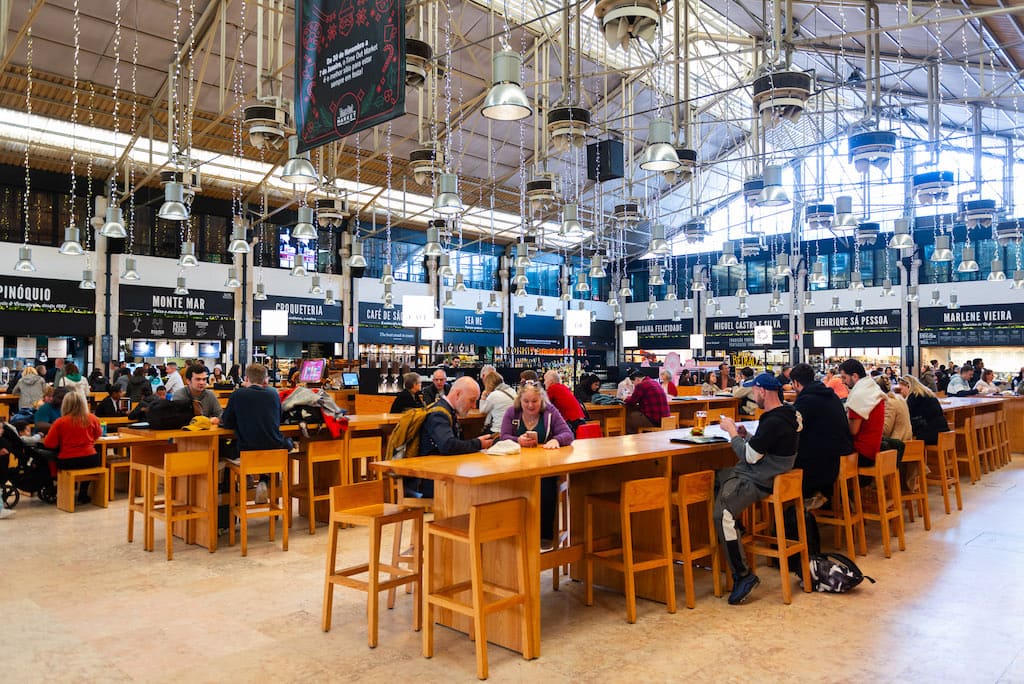
Following a major renovation, Time Out Market Lisbon opened in May 2014 with 30 restaurant stalls spread across approximately 3,000 m², offering seating for around 500 people indoors and 250 more on the outdoor terrace. Didier Souillat, who later led the brand’s international expansion, joined as Global CEO in 2016, after the Lisbon market had already established itself as a successful concept.
The numbers quickly confirmed the idea’s success. By 2016, the market was generating annual revenues of around €24 million while attracting more than 3 million visitors. By 2018, annual visitor numbers had risen to almost 4 million, making it one of Lisbon’s busiest attractions. That same year, Time Out Market received the Hamburg Foodservice Award, one of the hospitality industry’s most respected international honours.

The Chefs Who Opened the First Stalls
When Time Out Market opened in 2014, it brought together 30 restaurant concepts, including dedicated counters from five of Portugal’s best-known chefs: Alexandre Silva, Miguel Castro e Silva, Marlene Vieira, João Rodrigues, and Henrique Sá Pessoa. Their later careers helped establish the market as more than a food hall — it became a platform where established chefs could reach a wider audience while newer projects gained visibility.
Alexandre Silva had already won Portugal’s Top Chef competition in 2012 before joining the market. In December 2015, he opened Loco, which earned a Michelin star just eight months later. Henrique Sá Pessoa was the chef behind Alma, one of Lisbon’s most celebrated restaurants, awarded one Michelin star in 2016 and a second in 2018. After Alma closed in early 2026, he opened a new restaurant under his own name at Páteo Bagatela in Amoreiras, which immediately received two Michelin stars.
Marlene Vieira was the only woman among the five founding chefs. She continued operating both her own restaurant, Marlene, and a counter at Time Out Market, receiving her first Michelin star in 2025. The market has also long been home to Manteigaria, whose freshly baked pastéis de nata have become one of Lisbon’s most popular alternatives to the famous bakeries in Belém.
The restaurant line-up has evolved over the years, and today’s selection extends well beyond the original chefs. Even so, the pattern established in 2014 remains largely the same: Time Out Market serves not simply as a collection of food stalls, but as a showcase for many of Portugal’s leading chefs and some of the country’s most recognised restaurant brands.

More Than Food: Cooking School, Coworking and a Concert Stage
The restaurants may be the main attraction, but Time Out Market offers considerably more than places to eat.
Time Out Academy, the market’s cooking school, hosts classes ranging from introductory workshops to masterclasses led by well-known Portuguese chefs under the direction of Chef Miguel Mesquita. The building also includes a concert venue for live performances and events, as well as a late-night bar and club, helping explain why the market stays open until 02:00 on weekends rather than closing after dinner service.
One of the building’s least expected features is Second Home, a coworking space designed by the Spanish architecture studio SelgasCano. Hidden above the food hall, it transformed part of the former market into one of Lisbon’s most distinctive shared workspaces, demonstrating how a 19th-century municipal market has successfully evolved into a mixed-use destination without losing its original character.

From Cais do Sodré to an International Brand
Lisbon was not only the first Time Out Market — it became the model for every market that followed. After the success of the Mercado da Ribeira project, the concept expanded internationally, beginning with Miami in 2019. New markets subsequently opened in New York, Boston, Chicago, Montréal, and Dubai, with additional locations continuing to launch in other cities.
Each market follows the same principle first developed in Lisbon: bring together many of a city’s best chefs and restaurants under one roof, with the selection curated by Time Out’s editorial team rather than through a traditional commercial leasing process. The result is a food hall built around local restaurant recommendations instead of simply filling available space.
Despite its global expansion, the Cais do Sodré market remains the original and the flagship location. It continues to serve as the reference point for every new Time Out Market that opens elsewhere in the world.

Getting There and Practical Info
Address: Avenida 24 de Julho 49, 1200-479 Lisbon.
On foot: The market is about a 2-minute walk from Pink Street (Rua Nova do Carvalho), one of Lisbon’s best-known nightlife areas.
Metro, train and ferry: Time Out Market sits directly beside Cais do Sodré Station, served by the Green Line metro, the Cascais commuter railway, and the Transtejo ferry terminal with services to Cacilhas across the Tagus River. It is one of the city’s most convenient transport hubs.
Opening hours:
- Sunday–Wednesday: 10:00–00:00.
- Thursday–Saturday: 10:00–02:00.
Entry: Free. No reservation is required.
Best time to visit: The busiest period is 12:30–14:00, when tourists and local office workers arrive for lunch. For the best chance of finding a table without waiting, visit shortly after opening at 10:00 or later in the afternoon, after 15:00.
What to taste Portuguese food – check out our What to Eat in Lisbon guide.
Visit Time Out Market on a Private Lisbon Tour
Time Out Market is an easy addition to our Lisbon Private Tour, especially around lunchtime. Located between Baixa, Cais do Sodré, and the waterfront, it makes a convenient stop to experience some of the city’s best food without straying from the main sightseeing route.
If you’d rather try traditional Portuguese dishes than eat at a food hall, we can adjust the itinerary and recommend a local restaurant instead. Every private tour is flexible and can be tailored to your interests and preferred pace.
| Tour | Includes | Details |
|---|---|---|
| Lisbon Private Tour | Baixa · Alfama · optional Time Out Market stop · flexible itinerary | Private vehicle, hotel pickup |
FAQ
What is Time Out Market Lisbon?
Time Out Market is a food hall inside the historic Mercado da Ribeira building at Cais do Sodré, occupying roughly half the structure. Time Out Lisboa magazine won a Lisbon City Council public tender for the space in 2010 and opened the market in May 2014, curating stalls from restaurants the magazine had already reviewed and recommended.
Is Time Out Market free to enter?
Yes. There is no entry fee and no reservation required — visitors walk in, order individually from any of the 26 restaurants, 8 bars, or 6 kiosks, and find a seat at one of the shared tables.
What is the history of the building?
The market building first opened on 1 January 1882, designed by engineer Frederico Ressano Garcia. A fire on 7 June 1893 destroyed its eastern section; the city demolished the damaged structure in 1926 and rebuilt it under architect João Piloto, reopening in 1930 with the domed skylight visible today.
Why is the building nicknamed the "Turnip Mosque"?
The 1930 reconstruction added a domed skylight so grand it resembled religious architecture sitting above stalls selling vegetables. Lisboetas nicknamed the whole building “Mesquita do Nabo” (Turnip Mosque), and the name has remained in local use for nearly a century.
Is the old fish and vegetable market still there?
Yes. Roughly half of the historic building continues to operate as a working municipal market selling fresh fish, fruit and vegetables, the same trade it has hosted since 1882 — separate from, and next to, the Time Out Market food hall.
What chefs are behind Time Out Market's restaurants?
The market opened in 2014 with 30 restaurants, including flagship stalls from five chefs: Alexandre Silva, Miguel Castro e Silva, Marlene Vieira, João Rodrigues, and Henrique Sá Pessoa. Several went on to open Michelin-starred restaurants of their own, including Silva’s Loco (1 star, 2016) and Sá Pessoa’s Alma, which held 2 stars before closing in early 2026 — Sá Pessoa’s new restaurant at Páteo Bagatela earned 2 stars immediately on opening. Marlene Vieira, the only woman among the founding five, was awarded her own Michelin star in 2025.
What are Time Out Market's opening hours?
Sunday to Wednesday, 10:00 to midnight. Thursday to Saturday, 10:00 to 2:00 a.m. — late enough that the market functions as a nightlife stop as well as a dining venue.
How do I get to Time Out Market Lisbon?
It sits at Avenida 24 de Julho 49, directly beside Cais do Sodré station, which serves the Cascais commuter rail line, the Green Line metro, and the ferry terminal to Cacilhas. It is a two-minute walk from Pink Street (Rua Nova do Carvalho).
Is Time Out Market Lisboa the only one?
No. The Lisbon market, opened in 2014, was the first. Time Out Market expanded internationally starting in 2019 with locations in Miami, New York, Boston, Chicago and Montréal, followed by Dubai in 2021 — all modelled on the original Lisbon concept.
Is there anything at Time Out Market besides food stalls?
Yes. The building also houses Time Out Academy, an on-site cooking school; a concert venue; a late-night disco/bar; and Second Home, a coworking space designed by architecture firm SelgasCano.

Founder & Director of Yellow Cab TT Tours. Guiding in Portugal for 20+ years.
Founded Yellow Cab TT Tours in 2013. 3,372 five-star reviews on Tripadvisor.