
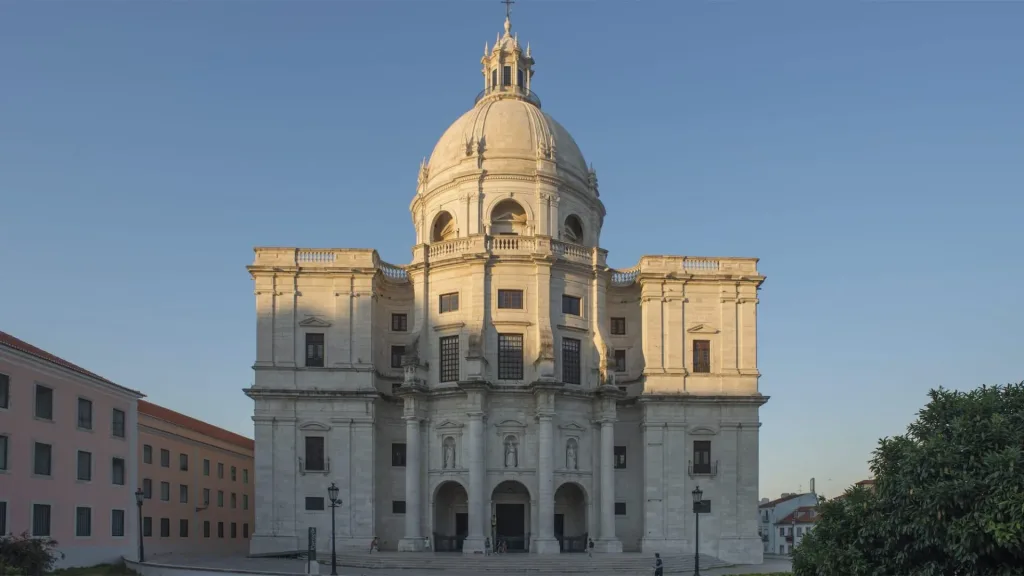

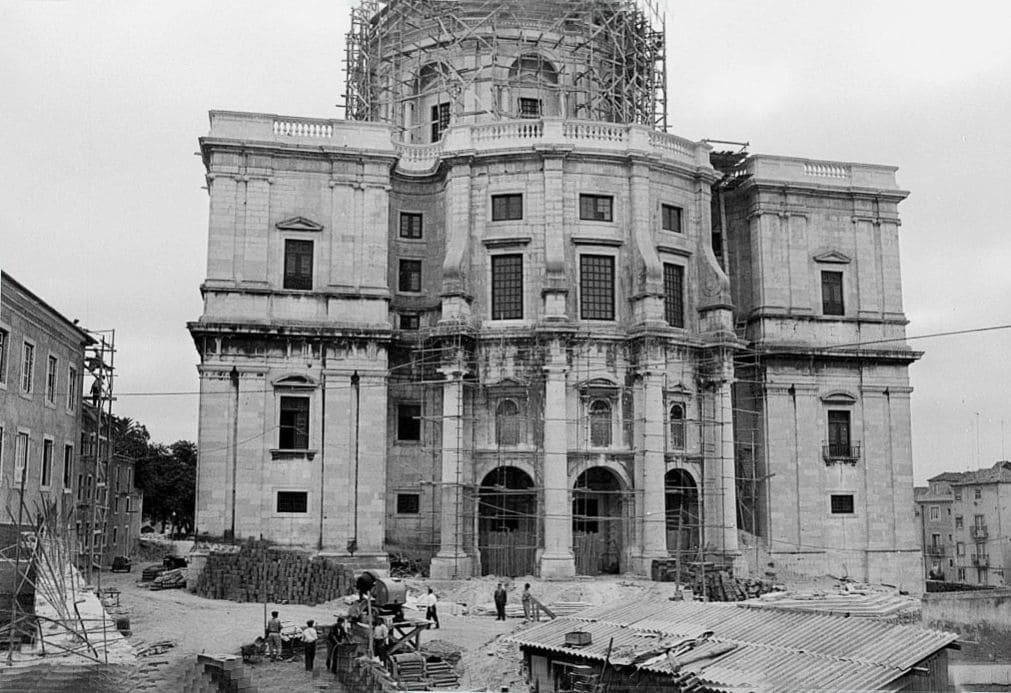
There’s a Portuguese expression for a job that never seems to end: “obras de Santa Engrácia” — the works of Santa Engrácia. It comes from one specific building, and the building earned it honestly. Construction began in 1682. It wasn’t finished until 1966. That’s 285 years, which is longer than the United States has existed as a country, spent building one domed church on a hill above Alfama.
The story behind the delay involves an abandoned king’s project, a man executed for a theft he didn’t commit, and a curse that turned out to be entirely accurate. By the time the dome was finally closed, the building had stopped being a church at all — it had become Portugal’s National Pantheon, the resting place of presidents, poets, a fado singer, and a footballer, alongside empty tombs honouring men whose actual remains lie elsewhere.
I’ve walked past this building for over twenty years on the way up to São Jorge Castle, and most visitors treat it as scenery — a big dome next to a monastery, worth a photo from outside and nothing more. It’s worth going in. Here’s the full story, including the one detail about ticket pricing that most guides to this place still get wrong.
The Building That Took 285 Years
The site had a church on it long before the current building existed. Infanta Maria, daughter of King Manuel I, commissioned a smaller 16th-century church here to house the relic of Saint Engrácia. It stood until a storm badly damaged it in 1681, which is what opened the door for something much bigger.
Reconstruction began in 1682 under architect João Antunes, working in the Portuguese Baroque style, with a Greek-cross floor plan and a dome as its centrepiece — genuinely ambitious for its time. Antunes died in 1712 with the building still incomplete, and King John V, who might have pushed it forward, chose instead to pour royal money and labour into the Convent of Mafra. Santa Engrácia was left to sit, quite literally roofless, for the better part of two centuries. At various points the unfinished shell served as an ammunition depot and briefly as a shoe factory — not exactly the trajectory anyone expects for a future national monument.
Out of this came the idiom: “obras de Santa Engrácia,” still used across Portugal today for any project — a house renovation, a piece of bureaucratic paperwork, a road repair — that seems to have no realistic end date. I’ve heard Portuguese friends use the phrase about things that have nothing to do with Lisbon or churches at all. It’s become fully detached from its origin, the way “kafkaesque” no longer requires anyone to have read Kafka.
The Curse of Simão Solis
The most vivid part of the story predates the current building. On 15 January 1630, the reliquary of Saint Engrácia was stolen from the church that stood on this site. A young man named Simão Pires Solis — a cristão-novo, one of Portugal’s “New Christians,” Jewish converts to Catholicism who were routinely viewed with suspicion in this period — was accused, tried, and, despite protesting his innocence, condemned to death.
The reason he’d been seen near the scene had nothing to do with the theft. Solis had been secretly riding to the nearby Convent of Santa Clara to meet Violante, a young woman forced to take the veil there against her will after her father refused to accept their relationship. To protect her from scandal, Solis never explained to his judges why he’d actually been in the area. He was burned at Campo de Santa Clara on 31 January 1631, in the square the Pantheon now overlooks, and as he passed the church on the way to his execution he is said to have cursed it: “It is as certain that I die innocent as these works will never end.” Given what happened over the next 285 years, it’s hard to argue with him.
The twist came years later, when the actual thief sought out Violante — by then a nun — and confessed directly to her: he had committed the theft, and had let suspicion fall on Solis precisely because he knew about the secret relationship and used it to save himself. Solis had died protecting a woman’s reputation rather than his own life.
It’s a strange thing to stand in the square today, at the base of a building whose endless construction was supposedly cursed into being by a man protecting a doomed romance, and realise the curse is the one part of this story nobody disputes.
Two Different Dates: Designated in 1916, Finished in 1966
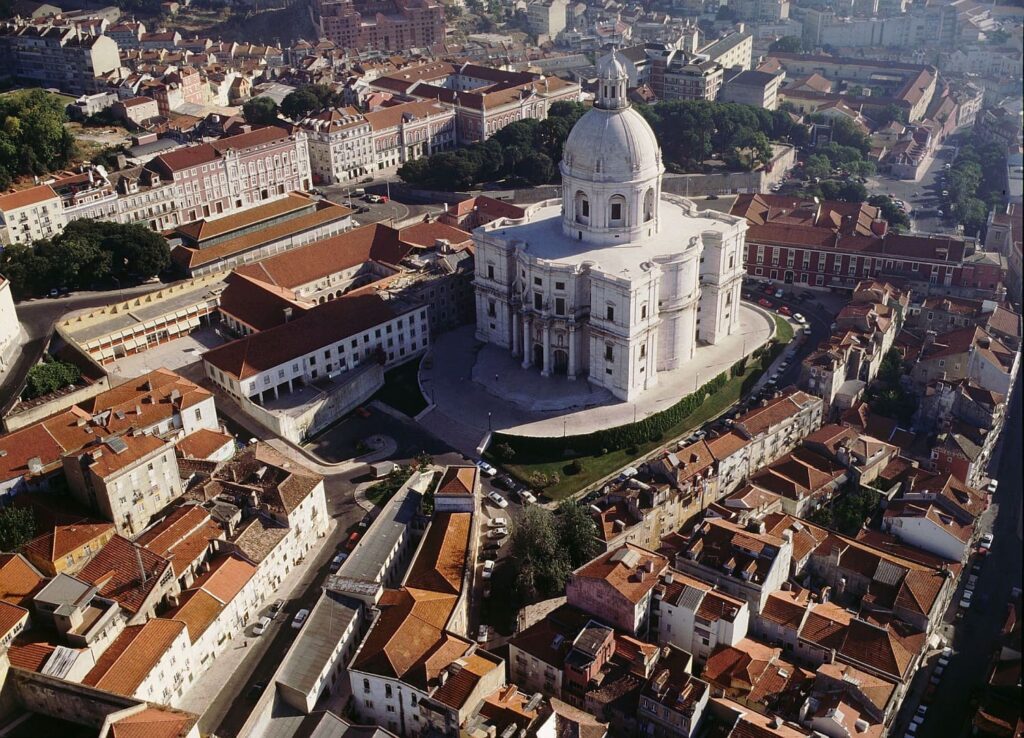
Most accounts of this building compress its 20th-century history into a single date — 1966 — as if the church simply sat unfinished and then, one year, became the National Pantheon. The actual sequence has three separate milestones, not one.
The unfinished, still-roofless church was first classified a national monument in 1910. Six years later, during the First Portuguese Republic, President Bernardino Machado’s government passed Law No. 520 (29 April 1916), formally designating the building — monument status and all, still with no roof — as Portugal’s National Pantheon, a place where the nation’s most significant figures would be honoured. At the time, this was closer to a statement of intent than a functioning building. The dome wasn’t closed, the marble floors weren’t laid, and there was, by most accounts, nowhere yet to actually place a tomb.
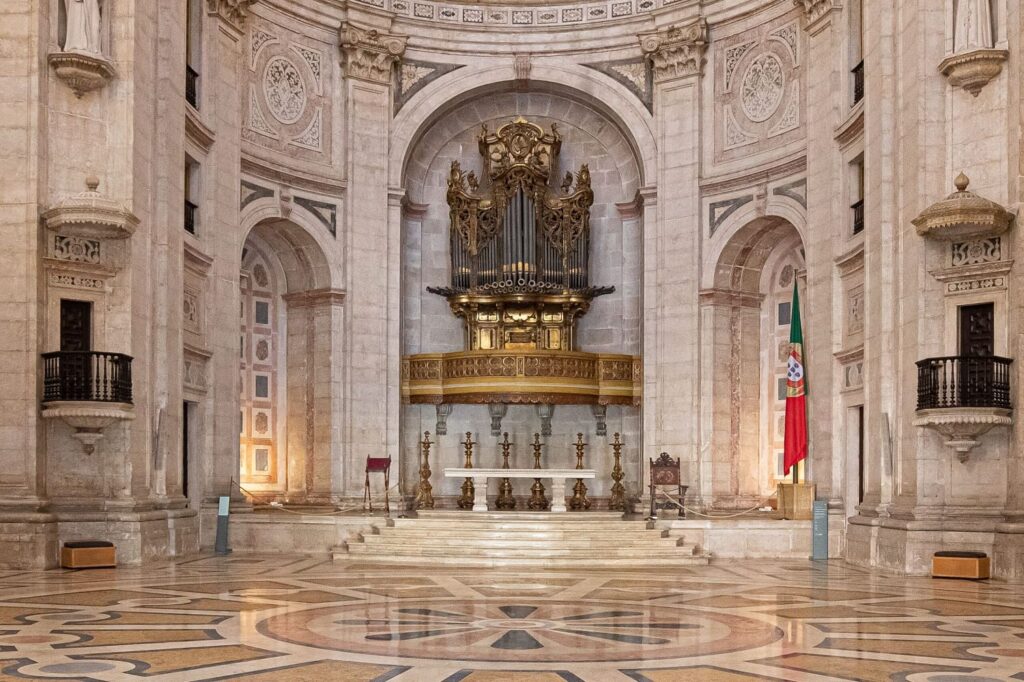
It took another five decades of construction, largely carried out under the Estado Novo, before the building was structurally and decoratively complete. It reopened on 1 December 1966 with its dome finished, its Greek-cross interior finally laid in coloured marble, and the first tombs transferred in.
Two hundred and eighty-five years after the first stone of the current building was set, and 50 years after Portugal decided on paper what the building would become, it actually became that thing.
Who’s Actually Buried Here — and Who Isn’t
The National Pantheon holds two very different categories of tomb, and conflating them is the single most common mistake in guides to this place.
Actual remains are interred here for several Portuguese presidents of the Republic — Manuel de Arriaga, Teófilo Braga, Sidónio Pais, and Óscar Carmona among them — along with writers Almeida Garrett, Eça de Queiroz, and poet Sophia de Mello Breyner Andresen. Fado singer Amália Rodrigues, who died in 1999 and remains the genre’s most recognised voice internationally, is buried here, as is footballer Eusébio, one of the greatest players of his generation. Humberto Delgado, the opposition leader assassinated by the regime’s secret police in 1965, was later reinterred here as well.
Cenotaphs — empty, symbolic tombs — honour figures whose actual remains rest elsewhere: Vasco da Gama, Luís de Camões, Pedro Álvares Cabral, and Afonso de Albuquerque among them. Vasco da Gama’s remains were moved to a carved tomb at Jerónimos Monastery in Belém in 1880, ahead of the 400th anniversary of his voyage — though even that attribution carries an asterisk historians still argue over: research published in 1884 suggested the bones exhumed from his original resting place near Vidigueira may actually belong to his great-grandson, whose gravestone had been confused with his centuries earlier. Whichever version of the story you believe, the point holds: the tomb in the National Pantheon is empty by design, a tribute rather than a grave.
Guests are often surprised the Pantheon doesn’t hold Camões or da Gama’s actual remains, given how prominently both names are attached to the building. It’s a good example of how Portuguese national memory works — the symbolic gesture of honouring someone here matters as much as where the body physically is.
The Dome and the View Most Visitors Miss
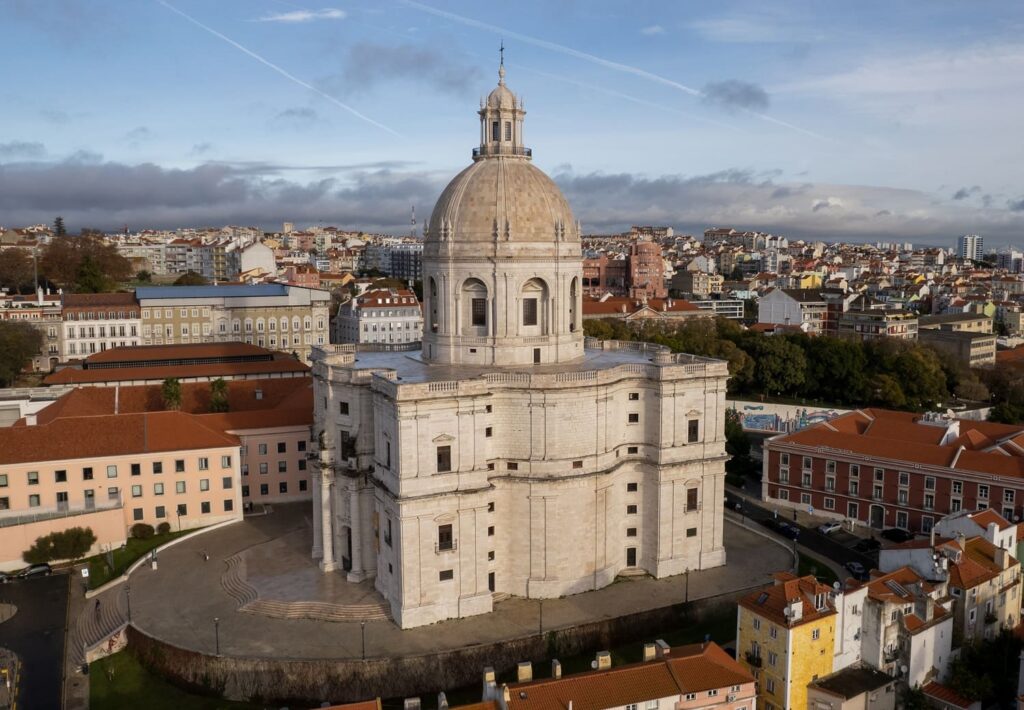
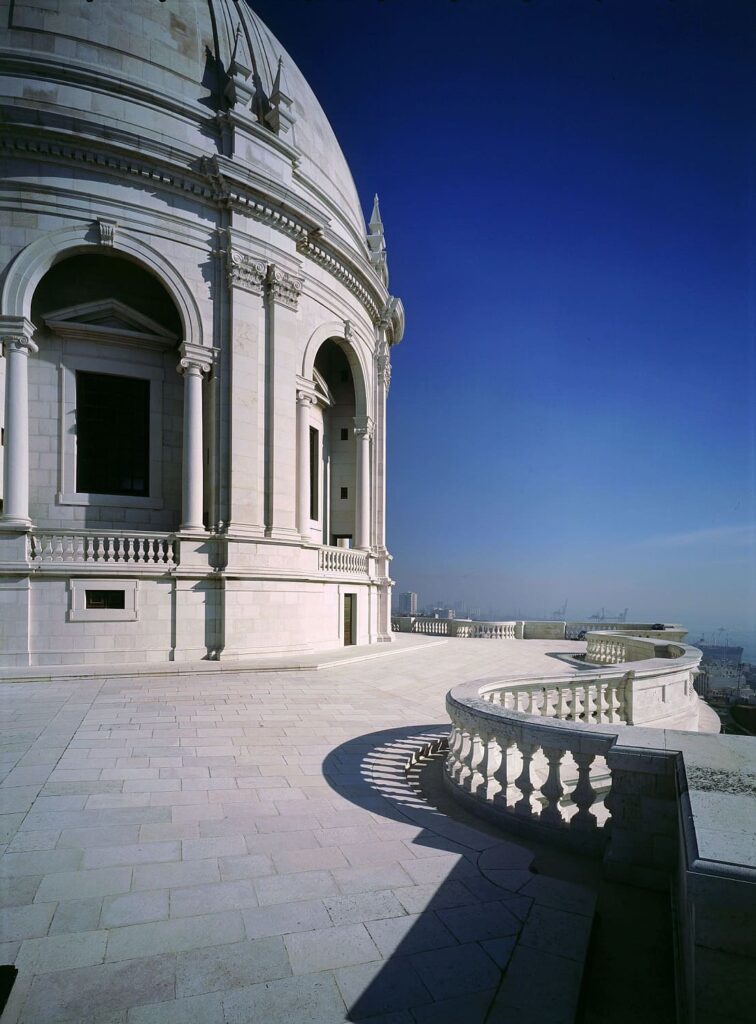
The Pantheon’s dome rises roughly 80 metres above the ground, and it’s climbable — an internal staircase leads up to a wraparound terrace built at its base, one of the better and less crowded viewpoints in this part of the city.
From the terrace, you get a genuine 360-degree sweep: the rooftops of Alfama immediately below, the Tagus river beyond them, the Monastery of São Vicente de Fora next door, and on a clear day, the Vasco da Gama Bridge visible far to the east. It’s a quieter, less-photographed alternative to the well-known Alfama miradouros, mostly because fewer visitors realise the terrace exists at all.
Directly below, on Campo de Santa Clara — the same square where Solis was executed in 1631 — Lisbon’s oldest flea market, Feira da Ladra, sets up every Tuesday and Saturday. If your visit lines up with one of those days, it’s worth combining the two: several centuries of history and a genuinely local market, a few steps apart.
Visiting: Tickets, Hours and Getting There
As of 2026, the official ticket price is €10 for adults, with a 50% discount (€5) for seniors aged 65+ and youth aged 13–24. Children under 12 enter free. Several published guides to this place still quote €4 or €8 — both are out of date; the current official price, confirmed directly on the Pantheon’s own website, is €10.
Entry is free on Sundays and public holidays until 14:00 for everyone, and Portuguese residents with a Cartão de Cidadão and NIF get free entry on up to 52 days per year. Lisboa Card holders enter free at any time, as do visitors with a disability rating of 60% or higher, plus one companion.
Opening hours: October–March, Tuesday to Sunday, 10:00–17:00 (last entry 16:40). April–September, Tuesday to Sunday, 10:00–18:00 (last entry 17:40). Closed Mondays and on 1 January, Easter Sunday, 1 May, 13 June, and 25 December.
Getting there: the Pantheon sits on Campo de Santa Clara in Alfama, next to the Monastery of São Vicente de Fora. The nearest metro is Santa Apolónia (blue line), roughly a 10-minute uphill walk. Tram 28 also passes close by, with a stop near São Vicente de Fora. A typical visit, including the terrace, takes around 30–45 minutes.
See More of Alfama’s History in One Day
The National Pantheon sits just past a stop we already make — ask your guide to add it.
- Private Lisbon City Tour → Alfama, São Jorge Castle, Baixa, Belém and Cristo Rei in one 8-hour day, with the National Pantheon available as an add-on. From €285/vehicle.
FAQ
What is the National Pantheon in Lisbon?
It’s the former Church of Santa Engrácia, converted into Portugal’s national mausoleum. It holds the tombs of presidents, writers, a fado singer, and a footballer, alongside symbolic cenotaphs honouring historical figures buried elsewhere.
Why is it called Santa Engrácia?
The site originally held a smaller 16th-century church dedicated to Saint Engrácia, whose relic it was built to house. The current Baroque building, begun in 1682, kept the name even after its 20th-century conversion into the National Pantheon.
How long did it take to build the National Pantheon?
Construction on the current building began in 1682 and wasn’t completed until 1966 — 285 years, including long stretches where the structure sat without a roof.
What does "obras de Santa Engrácia" mean?
It’s a Portuguese idiom for a job that never seems to finish — a home renovation, a bureaucratic process, anything with no realistic end date. It comes directly from this building’s notoriously slow construction.
Who is buried in the National Pantheon?
Real remains are interred for several presidents of the Republic, writers including Eça de Queiroz and Almeida Garrett, fado singer Amália Rodrigues, footballer Eusébio, and opposition leader Humberto Delgado.
Is Vasco da Gama really buried there?
No. His tomb in the National Pantheon is a cenotaph — an empty, symbolic tomb. The remains attributed to him were moved to Jerónimos Monastery in Belém in 1880, though historians have long debated whether those bones are actually his or his great-grandson’s.
How much does it cost to visit the National Pantheon?
€10 for adults, €5 for seniors (65+) and youth (13–24), and free for children under 12, as of 2026. Entry is free on Sundays and holidays until 14:00.
What are the opening hours?
Tuesday to Sunday, 10:00–17:00 October through March and 10:00–18:00 April through September (last entry 20 minutes before closing). Closed Mondays and on major holidays.
How do you get to the National Pantheon?
It’s on Campo de Santa Clara in Alfama, next to the Monastery of São Vicente de Fora. The nearest metro is Santa Apolónia (blue line), about a 10-minute uphill walk; Tram 28 also stops nearby.
Is the National Pantheon worth visiting?
Yes, particularly for the dome terrace view over Alfama and the Tagus, which is less crowded than the neighbourhood’s well-known miradouros, and for the building’s genuinely unusual history.
Does your Lisbon tour include the National Pantheon?
Not as a standard stop — the fixed itinerary currently reaches São Jorge Castle, a few minutes short of the Pantheon. It’s an easy add-on if you mention it when booking.

Founder & Director of Yellow Cab TT Tours. Guiding in Portugal for 20+ years.
Founded Yellow Cab TT Tours in 2013. 3,372 five-star reviews on Tripadvisor.