
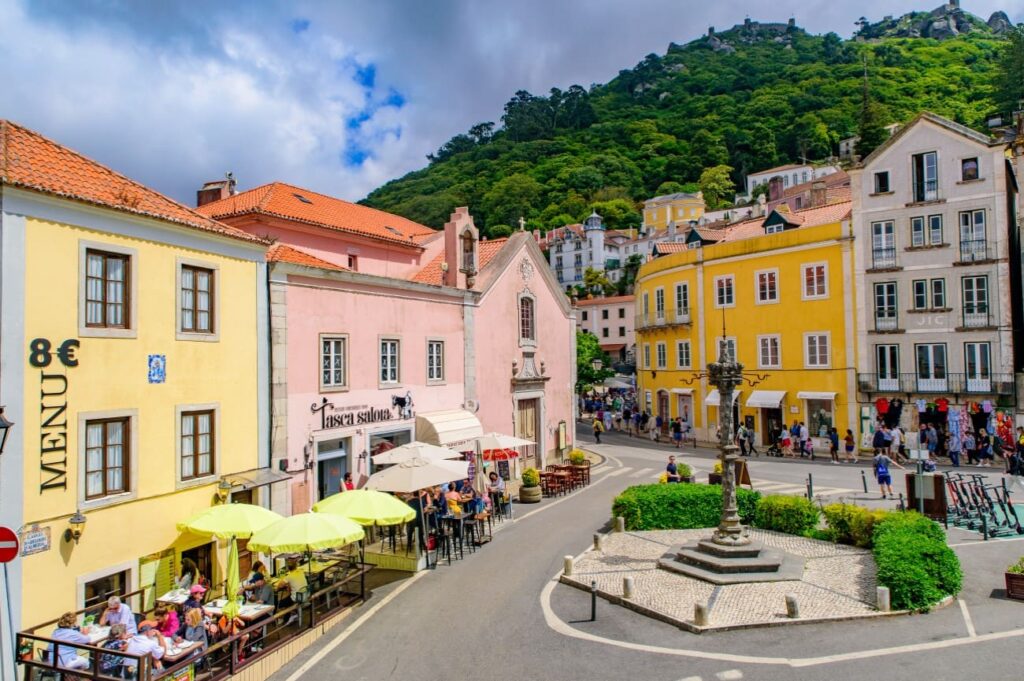

Sintra is 27 km from Lisbon. The train from Rossio takes 40 minutes and costs €2.55 each way. On paper, this is one of the easiest day trips in Europe.
In practice, Pena Palace attracts over 3.3 million visitors per year. Walk-up ticket queues during peak season can run to three hours. The Parques de Sintra system operates timed-entry slots that sell out days in advance during summer. If you arrive in Sintra at 10:30 on a Saturday in July without pre-booked tickets, you will spend most of your day queuing rather than visiting.
None of this means Sintra is not worth doing. It is worth doing — and the cultural landscape here became the first UNESCO World Heritage Site of its type in Europe when it was listed in 1995. What it means is that the train fare is the smallest decision you will make.
I have been guiding clients in Sintra since 2013. In that time the visitor numbers have roughly doubled. This guide is built around how the place actually works now — not how it worked ten years ago, when you could walk up to Pena Palace at 11:00 and buy a ticket on the spot.
How far is Sintra from Lisbon?
Sintra is 27 km northwest of Lisbon, in the foothills of the Sintra Mountains. The drive takes 35–45 minutes depending on traffic; the train takes 40 minutes from Rossio station.
The UNESCO Cultural Landscape of Sintra covers 946 hectares and includes the historic town centre, four major palaces, and the surrounding parkland. It was listed in 1995 as the first cultural landscape to receive UNESCO World Heritage status in Europe — a designation that recognised not just individual buildings but the way the entire hillside environment had been shaped by six centuries of royal and aristocratic building.
The altitude matters for visitors. Sintra town sits at approximately 200 metres elevation; Pena Palace at the summit is at 529 metres. The difference in microclimate between the valley and the hilltop is significant enough that you should carry a layer even in summer — it is noticeably cooler and often misty above 400 metres, which also explains why the vegetation here looks nothing like the rest of Portugal.
How to get to Sintra from Lisbon
By train
The direct train from Rossio station in central Lisbon runs every 15–20 minutes during peak hours and every 20–30 minutes off-peak. The journey is 40 minutes. A single ticket costs €2.55; there is no advance booking — this is an urban rail service operated by Comboios de Portugal, tickets are purchased at the station machines on the day.
If your hotel is not near Rossio, you can pick up the same line at Oriente (connections from the airport) or Entrecampos (connections from the Metro). Both add roughly 5–10 minutes to the journey.
Rossio station itself is worth a moment: the neo-Manueline horseshoe arches on the facade were completed in 1892 and give the building an appearance older than it actually is. The train departs from the lower level; follow signs for “Linha de Sintra.”
One practical note on the return: summer afternoon trains from Sintra are packed. The platform fills from around 16:00. If you want a seat rather than standing for 40 minutes with tired legs, aim to depart Sintra before 15:30 or after 18:30. The 18:30 window is genuinely quieter — most day-trippers leave by 17:00.
By private car or tour
Door-to-door from your accommodation. The A37 motorway from Lisbon to Sintra takes 35–45 minutes in normal traffic; the drive can stretch to 60–70 minutes on Friday afternoons in summer.
The main practical advantages over the train: no shuttle bus queues at the Sintra end, the ability to combine Sintra with Cascais or Cabo da Roca in the same day, door-to-door pickup with no luggage management, and a guide who handles ticket timing rather than you managing it.
There is also a less obvious advantage: a guide who has been making this trip for years knows which timed-entry slot gives you the best light at Pena Palace, which entrance at Quinta da Regaleira to use to avoid the main crowd flow, and where to find the view over Sintra town that nobody photographs because it requires a 3-minute detour off the main path.
For a full breakdown of every transport option including taxis, Uber, and rental cars: How to Get from Lisbon to Sintra.
What you can see in Sintra in one day
Sintra has more significant sites than any single day can cover properly. Realistically, most visitors manage two to three attractions well, or four attractions rushed. Here is what each main site involves — including the details that affect how long you actually need.
Pena Palace
The dominant landmark and the reason most people make the trip. Commissioned in 1838 by King Ferdinand II of Portugal on the ruins of a 16th-century Hieronymite monastery, it was completed in 1854. Ferdinand’s design combined Moorish, Manueline, Gothic, and Romanticist elements into a palace that most architectural movements would struggle to classify — which was exactly his intention.
It sits at 529 metres. The interior contains the original royal furnishings, tableware, and personal effects, largely unchanged since the 1880s. The kitchen still has the original copper pots. Queen Amélia’s bedroom looks as though she left that morning, if you can see it past the other visitors.
The park surrounding the palace covers 200 hectares of mixed forest, with walking trails, water features, and several viewpoints. The park-only experience (without entering the palace interior) is genuinely worthwhile on its own and much cheaper.
- Full ticket (park + palace interior): approximately €20.
- Park-only: approximately €12.
- Timed interior entry: enforced; 30-minute windows; book in advance at parquesdesintra.pt.
- Recommended time: 2 hours minimum for palace + park; 1 hour for park only.
For a full independent guide: Pena Palace, Sintra.

Castle of the Moors
A 9th-century fortification built by the Moors during the period of Islamic rule in the Iberian Peninsula, later captured by Afonso Henriques — the first King of Portugal — in 1147. The walls, towers, and battlements are walkable for their full length. The views from the highest tower over Sintra town, the coast, and on clear days to Lisbon, are among the best vantage points in the entire region.
It is significantly less crowded than Pena Palace and has a different character: quieter, more exposed to weather, more physically demanding (steep uneven stone steps throughout). Most visitors spend 45–75 minutes.
The Moorish Castle shares a shuttle stop with Pena Palace — you can visit both in sequence on the same morning without returning to Sintra town in between.

Quinta da Regaleira
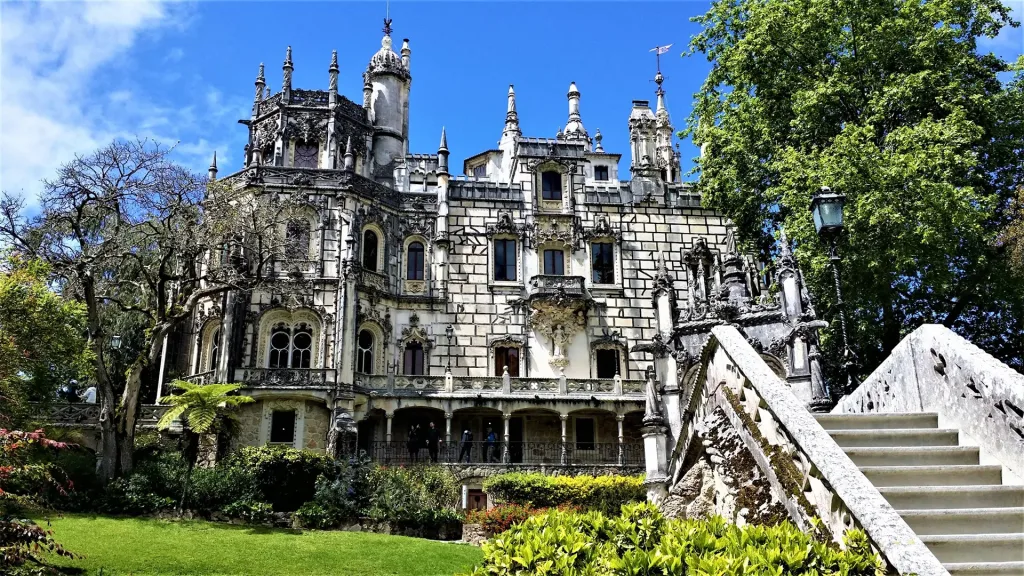
A late 19th-century estate built for Carvalho Monteiro, a Brazilian-born Portuguese millionaire with strong interests in Freemasonry, Rosicrucianism, and esoteric symbolism. The neo-Manueline palace is the centrepiece, but the gardens are what most visitors remember.
The Initiation Well is a 27-metre spiral stone staircase that descends rather than ascends — built for ceremonial use rather than access to water. At the base, a tunnel network connects several underground chambers and grottos spread across the property. The design references Dante’s nine circles, Tarot symbolism, and Templar iconography, which is either compelling or exhausting depending on your tolerance for that sort of thing.
- Ticket: €20.
- Recommended time: 1.5–2 hours minimum; 2.5 hours to explore the full tunnel network.
- Book in advance — not as critical as Pena Palace, but sells out on summer weekends.
For the full story: Quinta da Regaleira, Sintra.
Monserrate Palace
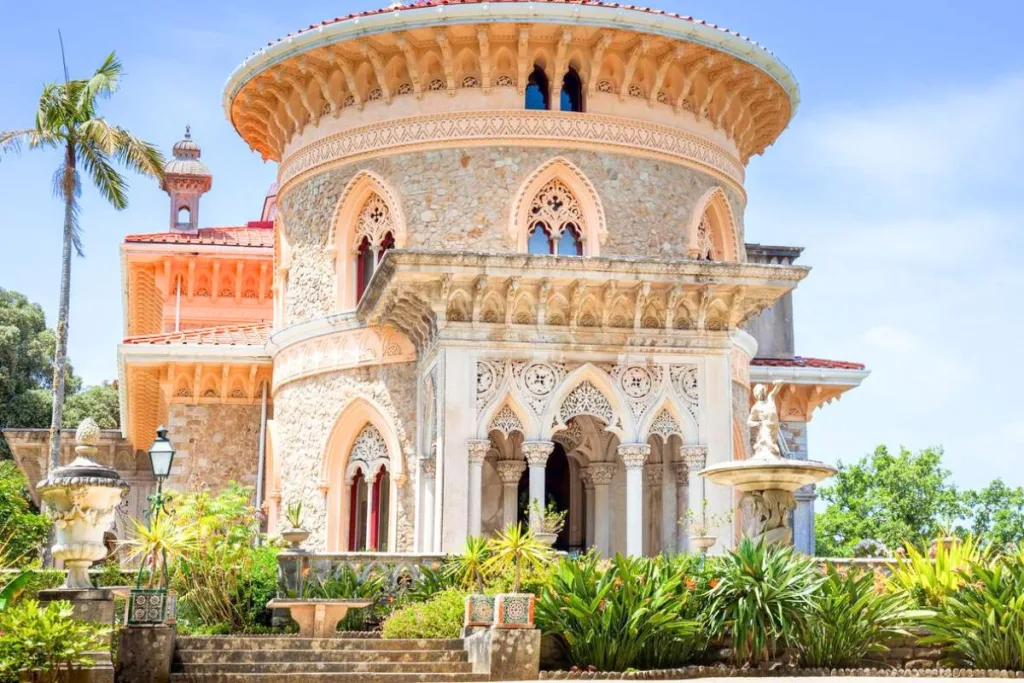
The quietest of the four major monuments, and for that reason often the most satisfying to visit. A Romantic-Moorish palace completed in 1858 within a 30-hectare botanical garden containing plants collected from across the Portuguese colonial world — tree ferns from the Azores, species from Australia, South Africa, and Brazil, all growing together in Sintra’s naturally humid microclimate.
The palace exterior blends Moorish, Gothic, and Indian architectural elements. The interior restoration is ongoing but the ground floor is open. Ticket: approximately €12.
Monserrate is 3.5 km from Sintra station — too far to walk conveniently unless you enjoy distance. The shuttle does not stop here directly; you need the Monserrate-specific bus line or private transport. This is why it sees fewer visitors: it requires a deliberate choice. That is also why it is worth making.
Full guide: Monserrate Palace, Sintra.
Sintra National Palace
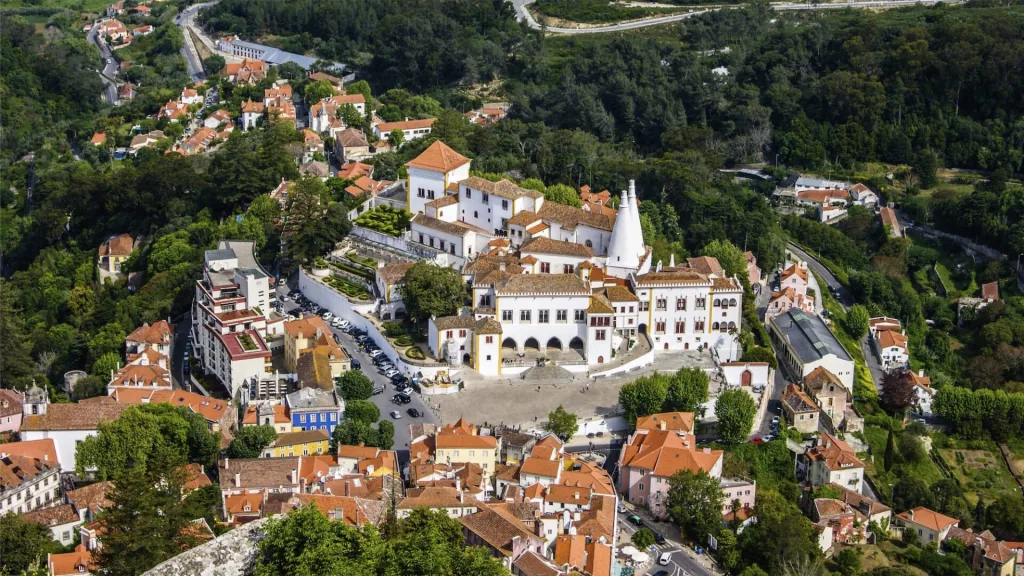
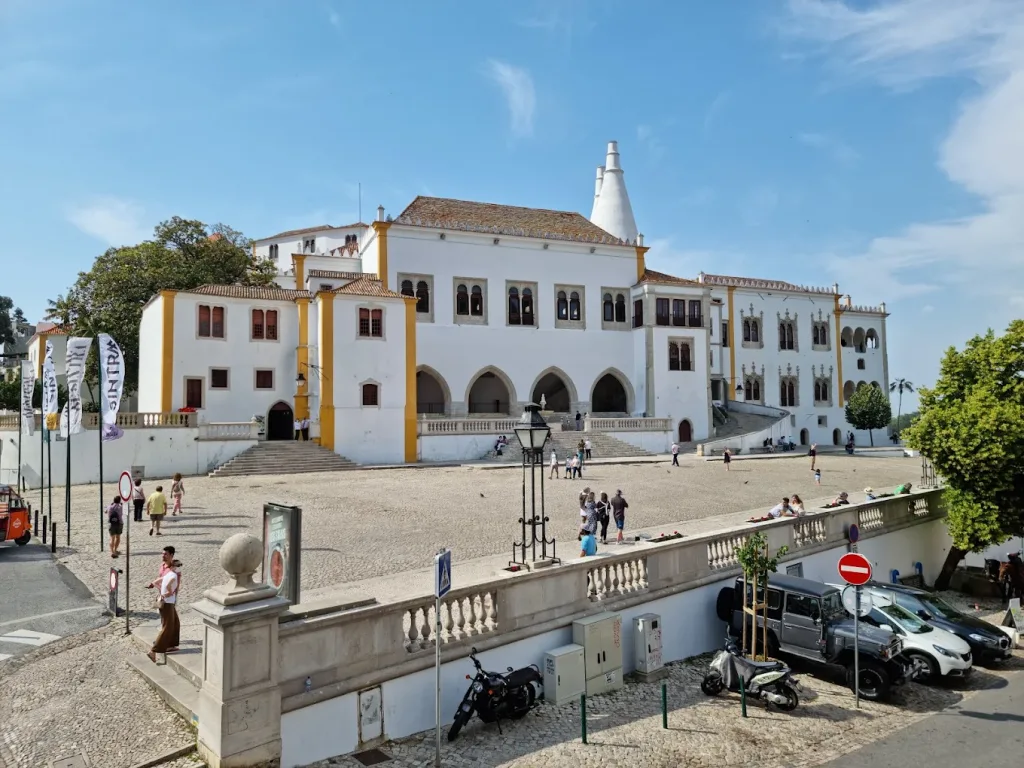
The only royal palace located inside Sintra town itself — no hill, no bus, no shuttle required. Two massive conical kitchen chimneys (each 33 metres high) above the roofline make it one of the most immediately recognisable buildings in the region. The earliest written records date to the 10th century; the current structure reflects additions made primarily under King João I in the early 15th century and King Manuel I in the 16th century.
The interior contains original azulejo tile panels, the Swan Room (gilded ceiling with 27 swans), the Magpie Room (magpies carrying scrolls inscribed “por bem” — for good — painted by João I after a courtier caught him kissing a lady-in-waiting), and the Moorish-influenced Arab Room.
- Ticket: €13.
- Recommended time: 45–60 minutes.
- Useful opening stop: the National Palace opens at 09:30, same time as the hilltop sites, and has no queue.

The honest problem with Sintra crowds
Parques de Sintra recorded 3.36 million visitors in 2023. Peak visitation concentrates between May and October, and within each day between 10:00 and 16:00. The operational consequences are consistent and predictable.
Walk-up queues at the Pena Palace ticket desk can reach 2–3 hours during peak season. Interior access runs on 30-minute timed-entry windows, which frequently sell out several days in advance. Shuttle buses from Sintra station to the hilltop palaces depart every 15 minutes, but during summer weekends they typically operate at capacity, with 30–45 minute boarding queues.
This is not a deterrent. It is operational reality. Sintra with pre-booked tickets and an early start is fundamentally different from Sintra without planning on a Saturday in August.
The practical rules:
- Book Pena Palace tickets online at https://www.parquesdesintra.pt before arrival, ideally 3–4 days in advance for summer weekends.
- Arrive before 09:30. The first interior entry slot opens at 09:30, and queues begin forming before 09:00.
- Weekdays outperform weekends significantly from June through September in terms of queue time and congestion.
- Shoulder seasons (May, September–October) offer the best balance of weather and manageable crowds.
- November–March provides the shortest queues and highest probability of low-density visitation, at the cost of higher rainfall probability.
In practical terms, the difference between a structured early arrival and a casual late-morning visit is the difference between a coherent itinerary and several hours lost to queuing. Timing is the controlling variable in Sintra, more than site selection itself.
The most common mistakes visitors make
Most problems in Sintra are predictable. These are the ones I see repeatedly — usually from visitors who are working from outdated guides or relying on advice from off-peak visits.
Not booking Pena Palace tickets in advance. The most common and most costly mistake. Walk-up queues during peak season can reach 2–3 hours at the ticket desk, and by the time entry is secured, the best morning light is gone and interior capacity is constrained. Tickets should be booked 3–4 days in advance in summer, or at least the day before in shoulder season.
Arriving in Sintra at 10:30–11:00. This coincides with arrival of most coach groups. Shuttle bus queues shift from manageable to 30–40 minutes within a short window. Taking the 08:58 train from Rossio typically results in arrival around 09:40, which provides a critical 45-minute operational advantage over the main visitor wave. That gap is often the difference between a controlled itinerary and a congested one.
Trying to visit five sites in one day. Sintra contains multiple major monuments, but attempting all of them results in insufficient time at each site (often ~45 minutes or less) and excessive transit time between them. A more functional approach is to select three primary sites and allocate proper time to each.
Skipping lunch planning. Restaurants around Sintra’s central square operate under peak tourist demand and typically develop queues after 12:30. Moving just a few streets away changes both pricing and wait times significantly. Without a plan, visitors often default to the first visible option and absorb the congestion.
Leaving Sintra on the 17:00 train. This is the peak outbound window. All major visitor groups converge on the station at the same time, resulting in standing-room conditions and platform congestion. A more efficient exit is typically before 15:30, or later around 18:30, once the peak flow has dissipated.
Driving and parking near Pena Palace. The access road is partially single-lane, and parking at the upper levels is extremely limited and typically full before 09:30 in summer. Even those who drive often still rely on the internal shuttle system after losing time searching for parking. The most efficient approach, if driving, is to park in Sintra town (e.g., Volta do Duche) and use shuttle transport from there.
Train vs private tour: which is right for you?
This is the question most visitors ask once they understand the logistics. The honest answer depends on what you want from the day.
Train makes sense if:
- You want full flexibility on timing and pace.
- You are comfortable navigating independently (transport apps, ticket machines, shuttle bus queues).
- You plan to visit just Sintra town and one or two sites within easy reach of the station.
- You are traveling on a tight budget.
Private tour makes sense if:
- You want to combine Sintra with Cascais, Cabo da Roca, or another stop in one day.
- You prefer not to manage ticket queues, shuttle timing, and return train crowds.
- You have limited mobility (the walks between sites at Sintra involve significant elevation change).
- You want context — someone who understands site orientation, timing, and how conditions change (for example, how light direction affects Pena Palace visibility at different times of day, or why the Moorish Castle walls are engineered as they are).
The train gets you to Sintra. A guide gets you through it efficiently. Both are valid approaches — they are simply different tools for different constraints and preferences.
If a private tour from Lisbon interests you: Sintra & Cascais Private Tour
Best time to visit Sintra
By season:
| Season | Crowds | Weather | Notes |
|---|---|---|---|
| Jan–Mar | Low | Cool, rain likely | Shortest queues; Pena Palace often half-empty. |
| Apr–May | Moderate | Mild, mostly dry | Good balance; book tickets 2–3 days ahead. |
| Jun–Aug | High–Very high | Warm, dry | Arrive before 09:30 or book via guide; avoid Saturdays and Sundays. |
| Sep–Oct | Moderate–High | Warm, occasional rain | Similar to spring; strongest photography light. |
| Nov–Dec | Low | Cool, some rain | Very quiet; Christmas decorations appear from December. |
By day of week:
Weekdays are consistently less crowded than weekends. The difference between a Tuesday in July and a Saturday in July at Pena Palace is roughly the difference between a 20-minute wait and a 2-hour wait.
By time of day:
Early arrival is the controlling variable. Taking the 08:58 or 09:15 train from Rossio typically places visitors in Sintra before the main influx. By 10:30–11:00, shuttle bus queues are already substantial. By 13:00, Sintra town is at peak density, with both pedestrian and transport bottlenecks fully saturated.
One-day Sintra itinerary
This is what a well-paced day actually looks like — not the version that assumes everything goes smoothly, and not the version that lists eight sites without mentioning that visiting all of them would require a time machine.
Two itineraries below: one for independent visitors by train, one for visitors with private transport.
By train — four sites, well-paced
08:45 — Train from Rossio station (€2.55). Buy at the ticket machines — right side of the main hall; card and cash accepted. Platform is underground; follow signs for Linha de Sintra.
09:25 — Arrival in Sintra. Proceed directly to the shuttle bus stop (approximately 100 metres from the station exit). The shuttle runs every 15 minutes. On a summer weekday, the first departures still have available capacity. By around 09:45 on weekends, boarding typically begins to reach full occupancy.
09:30–11:15 — Pena Palace. Enter using your pre-booked timed ticket. The interior visit is constrained to a 30-minute entry window, best used for the state rooms and terraces. Afterward, allocate approximately 45 minutes for the park. The forest descent route to the gate takes around 20 minutes and is generally less congested than the return shuttle.
11:30–12:30 — Castle of the Moors. Either walk uphill from Pena Palace (approximately 15 minutes) or take one shuttle stop. The combined ticket with Pena Palace typically saves around €3. Focus on the main wall walk and upper tower; visibility across the Serra de Sintra and toward the Atlantic coast is strongest from this elevation.
12:45–13:45 — Lunch in Sintra town. Return via shuttle or descend on foot (approximately 2.5 km / 35 minutes; steep but usually less crowded than the ascent). Avoid restaurants directly facing the National Palace around 13:00, where queues are most concentrated. Smaller side streets offer faster seating turnover.
13:45–14:15 — Sintra town centre. Optional stop for travesseiros at Casa Piriquita (established 1862; two locations near the National Palace, both typically queued but efficient). The National Palace exterior can be viewed from the square without entry.
14:15–16:15 — Quinta da Regaleira. Approximately 10-minute walk from the National Palace. Allow ~2 hours for the palace exterior, main gardens, Initiation Well, and selected tunnel routes. The east tunnel exit leads near the lake and can be used to avoid backtracking.
16:30 — Return to station via shuttle or on foot. Aim to reach the platform by 16:45 to secure a train before the 17:00–18:00 peak departure congestion. If missed, the system typically stabilises again around 18:30 when platform density decreases.
17:30 — Arrival in Lisbon.
This itinerary covers four major sites with a structured lunch break and minimal redundancy. Three sites is more comfortable and allows deeper time per location; five sites is possible but shifts the experience into a fast-moving logistics exercise rather than a visit.
By private tour — Sintra and Cascais in one day
The main advantage of private transport is the ability to continue beyond Sintra rather than returning to Lisbon. Sintra and Cascais are approximately 30 km apart by road and are not connected by a direct train line, which makes the combination straightforward by car but logistically inefficient by public transport.
A typical combined itinerary:
08:30 — Pickup from Lisbon hotel.
09:15–11:30 — Pena Palace (pre-booked timed entry; guide manages access and timing). Focus on the palace interior and terraces, with morning light on the western facade.
11:30–12:15 — Castle of the Moors. Use of combined ticket; time allocated to the ramparts and upper viewpoints.
12:30–13:15 — Lunch in Sintra town.
13:30–14:00 — Sintra town centre, National Palace square, and optional stop for travesseiros.
14:15–16:00 — Cascais. Drive via the Sintra–Cascais Natural Park road (approximately 30–40 minutes). Visit Cascais old town, the harbour, and Boca do Inferno (sea cave viewpoint ~2 km west of the centre).
16:30 — Cabo da Roca (optional depending on timing), the westernmost point of continental Europe.
18:30 — Return to Lisbon via the coastal corniche road.
This structure allows a full Sintra visit plus Cascais in a single operational day, avoiding return train congestion and platform peak flows in Lisbon. It is effectively a different category of itinerary compared to a train-based Sintra day, which is constrained by return logistics.
See Sintra & Cascais Private Tour for full details.
Visit Sintra with a Guide from Lisbon
Managing Sintra independently is straightforward if you have prepared well. For visitors who want to combine Sintra with Cascais, Cabo da Roca, or the coastal road — or who prefer not to navigate ticket systems, shuttle queues, and return train crowds — a private tour covers the logistics while you focus on the places.
Our Sintra & Cascais tour covers both towns in a single day, with an experienced guide who has been making this trip since 2013.
For a full overview of what Sintra contains: What to Do in Sintra and Sintra Destination Guide.




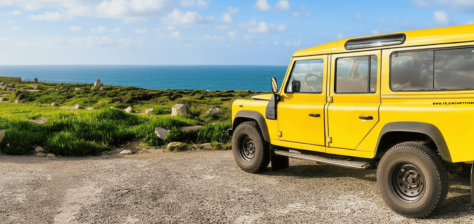
Private Sintra Photo Panoramic 4x4 Tour (Land Rover)
FAQ
How long is the train from Lisbon to Sintra?
Do I need to book tickets for Pena Palace in advance?
How many palaces can I visit in one day in Sintra?
Is Sintra worth visiting as a day trip from Lisbon?
What is the best way to get around Sintra?
Can I combine Sintra with Cascais in one day?
By train, it is technically possible but operationally inefficient — Sintra and Cascais sit on different coastal rail lines, with no direct connection between them. A transfer in Lisbon is required, which adds both time and friction to the journey.
By private car or guided tour, combining Sintra and Cascais in a single day is a standard itinerary. The road connection is direct, and the Sintra–Cascais Natural Park route allows continuous movement between sites without backtracking or platform delays.
See Sintra & Cascais Private Tour for full details.
Is Sintra suitable for children?
What should I wear for a Sintra day trip?
Is there parking in Sintra?
Limited and difficult. Parking near the town centre fills before 09:30 on summer weekends. The roads leading to Pena Palace are narrow and offer no parking near the entrance. If you drive, use the large car park on the eastern edge of Sintra town (Volta do Duche) and take the shuttle from there. Private tours avoid all of this.
What time should I arrive in Sintra?

Founder & Director of Yellow Cab TT Tours. Guiding in Portugal for 20+ years.
Founded Yellow Cab TT Tours in 2013. 3,372 five-star reviews on Tripadvisor.