

Most people who visit Évora go for one specific room: the Chapel of Bones. They see the walls built from 5,000 skeletons, photograph the inscription above the door, and leave without noticing they just walked past a Roman temple built for an emperor who was mistaken, four centuries later, for a goddess.
Évora’s historic centre covers about 100 hectares and holds structures from six distinct periods — Roman, Moorish, Gothic, Manueline, Renaissance and Baroque — which is why UNESCO called it a “museum-city” in 1986 rather than simply a historic town. Most guides list the Chapel of Bones and stop there, because it’s the one attraction with a marketing-ready name.
This guide covers what’s actually worth seeing in Évora beyond the chapel: the Roman Temple and its case of mistaken identity, the Cathedral’s rooftop terrace, an aqueduct with houses built into its arches, the main square, and — 16 km outside town — a stone circle older than Stonehenge. I’ve been bringing clients through all of it on Évora day tours since 2013.
Roman Temple: A Monument Mistaken for a Goddess’s Shrine
The Roman Temple of Évora stands at the highest point of the historic centre, on the site of the city’s original Roman forum. Built in the 1st century AD, it is now widely accepted to have been dedicated to Emperor Augustus, who was venerated as a deity during and after his reign.
For centuries, guidebooks referred to it as the “Temple of Diana.” The name has no historical basis. It originated with a 17th-century Portuguese priest and remained in popular use long enough to appear on maps and postcards. Fourteen of the original granite Corinthian columns still stand today, each formed from stacked stone drums and topped with intricately carved acanthus-leaf capitals.
The temple’s survival owes more to practicality than preservation. In the 14th century, it was incorporated into a medieval fortification, with the spaces between its columns filled in with masonry. From then until 1836, the structure served as Évora’s municipal butcher’s shop. Restoration began in the 19th century, and the monument was returned to its present open form in 1871.
I usually tell clients this story in whichever order gets the bigger reaction: the temple was dedicated to an emperor, renamed after a goddess by a 17th-century priest, and ultimately preserved because it spent four centuries as a butcher’s shop. Rome built it as a sacred monument. Évora kept it standing by finding it a practical use.
The temple stands in an open public square and can be viewed free of charge at any time.

Évora Cathedral and Its Rooftop Terrace
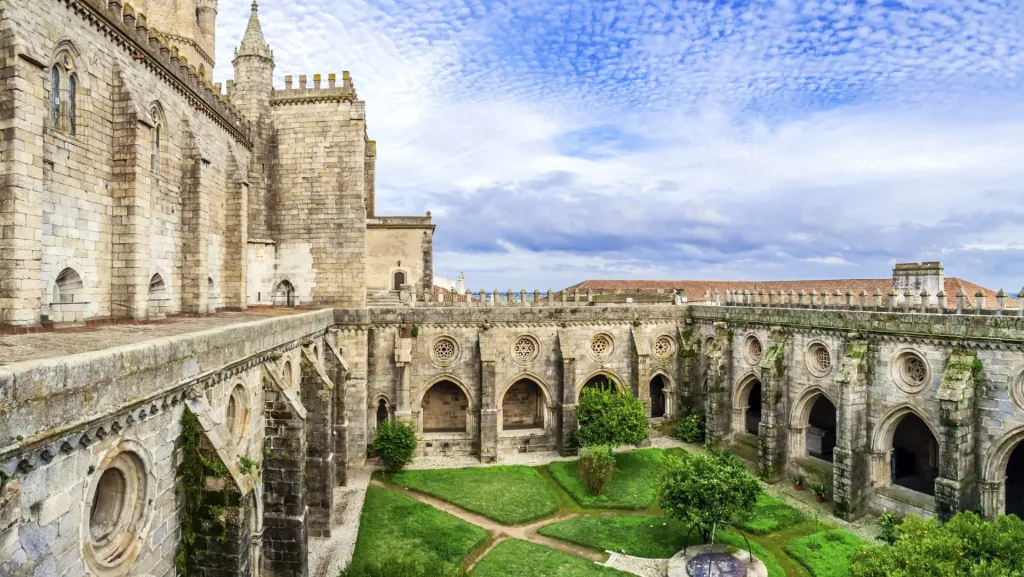
Next to the Roman Temple, on the same elevated ridge, stands the Cathedral of Évora (Sé de Évora), one of Portugal’s oldest cathedrals still largely preserved in its original form.
Construction began in 1186, and the original Romanesque cathedral was completed in 1204. Between 1280 and 1340 it was expanded in the early Gothic style, creating the distinctive blend of Romanesque and Gothic architecture visible today. The Gothic cloisters date from the 14th century, while a Manueline chapel was added in the early 16th century. The cathedral’s most recent major alteration came between 1718 and 1746, when King João V commissioned the Baroque reconstruction of the main chapel using richly coloured marble.
Most visitors come not only for the cathedral itself but also for the rooftop terrace. Reached by an internal staircase, it offers panoramic views across Évora’s whitewashed rooftops, the medieval walls, and the broad Alentejo plains stretching to the horizon.
The cathedral museum contains one of Portugal’s most important collections of religious art, including a rare 13th-century ivory statue of the Virgin Mary.
Tickets (2026):
- Church & Cloister: €2.50
- Church, Cloister & Rooftop Terrace: €3.50
- Church, Cloister & Museum: €4.00
- Complete Ticket (Church, Cloister, Rooftop & Museum): €4.50
If you’re deciding between the ticket options, the rooftop terrace is the upgrade I recommend. For an additional €1, it provides one of the finest viewpoints in Évora and is consistently one of the highlights of the visit.
Chapel of Bones: The Short Version
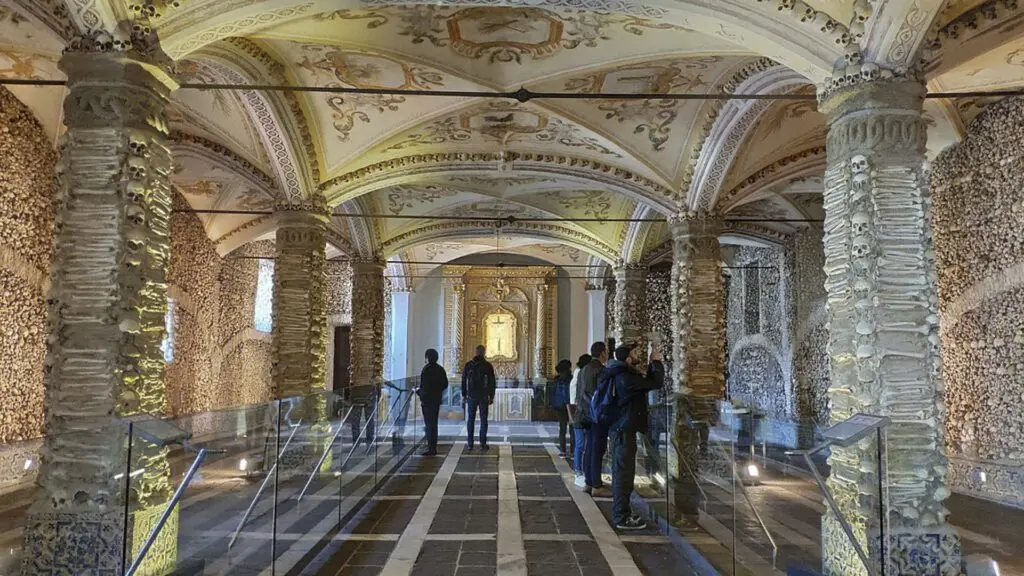
The Chapel of Bones is Évora’s best-known attraction. Built by Franciscan monks in the late 16th century, its walls are lined with the bones of approximately 5,000 people after the city’s monastic cemeteries reached capacity.
The chapel forms part of the Church of São Francisco and is accessed through the main nave. Above the entrance is its famous inscription:
“Nós ossos que aqui estamos pelos vossos esperamos.”
“We bones that are here await yours.”
At the far end of the chapel hang two mummified bodies. For generations, local legend claimed they belonged to a man who murdered his wife and child and was cursed never to decompose. A forensic investigation carried out in 2019 disproved the story. The remains belong to an adult woman, estimated to have been between 30 and 50 years old, and a young girl approximately two or three years old. Neither the legend nor the assumption that their identities would remain unknown survived modern scientific analysis.
Admission: €7 for adults.
For a complete history of the chapel, the meaning of its famous inscription, and the full findings of the 2019 forensic investigation, see our guide.
Água de Prata Aqueduct: The Water Line Built Into the City
Most aqueducts are monuments viewed from a distance. Évora’s is part of the city itself—people still live beneath and alongside its arches.
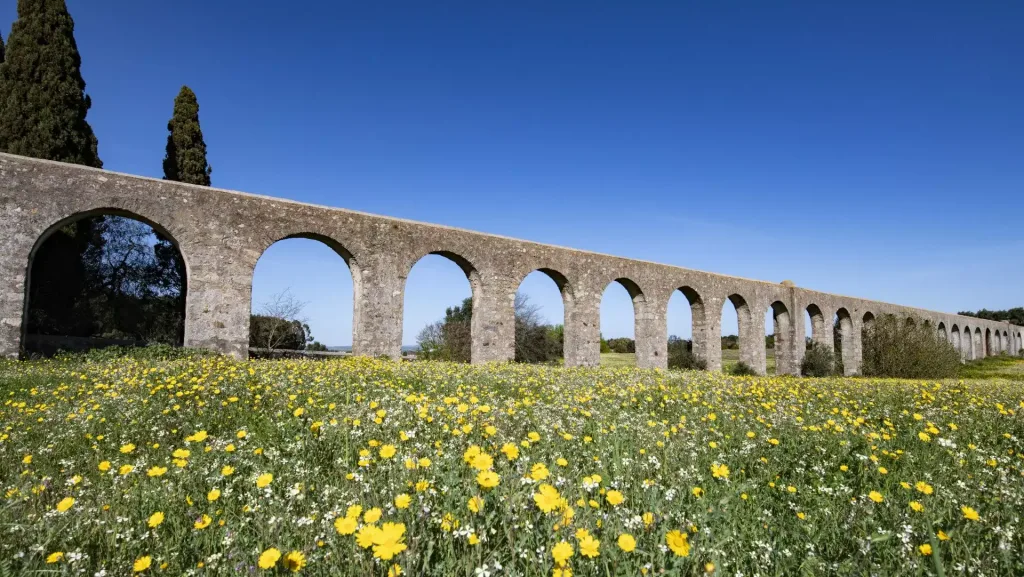
The Água de Prata (“Silver Water”) Aqueduct was built between 1532 and 1537. Commissioned by King João III and designed by Francisco de Arruda—the architect also associated with Belém Tower in Lisbon—it stretches for 18 kilometres and reaches a height of 26 metres before entering the historic centre. It was officially inaugurated in 1537 in Praça do Giraldo with the royal court in attendance.
Its greatest distinction is not the engineering but the way the city grew around it. In the Bairro de Nora neighbourhood, houses have been constructed directly against—and in some cases above—the aqueduct’s arches, integrating the structure into the everyday street network rather than isolating it as a monument. The aqueduct continued supplying water well into the 20th century and was designated a National Monument in 1910.
There is no entrance fee and no formal access point. Simply walk along Rua do Cano, and you are walking through one of Portugal’s most remarkable examples of living historical infrastructure.
Praça do Giraldo: Évora’s Main Square
Every itinerary in Évora begins or ends here, whether intentionally or not. Praça do Giraldo is both the geographic and social centre of the city’s historic walled core.
The square is named after Geraldo Sem Pavor (“Gerald the Fearless”), the Portuguese commander who recaptured Évora from Moorish rule on 1 January 1166. It is framed by arcaded buildings dating from the 16th and 17th centuries, while the Church of Santo Antão, at the eastern end, has stood here since construction began in 1557.
At the centre of the square is an elegant marble fountain, marking the point where the Água de Prata Aqueduct once delivered fresh water into the city.
Today, Praça do Giraldo serves much the same purpose as it has for centuries. Cafés fill the arcades, locals and visitors meet here throughout the day, and almost every walk toward the Cathedral or the Roman Temple begins with the gentle climb from this square.
I always allow about twenty minutes here for a coffee. In a city filled with monuments and history, Praça do Giraldo is one of the few places where doing very little is part of the experience.

Almendres Cromlech: The Stone Circle 16 km Outside Town
Everything covered so far lies within Évora’s city walls. The Almendres Cromlech is different. Located about 16 km from the historic centre, it requires a car—and it’s the stop that clients most often tell me they were glad they didn’t leave out.
The Almendres Cromlech is the largest known megalithic complex in the Iberian Peninsula. It consists of 95 surviving granite menhirs, arranged in two overlapping oval formations covering an area of roughly 70 × 40 metres. Archaeologists believe the monument was built in three phases between approximately 6000 and 4000 BC, making it several thousand years older than Stonehenge, whose earliest earthworks date to around 3000 BC. Several of the stones are engraved with circles, wavy lines, and other symbols whose meaning remains unknown.
There is no visitor centre, no ticket office, and no public transport. The final 2 km of the approach follows an unpaved road through the cork oak forests (montado) characteristic of the Alentejo region. From Évora, allow around 40 minutes for the drive and visit combined.
The stones have stood in the same field for roughly 7,000 years. They still don’t have a bus stop. You can draw your own conclusions about infrastructure priorities.

Visit Évora with Yellow Cab TT Tours
A private day tour from Lisbon covers Évora’s main highlights—including the Roman Temple, Cathedral, Chapel of Bones, and a traditional cork factory—in a single, well-paced itinerary. For travellers who want to explore beyond the city walls, the Almendres Cromlech can also be added to the day.
- Explore the Evora for an 8-hour private experience that includes a cork factory visit, with prices from €330 per vehicle.
- If you’d like to combine Évora with Portugal’s capital, this tour brings together Évora’s UNESCO-listed centre and Lisbon’s historic highlights in one full day, from €350 per vehicle.
- For travellers interested in the Alentejo’s wine culture, the Alentejo wine tour pairs vineyard visits with time to explore Évora’s historic centre.
FAQ
What are the top things to do in Évora?
Is Évora worth visiting for a day?
What is the Roman Temple of Évora actually dedicated to?
How much does it cost to visit the Chapel of Bones?
Can you go up to the Évora Cathedral rooftop?
Is the Água de Prata Aqueduct free to visit?
What is the Almendres Cromlech and how do you get there?
How long do you need to see everything in Évora?
Is Évora walkable?
What's the best time of year to visit Évora?

Founder & Director of Yellow Cab TT Tours. Guiding in Portugal for 20+ years.
Founded Yellow Cab TT Tours in 2013. 3,372 five-star reviews on Tripadvisor.