

Four beaches sit within a few kilometres of each other on the Sintra coast, and they don’t behave the same way. Praia Grande has dinosaur footprints in its cliffs and hosts international bodyboarding competitions. Praia da Adraga has currents strong enough that local guidance treats it as unsuitable for weak swimmers. Praia das Maçãs still has a working tram from Sintra town, a leftover from a rail line that once ran further up the coast. Most articles that rank for “Sintra beaches” treat all four as interchangeable stops on a list — same warning, same one-line description, same photo of white sand.
They aren’t interchangeable. This stretch of Atlantic coast sits inside the Sintra-Cascais Natural Park, and each beach has its own access, parking situation, and water conditions, which matters more here than it does on the calmer Cascais coast to the south. The water is colder, the currents are less forgiving, and picking the wrong beach for the wrong day — a family with young children ending up at Adraga on a rough swell day, for instance — is an avoidable mistake.
This covers what’s actually different about each of the four main beaches, what the 2026 Blue Flag list says, and when this coast is worth the drive from Lisbon.
Praia Grande: Bodyboard Waves and Dinosaur Footprints
Praia Grande is the beach most tour itineraries stop at, and the reason isn’t just its size — at close to 2 km, it’s the largest on this stretch of coast.
It’s also the only one with a genuine curiosity built into its cliffs: 66 dinosaur footprints, dated to roughly 110–115 million years ago (Early Cretaceous), discovered on the near-vertical rock face at the top of the beach’s southern end on 24 April 1981 by geology student José Madeira. They show up best in raking, low-angle light rather than at any specific tide. Most visitors walk past them without knowing they’re there, since nothing at beach level announces it.
The surf is serious enough that Praia Grande has hosted stops on international bodyboarding and surf competition circuits, including editions of the IBC World Tour under the “Sintra Pro” name. That competition-grade swell is exactly why it isn’t the easiest beach for casual swimming — the same waves that make it good for the sport make it more demanding for a family swim than the beaches further south around Cascais.
Clients often ask if the footprints are worth the walk down. They’re a five-minute detour from the main beach access, and I tell people: go late afternoon for the raking light, otherwise you’re looking at a flat rock face and taking my word for it.
Getting to Praia Grande
By public transport, Scotturb bus route 441 connects Sintra train station to Praia Grande in around 16 minutes, running via Praia das Maçãs and Azenhas do Mar on the same route; route 439 also serves the beach.
There’s a beachfront car park directly by the sand, but it fills on summer weekends — arriving before mid-morning matters more here than at any of the other three beaches, since there’s no practical overflow option once it’s full.
Praia das Maçãs: The Beach with a Tram
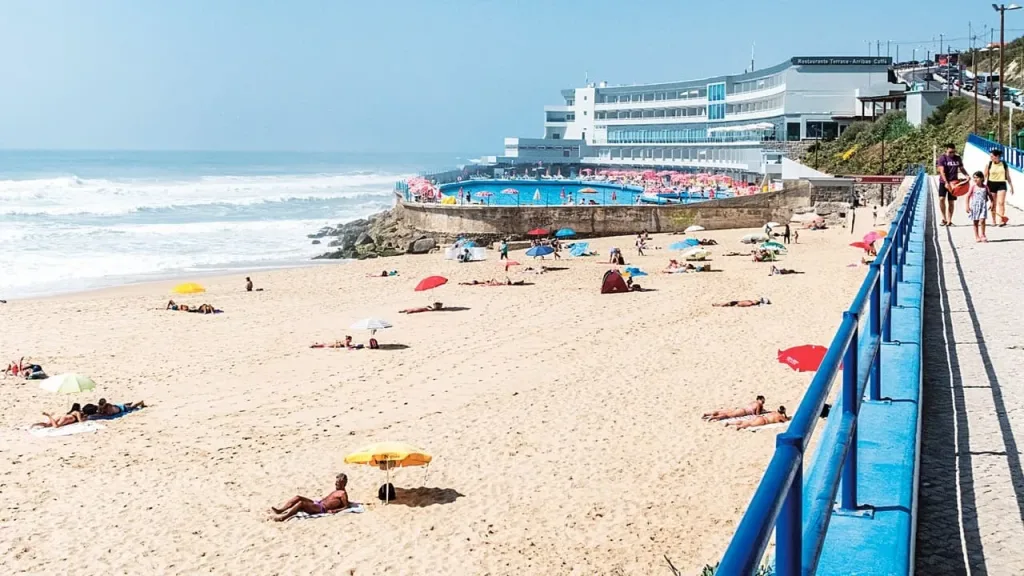
Praia das Maçãs — “apple beach” — is reached from Sintra town by a heritage tram, one of the few working historic lines left in Portugal outside Lisbon and Porto.
The original section, Sintra to São Sebastião de Colares, opened in 1904; the extension reaching Praia das Maçãs itself followed in 1905. A further extension up the coast to Azenhas do Mar was added later, in 1930, and closed in 1955; today’s tram runs only between Sintra and Praia das Maçãs, a detail several travel sites still get wrong by describing the tram as reaching Azenhas do Mar.
The beach itself is broad and sandy, with more built-up infrastructure around it than Praia Grande or Adraga — a small seafront promenade, more parking, and easier access for anyone not driving. It’s the most straightforward of the four beaches logistically, which is exactly why it draws more day-trippers from Sintra town than the others.
Riding the Tram from Sintra
The tram is a single carriage running one route, which means its schedule is thinner than most visitors expect: three departures a day on weekdays, rising to six on weekends and in summer, for a journey of about 45 minutes each way.
A return adult ticket runs around €5, with reduced fares for children and seniors and free travel under age six. Bus route 441 covers the same corridor with far more frequent departures, for anyone who doesn’t want to plan around three timetable slots.
I’ve had clients time an entire afternoon around the tram’s return schedule without realising there were only three trains that day. Check the timetable before building a plan around it — it’s a heritage line, not a shuttle service.
Praia da Adraga: The Rugged One
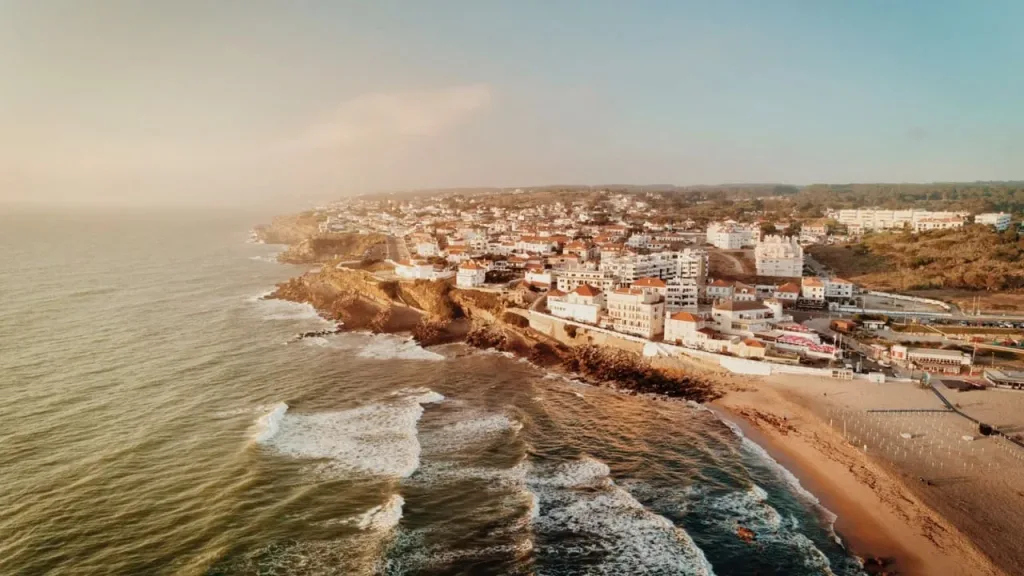
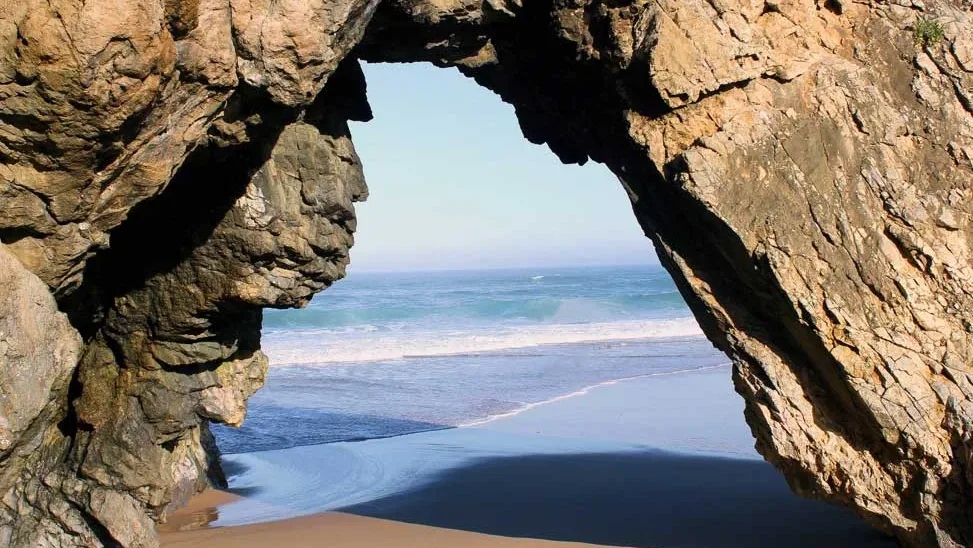
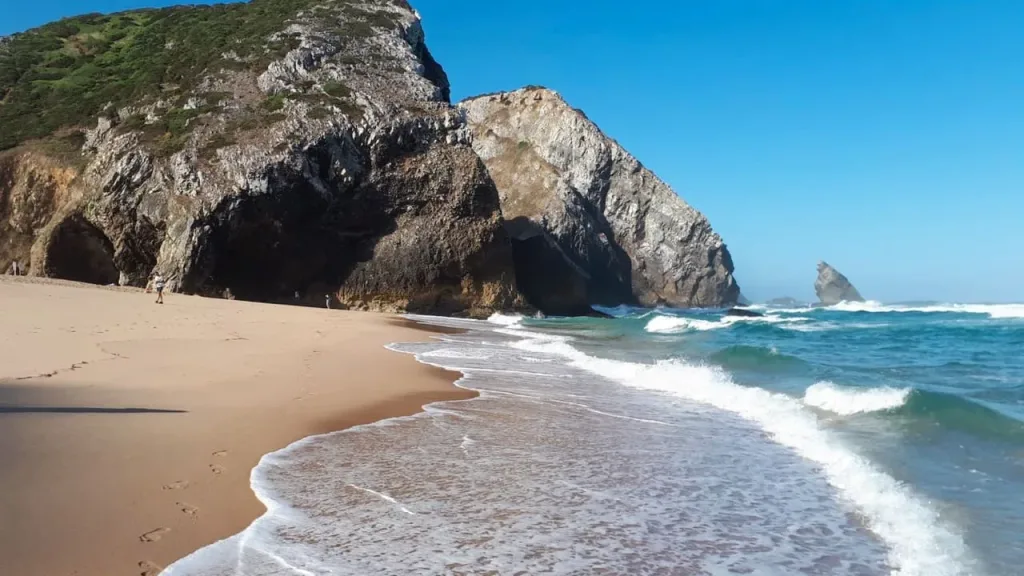
Praia da Adraga sits near the village of Almoçageme, inside the Sintra-Cascais Natural Park, and looks different from the other three — a natural rock arch, scattered rock clusters in the sand, and cliffs close enough to give the beach a genuinely wild feel rather than a manicured one. It has a small parking area that fills quickly and limited facilities beyond a single restaurant.
The trade-off for that scenery is water that local guidance consistently treats as unsuitable for weak swimmers — the currents here are stronger and less predictable than at Praia Grande or Praia das Maçãs, and it’s a beach where checking conditions before swimming matters more than it does elsewhere on this coast.
I’ve stopped clients from swimming at Adraga more than once, not because the beach isn’t worth seeing, but because the currents that day weren’t worth testing.
Getting to Praia da Adraga
Adraga sits about 15 km from Sintra town and roughly a 20-minute walk from the village of Almoçageme, which is as close as public transport gets — Scotturb route 439 (Portela de Sintra to Praia Grande) and route 403 (Sintra station to Cabo da Roca and Cascais) both stop at Almoçageme, leaving that final stretch on foot.
This is the one beach on this coast genuinely difficult to reach without a car, which is part of why it stays quieter than Praia Grande or Praia das Maçãs even in peak season. The small car park fills on summer days, with informal overflow parking further up the access valley that isn’t sufficient for a full weekend crowd.
Azenhas do Mar: A Village Beach and Tide Pool
Azenhas do Mar, a few kilometres north of Praia das Maçãs, is different again — a white-washed cliffside village with a tide-filled ocean pool built into the rock at its base rather than an open sand beach.
The pool was closed for nine months in 2025–2026 for safety repairs and has since reopened; the small beach beside it depends entirely on tide and season for its size.
This village and its pool get a full write-up on their own — see the complete guide to Azenhas do Mar for the pool’s history, closure, and current status.

Safety, Currents and the 2026 Blue Flag List
Blue Flag certification — an international standard covering water quality, safety, and facilities — was renewed for the 2026 season at Praia Grande, Praia das Maçãs, Praia da Adraga, and Praia do Magoito, along with Praia de São Julião further along the coast.
Praia Grande and Praia das Maçãs also carry lifeguard cover during the official national bathing season, whose outer window runs 15 April to 31 October in 2026 — though the actual start date is staggered by region, and this stretch of coast typically comes into full lifeguard cover later than that national ceiling date implies.
That certification doesn’t mean every beach behaves the same in the water. This is the open Atlantic, not the more sheltered Cascais coast — sea temperatures here range from around 15–16°C in winter to about 19°C at the summer peak, noticeably cooler year-round than beaches closer to the mouth of the Tagus, and currents vary sharply from one beach to the next depending on the day’s swell.
Portugal has faced a reported shortage of qualified lifeguards in recent seasons, which is worth knowing if visiting outside peak summer weekends when cover can be thinner than expected.
Visiting the Sintra Coast from Lisbon
The Sintra coast sits roughly 35–40 km from Lisbon, a drive of about 45–60 minutes under normal conditions via the IC19/A37 corridor or the A16 (which uses electronic tolls, worth knowing if renting a car).
None of these four beaches work well as a single standalone day trip from the city — most visitors combine two or three of them with Sintra’s palaces or Cabo da Roca on the same day, since the coastal road (N247) links Praia Grande, Praia das Maçãs, and Azenhas do Mar in a matter of minutes and continues on toward Adraga and Cascais.
Praia das Maçãs is the only one reachable without a car, via the tram or bus from Sintra town; the other three need private transport or a tour.
I run this coastline as part of both the Sintra & Cascais route and the dedicated 4×4 coastal circuit, timing beach stops around whichever swell and tide conditions that day actually allow — not a fixed script that ignores what the ocean is doing.
For the other beach coasts near Lisbon — Costa da Caparica, the Cascais coast, and Arrábida — see our complete Lisbon beaches guide.
See the Sintra Coast on a Private Tour
The beaches, cliffs, and the fishing villages between them are part of our Sintra coastal routes — timed around tide and swell rather than a fixed script, with stops chosen for whichever conditions that day actually allow.
- Sintra Jeep Tour → Land Rover Defender, coastal route including this stretch, from €330/vehicle.
FAQ
Which is the best beach in Sintra?
It depends on what you want. Praia Grande suits surfers and bodyboarders and has the dinosaur footprints; Praia das Maçãs is the easiest to reach without a car and has more facilities; Praia da Adraga is the most scenic but has stronger currents; Azenhas do Mar is a village and tide pool rather than a swimming beach in the usual sense.
Are Sintra beaches safe for swimming?
Praia Grande, Praia das Maçãs, Praia da Adraga, and Praia do Magoito all held Blue Flag certification for the 2026 season. That said, this is open Atlantic coast with currents that vary by beach and by day — Praia da Adraga in particular is treated by local guidance as unsuitable for weak swimmers.
Is there a beach with a tram in Sintra?
Yes. Praia das Maçãs is reached by a heritage tram from Sintra town; the original section opened in 1904 and the extension reaching the beach followed in 1905. A further extension up the coast to Azenhas do Mar was added in 1930 but closed in 1955.
How far are the Sintra beaches from Lisbon?
Roughly 35–40 km, depending on which beach and route. There’s no direct public transport from Lisbon to most of them; the practical options are a private car, a tour, or the train/tram combination via Sintra town for Praia das Maçãs.
Are there dinosaur footprints at a Sintra beach?
Yes, at Praia Grande. Sixty-six footprints were discovered in the cliffs at the beach’s southern end in 1981, dated to over 100 million years old, and are visible from a stairway at low tide.
What is the water temperature at Sintra beaches?
Sea temperature on this stretch ranges from around 15–16°C in winter to about 19°C at the summer peak, cooler year-round than beaches closer to Lisbon and the mouth of the Tagus. Summer (June–September) is the most comfortable window for swimming.
Is Praia da Adraga good for families?
Not as a first choice on a rough-swell day. The currents there are stronger than at Praia Grande or Praia das Maçãs, and local guidance treats it as unsuitable for weak swimmers. Families looking for an easier swim tend to do better at Praia das Maçãs.
Do the Sintra beaches have lifeguards?
Praia Grande and Praia das Maçãs have lifeguard cover during the bathing season, whose national outer window runs 15 April–31 October in 2026 — though actual coverage on this coast typically starts later than that ceiling date. Portugal has reported lifeguard shortages in recent seasons, so cover can be thinner outside peak summer weekends.
Can you visit all the Sintra beaches in one day?
Yes, with a car — the four beaches are within a short drive of each other, and most visitors combine two or three with Sintra’s palaces or Cabo da Roca on the same itinerary rather than spending a full day at the coast alone.
What is the closest beach to Sintra town?
Praia das Maçãs, reachable by the heritage tram in around 40 minutes and the only one of the four with regular public transport access from Sintra.

Founder & Director of Yellow Cab TT Tours. Guiding in Portugal for 20+ years.
Founded Yellow Cab TT Tours in 2013. 3,372 five-star reviews on Tripadvisor.