
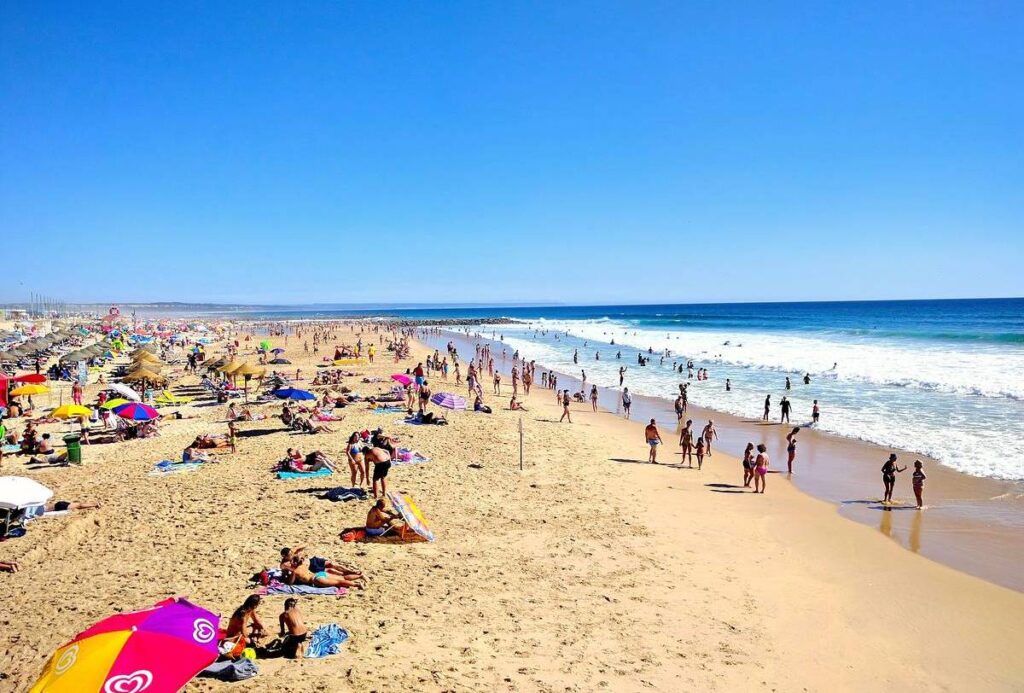

Most visitors assume there’s one beach near Lisbon. There are three completely different coastlines, within 30 to 60 minutes of the city centre, with water temperatures, crowds, transport, and character so different that choosing wrong means a wasted day.
Most travel guides list them together as if the Atlantic side of Cascais and the sheltered coves of Arrábida are the same decision. They are not. One involves a 26-minute train. The other requires a licensed tour vehicle from June to September, because private cars are banned from the park roads during daylight hours.
This guide covers the three main beach zones within a day trip of Lisbon — Costa da Caparica, the Cascais coast, and Arrábida — with honest transport options, what each one actually delivers, and when each makes sense. I’ve been taking clients to all three for over 20 years. Some of the recommendations here will go against what the guidebooks say.
“Every year, someone asks me which beach is best. I tell them Arrábida. They say great, how do we get there? I explain the seasonal car ban, the park shuttle, and the 10-minute cliff path with no shade. Then they ask if Carcavelos is nice.”
Three Coasts, Three Different Beach Experiences
Before picking a beach, understand that the three zones around Lisbon are not variations of the same thing — they differ in water temperature, crowd density, transport, and the kind of day they produce.
Costa da Caparica faces southwest into the open Atlantic — bigger waves, cooler water, surf-oriented. 30 km of continuous beach, 24 named sections. The water temperature sits around 18–20°C in summer. The Cascais coast faces west along the Estoril Riviera — calmer sea in the town beaches, wild and windy at Guincho (5 km north of Cascais). Carcavelos is Blue Flag certified and 26 minutes by train. Arrábida faces south into the Setúbal Peninsula — sheltered from Atlantic swell, water temperature reaches 22–24°C in summer. Praia dos Galapinhos was named Europe’s Best Beach in 2017 by European Best Destinations. Private cars are banned from Arrábida park roads Jun 7–Sep 15, 07:00–19:00. Licensed tour operators are exempt.
“Most clients ask me which beach is closest?” — the answer is Caparica (25 min by car). But closest is rarely the same as best, and this is one of those cases.
Carcavelos is 26 minutes from Cais do Sodré by train, Blue Flag certified, and reliably packed. It is what happens when you make a good beach easy to reach from a city of 550,000 people.
Costa da Caparica: Lisbon’s Closest Proper Beach
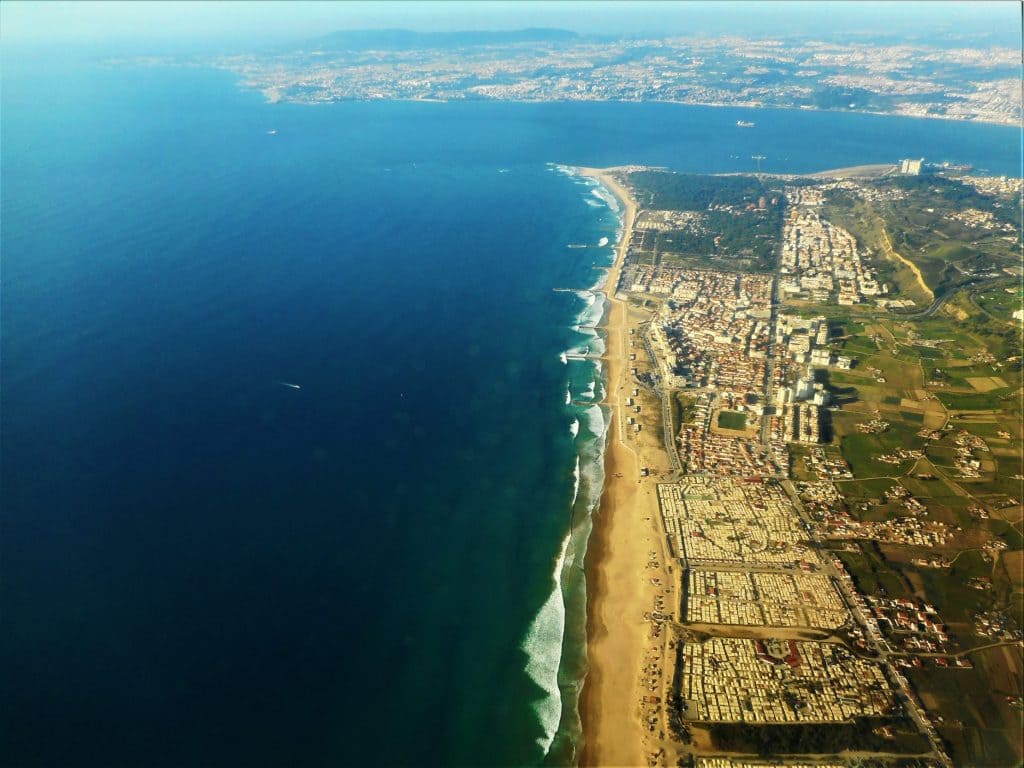
Costa da Caparica is the city’s default beach — 30 km of Atlantic-facing sand, accessible without a car, with surf schools, restaurants, and a numbered section system that separates families from surfers.
The beach runs 30 km in 24 numbered sections (praias). Water temperature sits at 18–20°C in summer — Atlantic, not warm, but swimmable. The biggest waves are in the sections further south; sections 1–4 near the town are calmer. The Transpraia mini-train runs June–September, covering 9 km southward from the town and stopping at each section — tickets ~€1.80 per section. Lifeguards cover all main sections from June to September.
Getting here without a car: Bus line 3710 (Rede Expressos) from Praça de Espanha takes 46 minutes, ~€2–4. Alternatively, take the ferry from Terreiro do Paço to Cacilhas (€1.50, 10 minutes) then bus 3022 or 3011 — 35–45 minutes additional. Driving takes ~25 minutes and parking at the beach is free.
Caparica has 24 numbered beach sections. Sections 1–4 are family-friendly. From section 10 onward, the signage assumes you know what you’re doing. There is no section that is both uncrowded and easy to reach — that particular beach does not exist near any major European capital.
The Cascais Coast: Best Beach by Train
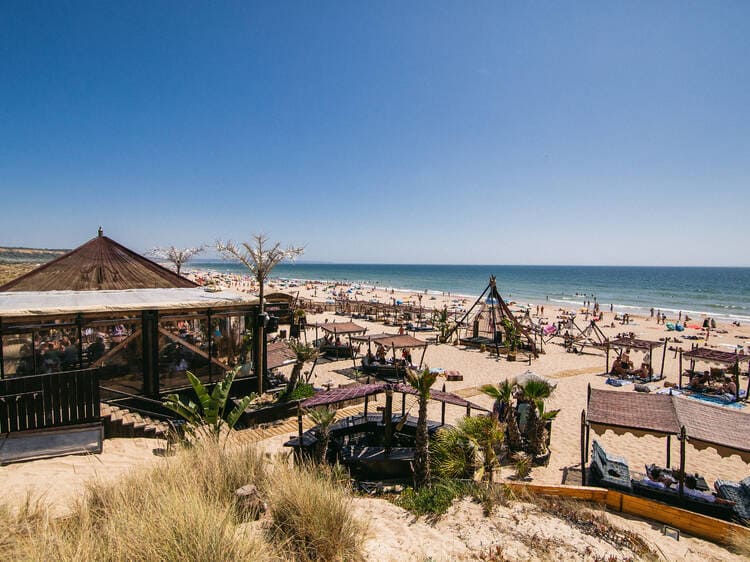
The Cascais line from Cais do Sodré puts you at four distinct beaches — each with its own character — in under 40 minutes, without a car or tour.The train runs every 20 minutes and takes 40 minutes to Cascais, ~€2.40 (CP Urbanos de Lisboa). Key stops:
Carcavelos (26 min) — the longest beach on the line, approximately 1 km, Blue Flag certified. Popular with surfers and families. Gets very crowded July–August.
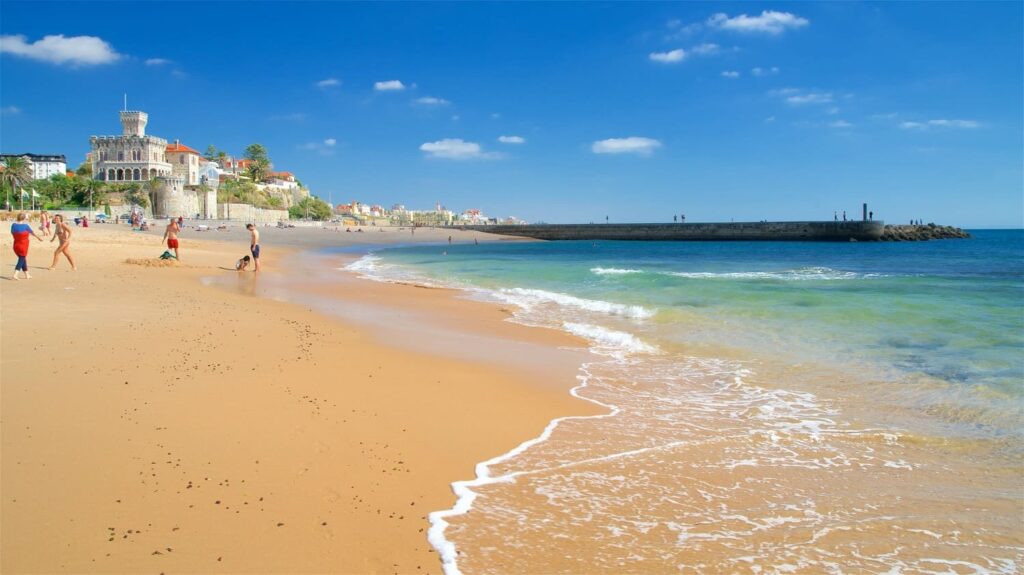
Estoril / Tamariz (31 min) — small sheltered beach with a historic casino backdrop. Calm water, better for non-swimmers or an afternoon stop.
Cascais town beaches (40 min) — Praia da Rainha and Praia da Conceição are small protected coves. Good for a few hours, not a full beach day.
Throughout summer you’ll notice young people in blue uniforms at Tamariz, Rainha, and Conceição — these are volunteers from the municipality’s Maré Viva programme, around 1,100 each season. They monitor safety and collect beach litter. They are not lifeguards — those are a separate team — but they know the beaches well and can point you in the right direction.
Praia do Guincho — 5 km north of Cascais, no direct train. Take a taxi (~€10–12) or hire a bike in town. 1.5 km of wild Atlantic sand inside Sintra-Cascais Natural Park. Wind averages 25 knots in summer — consistent conditions for kitesurfing and windsurfing. Water temperature similar to Caparica (18–20°C).For a spontaneous beach day with zero planning, the Cascais train is the correct answer. Guincho is 5 km from Cascais, directly in the path of every north Atlantic weather system that didn’t have anywhere else to be. If you want to swim, Cascais town is better. If you want to feel like you’re at the edge of the world, Guincho is accurate.
Arrábida: The Best Water Near Lisbon
Arrábida is the only place near Lisbon where the water is turquoise, warm, and clear — because the Serra da Arrábida blocks the Atlantic swell and the limestone cliffs filter runoff. It is also the most restricted and the hardest to reach without a private vehicle or tour.
Arrábida Natural Park was established in 1976, covering a limestone mountain range with 35 km of coastline. Water temperature reaches 22–24°C in summer — significantly warmer than the Atlantic-facing beaches. The park is approximately 45 km from Lisbon, about 50 minutes by car.
The main beaches: Portinho da Arrábida is the most accessible cove — gentle slope, clear water, small bar. Praia dos Galapinhos was named Europe’s Best Beach in 2017 by European Best Destinations. No facilities (no bar, no showers), access via a steep 10-minute path. Praia dos Galapos (different beach, often confused with Galapinhos) — calmer and more accessible.
Summer access restriction (Arrábida O2 programme): Private cars are banned from the park coastal roads Jun 7–Sep 15, 07:00–19:00. TVDE and licensed tour operators are exempt with a municipal card. A free shuttle (Line 4477) runs from the Creiro car park every ~30 minutes — weekends from late June, daily through July and August.
Every client who has been to both Cascais and Arrábida says the same thing: they wish they had gone to Arrábida first. The restriction is the point — without it, Galapinhos would look like Carcavelos in August.
Arrábida was named Europe’s best beach in 2017. The park authority responded by banning private cars on the coastal road in summer. This is either ironic or entirely logical, depending on whether you own a car.

Which Beach Is Right for Your Day?
The right beach depends on time, transport, and what kind of day you want.
| Scenario | Best choice | Why |
|---|---|---|
| Half a day, no car, spontaneous | Carcavelos or Estoril | Train in 26–31 min, no planning needed |
| Full day, want the best water | Arrábida | Book a licensed tour or take shuttle in peak season |
| Surf / kitesurfing | Guincho or Caparica | Atlantic exposure, consistent conditions |
| Families with small children | Estoril (Tamariz) or Cascais town | Calm water, sheltered, no driving |
| Budget day out | Costa da Caparica | Bus from ~€2–4, cheapest beach option near Lisbon |
August is the one month where I’d avoid Carcavelos entirely. Arrábida in August with a tour is still excellent — the restrictions actually keep it manageable.
The ‘families with small children’ row in this table has ‘calm water, sheltered, no driving’ in the Why column. The ‘surf / kitesurfing’ row has ‘Atlantic exposure, consistent conditions.’ These are the same beach day described by two different people.

How to Get to Each Beach from Lisbon (Summary)
| Destination | Transport | Time | Cost (approx) |
|---|---|---|---|
| Costa da Caparica | Bus 3710 from Praça de Espanha | ~46 min | ~€2–4 |
| Costa da Caparica | Ferry (Terreiro do Paço → Cacilhas) + bus 3022/3011 | ~50–55 min total | ~€4–6 |
| Carcavelos | Train from Cais do Sodré (Cascais line) | 26 min | ~€2.40 |
| Cascais | Train from Cais do Sodré | 40 min | ~€2.40 |
| Guincho | Train to Cascais + taxi | ~55 min | ~€12–15 |
| Arrábida (peak season) | Licensed tour / shuttle bus | ~50 min | Tour from €75/pax |
| Arrábida (off-peak) | Car | ~50 min | Parking free at most beaches |
The cheapest way to reach the best beach near Lisbon involves a car ban, a park shuttle, a steep path, and the willingness to arrive before the shuttle fills up. The second cheapest way involves a tour. Both require planning.

Visit Arrábida and the Cascais Coast with a Guide
The transport logistics for Arrábida are the main reason clients book a tour rather than sort it out independently. From June to September, private cars cannot access the park roads during daylight hours — but as a licensed operator, we can drive clients directly to the coves that public transport doesn’t reach. For the Cascais coast, the train works perfectly; our Sintra-Cascais private tour adds Sintra, Cabo da Roca, and the full coastline to what would otherwise be a single beach stop.
- Private Sintra & Cascais Full Day Tour → Cascais town + Guincho coastline + Sintra + Cabo da Roca in one day.
- Private Arrábida Tour from Lisbon → Arrábida Natural Park + Setúbal Peninsula + Lisbon city highlights.
- Best Solution Tour → Lisbon + Sintra + Cascais + Cabo da Roca in one day — good for first-time visitors who want coast and culture.
- Private Arrábida Tour → Arrábida Natural Park + Setúbal Peninsula full day.
- Check out also our Sintra Beaches Guide.

FAQ
What is the closest beach to Lisbon city centre?
Can you reach Lisbon beaches without a car?
Is Arrábida accessible in summer without a car?
What is the water temperature in Lisbon beaches?
Which is the best beach near Lisbon for families?
Are Lisbon beaches good for surfing?
Is Praia dos Galapinhos worth visiting?
What is the best time of year to visit Lisbon beaches?
How long is Costa da Caparica beach?
Do Lisbon beaches have lifeguards?

Founder & Director of Yellow Cab TT Tours. Guiding in Portugal for 20+ years.
Founded Yellow Cab TT Tours in 2013. 3,372 five-star reviews on Tripadvisor.