


On 13 May 1917, three children were grazing sheep at a hollow called Cova da Iria, outside the village of Aljustrel in rural Portugal. Lúcia dos Santos was 10. Her cousins Francisco Marto was 9 and Jacinta Marto was 7. Shortly after midday, they reported seeing a woman standing above a holm oak tree — luminous, dressed in white, asking them to return on the 13th of each month for six months.
They came back. And each time, the crowd around them grew. By the final apparition on 13 October 1917, approximately 70,000 people had gathered in the same hollow — including secular journalists and people who had come specifically to disprove the story.
What those 70,000 people saw, or reported seeing, became known as the Miracle of the Sun. The Church took thirteen years to issue a formal response. The site now receives 6.2 million visitors annually, making it one of the most visited Catholic pilgrimage destinations in the world.
This article covers who the three children were, what each of the six apparitions involved, what the Three Secrets of Fátima contain, and how the Catholic Church ultimately responded.
The Three Children — Who They Were
Most accounts treat the children as a collective. They were three distinct individuals with different personalities, different fates, and different roles in what followed.
Lúcia de Jesus Rosa dos Santos was born on 22 March 1907 in Aljustrel, a hamlet of approximately 50 families near Fátima in the Ourém municipality, Santarém district. She was the youngest of seven children. By all contemporary accounts she was the most articulate of the three and the primary communicator during the apparitions — the one who spoke to the Lady and relayed the messages. She would go on to write four memoirs documenting the events, the last completed in 1941. These memoirs are the primary source for most of what is known about the apparition content.
Francisco Marto was born on 11 June 1908. He was Lúcia’s first cousin. During the apparitions, Francisco reported that he could see the Lady but could not hear her — Lúcia relayed what was said. By contemporary accounts he was quiet and interior in temperament. He died on 4 April 1919, aged 10, of pneumonia during the 1918–1919 influenza pandemic — one of an estimated 50 million deaths worldwide in that outbreak. He did not live to see the Church’s formal response to the apparitions.
Jacinta Marto was born on 11 March 1910, Francisco’s sister. She was the youngest of the three. She died on 20 February 1920, aged 9, of pleurisy in a Lisbon hospital — separated from her family, having declined to reveal her location to the doctors because a woman she reported seeing in a vision had told her not to. Whether this detail belongs to history or to hagiography is a matter of interpretation.
Francisco and Jacinta were beatified by Pope John Paul II on 13 May 2000 and canonised by Pope Francis on 13 May 2017 — the centennial of the first apparition. They are the youngest non-martyr saints in the history of the Catholic Church. Lúcia was declared Venerable by Pope Francis in 2023, the first formal step toward beatification.

The Six Apparitions — What Happened Each Time
Most sources mention “six apparitions” as a number. What actually happened at each one is rarely laid out clearly.
13 May 1917 — The first apparition. The children saw a flash of light, then a figure they described as a young woman, approximately 18 years old, standing above a holm oak tree (*azinheira*). She told them to return on the 13th of each month for six months. She identified herself, at a later visit, as “Our Lady of the Rosary.” A crowd of approximately 60 family members and neighbours gathered at subsequent visits.
13 June 1917 — Second apparition. Approximately 50 people present. The crowd could not see the figure but reported a sound like bees humming and a luminous glow around the children.
13 July 1917 — Third apparition. Approximately 5,000 people present. At this visit the Lady is reported to have revealed the first two of the Three Secrets of Fátima (see next section) and made a prophecy: that Russia would spread its errors through the world unless it was consecrated to the Immaculate Heart of Mary. The conditions and implications of this prophecy became a matter of sustained theological and geopolitical discussion throughout the 20th century.
19 August 1917 — The August apparition was delayed from the 13th. Local administrator Artur de Oliveira Santos, a known anti-clerical, had the children arrested on 13 August and held for two days in an attempt to force a retraction. The apparition occurred six days later, near Valinhos, to the three children and their families. Santos became, in a roundabout way, part of the historical record.
13 September 1917 — Fifth apparition. Approximately 30,000 people present. The Lady told Lúcia that Jesus, Our Lady of Sorrows, Our Lady of Carmel, and Saint Joseph with the Christ Child would appear at the October apparition.
13 October 1917 — The sixth and final apparition. Approximately 70,000 people present. This is the event known as the Miracle of the Sun. The Lady identified herself as Our Lady of the Rosary and asked for a chapel to be built on the site. She reportedly showed the three children brief visions of the Holy Family and Our Lady of Sorrows.
The Three Secrets of Fátima
“The Three Secrets” is referenced constantly in connection with Fátima, but what they actually contain is rarely set out in plain terms.
The Three Secrets were reportedly communicated to the children at the third apparition on 13 July 1917. They were written down by Lúcia in documents she sealed and submitted to Church authorities, with instructions that they not be opened until after her death or until 1960, whichever came first.
First Secret: A vision of hell — described by Lúcia as a sea of fire with souls falling in, suffering and screaming. The Lady said this was shown to them so they would pray for sinners.
Second Secret: A prophecy that World War I would end, but that if people did not stop offending God, another worse war would begin. It included a specific condition: that Russia be consecrated to the Immaculate Heart of Mary. If this was not done, Russia would spread its errors through the world. The second secret was made known publicly in 1941 through Lúcia’s memoirs.
Third Secret: This remained sealed until 26 June 2000, when Pope John Paul II, recovering from the 1981 assassination attempt on his life, authorised its publication. The text describes a vision of an “Angel with a flaming sword” and a figure in white — interpreted by the Vatican as the Pope — being killed by soldiers. Pope John Paul II and the Vatican officially interpreted this as a prophecy of the 1981 assassination attempt on the Pope, which he survived. Others have disputed this interpretation. The debate has not been formally resolved.
The year 1960 passed without the Third Secret being revealed, which produced significant speculation. Pope John XXIII reportedly read the text in 1960 and declined to release it. The decision generated decades of commentary that the text contained something the Church was unwilling to disclose.
In my experience, visitors who arrive at Fátima knowing the contents of the Third Secret spend considerably longer at the sanctuary than those who do not. The architecture is the same either way.
The Miracle of the Sun — 13 October 1917
This event is covered in detail in the companion article A5. Here: the basic facts and why it matters for understanding the apparitions as a whole.
The final apparition, 13 October 1917, concluded with a phenomenon witnessed by approximately 70,000 people gathered in the Cova da Iria in heavy rain. Multiple witness accounts — including those of secular journalists from Lisbon who had come to debunk the story — describe the sun appearing to spin, change colour, and move toward the earth for approximately ten minutes before returning to its normal position.
This event is what separated Fátima from hundreds of other reported apparitions in the same period. The scale of the witness testimony, across believers and sceptics, provided the Church with evidence that was difficult to categorise as simple collective delusion. The correspondent of *O Século*, Avelino de Almeida — who had written a satirical article about the crowds gathering for the apparition the previous week — filed a report on 15 October 1917 describing the solar phenomenon as something he could not explain.
The article covers the October event in full — the exact witness accounts, the meteorological context, and the range of explanations that have been proposed.
The Church’s Response — Thirteen Years of Investigation
The Church did not immediately validate the apparitions. The formal process took thirteen years and involved specific canonical steps worth understanding.
The Diocese of Leiria began its official investigation of the apparitions in 1922 — five years after the events. Bishop José Alves Correia da Silva established a canonical commission that interviewed witnesses, examined documents, and assessed the theological content of the reported messages.
On 13 October 1930 — exactly thirteen years after the final apparition — Bishop da Silva issued a pastoral letter declaring the visions “worthy of belief” (digna de crédito). This is the formal canonical standard for Marian apparitions: not proof that the events occurred as described, but a judgment that they are consistent with Catholic faith and that the faithful may, without error, believe in them.
The distinction matters. The Church’s declaration was not a statement that the apparitions happened. It was a statement that believing they happened does not contradict Catholic doctrine. The difference is subtle but theologically significant — and has been the source of significant misrepresentation in popular accounts.
The consecration of Russia to the Immaculate Heart of Mary, requested in the second secret, was performed by Pope Pius XII in 1942 and again more explicitly by Pope John Paul II on 25 March 1984, in union with the world’s bishops. Whether the conditions of the second secret were met by either consecration has been disputed within the Church. It remains an open theological question.

What Happened to the Children
The post-apparition lives of the three children complete the historical record — and are rarely covered in full.
Francisco Marto entered the local primary school briefly after the apparitions, reportedly to fulfil a request he attributed to the Lady, and died of pneumonia on 4 April 1919, aged 10. He never left Aljustrel.
Jacinta Marto was hospitalised repeatedly from 1918 onward. She was taken to Lisbon in 1920 for treatment of pleurisy and an abscess on her left lung, and died at the Hospital D. Estefânia on 20 February 1920, aged 9. She had told Lúcia she would die alone in Lisbon, and she did.
Lúcia dos Santos survived. She entered the Sisters of Saint Dorothy in Tuy, Spain, in 1921 and took the religious name Sister Maria Lúcia of the Immaculate Heart. In 1948 she transferred to the Carmelite Order and entered the Carmel of Coimbra, where she lived in enclosure for the remaining 57 years of her life. She died on 13 February 2005, aged 97, having outlived the two cousins who had seen the same apparitions by 85 and 86 years respectively.
Her remains were transferred to the Basilica of Our Lady of the Rosary in Fátima in 2006. She is interred there alongside Francisco and Jacinta.

The Sanctuary Today
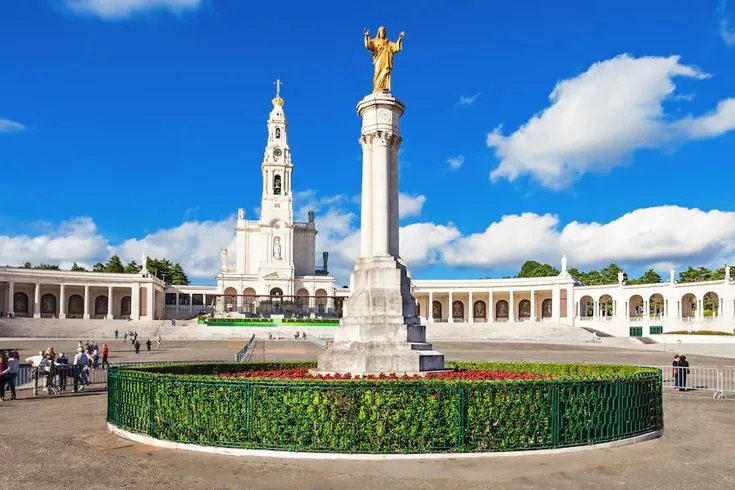
The Cova da Iria — the hollow where the apparitions occurred — is now the centre of a sanctuary complex that covers approximately 25 hectares. The holm oak tree where the Lady appeared was gradually stripped by pilgrims taking pieces as relics and no longer exists. The Chapel of the Apparitions, built in 1919 on the precise site, operates 24 hours a day and remains the spiritual focal point of all ceremonies.
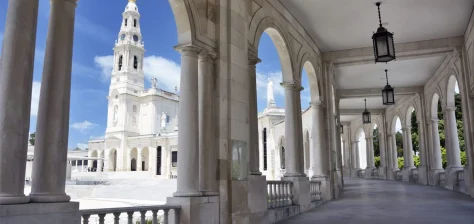
The main esplanade — the open paved area in front of the Basilica of Our Lady of the Rosary — is twice the size of St Peter’s Square in Rome. On pilgrimage dates it fills entirely. On a quiet Tuesday in February it is nearly empty, and the basilica’s 65-metre campanile is audible at a distance before the sanctuary is visible.
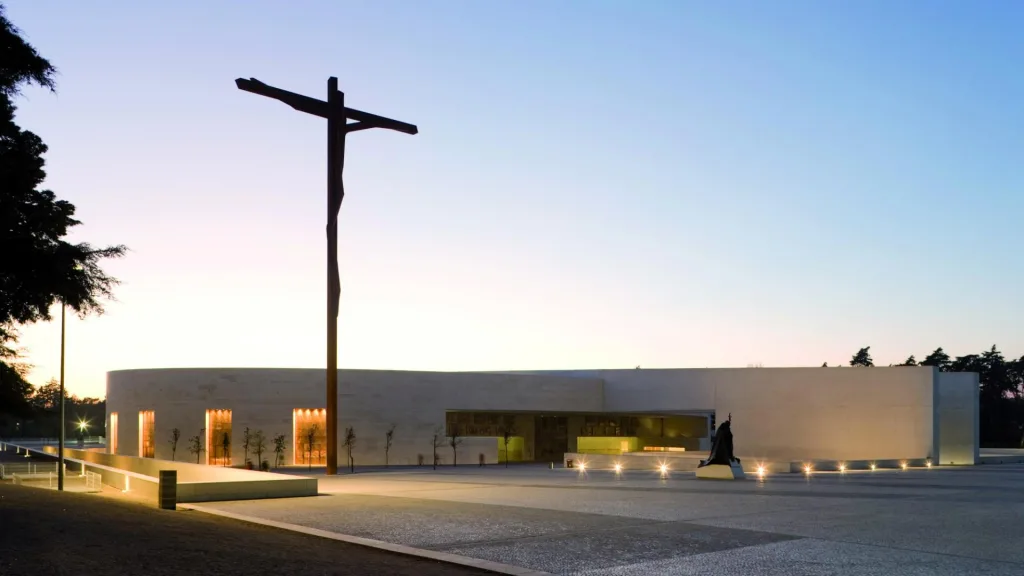
The Basilica of Our Lady of the Rosary (consecrated 1953) and the Basilica of the Holy Trinity (inaugurated 2007, capacity 8,633) are both freely accessible. The tombs of Francisco, Jacinta, and Lúcia are inside the Basilica of Our Lady of the Rosary, in the lateral chapels.
Entry to all three structures is free. The sanctuary receives 6.2 million visitors annually (2024 figure). The two major pilgrimage dates — 12–13 May and 12–13 October — draw hundreds of thousands of pilgrims; October can reach one million. Any other date offers a substantially different experience.

Visit Fátima from Lisbon
The sanctuary is freely accessible and takes 2–4 hours depending on how much of the complex you want to cover. What a guide adds is context — the sequence of events, the content of the secrets, the significance of each structure — which transforms a walk across a large esplanade into a coherent narrative.
Fátima is 142 km from Lisbon. A private tour combines the sanctuary with Batalha Monastery (22 km north — UNESCO 1983) and Nazaré or Óbidos, covering the full northern circuit in one day.
FAQ
Who is Our Lady of Fátima?
How many apparitions were there at Fátima?
Who were the three children of Fátima?
What are the Three Secrets of Fátima?
What was the Miracle of the Sun?
Did the Catholic Church officially recognise the Fátima apparitions?
Where are the three children buried?
How many people visit Fátima each year?
Is Fátima worth visiting if you are not Catholic?
How far is Fátima from Lisbon?

Founder & Director of Yellow Cab TT Tours. Guiding in Portugal for 20+ years.
Founded Yellow Cab TT Tours in 2013. 3,372 five-star reviews on Tripadvisor.