

LX Factory is not a museum, not a market, and not a shopping centre — though it contains elements of all three. It is a 23,000-square-metre former textile factory in the Alcântara district, built in 1846 and left largely derelict for decades before being converted into a creative hub in 2008. Today it holds around 60 independent businesses: restaurants, concept stores, a bookshop, art galleries, design studios, and a Sunday market that draws most of the visitors.
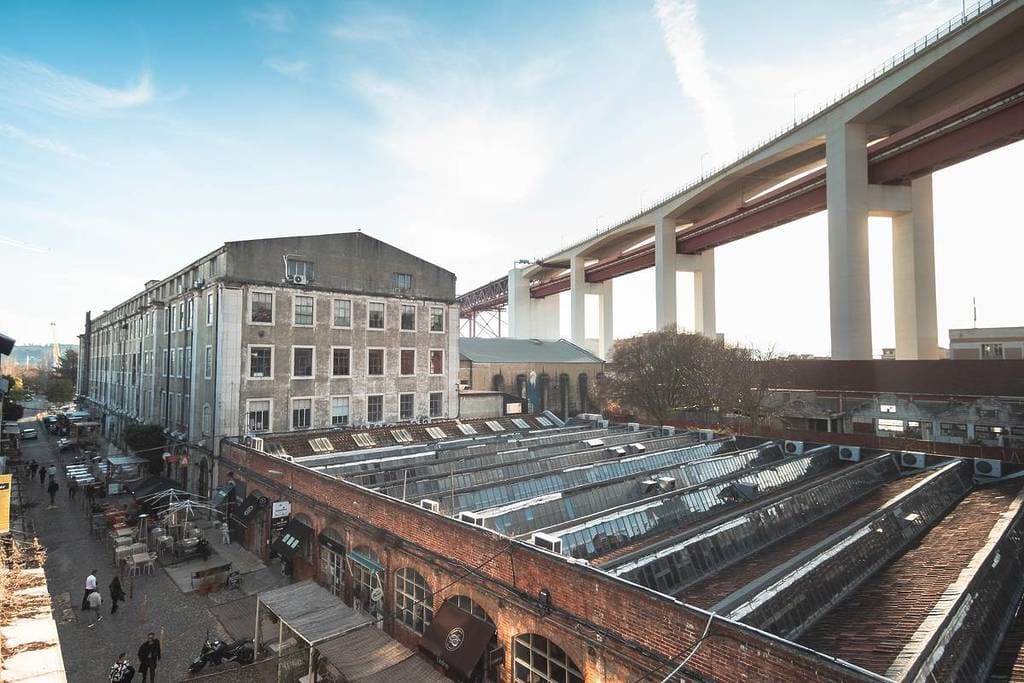
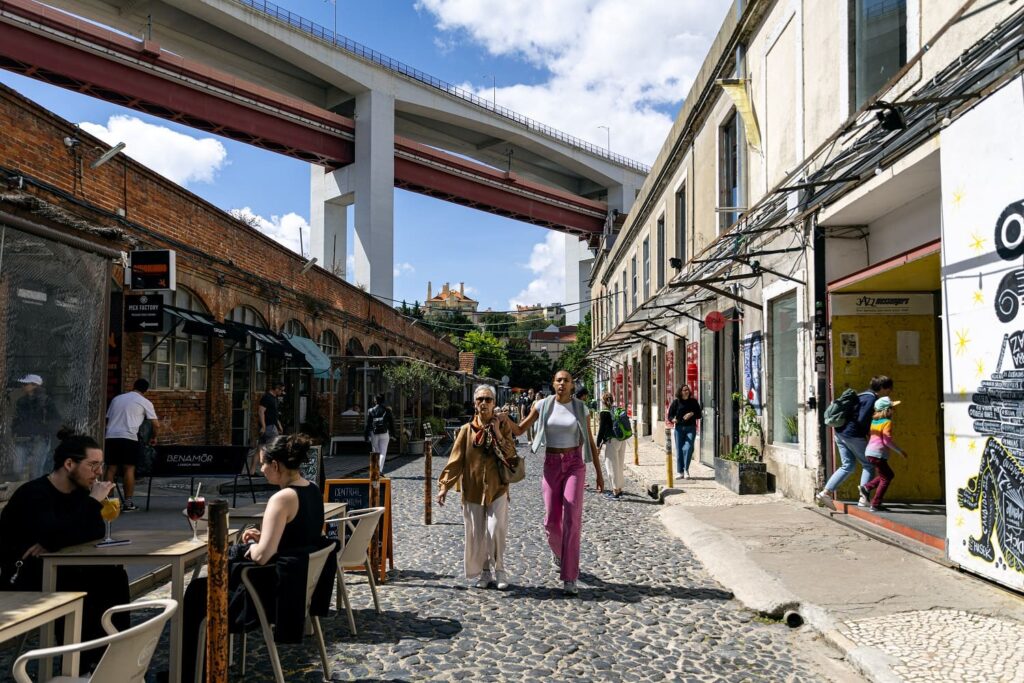
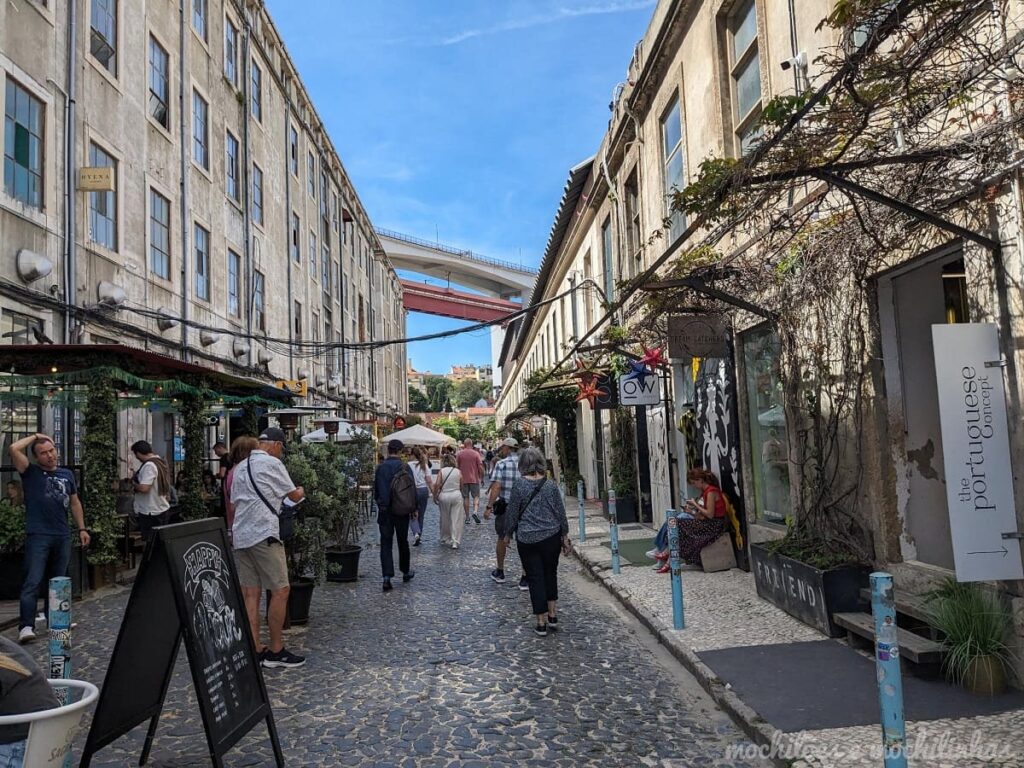
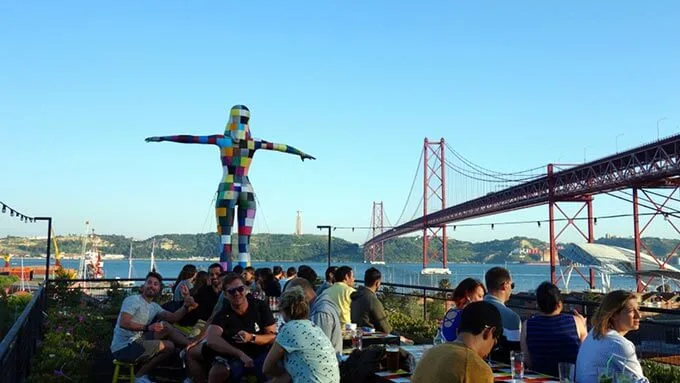
What makes the space distinctive is the physical context. It sits directly under the approach span of the 25 de Abril Bridge — Lisbon’s suspension bridge over the Tagus — and the bridge traffic overhead is audible from the courtyards below. The industrial architecture has been kept: exposed brick, iron columns, rusted metalwork, the original factory floor plans. The businesses occupy the buildings as found rather than behind a renovated facade.
Most visitors come on Sunday for the market. The space works on weekdays too, particularly for the bookshop and the restaurants, but the critical mass of activity concentrates on Sunday mornings. I bring clients here when they want something outside the standard Lisbon monuments circuit — it is a different register of the city, and it works as a contrast to Belém or Alfama rather than as a replacement.
From Textile Factory to Creative Hub: The History of LX Factory
The building that now houses LX Factory was constructed in 1846 for the Companhia de Fiação e Tecidos Lisbonense — a thread and fabric company that became one of Alcântara’s most important industrial tenants. The site covers 23,000 square metres along the Tagus riverbank, and at its peak it was part of a dense industrial corridor that included textile mills, food processing plants, and printing houses.
The decline was gradual. As Lisbon’s industrial base contracted through the second half of the 20th century, the Alcântara waterfront lost its function. The factory complex passed through several owners and uses — food processing, printing — before becoming largely abandoned. The neighbourhood around it followed a similar trajectory: once a working-class industrial district, it became one of the areas the city had not yet decided what to do with.
In 2008, Mainside Investments acquired the site and began the conversion. The approach was deliberate: preserve the industrial character of the buildings, bring in independent creative businesses rather than chains, keep the entry free. The result was an open block of workshops, studios, and small commercial spaces that filled gradually over the following years with the kind of tenants that tend to move on when an area becomes expensive — which is, broadly, what is now happening. Some of the original businesses that established LX Factory’s character in 2009 and 2010 have since relocated as rents have increased — which is a trajectory familiar enough to have its own name in most European cities.
The 25 de Abril Bridge — inaugurated in 1966, originally named Salazar Bridge after the dictator, renamed after the 1974 Carnation Revolution — passes directly overhead. The noise is part of the atmosphere. Whether this is a feature or a drawback depends on the visitor, and on how they feel about suspension bridges at close range.
The Sunday Market: What to Expect
The LX Market runs every Sunday and is the main reason most visitors come. In summer (roughly May–September) it operates from 11:00 to 20:00; in winter from 10:00 to 18:00. Entry is free.
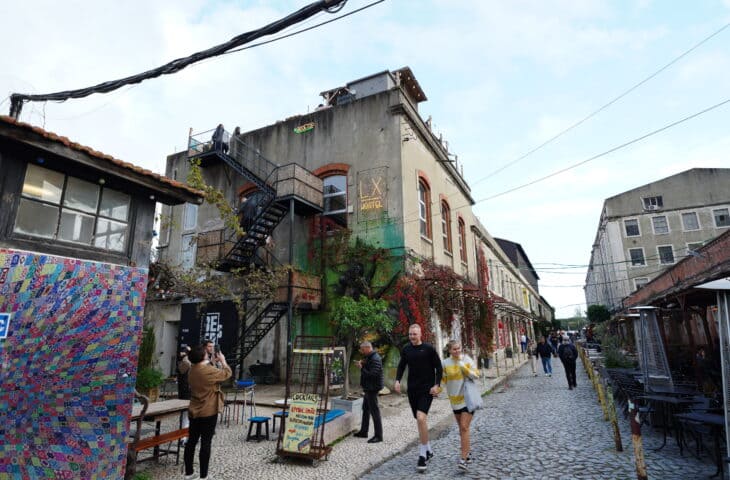
The market occupies the main courtyard and surrounding areas. It has two distinct parts: a craft and design section, with vendors selling handmade jewellery, clothing, ceramics, prints, and original artwork; and a food section, with street food stalls, pastry vendors, and small producers. The balance shifts week to week — some Sundays are heavier on crafts, others on food.
What to expect practically: the market draws significant crowds by midday in summer. The courtyard fills, the restaurants queue up, and the bookshop becomes difficult to navigate. Arriving before 11:30 gives a more manageable experience. By 13:00, the combination of tourists, Lisbon residents, and families with children creates conditions that are either vibrant or crowded, depending on your tolerance for both.
The food quality is genuinely variable. Some stalls are excellent; others are standard festival food at elevated prices — a combination that has been independently discovered by every street market in Europe since approximately 2010. The craft section has a higher floor — most vendors are actual makers rather than resellers, which means the market has a different character from a generic flea market. Whether anything is worth buying is a personal matter. Whether it is worth attending on a Sunday morning in Lisbon is less disputed.
What to See and Do at LX Factory
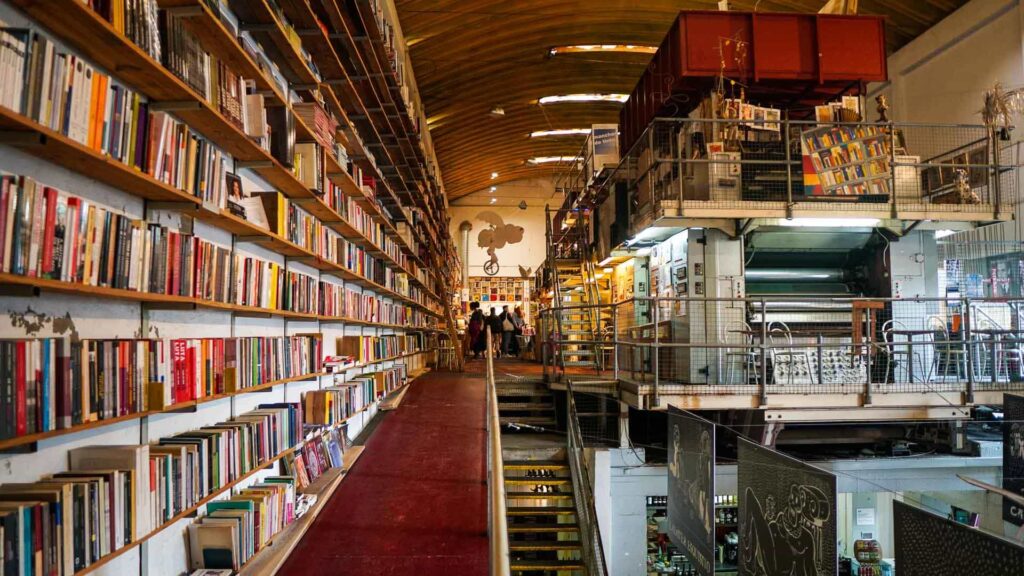
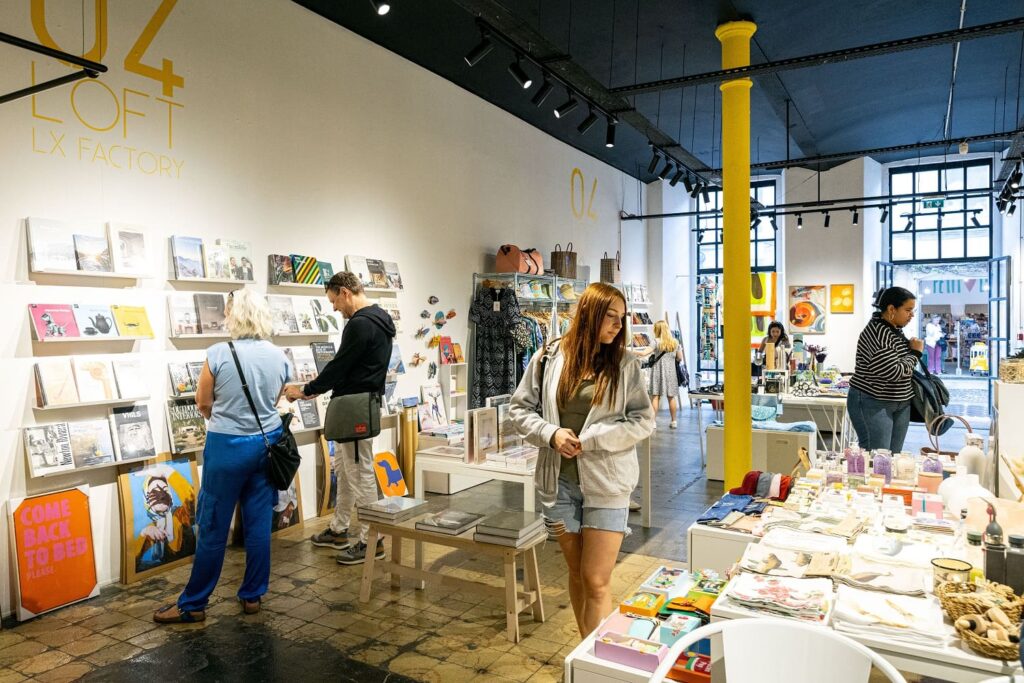
Ler Devagar is the bookshop and the most discussed single element of LX Factory. It occupies a former printing press building with high ceilings and iron mezzanine galleries, and the physical space is as much the attraction as the books themselves. The shop stocks Portuguese and international titles, design objects, and a curated selection of vinyl records. It remains open beyond Sunday market hours — typically from around 11:00 to 22:00 on weekdays and later at weekends. A suspended bicycle installation hangs above the central floor. Whether this is an inspired artistic touch or an exercise in industrial-chic excess is largely a matter of personal taste.
Restaurants and cafés occupy several buildings throughout the complex. 1300 Taberna remains one of the most established dining options, serving contemporary Portuguese cuisine in a converted industrial space with original factory architecture. Reservations are strongly recommended on Sundays. While the Sunday market introduces additional food vendors and pop-up stalls, the permanent restaurants generally provide the strongest dining experience.
The courtyards and industrial buildings deserve exploration in their own right. Exposed brickwork, cast-iron columns, original factory layouts, and preserved warehouse structures form the architectural identity of the complex. Much of LX Factory’s appeal comes from how creative businesses have adapted these spaces while retaining their industrial character. The result feels authentic rather than overly curated.
Village Underground Lisboa, located next to LX Factory, consists of repurposed double-decker buses and shipping containers transformed into creative studios, offices, and event spaces. While technically separate from LX Factory, it contributes to the same creative ecosystem and is worth a brief visit while exploring the area.
LX Factory is included on many of our Lisbon itineraries as part of a broader exploration of the city’s contemporary culture and creative districts. Visitors often combine it with nearby Belém, creating a route that contrasts Lisbon’s industrial heritage with its maritime history and monumental architecture. For a private tour that combines both historic and contemporary Lisbon, see the Lisbon Private City Tour or the Best of Lisbon & Sintra Tour.
Bordalo II and the Street Art
Artur Bordalo — known as Bordalo II, born 1987 — is a Lisbon-based street artist whose work appears throughout the city and internationally. His technique involves collecting discarded industrial materials — car bumpers, plastic ducting, wire mesh, shower curtains — and assembling them into large-format animal sculptures mounted on walls. The animals depicted are typically species affected by industrial pollution: the material and the subject are the same problem rendered at different scales.
LX Factory has been a recurring site for his work, including a large bee assembled from plastic components that has become one of the most photographed elements of the complex. The piece is made from plastic ducts, shower curtains, car bumpers, and wire netting — visible in its components if you look closely, coherent as an animal from a distance.
Other street artists have also worked at LX Factory, and the walls of the complex carry a changing collection of murals and installations. The quality varies significantly. Bordalo II’s work is the anchor. Most of the rest is worth a glance; some of it is worth stopping for.
The street art is free to view and visible from the public courtyards without entering any building.
Practical Information: Hours, Getting There and What It Costs
Entry: Free. The complex is open to walk through at all times during business hours. Individual businesses have their own hours.
Sunday market: May–Sep 11:00–20:00 / Oct–Apr 10:00–18:00
Ler Devagar bookshop: Tue–Thu 11:00–22:00, Fri–Sat 11:00–00:00, Sun 11:00–20:00, closed Mon
Address: Rua Rodrigues de Faria 103, 1300-501 Lisboa
| Transport | Detail |
|---|---|
| Tram 15E | From Praça da Figueira or Cais do Sodré → Alcântara-Mar stop, ~20 min |
| Train (Cascais line) | Cais do Sodré → Alcântara-Mar station, ~5 min, then 5 min walk |
| Bus 714 / 727 | From city centre to Alcântara |
| Private vehicle | Parking available on surrounding streets; limited on Sunday market days |
The train from Cais do Sodré is the fastest and least crowded option on Sundays. The tram 15E is more scenic but significantly slower and crowded during market hours.
Adding LX Factory to a private tour: LX Factory is not a standard stop on group tours or fixed itineraries, but private tours are flexible by design. It works well as an add-on to a morning in Belém — Jerónimos Monastery and the Belém Tower are 2 kilometres east along the waterfront. Alternatively it pairs with Alcântara and the Tagus riverfront as an afternoon stop. Discuss with your guide at booking.
Add LX Factory to Your Lisbon Private Tour
LX Factory is not on the standard tour circuit — but private tours are not standard. If you want to include Alcântara and the creative district alongside Belém, Alfama, or Bairro Alto, that is straightforward to arrange. Private tours are built around your itinerary, not a fixed route.
- Lisbon Private City Tour — visit Alfama, Belém, Bairro Alto, Mouraria and Baixa in one day, with flexible add-ons including Alcântara and LX Factory. See full details at Lisbon Private City Tour.
- Best of Lisbon & Sintra — Lisbon highlights combined with Sintra and Cabo da Roca in one full day. See full details at Best of Lisbon & Sintra.
FAQ
What is LX Factory in Lisbon?
When is the LX Factory Sunday market?
How much does it cost to enter LX Factory?
What is the best time to visit LX Factory?
Who is Bordalo II?
Is LX Factory good for families?
How do I get to LX Factory from the city centre?
Is LX Factory near Belém?
What is the Ler Devagar bookshop?

Founder & Director of Yellow Cab TT Tours. Guiding in Portugal for 20+ years.
Founded Yellow Cab TT Tours in 2013. 3,372 five-star reviews on Tripadvisor.