
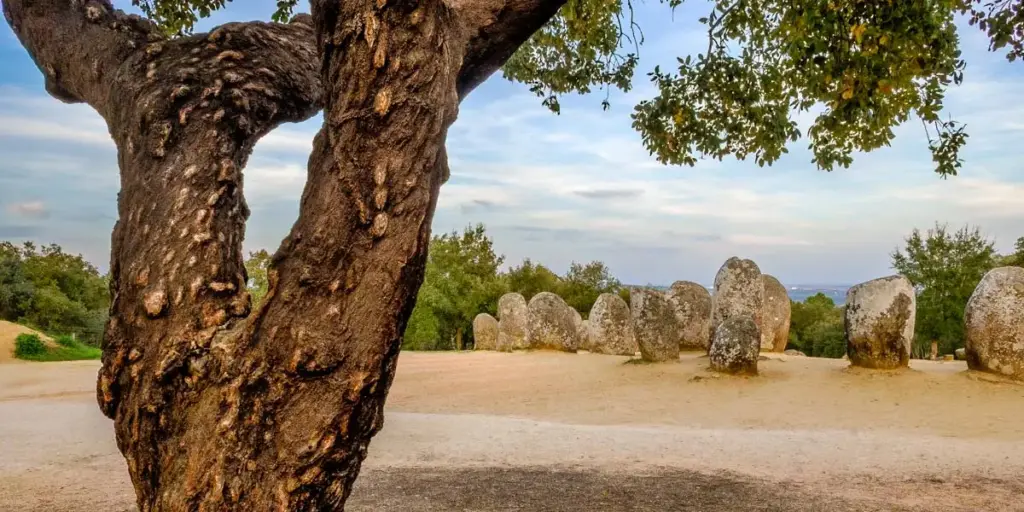

Stonehenge is the most visited prehistoric monument in Europe. The Almendres Cromlech, 16 km west of Évora in Portugal’s Alentejo region, is larger, older, and considerably less crowded. Construction at Almendres began around 6000 BC — approximately 3,000 years before the first stones were raised at Stonehenge. The site contains around 95 granite menhirs arranged in two linked oval formations, some still standing, some fallen, some bearing carved symbols that have not been fully interpreted.
The reason most people have not heard of Almendres is practical rather than historical. There is no public transport to the site. The approach road is 8 km of gravel track through cork oak and olive groves. There is no entrance fee, no ticket booth, no café, and no audio guide. The site is simply there, in an Alentejo field, as it has been for approximately eight millennia.
I have brought clients to Almendres as an add-on to the Évora day tour. The reaction is consistent: people expect a minor roadside attraction and arrive at something that takes several minutes to process. This guide covers what Almendres is, how to reach it, and what to do with the time once you are there.
What Almendres Actually Is
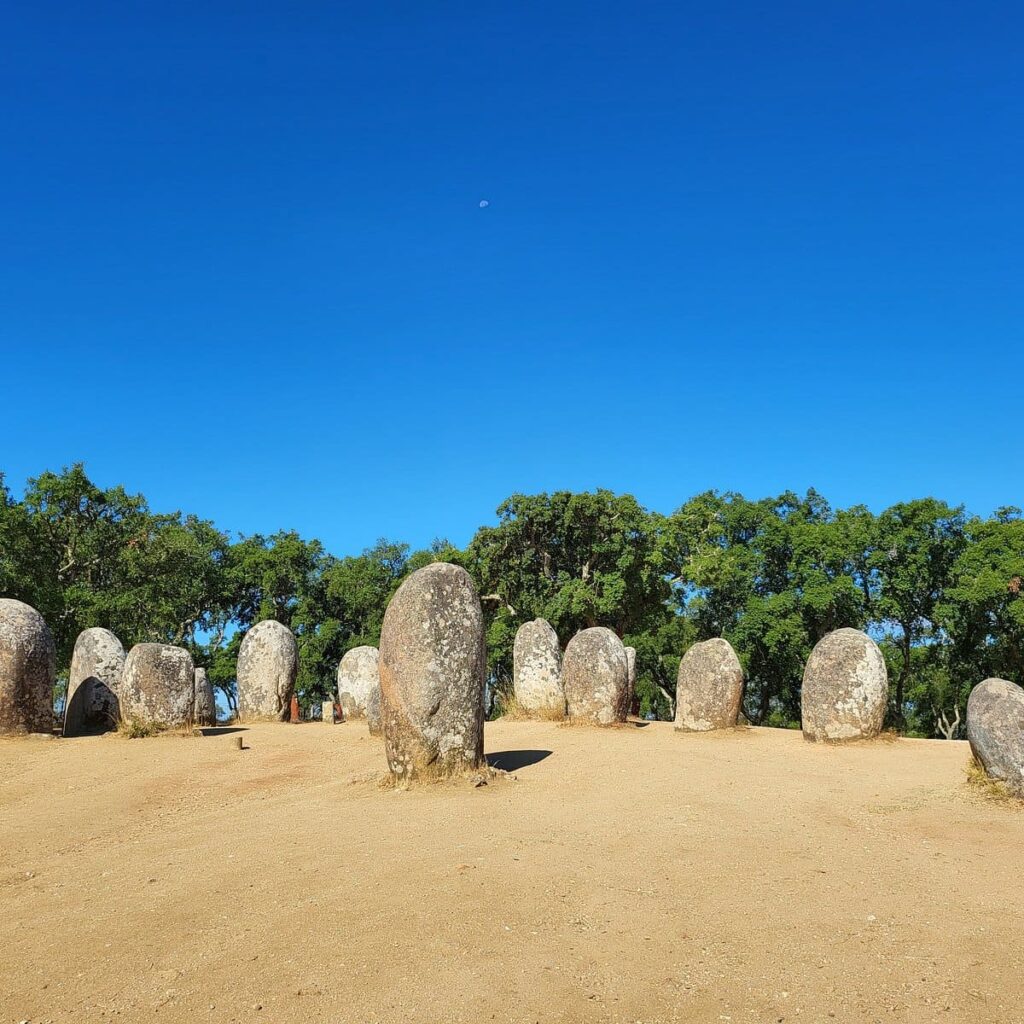
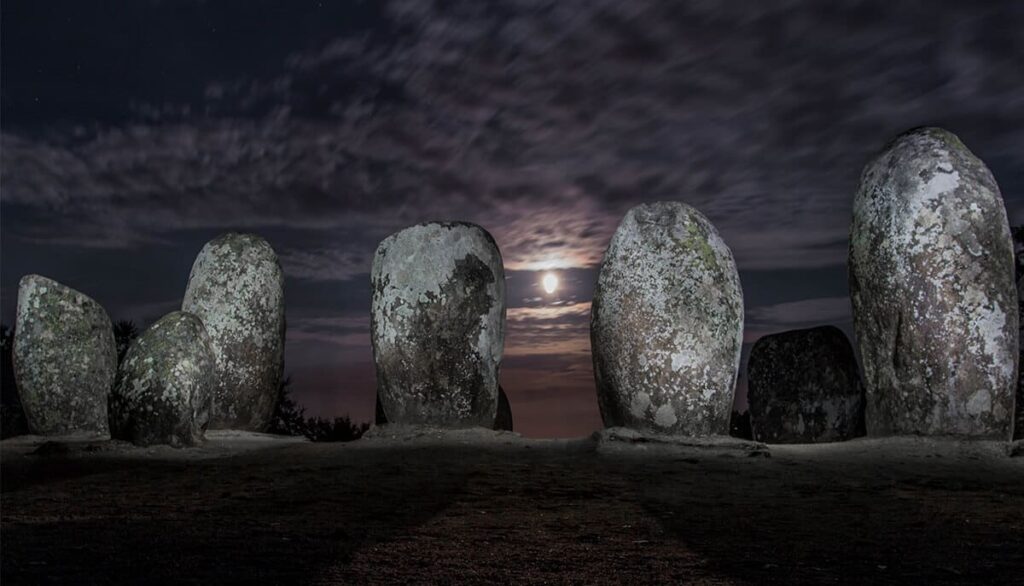
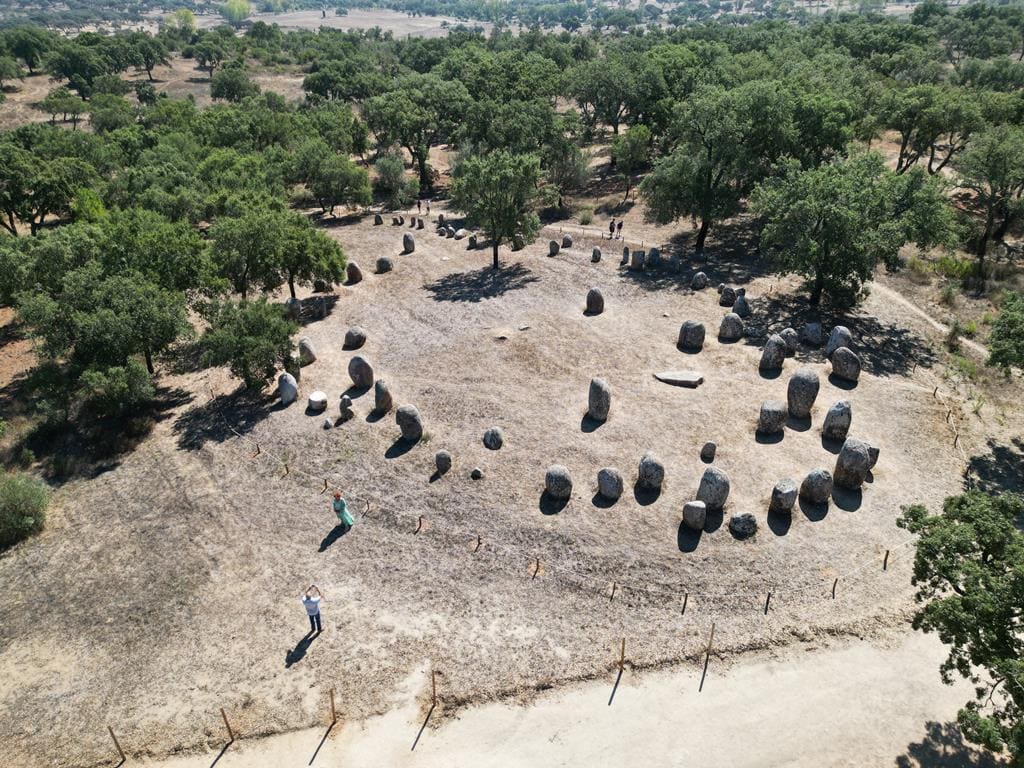
The Almendres Cromlech — Cromeleque dos Almendres in Portuguese — is the largest megalithic complex in the Iberian Peninsula. It consists of approximately 95 granite menhirs arranged in two linked oval formations on a hillside above the Alentejo plain. The stones range in height from under a metre to over 2.5 metres. Several bear carved cup marks and geometric symbols; a small number have anthropomorphic carvings.
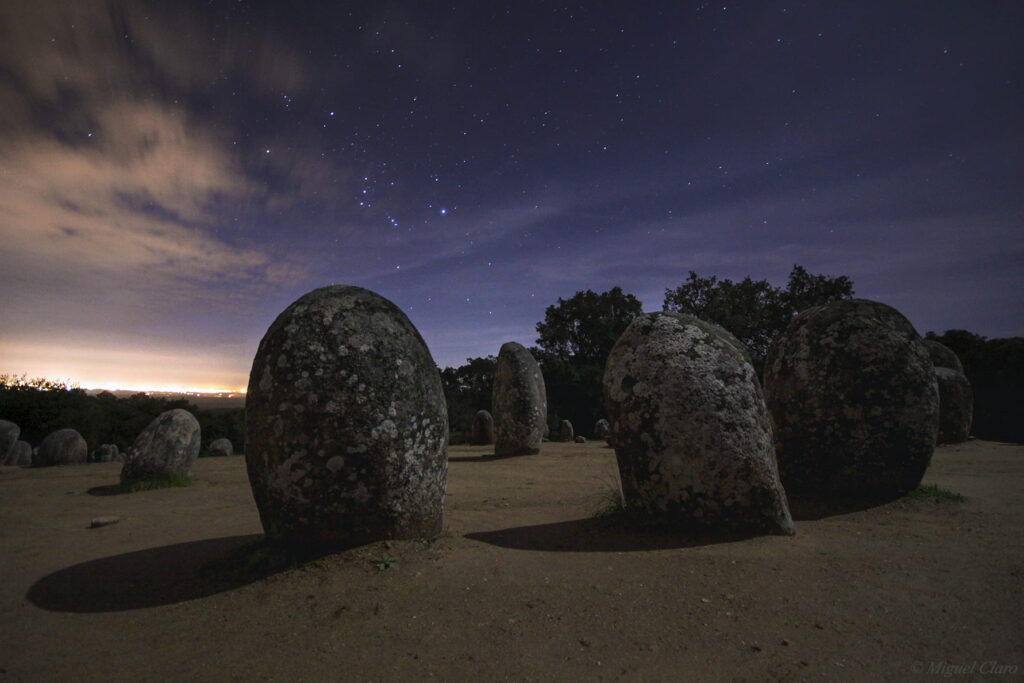
The term cromlech — from the Welsh/Breton crom (curved) and lech (stone) — describes a circular or oval arrangement of standing stones. Unlike Stonehenge, where the stones were transported from Wales and arranged with lintel structures, the menhirs at Almendres are local granite, placed upright in situ. The arrangement is not random: astronomical alignments with the winter solstice sunrise and the rising of certain stars have been documented by researchers at the University of Évora, though the full purpose of the site remains a subject of ongoing study.
The cromlech sits at approximately 300 metres elevation, on a gentle hillside enclosed by cork oak (Quercus suber) and olive trees. The landscape itself is part of what makes the visit — this is the Alentejo interior, silent except for wind and occasional livestock, and the stone circle occupies that silence with a kind of weight that photographs do not capture.
How Old Is Almendres — and How Do We Know?
Construction at Almendres took place in phases over several millennia. The earliest stones were erected around 6000 BC, during the Early Neolithic period. The site was expanded and modified through the Chalcolithic (Copper Age), with the most recent phase of construction dated to approximately 3000–2500 BC. Stonehenge’s construction began around 3000 BC and continued to approximately 1500 BC — meaning the oldest stones at Almendres predate Stonehenge’s first phase by approximately 3,000 years — or by around 1,000 years when comparing the final Almendres construction phase (~4000 BC) with Stonehenge’s stone settings (~3000 BC).
Dating was established through radiocarbon analysis of organic material found during excavations by the archaeologist Henrique Leonor Pina in the 1960s and subsequent excavation and restoration by archaeologist Mário Varela Gomes in the 1980s. The carved symbols on some stones — concentric circles, crescent forms, and shepherd’s crook shapes — correspond to carvings found at other Alentejo megalithic sites from the same period, providing corroborating typological evidence.
The multi-phase construction explains why the site has two distinct oval formations rather than one coherent circle. The northern oval is the older structure; the southern oval was added later and is slightly different in stone size and spacing. Whether the builders of the two phases had any continuous institutional relationship with each other across several thousand years of construction is a question archaeology cannot currently answer. The stones are simply there, from both periods, in the same field.
The Stones Themselves: What You See on the Ground
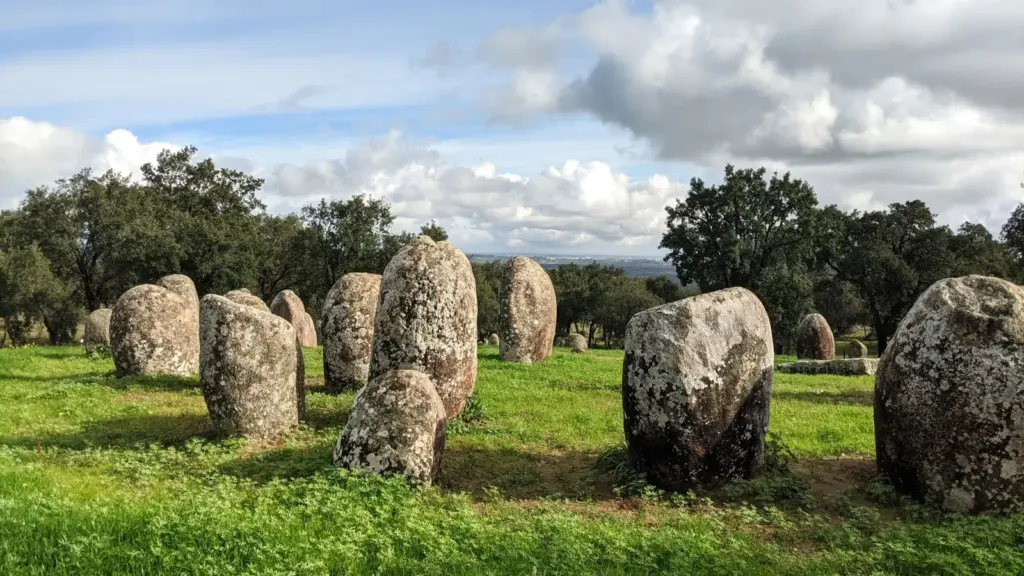
Of the approximately 95 menhirs documented at Almendres, the majority were re-erected during restoration work carried out by Mário Varela Gomes in the 1980s. Some stones remain fallen or fragmented, primarily as a result of agricultural disturbance in the medieval and early modern periods, when the site was not recognised as a monument and the stones were occasionally used as building material.
The tallest stones stand at the southwestern end of the complex. Several bear carvings — most visible are the cup marks (small circular depressions) and a set of crescent-shaped symbols on stones in the northern oval. The anthropomorphic carving on one stone near the centre of the complex, depicting what appears to be a simplified human form, is among the more unusual features; comparable figures appear at other Chalcolithic sites in the Alentejo but remain poorly understood.
The site is unfenced and unguarded. You walk directly among the stones. There are no roped-off zones, no barriers, and no guide present unless you have brought one. This is unusual for a monument of this significance, and it works both ways: the experience is completely unmediated, and so is any potential for damage. The stones have survived 7,000 years without a visitor management system. Whether that continues depends on whether visitor numbers stay manageable — which, given the access conditions, they currently do.
Almendres and the Alentejo Megalithic Landscape
Almendres is the most prominent site in a megalithic landscape that covers much of the Alentejo region. Within 30 km of Évora, there are several other significant monuments:
Menhir dos Almendres — a single large standing stone approximately 1 km from the cromlech, likely the earliest phase of the same megalithic tradition. It stands alone in an olive grove.
Anta Grande do Zambujeiro — the largest dolmen (megalithic tomb) in the Iberian Peninsula, located approximately 10 km southwest of Évora near Valverde. Its entrance corridor and capstone are among the largest of any dolmen in Europe.
Cromeleque do Xerez
a smaller stone square (not a circle — 55 menhirs in a square formation) originally located near Reguengos de Monsaraz, approximately 55 km east of Évora. The complex was dismantled in November 2001 before the Alqueva reservoir flooded the area, and reinstalled near the Convento da Orada, in the village of Telheiro, in June 2004. It is the only megalithic monument relocated as part of the Alqueva reservoir project.
The density of megalithic monuments in the Alentejo suggests the region was a centre of Neolithic and Chalcolithic population and ritual activity — the stones were built and maintained by communities that farmed the same landscape over thousands of years. The Alentejo’s current agricultural identity (cork, olive, grain, sheep) has roots that are considerably older than the Roman occupation.
How to Get There: The Practical Problem
The Almendres Cromlech is located approximately 16 km west of Évora, near the village of Nossa Senhora de Guadalupe. There is no public transport to the site. The route from Évora follows the N114 towards Montemor-o-Novo for approximately 8 km, then turns north onto the CM1075 through the village of Nossa Senhora de Guadalupe; after the village the road becomes a dirt track for the final 3 km to the site. Brown and white “cromeleque” signs mark the turns.
The dirt track is navigable in a standard car in dry conditions. After rain, the surface can become soft in sections — a higher-clearance vehicle is preferable. There is a small unpaved parking area at the site. Parking is free.
From Évora by private car, the drive takes approximately 25 minutes each way. By taxi from Évora, the round trip with waiting time costs approximately €30–40, depending on the driver. No rideshare services operate reliably in this area.
We include Almendres as an optional extension on our Évora private day tour from Lisbon. Adding the cromlech extends the day by approximately 1 hour and requires no additional logistics from the client — the guide handles the route and the timing. For visitors who want to reach the site independently, a rental car is the only realistic option.
When to Visit
Spring (March–May) is the best season. Temperatures are 15–22°C, the wildflowers are in bloom across the Alentejo plain, and the morning light on the stones between 07:00–09:00 is flat and low, revealing the carved symbols more clearly than midday sun. Crowds are minimal at any time of year, but spring sees the fewest visitors.
Summer (June–August) is difficult. Évora regularly reaches 38–40°C in July and August. The cromlech is fully exposed — no shade, no water source. If visiting in summer, arrive at opening (the site is accessible from sunrise) and leave before 10:00.
Autumn (September–October) is a reasonable alternative to spring: harvest activity in the surrounding fields, temperatures drop to 20–28°C by October, and the site is quieter than summer.
Solstice visits are worth noting: the winter solstice sunrise (around December 21) aligns with the axis of the cromlech according to documented archaeoastronomical research. Several visitors specifically time visits to the solstice. The site has no organised event for this, which is either a problem or the point, depending on what you are looking for.
Visit Almendres Cromlech from Lisbon
Almendres is 15 km from Évora on a gravel road with no bus service. The easiest way to visit is as part of a private Évora day tour — we handle the route, the timing, and the historical context. Almendres is an optional extension on the standard itinerary; adding it requires about 1 extra hour.
Private Évora Tour from Lisbon — Roman Temple (1st century AD), Chapel of Bones (~5,000 human remains), working cork factory, Almendres Cromlech as optional add-on. 8–9 hours. From €330/vehicle.
FAQ
Is there an entrance fee for the Almendres Cromlech?
How do I get to the Almendres Cromlech without a car?
How many standing stones are at Almendres?
How does Almendres compare to Stonehenge in age?
Is the Almendres Cromlech a UNESCO World Heritage Site?
What do the carvings on the stones mean?
Can you visit Almendres as a day trip from Lisbon?
What time does the Almendres Cromlech open?
Are there other megalithic sites near Almendres?
Is the site suitable for children?

Founder & Director of Yellow Cab TT Tours. Guiding in Portugal for 20+ years.
Founded Yellow Cab TT Tours in 2013. 3,372 five-star reviews on Tripadvisor.