
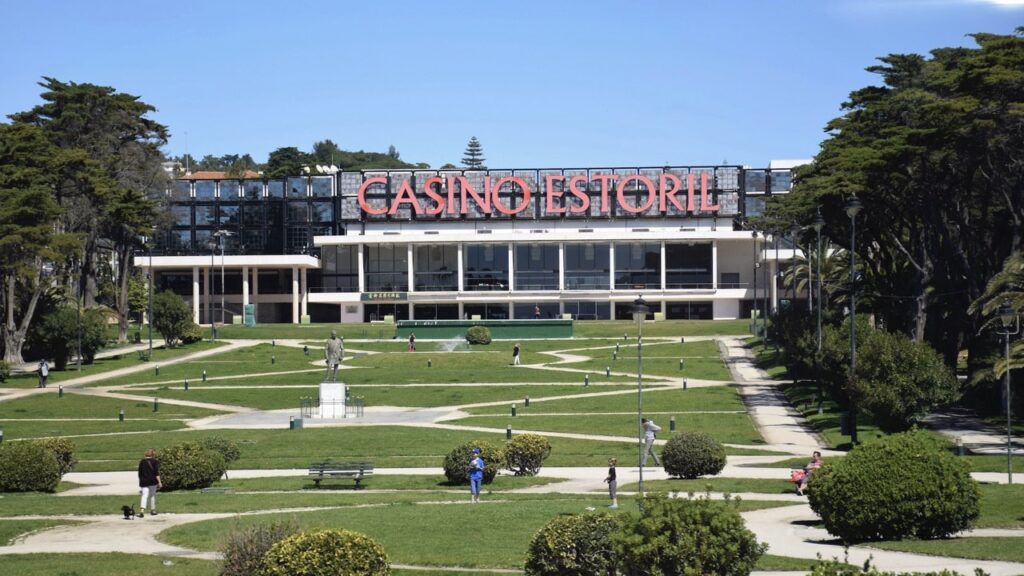

On a night in early August 1941, a Yugoslav double agent walked into Casino Estoril carrying $38,000 in cash his German handler had just given him. He sat down at the baccarat table and started betting it against a wealthy stranger with twice his bankroll. A British naval intelligence officer sat nearby, watching. Twelve years later, that scene reappeared almost unchanged in a novel called Casino Royale — the first James Bond book.
Most guides to Estoril mention this in one sentence: “Ian Fleming visited the casino and it inspired James Bond.” That’s true, but it skips the actual mechanics of what happened, who the players really were, and why a stretch of Portuguese coastline was full of exiled kings and working spies in the first place. The short version undersells one of the more specific, well-documented origin stories in 20th-century fiction.
Estoril is one stop on our Sintra + Cascais route, and it’s the one clients ask the most follow-up questions about — usually starting with “wait, that’s a real casino?” This is the full version: how a casino got licensed in Portugal eleven years before gambling was actually legal, why Europe’s deposed royalty ended up on this coast, what really happened at that baccarat table, and what the building looks like today.
A Casino Portugal Wasn’t Supposed to Have
Gambling was effectively illegal across mainland Portugal until Decree-Law 14,463 legalised it nationally on 3 December 1927. Casino Estoril had already been operating as a licensed gambling house for eleven years by then — a specific, government-granted exception, not an oversight.
The exception existed because of one man’s larger plan. Fausto Cardoso de Figueiredo, born in 1880, trained and briefly worked as a pharmacist before deciding that wasn’t his calling. After years travelling Europe and studying how resort towns were built, he partnered with his brother-in-law Augusto Carreira de Sousa in 1910 to found the Estoril Society — a company created to turn an undeveloped stretch of Atlantic coast west of Lisbon into a tourist destination from scratch, with a hotel, a rail line, and a casino as its three anchors.
The casino’s foundation stone was laid on 16 January 1916, by then-President Bernardino Machado in person. A sitting head of state personally inaugurating a casino’s cornerstone tells you how seriously the government treated the project — this wasn’t a private vice den seeking to avoid attention, it was a state-sanctioned economic development scheme that happened to run on baccarat and roulette.
I get asked fairly often why a famously Catholic country has one of Europe’s largest casinos sitting openly on its coast. The honest answer starts with this 1916 exemption, not with anyone’s tolerance for gambling.
Fifteen Years From Cornerstone to Curtain-Up
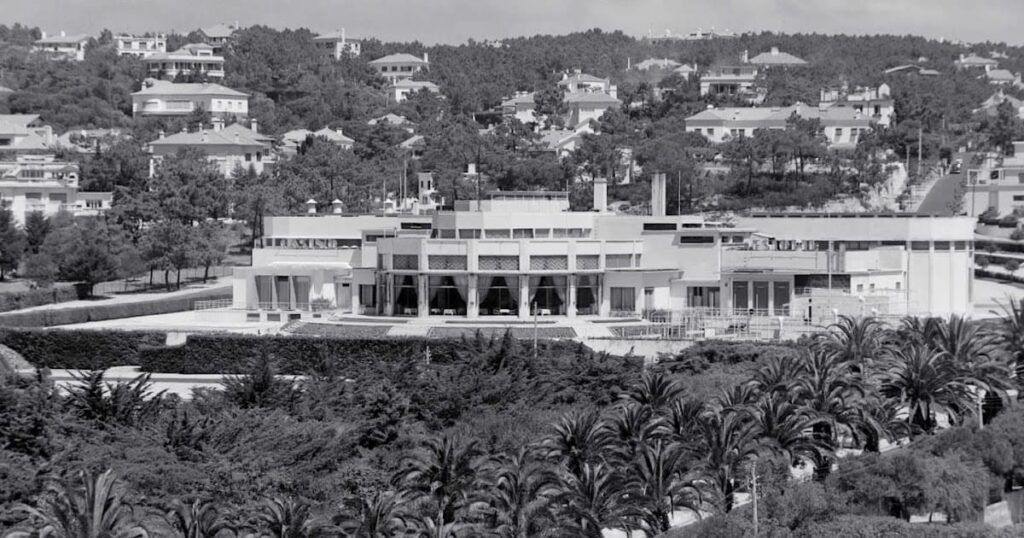
Fifteen years passed between the 1916 cornerstone and the casino’s official opening in April 1931 — the Estoril Society was building an entire resort around it, not just one building. In 1928, Fausto de Figueiredo started the neighbouring Palácio Estoril Hotel project, completed two years later; hotel and casino were designed as one package, not separate ventures.
Ownership changed hands more than once after Figueiredo’s death in 1950. In 1958 the casino passed to José Teodoro dos Santos. The 1960s brought a major expansion and redesign, overseen by architect Filipe Nobre de Figueiredo and José Segurado, with interiors by Daciano da Costa and José Espinho — the version of the building most visitors see today dates largely from this era, not 1931. In 1987, Macau gaming magnate Stanley Ho acquired a majority interest through Sociedade de Turismo e Diversões de Macau (STDM), and in 2022 the gaming licence passed to his daughter Pansy Ho’s Estoril Sol company. The same Macau-based family has controlled the casino for close to four decades now.
Neutral Portugal’s Waiting Room for Exiled Royalty
Portugal stayed neutral throughout the Second World War, and that single fact turned this stretch of coast into something unusual: a place where the war was happening everywhere except directly here. Deposed and displaced European royalty gravitated to it in numbers. Umberto II, the last King of Italy, spent much of his 37 years in exile on this coast. Carol II of Romania settled in Estoril after abdicating and died there of a heart attack in 1953 — the same year, as it happens, that Casino Royale was published. Miklós Horthy, Hungary’s wartime regent, and Juan de Borbón, Count of Barcelona and father of the future King Juan Carlos I of Spain, both passed through or settled nearby.
A king in exile still needs somewhere to lose money that doesn’t look undignified doing it. Estoril offered exactly that, and the casino became the shared social space for a coastline full of people with nowhere else to be seen.
With that much displaced money and status concentrated in one small area, intelligence services on both sides of the war found Lisbon and Estoril useful places to operate relatively openly — which is precisely the environment a British naval intelligence officer walked into in the summer of 1941.
The Baccarat Hand That Became Casino Royale
Ian Fleming first checked into the Palácio Hotel on 20 May 1941, travelling as a Lieutenant Commander and personal assistant to Rear Admiral John Godfrey, Britain’s Director of Naval Intelligence, en route to Washington, D.C. He wasn’t there by accident even then — but the scene that actually became Casino Royale happened later that same year, during a second stretch in the region.
After the Washington trip, Fleming spent weeks working across Lisbon, Madrid, Gibraltar, and Tangier, reporting back to Godfrey by cable as late as 11 August. He was back at the Palácio by early August, which is when he crossed paths with Yugoslav double agent Duško Popov, codenamed TRICYCLE by MI5 — a name chosen because he ran a three-man network, not because of anything more colourful — who was staying at the same hotel between late June and 10 August 1941 while feigning loyalty to Germany’s Abwehr.
In early August, Popov received $38,000 from his German handler as part of a deliberately staged financial exchange British intelligence called Operation MIDAS, with the Abwehr keeping $2,000 for itself. Rather than banking the money quietly, Popov carried it to Casino Estoril’s baccarat table one night that week and used it to face down a wealthy gambler — a man named Bloch, described in contemporary accounts as fleeing the Nazis from Liechtenstein — betting far beyond what a reasonable player would risk.
Fleming watched from nearby. He later claimed, in interviews, that a similar incident had happened to him personally with a German agent on the outbound leg of his own trip. It hadn’t. Britain’s Official Secrets Act made it impossible for him to credit Popov directly, so he invented a version he could tell in public.
From a Card Table to the World’s Best-Known Spy
Casino Royale was published on 13 April 1953 — the first James Bond novel — and the transformation from that August night is close to one-to-one. Estoril becomes the fictional Royale-les-Eaux; Casino Estoril becomes Casino Royale; Bloch becomes the villain Le Chiffre; and Popov, the man actually holding the cash at the table, becomes the seed of James Bond himself. Fleming wrote himself into the story too, as the watchful intelligence officer Mathis.
The connection didn’t end with the book. In 1969, the Bond film On Her Majesty’s Secret Service shot scenes in Cascais and Estoril, including at the Palácio Hotel where Fleming had stayed nearly three decades earlier — the production returning, deliberately, to the actual setting of the story’s origin rather than a studio stand-in.
It’s a fair claim that no other still-operating casino in Europe can point to a specific documented card game as the direct source material for a piece of 20th-century fiction this famous. Most casinos settle for “glamorous atmosphere.” This one has receipts.
What’s Actually Inside Today
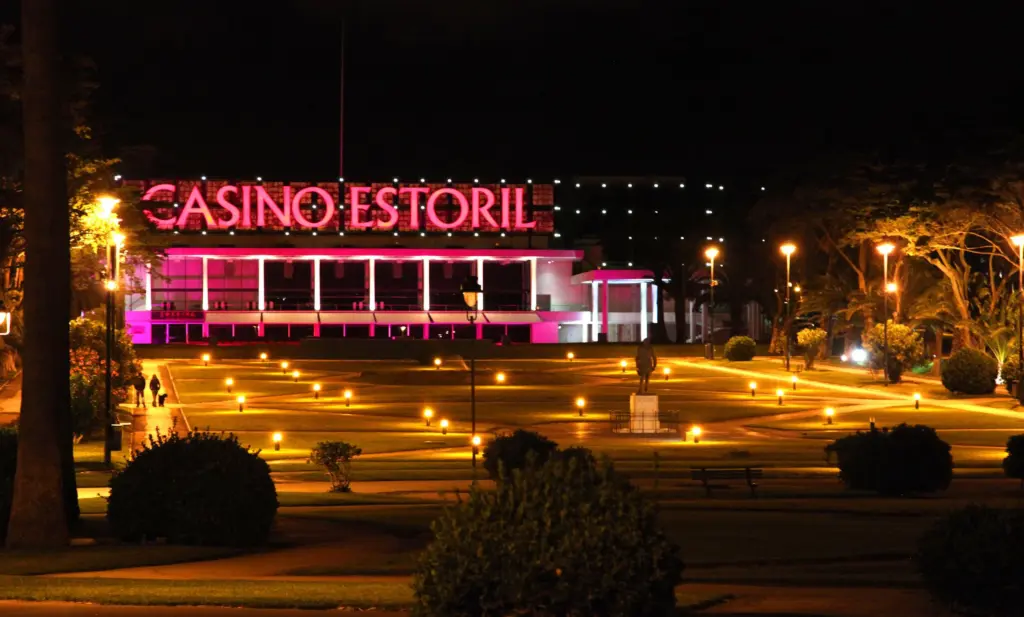
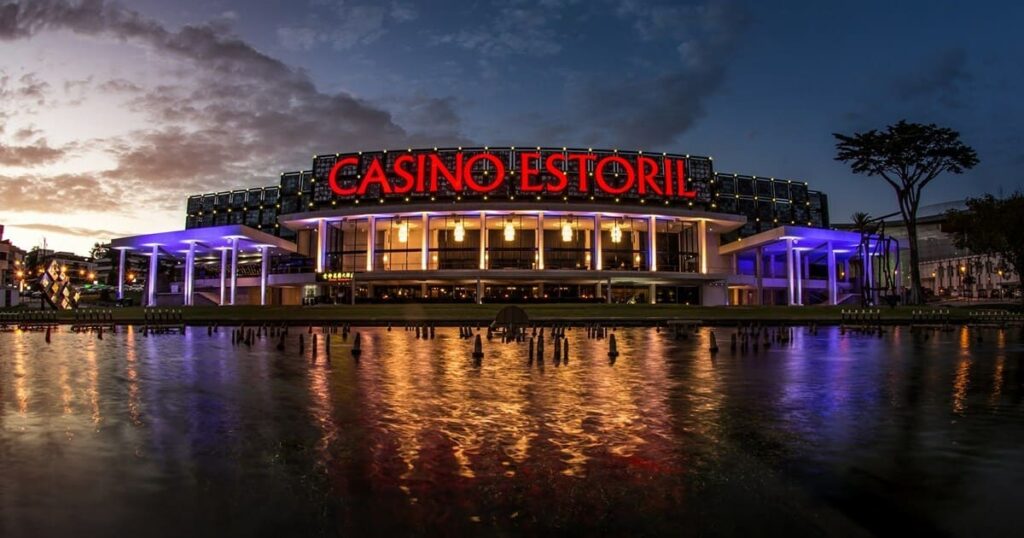
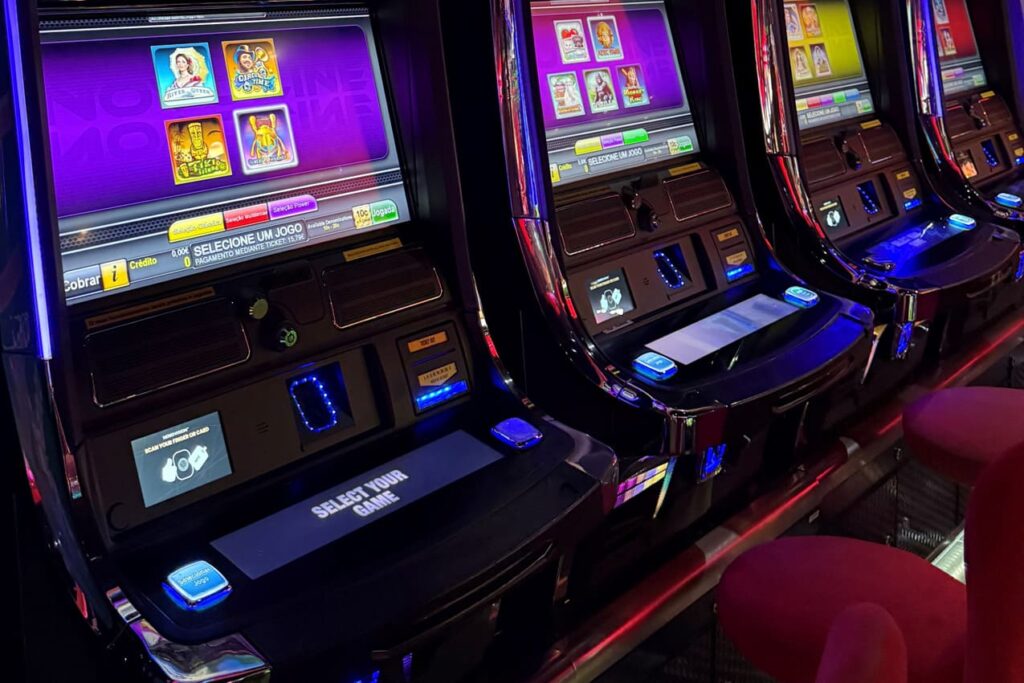
Casino Estoril is one of the largest casinos in Europe by scale — some tourism sources call it outright “the largest,” but no independent ranking body certifies that superlative, and it’s worth treating as a widely repeated claim rather than a settled fact. What’s not in dispute is the range on offer: seven types of games across the gaming floor, including roulette, blackjack, baccarat, punto banco, banca francesa (a Portuguese variant), poker, and slot machines.
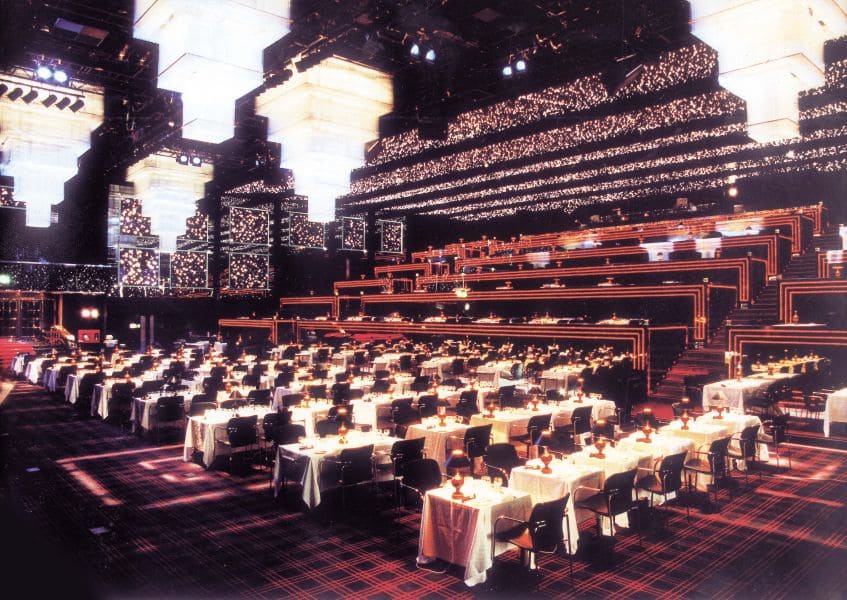
Beyond the tables, the building holds two restaurants — including Estoril Mandarim, a long-established Chinese restaurant regularly cited as one of the more elegant of its kind in Europe — three bars, and an art gallery. The Salão Preto e Prata, a roughly 400 m² hall seating around 353 people, hosts concerts, theatre, and comedy shows on a rotating schedule; it’s worth checking the casino’s own events page before visiting if a show is part of the plan.
Visiting Casino Estoril: Hours, Dress Code, Getting There
Entry to the casino is free, and no ticket is required — unusual on a coast where most attractions charge admission. The gaming floor requires visitors to be at least 18 years old with valid photo ID, and the dress code is smart casual: closed shoes, no shorts, no sportswear, no flip-flops. Public areas (restaurants, bars, the art gallery) enforce this more loosely than the gaming rooms themselves.
Opening hours: 15:00–03:00, every day of the year except 24 December. The casino sits directly outside Estoril train station, on the same Linha de Cascais that serves Cascais itself — from Lisbon’s Cais do Sodré station, the ride to Estoril takes roughly 30 minutes.
We usually reach Estoril from the Cascais seafront rather than build it into the route as a separate stop — the walk along the Paredão promenade takes about 25–30 minutes, and most people would rather see the coastline than sit in a car for a five-minute transfer.
See Estoril the Way It Actually Fits Into a Day on the Coast
Casino Estoril sits one stop before Cascais on the coastal line — close enough to see in person, not just read about.
- Sintra + Cascais Private Tour → Cascais, Cabo da Roca, and Sintra in one day, with Estoril reachable along the same stretch of coast. From €285 per vehicle.
- More on the wider area: Boca do Inferno, museums, beaches, and how to combine Cascais with Sintra.
FAQ
What is Casino Estoril famous for?
It’s best known as the direct inspiration for Ian Fleming’s first James Bond novel, Casino Royale (1953), after Fleming witnessed a real high-stakes baccarat game there in August 1941 involving double agent Duško Popov. It’s also widely described as one of Europe’s largest casinos.
When was Casino Estoril built?
Its foundation stone was laid on 16 January 1916 by then-President Bernardino Machado. It opened officially in April 1931, and underwent a major expansion and redesign in the 1960s — the version most visitors see today largely dates from that era.
Is Casino Estoril really the largest casino in Europe?
It’s routinely described that way in tourism and casino-industry sources, based on its scale of gaming tables and slot machines, but no independent body formally certifies “largest in Europe” rankings. Treat it as a widely repeated claim rather than an official title.
What is the Ian Fleming connection to Casino Estoril?
In August 1941, British naval intelligence officer Ian Fleming was staying at the neighbouring Palácio Hotel and witnessed double agent Duško Popov bet $38,000 in cash — money just handed to him by his German handler — at the casino’s baccarat table against a wealthy gambler named Bloch. Fleming used the scene, closely, as the basis for *Casino Royale*.
Who was Duško Popov and was he really the inspiration for James Bond?
Popov was a Yugoslav double agent, codenamed TRICYCLE by MI5, who fed intelligence to Britain while posing as a German Abwehr asset. He is widely credited as a major real-life influence on the character of James Bond, particularly through the 1941 Estoril baccarat incident, though Fleming drew on other sources for the character as well.
How much does it cost to enter Casino Estoril?
Entry is free, and no ticket is required. Visitors must be at least 18 years old and carry valid photo identification to access the gaming floor.
What is the dress code at Casino Estoril?
Smart casual: closed shoes, no shorts, no sportswear, and no flip-flops on the gaming floor. Restaurants, bars, and the art gallery enforce this more loosely than the gaming rooms.
What is the minimum age to enter?
18 years old, with valid photo identification required at the gaming floor entrance.
How do you get to Casino Estoril from Lisbon?
By train from Cais do Sodré station on the Linha de Cascais — about 30 minutes to Estoril, with the casino directly outside the station. It’s also reachable on foot from Cascais along the Paredão seafront promenade, roughly 25 to 30 minutes.
Can you visit Casino Estoril without gambling?
Yes. The restaurants, bars, art gallery, and the Salão Preto e Prata theatre are open to visitors without playing at the tables. The gaming floor itself still requires the 18+ ID check even for those just observing.

Founder & Director of Yellow Cab TT Tours. Guiding in Portugal for 20+ years.
Founded Yellow Cab TT Tours in 2013. 3,372 five-star reviews on Tripadvisor.