

On the night before his departure in July 1497, Vasco da Gama and his crew spent their last hours in Portugal in a small chapel on the Belém waterfront. They prayed before sailing for India — a route that had never been completed. Two years later, they came back with pepper, cinnamon, and enough wealth to change the course of European history.
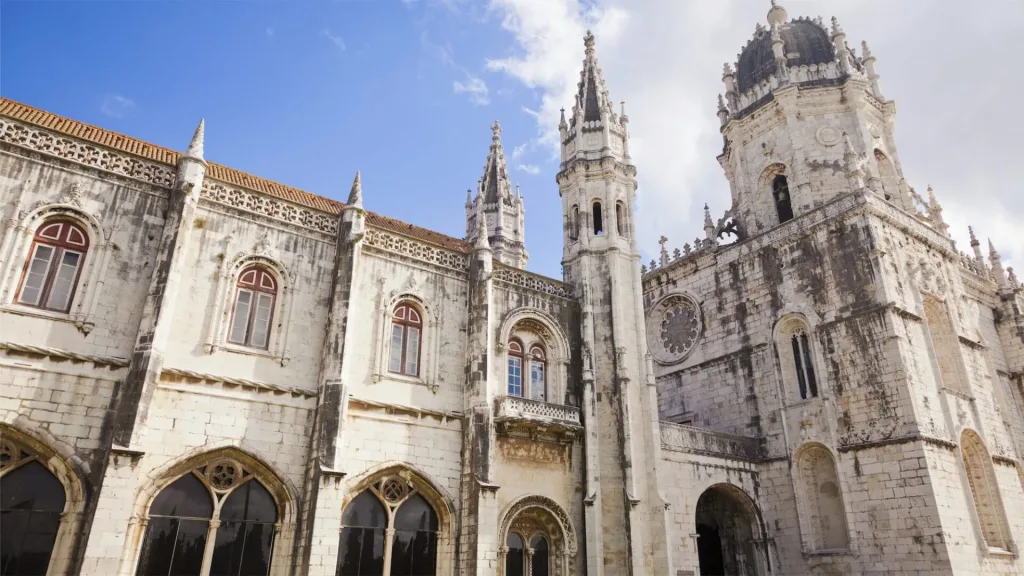
King Manuel I used a portion of that wealth to build something on the same site. Construction began on 6 January 1501. It took one hundred years, five architects, and a five-percent tax on all trade from Africa and the Orient — approximately 70 kilograms of gold per year — to complete. The result is the Mosteiro dos Jerónimos: the largest and most complete expression of Manueline architecture in existence, and one of the few buildings in Lisbon that survived the 1755 earthquake without significant damage.
This guide covers what the monastery is, how it was built, what you will find inside, and — critically — the part that most visitors do not know going in: the church of Santa Maria de Belém, which contains the tombs of Vasco da Gama and Luís de Camões, is free to enter. No ticket required. You walk past the paid queue and in through the west door.
Why Belém? The Story Behind the Location
The monastery does not stand in the historic centre of Lisbon. It stands 6 kilometres west, on the bank of the Tagus estuary, in the district of Belém — and the location was not arbitrary.
Belém was the departure point for Portugal’s Age of Discoveries. Every ship leaving for Africa, India, or Brazil sailed past this stretch of riverbank. The small chapel that stood here before the monastery — the Ermida do Restelo, founded by Prince Henry the Navigator in the mid-15th century — served as the last point of prayer before the open Atlantic.
Vasco da Gama’s expedition to India in 1497 changed what the site meant. His fleet returned in 1499 having completed the first direct sea route from Europe to India. The profits were immediate and enormous. The spice trade — previously controlled by Arab and Venetian middlemen — was now accessible directly. Manuel I commissioned a monastery on the site of the chapel in recognition of the voyage, funded by the trade it had made possible.
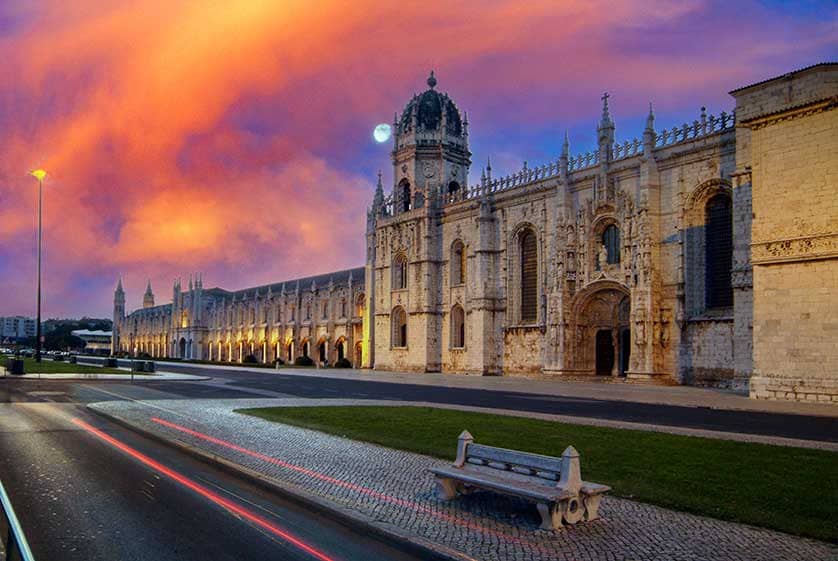
The location also served a symbolic purpose: a monument visible to every ship entering and leaving the Tagus. By the time the monastery was complete, it was the most prominent structure on the Lisbon waterfront and the last thing Portuguese sailors saw leaving the country.
One Hundred Years and Five Architects
The foundation stone was laid on 6 January 1501. The building was not completed until approximately 1601. This is not unusual for major European religious architecture of the period — but it is worth understanding, because the monastery shows the evidence of its century of construction in ways that make it more interesting, not less.
Diogo de Boitaca (1501–1516): The original architect. Boitaca established the overall plan, began the church and cloister, and developed the emerging Manueline vocabulary that defines the building. He is considered one of the founders of the style.
João de Castilho (1517–c.1550): A Spanish-born architect who took over after Boitaca. Castilho designed the south portal — the main ceremonial entrance, 32 metres high and 12 metres wide — and continued the cloister. His work introduced Spanish Plateresque elements into the Manueline framework.
Nicolau Chanterene (from 1517): A French sculptor who contributed Renaissance figurative work, including some of the portal’s sculptural programme.
Diogo de Torralva (from 1550): Resumed construction of the main chapel in a more classical style.
Jérôme de Rouen (from 1571): Added the final classical elements as the building moved toward completion.
The result is a building that shifts stylistically as you move through it — Manueline exuberance at the south portal and cloister, more restrained Renaissance classicism toward the east end. This is not inconsistency; it is a record of how Portuguese architecture changed across a century. Five architects over a hundred years will do that.
The Architecture: Manueline at Its Peak
Manueline architecture — Portuguese Late Gothic — emerged during the reign of Manuel I and lasted roughly one generation. It applied maritime and navigational motifs to Gothic structural forms: twisted ropes, armillary spheres, coral, the Cross of the Order of Christ, exotic animals, and nautical instruments, all rendered in stone.
The Jerónimos Monastery is the fullest surviving expression of this style. Where the Torre de Belém applies it to a small military tower, Jerónimos applies it to an entire monastic complex of 300 metres in length.
The south portal is the entry point most visitors use and the most photographed element of the exterior. At 32 metres tall, it is covered in carved figures, royal emblems, and religious iconography, organised across multiple registers. The sheer density of carved detail on a single doorway is unusual even within Manueline architecture — most buildings of the period spread this level of ornament across larger surfaces.
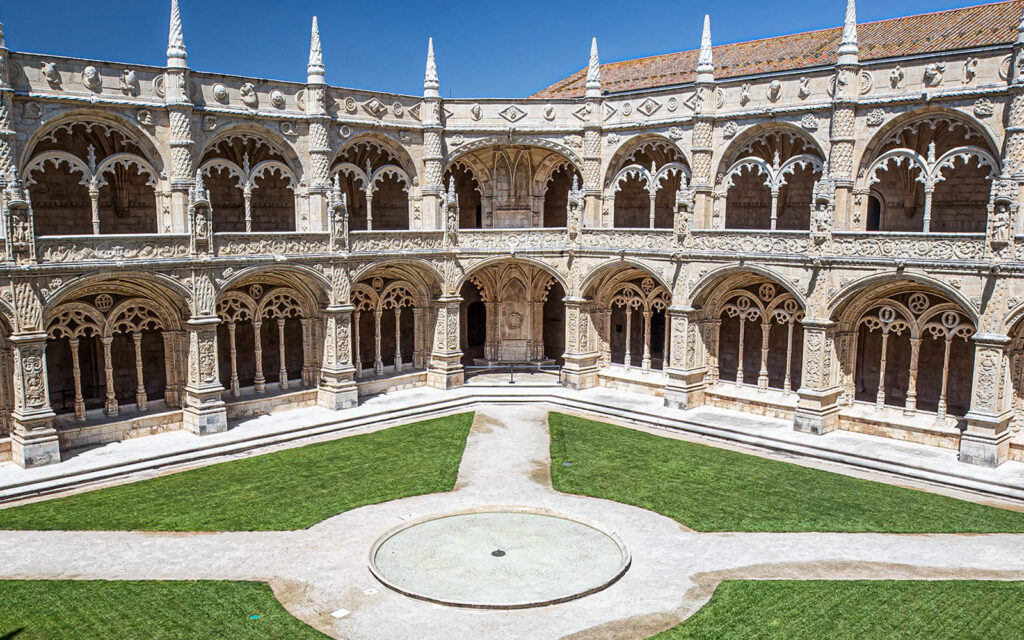
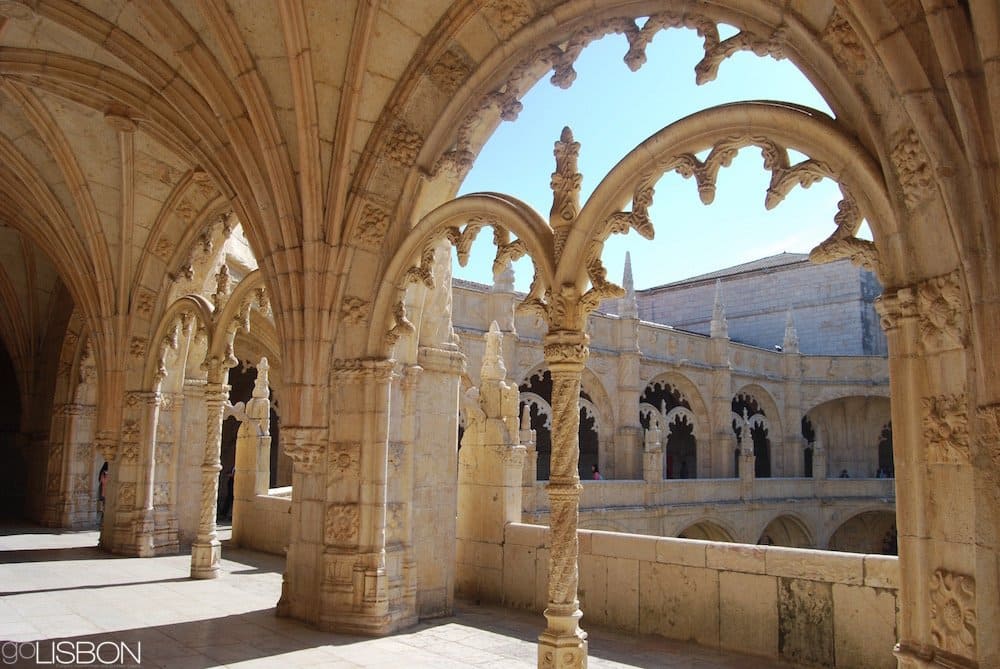
The cloister is the interior centrepiece. Measuring 55 by 55 metres, it has two stories of arcaded galleries, with twisted columns the width of a palm trunk rising to Gothic arches filled with carved tracery. The upper story is slightly different in character — more restrained — reflecting the later phase of construction under Castilho and his successors. The cloister is the paid section of the visit, and it is the reason most people buy a ticket.
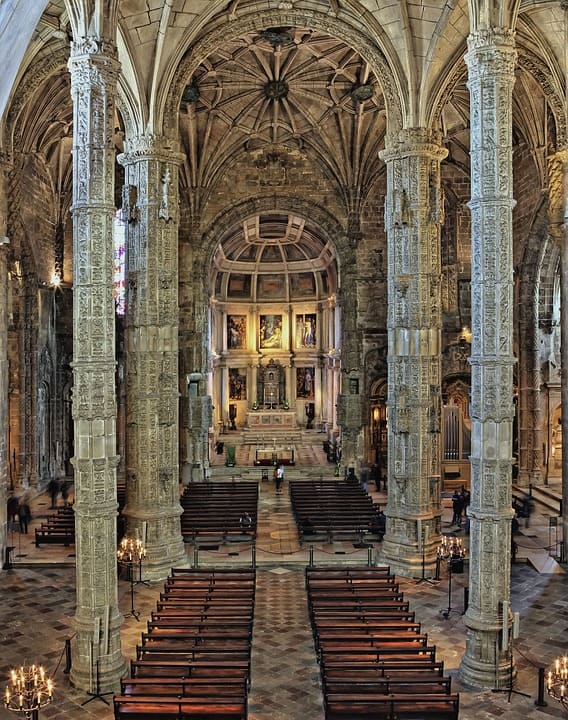
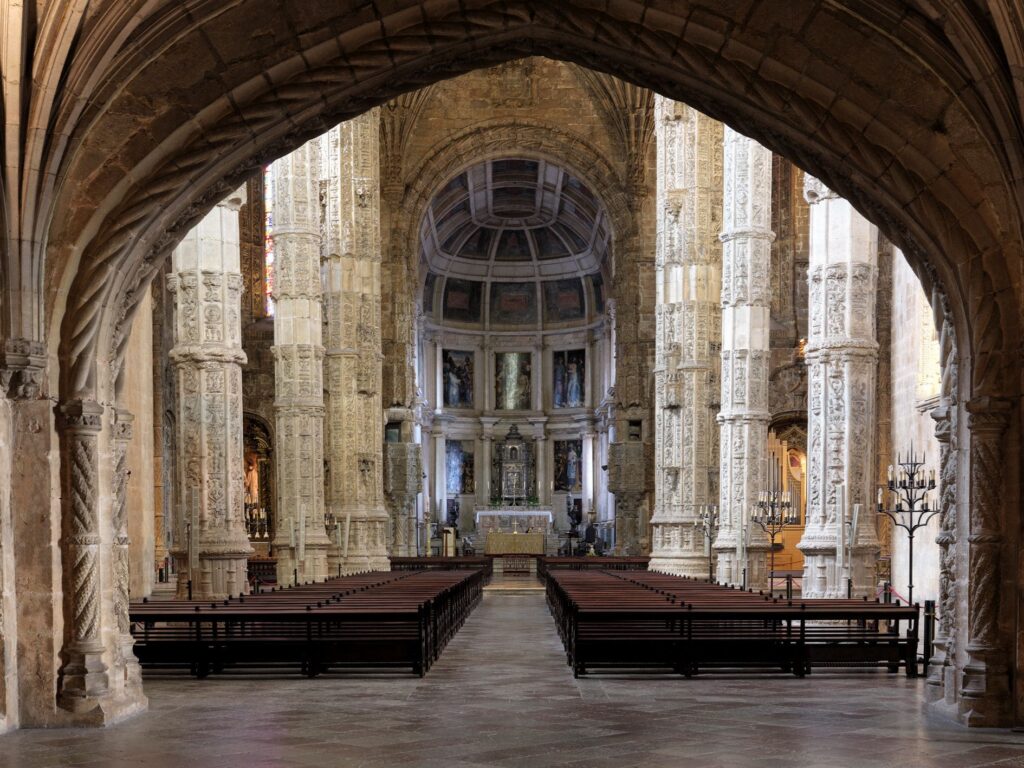
The church nave runs 90 metres in length, with ribbed vaults rising to 25 metres supported by six octagonal columns covered in carved decoration. There are no flying buttresses — the structural load is carried internally, which keeps the exterior clean and gives the interior its characteristic sense of openness. The effect of the columns — often described as resembling palm trees or tree trunks growing into the ceiling — comes from the way the carved ribs branch outward from the column capitals rather than stopping at the arch spring.
Inside the Monastery: Church and Cloister
The Church of Santa Maria de Belém is the free section. Entry is through the west door or the south portal. The church functions as an active place of worship — masses are held on Sundays — and entry to the nave is unrestricted during visiting hours. This is where the tombs of Vasco da Gama and Luís de Camões are located, near the entrance at the west end of the church.
The choir, at the east end, contains the royal tombs of Manuel I, João III, and members of the House of Aviz — the dynasty whose wealth built the monastery. These are accessed on a raised platform above the main nave floor.
The Cloister is the paid section. It occupies the south side of the complex and is the largest and most elaborate cloister in Portugal. A visit takes 45–60 minutes at a normal pace — significantly longer than the Belém Tower, because the cloister rewards slow attention. The carved detail on the columns, the views of the church exterior from the upper gallery, and the scale of the space are all best appreciated without rushing.
The upper gallery of the cloister — accessed by stairs in the corners — provides a different view of the courtyard and a close-up of the carved stonework on the arches. Most visitors skip it. It is worth doing.
The monastery also contains the Museu Nacional de Arqueologia and the Museu da Marinha (Maritime Museum), housed in the west wing. These are separate institutions with separate tickets, and most first-time visitors do not need to include them in the same visit.
The Tombs: Vasco da Gama, Luís de Camões and the Kings
The two tombs at the west end of the church nave are the reason most people specifically want to see the inside of the building. They were placed here in 1880, during the nationalist Romantic revival that repositioned Portugal’s Age of Discoveries as a defining national narrative.
Vasco da Gama (c.1460–1524): The navigator who completed the first sea voyage from Europe to India in 1497–1499, opening the direct spice trade route. He died in Kochi, India, on his third voyage to the subcontinent. His remains were returned to Portugal in 1539 and transferred to Jerónimos in 1880. His tomb is on the left-hand side (south wall) of the church, carved by Costa Mota, with a caravel and armillary sphere among the decorative elements.
Luís de Camões (c.1524–1580): Portugal’s most celebrated poet, whose epic Os Lusíadas (1572) narrates the Vasco da Gama voyage as mythology. Camões spent 17 years in Asia — as a soldier, prisoner, and government official — before returning to Lisbon to publish his poem. He died in poverty. His tomb is on the right-hand side (north wall), opposite Da Gama. Whether it actually contains his remains is historically uncertain — the grave was not formally identified until the 1880 transfer, nearly 300 years after his death. Portugal decided this was close enough.
The two men were chosen to flank the church entrance as the defining figures of Portugal’s maritime age: the navigator who opened the route and the poet who made it permanent in the national imagination. Placing them here, in the monastery built to commemorate the voyage, closes a circle that took nearly 400 years to complete.
The Royal Tombs in the choir contain Manuel I and João III — the two kings under whose reigns the monastery was primarily built — along with members of their families. These are in the raised choir at the east end of the church, accessible from the nave.
Practical Information: Tickets, Hours and the Free Entry Secret
The free entry fact: The Church of Santa Maria de Belém — the nave with the tombs of Vasco da Gama and Luís de Camões — does not require a ticket. Entry is free at the west door during visiting hours. This is not widely promoted, for reasons that are not difficult to guess, but it is confirmed and consistent.
If you want to see the cloister, you need a paid ticket. If you only want the church and the tombs, you do not.
| Detail | Info |
|---|---|
| Opening hours (May–Sep) | Tue–Sun 09:30–18:30 (last entry 18:00) |
| Opening hours (Oct–Apr) | Tue–Sun 09:30–17:30 (last entry 17:00) |
| Closed | Mondays, 1 Jan, Easter Sunday, 1 May, 13 Jun, 25 Dec |
| Cloister ticket (adult) | €18 |
| Church | Free |
| Sunday free entry | Until 14:00 (cloister also free) |
| Children under 12 | Free |
| Booking | Online at museusemonumentos.pt or at the ticket office |
Queue reality: In summer, the ticket office queue can reach 30–45 minutes. Online booking eliminates this. The church free-entry queue is shorter — typically 5–10 minutes — because fewer people know about it. Arriving before 10:00 or after 16:00 reduces wait times at both entrances.
Visit duration: The cloister alone takes 45–60 minutes. Adding the church and both levels of the cloister: 75–90 minutes total. Most clients I take to Jerónimos spend about an hour and find that correct.

Visit Belém with a Private Guide
Jerónimos and the Belém Tower are 500 metres apart and together form the strongest single morning in Lisbon. A private tour handles transport from the city centre, gets you to Belém before the queues build, and covers both monuments with context that changes what you see. Belém is a standard stop on every Lisbon tour we run.
- Lisbon Private City Tour — Alfama, Belém, Bairro Alto, Mouraria and Baixa in one day. Pickup from your hotel.
- Best of Lisbon & Sintra — Lisbon highlights including Belém combined with Sintra palaces and Cabo da Roca in one full day.

FAQ
Is entry to Jerónimos Monastery free?
How much does Jerónimos Monastery cost?
How long does a visit to Jerónimos Monastery take?
Who is buried in Jerónimos Monastery?
When was Jerónimos Monastery built?
Who designed Jerónimos Monastery?
Is Jerónimos Monastery open on Sundays?
How do I get to Jerónimos Monastery?
Did Vasco da Gama really spend his last night at Jerónimos?
What is the difference between the church and the cloister?

Founder & Director of Yellow Cab TT Tours. Guiding in Portugal for 20+ years.
Founded Yellow Cab TT Tours in 2013. 3,372 five-star reviews on Tripadvisor.