


Lisbon has four funiculars. As of June 2026, one is running. The other three have been closed since a serious incident on the Glória line in September 2025, following which the city suspended all historic funicular services pending safety reviews. No reopening date has been announced for the Glória, Bica or Lavra.
This guide covers what each line is, how the funicular system works, which one is currently operating, and how to get around Lisbon’s hills in the meantime.
What Is a Funicular — and Why Did Lisbon Need Four?
Lisbon is built on seven hills. The historic centre — Alfama, Mouraria, Bairro Alto, Graça — sits above the flat Baixa district at elevations ranging from 40 to 110 metres. Before the mid-19th century, the only way up was on foot or by horse, both of which became increasingly inconvenient as the city’s population doubled after the 1755 earthquake reconstruction.
A funicular is a cable railway operating on an inclined track. Two cars are connected by a single cable: as one descends, its weight assists the other in climbing. The system is mechanically simple, highly efficient on steep grades, and was first used in Lyon in 1862. Lisbon’s engineers adapted it for the city’s specific problem: short, very steep climbs of 80–200 metres connecting the lower commercial districts to the upper residential neighbourhoods.
The first line, Lavra, opened in 1884. Three more followed by 1892. Together they became part of the city’s standard transport network — not tourist attractions but daily commuter infrastructure, used by residents carrying groceries up a hill they had no alternative way of climbing. Tourism came later, mostly because the cars are yellow, the streets are narrow, and the views are good. One hundred and forty years of daily commuter infrastructure, and what people now remember is that it looked good in photographs.
Raoul Mesnier du Ponsard, a Portuguese engineer of French origin, designed all three historic funiculars. He also designed the Santa Justa Lift, which is sometimes grouped with the funiculars but is technically a vertical elevator, not an inclined railway.
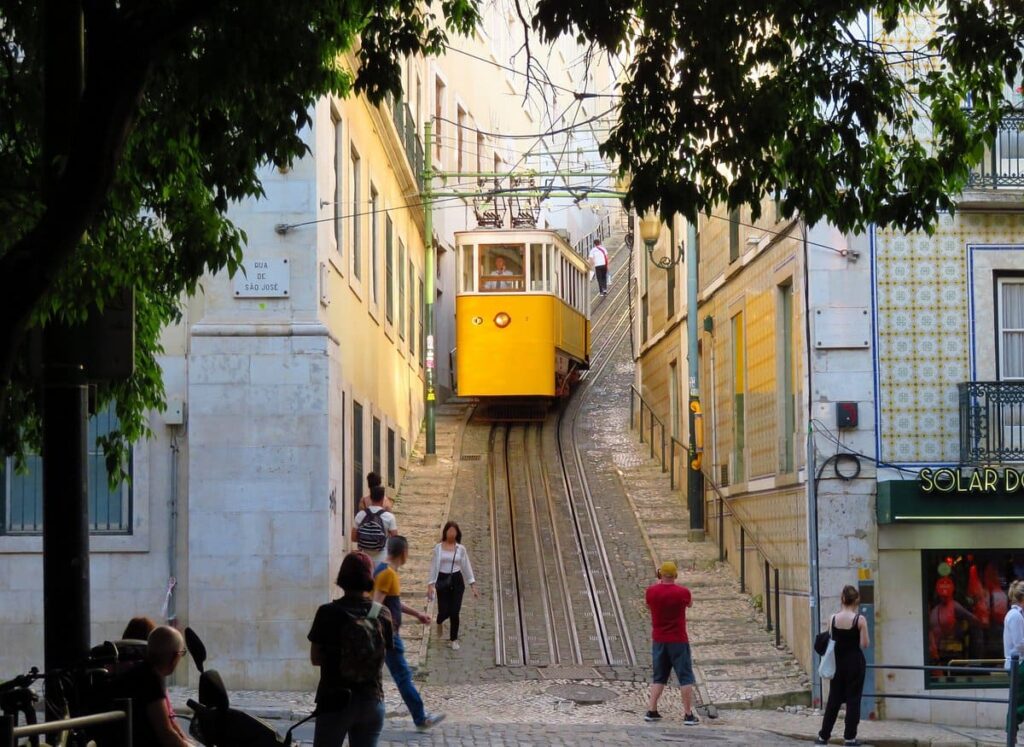
The Four Funiculars: Routes, Dates and How They Work
Elevador do Lavra — the oldest (1884)
Inaugurated 19 April 1884, Lavra is the oldest funicular in Lisbon and the least used. Its route runs up Calçada do Lavra from the lower city to the Torel viewpoint, a small garden with views over the Baixa and Tejo. The incline is the steepest of the three historic lines. Before the 2025 closure it was also the quietest — mainly used by residents of the surrounding streets, it rarely appeared in tourist itineraries. Lavra has been operating for 140 years without ever appearing on a postcard. This is either a failure of marketing or a reasonable outcome for a commuter line that goes somewhere most tourists have not planned to go.
Elevador da Glória — the most used (1885)
Opened 24 October 1885, the Glória ran 275 metres (902 feet) up Calçada da Glória from Praça dos Restauradores to Bairro Alto. Capacity: 42 passengers plus conductor. It was by far the busiest of the four lines and the most photographed. Bairro Alto — Lisbon’s nightlife district — is accessible by several routes, but the Glória was the direct one from the main tourist corridor. In summer it ran with queues; in winter it was still busy. It is the line that derailed in September 2025.
Elevador da Bica — the most photographed (1892)
Inaugurated 28 June 1892, the Bica runs from Rua de São Paulo in the Cais do Sodré district up to Largo do Calhariz near Bairro Alto. Capacity: 23 passengers. The Bica became the most reproduced image of Lisbon’s funiculars — the combination of a narrow street, yellow car, and a glimpse of the river at the bottom appears on approximately every travel article about Portugal published since 2010. It was closed following the Glória accident and remains so.
Funicular da Graça — the newest (2024)
The Graça is a different generation of infrastructure — conceived in the early 2000s, begun in 2009, and completed in 2024, which is a construction timeline that puts it somewhere between ambitious planning and geological time. Opened 12 March 2024 and transferred to Carris management in January 2025, it connects Mouraria at the foot of the hill to the Graça viewpoint. The track is 74 metres long with a 31-degree gradient and a 44-metre elevation change. Capacity: 14 passengers. It was closed as a precaution after the Glória accident despite having no mechanical connection to the older lines. Following a technical safety inspection, it reopened on 30 April 2026. Operating hours as of June 2026: 7:00–21:00 daily. Ticket: €4.30 for two trips (Carris onboard fare) or included with Navegante pass.
Lower stop: R. dos Lagares 22, (10 min walk from Rossio, or tram to Praça Martin Moniz).
Upper stop: Calçada da Graça, next to the Miradouro da Graça. ✅ Open daily 7:00–21:00.
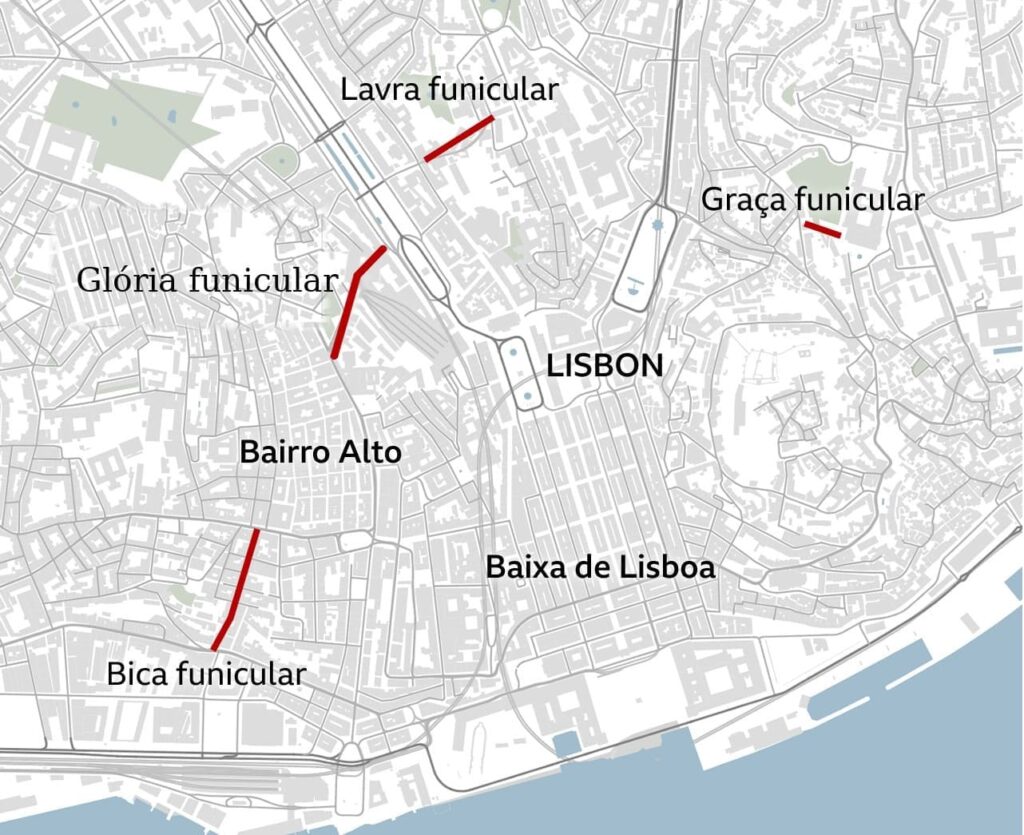
Current Status: What Is Open in June 2026
| Line | Status | Notes |
|---|---|---|
| Elevador da Glória | ❌ Closed | Accident site; under redesign review |
| Elevador da Bica | ❌ Closed | Suspended Sep 2025; no reopening date |
| Elevador do Lavra | ❌ Closed | Suspended Sep 2025; no reopening date |
| Funicular da Graça | ✅ Open | Reopened 30 Apr 2026; 7:00–21:00 daily |
| Elevador de Santa Justa | ⚠️ Partial | Lift operational for transport (Baixa → Chiado); observation deck closed since Jul 2025 for renovation |
The Graça is the only funicular operating. It is also the one least likely to appear in older travel guides, since it opened in 2024 — which means every guide written before that date describes a Lisbon that currently has zero operational historic funiculars and one that nobody had heard of. The Mouraria–Graça connection is a genuine route — Mouraria is one of the oldest neighbourhoods in Lisbon, and the Graça viewpoint (Miradouro da Graça) offers a wider panorama of the city than the more crowded Portas do Sol.
For visitors planning around the historic funiculars specifically, the situation requires accepting that Bica, Lavra and Glória are not operational and may not reopen in 2026. The aesthetic those lines provided — yellow car on a narrow 19th-century street — is not currently available in three of its four incarnations.
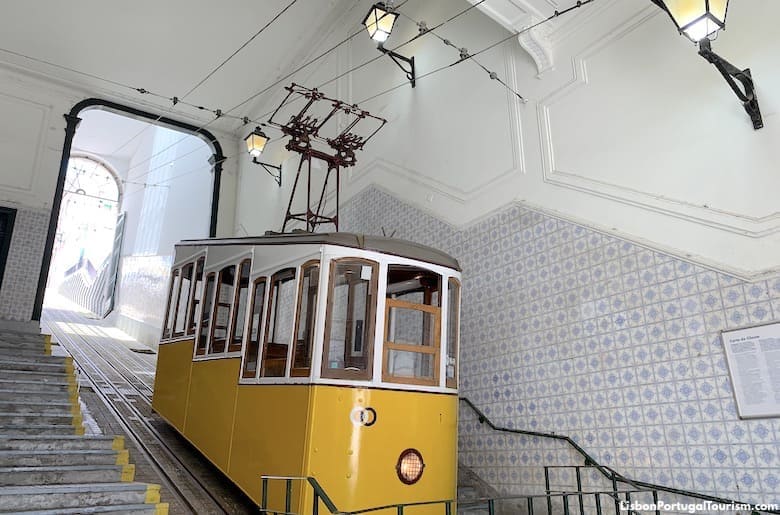
How to Get Up Lisbon’s Hills Without the Funiculars
The hills have not moved. The alternatives are more numerous than most guides suggest.
Tram 28 runs through Alfama and up to Graça, covering similar territory to what the funiculars serve from a different angle. It is a full tram route on standard tracks, operational, and uses the same Navegante pass or ticket system. It is also crowded in summer, but that is true of most of Lisbon’s historic infrastructure.
Walking is faster than it sounds on the shorter ascents. Calçada da Glória — the street the Glória runs on — is a 275-metre walk. At a normal pace that is three minutes. The view from the top is the same view the funicular provided. Lavra’s route is comparable. The Bica is steeper but also short. Most clients I take to Bairro Alto are surprised by how manageable it is on foot once the sun is not directly overhead.
Private vehicle covers the same distances without the gradient. A private tour of Lisbon includes Alfama, Bairro Alto, Mouraria, Belém and other districts as standard stops, with the vehicle handling the elevation changes and parking finding — the two things that complicate self-guided exploration of a hillside city.
The Graça funicular, currently operating, is the one alternative that provides the specific experience of riding an inclined railway in Lisbon in 2026.
If you are planning a fuller day in the city, our guide covers the main districts, transport options and how to structure the time.
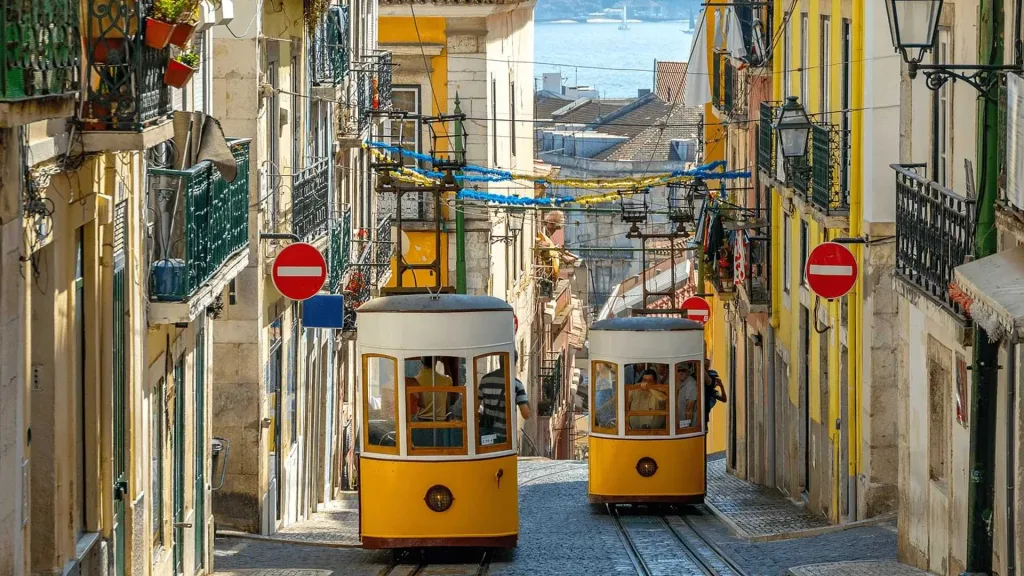
Explore Lisbon’s Historic Districts with a Private Guide
Lisbon’s hills were here long before the funiculars, and the neighbourhoods they connect — Bairro Alto, Alfama, Mouraria, Graça — are still fully accessible by private vehicle. A private tour includes all of these districts as standard stops, with transport handled between them and a guide who knows which streets are closed on which days.
Lisbon Private City Tour — Alfama, Belém, Bairro Alto, Mouraria, Baixa in one day. Pickup from your hotel.
Best of Lisbon & Sintra — Lisbon city highlights combined with Sintra palaces and Cabo da Roca in one full day.

FAQ
Are Lisbon's funiculars open in 2026?
Why is the Glória funicular closed?
How many funiculars does Lisbon have?
What is the difference between a funicular and the Santa Justa Lift?
How much does the Graça funicular cost?
Where does the Graça funicular go?
Is the Bica funicular open?
Can you walk up instead of taking the funicular?
Who designed Lisbon's funiculars?
Is the funicular included in the Navegante card?

Founder & Director of Yellow Cab TT Tours. Guiding in Portugal for 20+ years.
Founded Yellow Cab TT Tours in 2013. 3,372 five-star reviews on Tripadvisor.