

In 1307, the Knights Templar were the most powerful military order in the Christian world. They had 870 castles, controlled trade routes from England to the Holy Land, and held more wealth than most European kings. Nine months later, they no longer existed — in most of Europe.
Their collapse was not caused by losing a war, failing a crusade, or any particular moral breakdown. It was caused by one king’s unpaid debts, one conveniently French pope, and arrest warrants executed with unusual pre-dawn efficiency.
Portugal was different.
This guide covers 12 centuries of Templar history in Portugal: how they arrived in 1128, how they built the castle at Tomar in 1160, why King Dinis I refused to follow the rest of Europe after 1307, and how their legacy shaped the Portuguese Age of Discovery. It also covers where to see their monuments today and how to visit them from Lisbon.
Table of Contents
Friday, October 13, 1307: The Day That Changed the Templars Forever
The Knights Templar were founded in Jerusalem around 1119 by Hugues de Payens and eight companions. Their original mission was to protect Christian pilgrims traveling to the Holy Land after the First Crusade of 1099. Within a decade, the order had the backing of Saint Bernard of Clairvaux and official recognition from Pope Honorius II (1128). That same year, the Templars arrived in Portugal.
The Templars Arrive in Portugal: 1128
The Knights Templar were founded in Jerusalem around 1119 by Hugues de Payens and eight companions. Their original mission was to protect Christian pilgrims traveling to the Holy Land after the First Crusade of 1099. Within a decade, the order had the backing of Saint Bernard of Clairvaux and official recognition from Pope Honorius II (1128).
That same year, the Templars arrived in Portugal.
Castle of Soure and the Reconquista
On March 19, 1128, Countess Teresa of Portugal granted the Knights Templar the frontier castle of Soure, near Coimbra. The castle stood on the contested boundary between Christian-held northern Portugal and Moorish-held southern territory. The Templars’ job was to hold the frontier while the Portuguese expanded south. They were effective. In 1147, Templar forces fought alongside King Afonso Henriques in the conquest of Santarém — a decisive military campaign that pushed the Moorish line south and secured central Portugal for the Christian kingdoms. The same year, the Templars participated in the Siege of Lisbon, which ended eight centuries of Moorish control of the city.
The Role of the Templars in Building a Nation
Portugal in 1128 was not yet a kingdom — it was a county under Castilian sovereignty. The Templars backed Afonso Henriques as he fought both the Moors and the Castilians, helping establish Portuguese independence. In 1143, Afonso Henriques was recognized as King of Portugal by the papacy. The Templars had helped create the country. In return, they received enormous land grants across central and southern Portugal: castles, monasteries, and territories that generated agricultural and commercial revenue for two centuries.
Gualdim Pais Builds Tomar: 1160
Gualdim Pais (1118–1195) was born in northern Portugal and joined the Knights Templar as a young man. He fought in the Second Crusade (1147–1149) alongside King Afonso Henriques and returned to Portugal as a senior officer. By 1157, he had been appointed Grand Master of the Knights Templar in Portugal.
In 1160, Gualdim Pais selected a hilltop above the Nabao River, 136 kilometres northeast of Lisbon, and began construction of what would become the most important Templar complex in Portugal: the Castle of Tomar.
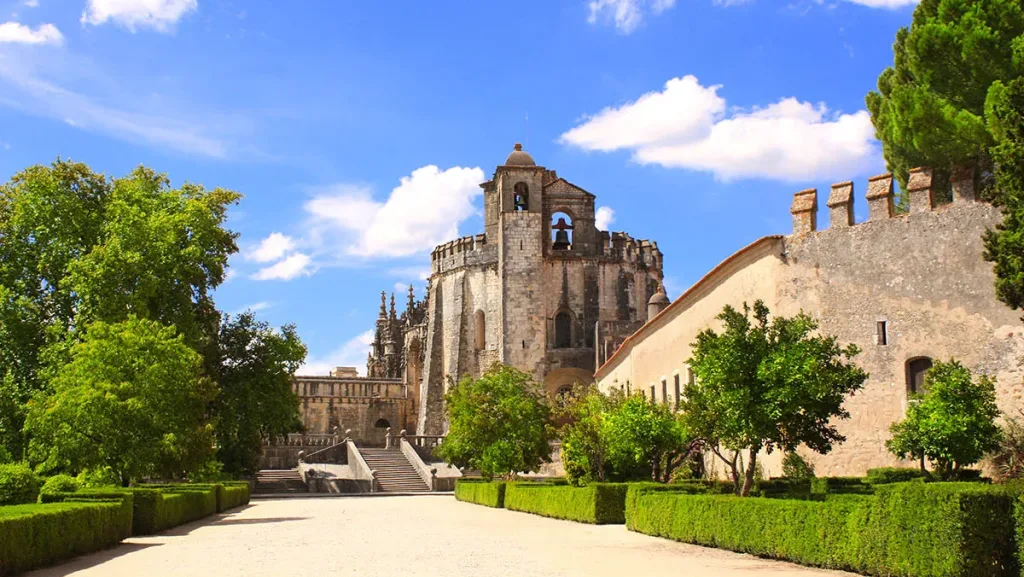
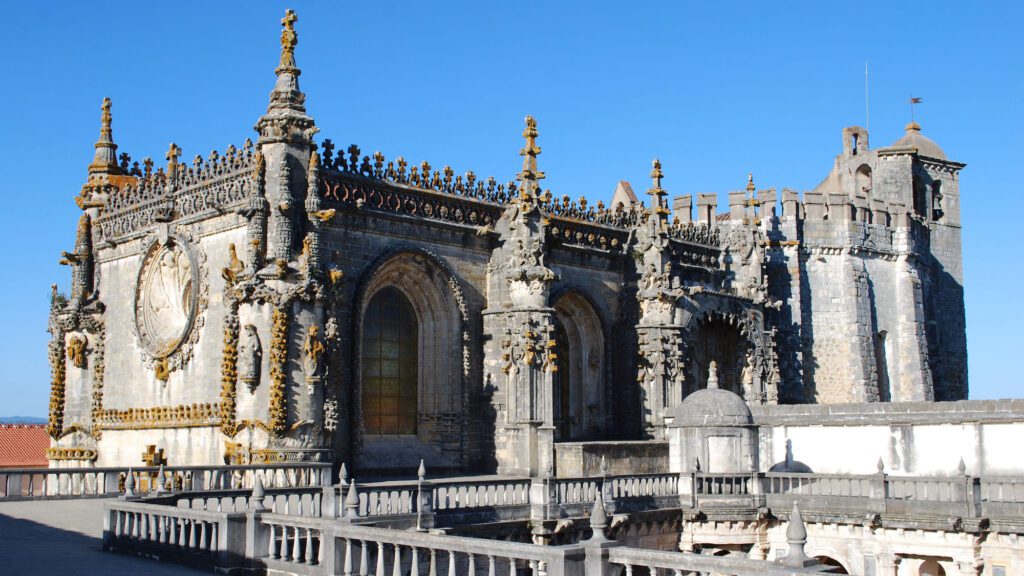
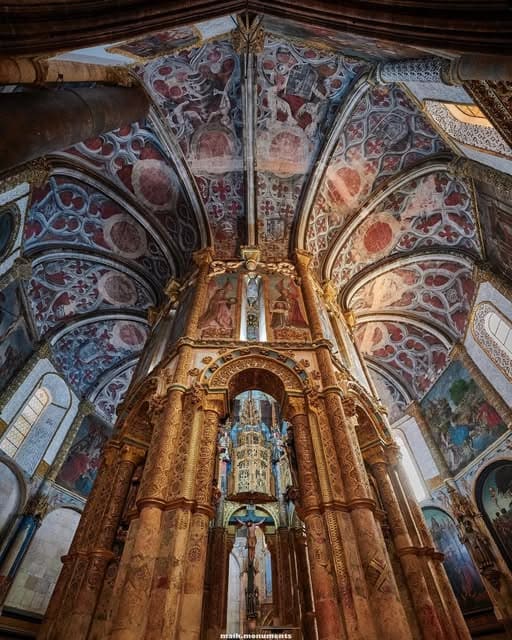
The castle included a circular Romanesque chapel — the Charola — built between 1160 and 1190, modeled on the Church of the Holy Sepulchre in Jerusalem. The 16-sided rotunda allowed mounted knights to attend Mass without dismounting, a practical design for a military order.
Gualdim Pais defended the castle against a Moorish assault in 1190, holding Tomar when most of the surrounding territory fell. He died in 1195 and was buried at the Church of Santa Maria do Olival in Tomar, which he himself had founded as the ceremonial burial site for the Grand Masters of the Order.
The town of Tomar grew around the Templar castle. Its street plan, its church, its aqueduct — all trace back to the 160 years the Templars used it as their Iberian headquarters.
I have been inside the Charola at the top of that hill more times than I can count. It is intact — the dome complete, the ambulatory walkable, the altar still in place. Most comparable Templar structures elsewhere in Europe are ruins or archaeological traces. Tomar’s is not. When I bring clients here for the first time, the Charola is usually the moment the whole history stops being abstract.
Dissolution in Europe, Survival in Portugal: 1307–1319
King Philip IV of France and Pope Clement V
By 1300, the Crusades were over. Jerusalem had been lost in 1187 and never permanently recovered. The Templars’ original military purpose — protecting pilgrims to the Holy Land — had disappeared. They had transformed into a banking and financial institution: lending money to kings, managing international trade routes, and accumulating a land portfolio across Europe that made them politically threatening.
Philip IV of France owed the Templars large sums. He was also in a protracted conflict with the papacy over taxation of French clergy. When Clement V — a Frenchman, elected to the papacy in 1305 under significant French pressure, and who relocated the papal court to Avignon rather than Rome — became pope, Philip found an ally well-positioned to help. The charges of heresy were drawn up, the arrests coordinated, and in 1312, *Vox in excelso* dissolved the order. It is worth noting that Philip also expelled the Jews from France in 1306, seizing their assets. His financial strategy had a pattern.
King Dinis of Portugal Refuses
The question history-minded clients ask most often is why Portugal reacted so differently from France, Castile, or England. The practical answer is that King Dinis owed the Templars a national debt — without them, the frontier that became Portugal might never have held. The political answer is that he was a pragmatist: he saw no reason to destroy a functional military institution that had served the country for 180 years, and every reason to preserve it under a different name.
In Portugal, King Dinis I (r. 1279–1325) refused to follow the same path as the rest of Europe. The Templars in Portugal had not been accused of heresy by any Portuguese court. They had protected the kingdom for 180 years, participated in the Reconquista, and built some of the country’s most important fortifications.
Dinis refused to persecute them. He also refused to hand their Portuguese properties over to the Knights Hospitaller, as the papal bull technically required.
Instead, Dinis negotiated. He argued that the Templar property in Portugal should remain in Portuguese hands — not transferred to a foreign order. He spent seven years in diplomatic negotiation with the papacy.
The Order of Christ Is Born: 1318–1319
In 1318, King Dinis founded the Order of Christ (*Ordem de Cristo*) at Castro Marim, in the Algarve. The new order formally absorbed the surviving Knights Templar of Portugal, adopting the same structure, the same membership, and the same headquarters at Tomar.
On March 14, 1319, Pope John XXII issued the papal bull *Ad ea ex quibus*, confirming the Order of Christ as the legitimate successor to the Knights Templar in Portugal. The Templar properties — castles, land, monasteries — were formally transferred to the new order.
In 1356, the Order of Christ moved its headquarters to Tomar Castle, the former Templar seat, where it remained for two centuries.
Portugal was the only country in Europe where the Knights Templar were never truly dissolved — they simply changed their name.
Henry the Navigator and the Age of Discovery: 1417–1460
The Order of Christ continued as a military and religious institution through the 14th and early 15th centuries. Then, in 1417, Prince Henry became Grand Master of the Order — and changed its purpose entirely.
Henry (1394–1460), third son of King João I, was not a sailor. He never captained a voyage. He is nonetheless called Henry the Navigator, a title that reflects what he funded rather than what he personally did. As Grand Master of the Order of Christ, he controlled the order’s considerable wealth and used it to finance systematic maritime exploration along the African coast — arguably becoming history’s most consequential venture capitalist.
The Order of Christ financed:
- The capture of Ceuta, North Africa, 1415ю
- The discovery of Madeira, 1420.
- The settlement of the Azores, 1427.
- The rounding of Cape Bojador, West Africa, 1434
- The discovery of Cape Verde, 1456.
The cross that appeared on the sails of Portuguese ships during the Age of Discovery — the red cross pattee on a white field — was the cross of the Order of Christ, direct successor to the Knights Templar cross.
Every expedition that left Lisbon in the 15th century carried a Templar symbol. The wealth of the order that Gualdim Pais built at Tomar in 1160 funded the exploration of the globe.
Where to See the Knights Templar Legacy in Portugal Today
Convent of Christ, Tomar (UNESCO 1983)
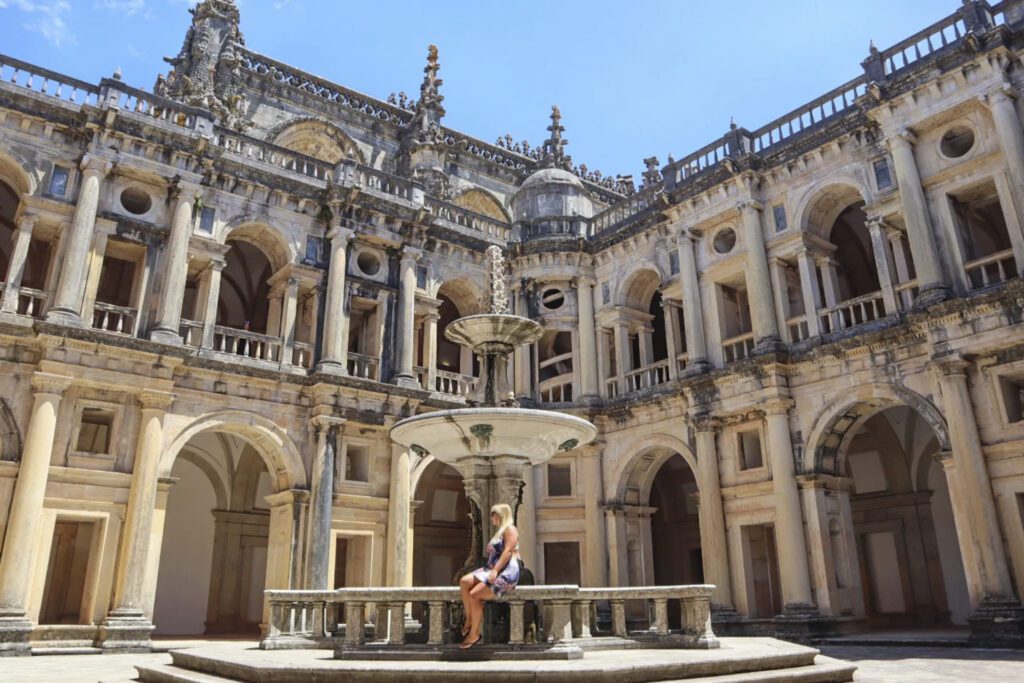
The Convent of Christ is the most complete surviving example of Templar and Order of Christ architecture in the world. Built on the same hilltop as the 1160 castle, the complex expanded over four centuries: the Charola (1160–1190), the main church (1510–1515, Manueline style), and eight cloisters added between the 13th and 17th centuries. UNESCO declared it a World Heritage Site in 1983.
Entry is 15 EUR per adult. The visit takes 2 to 3 hours.
For a full visiting guide — what to see, how much time each section needs, practical logistics — read: Convent of Christ Tomar: History, Architecture and Visiting Guide.
To see everything Tomar has to offer beyond the Convent: Things to Do in Tomar, Portugal.
Castillo de Almourol
Almourol Castle sits on a small granite island in the middle of the Tagus River, 76 kilometres northeast of Lisbon. The Templars rebuilt and enlarged the existing Roman fortification in 1171, under the direction of Gualdim Pais. The castle consists of a central keep, 10 towers, and a perimeter wall — all surrounded by water on all sides.
The island is accessible only by boat, with small ferries departing from the riverbank. No entry fee for the exterior; the keep interior has minimal facilities. The castle appears in multiple medieval Portuguese romances and is a classified national monument under the Portuguese Directorate-General of Cultural Heritage patrimoniocultural.gov.pt.
Our private tour to Tomar includes a stop at Almourol: Private Tour: Tomar and Almourol from Lisbon.
Quinta da Regaleira, Sintra
Quinta da Regaleira is not a Templar building. It was completed in 1910 — roughly 600 years after the Templars ceased to exist in most of Europe. Visitors sometimes ask, with genuine curiosity, whether the Initiation Well is “really Templar.” It is not. It is the personal commission of a 20th-century millionaire who found the symbolism more compelling than the documented history. This does not make the well less worth visiting — it descends 27 metres through nine spiral landings and is one of the more unusual constructions in the Sintra region. It simply does not make it medieval.
The Templar connection is symbolic, not historical — but the property sits 3 kilometres from the Moorish Castle that Templar-era military orders also used. For visitors interested in the Templar mythology of Sintra, Quinta da Regaleira is the main draw.
Our Sintra Palaces private tour includes Quinta da Regaleira: Private Tour: Sintra Palaces from Lisbon.
Beyond the Convent: The Rest of Tomar in Brief
The Convent accounts for most of what draws visitors to Tomar, but the city has three additional monuments within 15 minutes’ walk of the hilltop that change the character of the visit considerably.
El Sinagoga de Tomar (built 1430–1460) is the only intact medieval synagogue in Portugal — a National Monument now housing the Abraham Zacuto Museum.
El Iglesia de Santa Maria do Olival (12th century) is the burial church of the Knights Templar Grand Masters and was designated by papal bull in 1455 as the Mother Church of all Portuguese overseas parishes.
The Pegões Aqueduct (1593–1614, 6.223 km, 180 arches, 30 metres at maximum height) was designed by the same Filippo Terzi who completed the Main Cloister above. For full descriptions of all four Tomar monuments with visiting logistics, see Things to Do in Tomar: Complete Guide.
Private Tours to Tomar and the Templar Sites from Lisbon
Tomar is 136 kilometres from Lisbon — approximately 1 hour 30 minutes by car on the A1 motorway. By train from Lisbon Santa Apolonia, the journey takes 2 hours with a change at Entroncamento (10–12 trains daily, 11–13 EUR).
On a private tour, a guide with knowledge of the Templar history narrates what you see rather than leaving you to read information panels. We have run Templar-route tours from Lisbon since 2013.
Our tours that include Tomar:
Tour Templario en Tomar

Tomar - Convent of Christ - Almourol - Santarém
Tomar + Tour Fátima

Historia, Fe y Patrimonio de la UNESCO
Tomar con tour de Coimbra

Historia Templaria y Encanto Académico
Tomar + Lisboa
Un día de fe, historia y encanto de la ciudad.
FAQ — Visiting Tomar
What is the connection between the Knights Templar and Friday the 13th?
On Friday, October 13, 1307, King Philip IV of France ordered the simultaneous arrest of Knights Templar across France. However, historians including those at National Geographic confirm the connection to the modern Friday the 13th superstition is not direct — the superstition was not documented until the early 20th century. October 13, 1307 is historically significant for the Templars, but it did not give birth to the bad-luck myth.
Why did Portugal treat the Knights Templar differently from the rest of Europe?
King Dinis I of Portugal refused to execute or persecute the Templars because they had defended Portugal for 180 years during the Reconquista. Rather than hand their properties to the Knights Hospitaller as the pope required, he negotiated for 7 years and created the Order of Christ in 1318 — a new order that absorbed the Templars entirely.
Who was Gualdim Pais?
Gualdim Pais (1118–1195) was Grand Master of the Knights Templar in Portugal from 1157. He fought in the Second Crusade and returned to found the Castle of Tomar in 1160. He defended the castle against a Moorish siege in 1190 and died in 1195. He is buried at the Church of Santa Maria do Olival in Tomar, which he also founded.
What is the Order of Christ?
The Order of Christ is the Portuguese successor organisation to the Knights Templar, founded by King Dinis in 1318 and confirmed by papal bull in 1319. It inherited all Templar properties, personnel, and the headquarters at Tomar Castle. It remained active as a religious and military order through the 16th century. Henry the Navigator served as its Grand Master from 1417.
What role did the Knights Templar play in the Portuguese Age of Discovery?
Through the Order of Christ, the Templar infrastructure and wealth funded the Portuguese maritime explorations of the 15th century. Henry the Navigator used Order of Christ funds to finance expeditions to Madeira (1420), the Azores (1427), and the West African coast. The cross on Portuguese sails — the cross pattee in red on white — was the cross of the Order of Christ.
Where can I see Knights Templar sites in Portugal?
The main site is the Convent of Christ in Tomar (UNESCO 1983), which includes the original 1160 Charola chapel. Almourol Castle (1171, on a Tagus River island) is the second major site. Other Templar-era locations include Monsanto Castle, the Church of Santa Maria do Olival in Tomar, and Pombal Castle (built by Gualdim Pais in 1156).
Is the cross on Portuguese sails a Templar cross?
Not exactly the same cross. The Templar cross was red on white. The Order of Christ adopted a modified version: a red cross pattee with a white inner cross, placed on a red field. This Cross of Christ appeared on the sails of Vasco da Gama’s ships to India (1497) and Pedro Alvares Cabral’s ships to Brazil (1500).
Can I visit Tomar as a day trip from Lisbon?
Yes. Tomar is 136 kilometres northeast of Lisbon, approximately 1 hour 30 minutes by car. By train, the journey takes about 2 hours with a change at Entroncamento. A private tour from Lisbon allows you to combine Tomar with Almourol Castle in a single day without worrying about train schedules or parking.
When was the Order of Christ created?
King Dinis founded the Order of Christ in 1318 at Castro Marim, Algarve. Pope John XXII confirmed it by the papal bull Ad ea ex quibus on March 14, 1319. In 1356, the order moved its headquarters to Tomar Castle.
What happened to the Order of Christ after the Age of Discovery?
The Order of Christ remained an active institution through the 16th century, gradually shifting from military to religious functions as Portugal’s empire expanded. It was secularised in 1789 and now exists as an honorary Portuguese state order. The Grand Cross of the Order of Christ is awarded by the President of Portugal for distinguished service.
Planning a day trip to Tomar? We pick up from your hotel in Lisbon or Cascais → WhatsApp us: +351 965 856 169 → Or use the contact form.

Founder & Director of Yellow Cab TT Tours. Guiding in Portugal for 20+ years.
Founded Yellow Cab TT Tours in 2013. 3,372 five-star reviews on Tripadvisor.