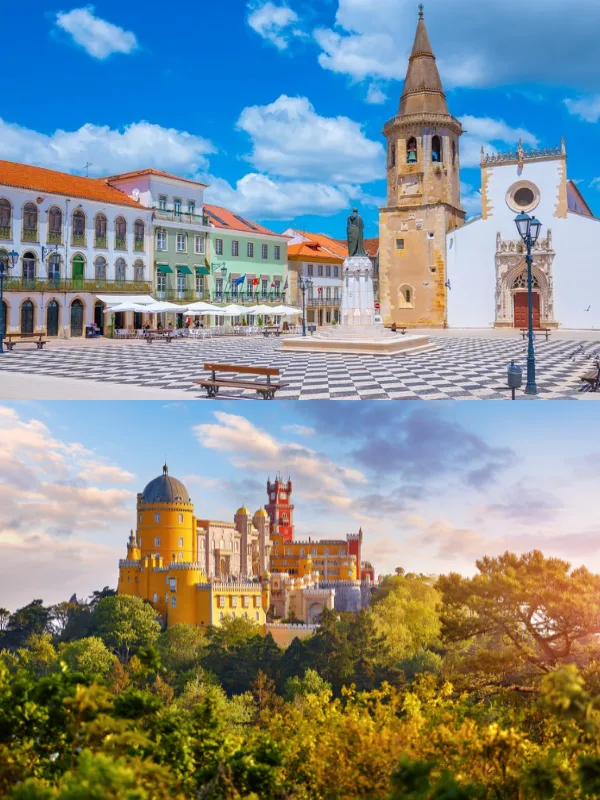
Tour privado de Tomar y Fátima desde Lisboa: Convento de Cristo y Santuario de Fátima
- (¡Tour privado con vehículo y conductor-guía solo para usted!)


8 Horas
Visita privada
Máx. 8px/Van
Recogida en hotel o apartamento en Lisboa, Sintra, Cascais, Estoril o en cualquier punto de la costa.
Convento de Cristo, Monasterio de Santa Cruz, Universidad de Coimbra, Biblioteca Joanina
Desde 350€ por vehículo privado (ver precios más abajo)

Calificado 5/5 en TripAdvisor.
basado en +3.387 reseñas
Resumen del Tour
- Duración: 8 horas.
- Salida: Sugerido 08:30–09:00 – recogida en hotel o apartamento en Lisboa, Sintra, Cascais, Estoril, o en cualquier lugar de la costa.
- Regresar: 17:00–17:30 a su lugar de recogida.
- Tipo de tour: 100% privado: solo para tu grupo.
- Tamaño del grupo: Hasta 8 pasajeros.
- Vehículo Furgoneta privada con aire acondicionado.
- Guía: Conductor-guía con licencia disponible en inglés, español, francés y portugués.
- Destinos: Tomar y Fátima.
- Distancia total de conducción: Aproximadamente 300 km.
- Precio desde: 350 € por vehículo.
- Valoración de Tripadvisor: 5,0/5 según 3.387 opiniones.
- Licencia RNAAT 119/2013.
- Política de cancelación: Cancelación gratuita hasta 24 horas antes de la salida.
Resumen del tour
Esta excursión privada de día completo desde Lisboa cubre dos de los lugares más importantes históricamente de Portugal: Convento de Cristo en Tomar – Patrimonio de la Humanidad de la UNESCO desde 1983 y antigua sede de los Caballeros Templarios en Portugal – y el Fátima El Santuario, el lugar de peregrinación católica más visitado de la Península Ibérica, recibió 6,2 millones de visitantes en 2024.
El Convento de Cristo fue fundado en 1160 por Gualdim Pais, Gran Maestre de los Caballeros Templarios en Portugal, en una colina sobre el río Nabão. Permaneció como sede operativa de la Orden de Cristo —sucesora de los Templarios en Portugal— durante los siglos XV y principios del XVI, cuando Enrique el Navegante (gobernador de la Orden, 1420-1460) utilizó Tomar como base logística para las exploraciones atlánticas portuguesas. La riqueza obtenida de esos viajes financió las ampliaciones manuelinas del convento, incluyendo el ventanal capitular (1510-1513), considerado uno de los ejemplos más elaborados de arquitectura manuelina que existen.
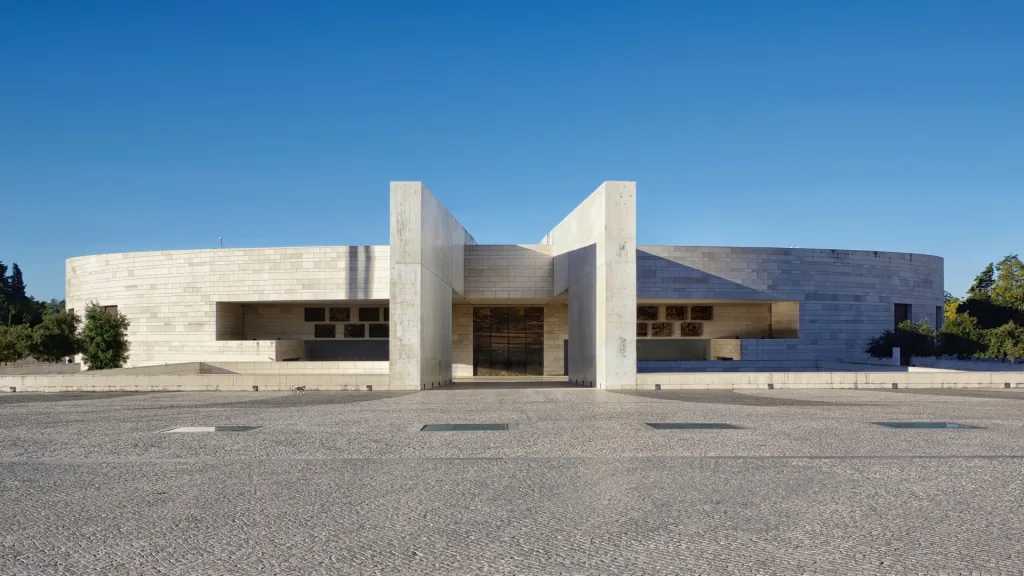
Fátima, situada a 34 km al suroeste de Tomar por la IC9, es el lugar donde se registraron seis apariciones marianas en 1917, presenciadas por tres pastorcitos del pueblo de Aljustrel. El complejo del Santuario creció a lo largo del siglo XX hasta incluir la Basílica de Nuestra Señora del Rosario (consagrada en 1953) y la Basílica de la Santísima Trinidad (dedicada en 2007, con capacidad para 9.000 personas), que flanquean la explanada central que rodea la capilla original de las apariciones (construida en 1919).
Este tour es privado (100%). Distancia total en coche: aproximadamente 300 km. Este tour difiere del anterior. Tour de Tomar, Almourol y Santarém – ese itinerario incluye el Castillo de Almourol y Santarém pero no incluye Fátima. También difiere del Tour de Fátima, Batalha, Nazaré y Óbidos – Esa ruta combina Fátima con el circuito norte, pero no incluye Tomar ni el Convento de Cristo.
Por qué los viajeros eligen este tour
- 3.387 reseñas verificadas · 5.0 Tripadvisor – Travelers’ Choice Best of the Best 2025; operador turístico privado mejor valorado de Lisboa en la plataforma.
- Solo existe una excursión privada que combine Tomar y Fátima. El Convento de Cristo (UNESCO 1983, ~2h) y el Santuario de Fátima (6,2 millones de visitantes en 2024, todos los sitios son gratuitos) se encuentran a tan solo 34 km de distancia. Ningún otro proveedor ofrece esta combinación específica en formato privado por vehículo.
- El recorrido que va desde los templarios hasta los lugares de peregrinación en un solo día, desde la fortaleza militar-religiosa de los Caballeros Templarios (1160) hasta el santuario mariano más grande de Portugal del siglo XX; la guía conecta ambos sitios dentro de la narrativa más amplia del catolicismo portugués a lo largo de ocho siglos.
- Todos los sitios de Fátima son gratuitos. – Capilla de las Apariciones, Basílica de Nuestra Señora del Rosario, Basílica de la Santísima Trinidad; entrada gratuita, sin reserva previa ni horario fijo. Solo el Convento de Cristo requiere entrada.
- Licencia RNAAT 119/2013. Idiomas: EN, ES, FR, PT. Operando desde 2013.
Qué puedes ver en este tour
Castillo de Tomar (Castelo de Tomar)
El castillo de Tomar fue construido en 1160 por Gualdim Pais por orden del rey Afonso Henriques como cuartel general militar de los Caballeros Templarios en Portugal. El castillo se asienta sobre una colina boscosa (Morro do Castelo, aproximadamente 100 metros (Situada sobre la ciudad) directamente sobre el valle del río Nabão. Sus murallas almenadas encierran una superficie de aproximadamente 1,5 hectáreas. Siete torres cuadradas y dos poligonales salpican el perímetro.
El castillo nunca fue asediado con éxito y permaneció bajo control templario —y posteriormente de la Orden de Cristo— durante todo el período medieval. Tras la disolución de los templarios por el papa Clemente V en 1307, el rey Dinis I de Portugal persuadió al papado en 1319 para permitir que los templarios portugueses se reorganizaran como la Orden de Cristo, manteniendo Tomar como su sede. El castillo y el convento fueron declarados Patrimonio de la Humanidad por la UNESCO en 1983.
Se puede acceder libremente a los terrenos del castillo desde la carretera que se encuentra más abajo. Para visitar el Convento de Cristo, situado dentro de sus muros, se requiere una entrada de pago; consulte los precios a continuación.
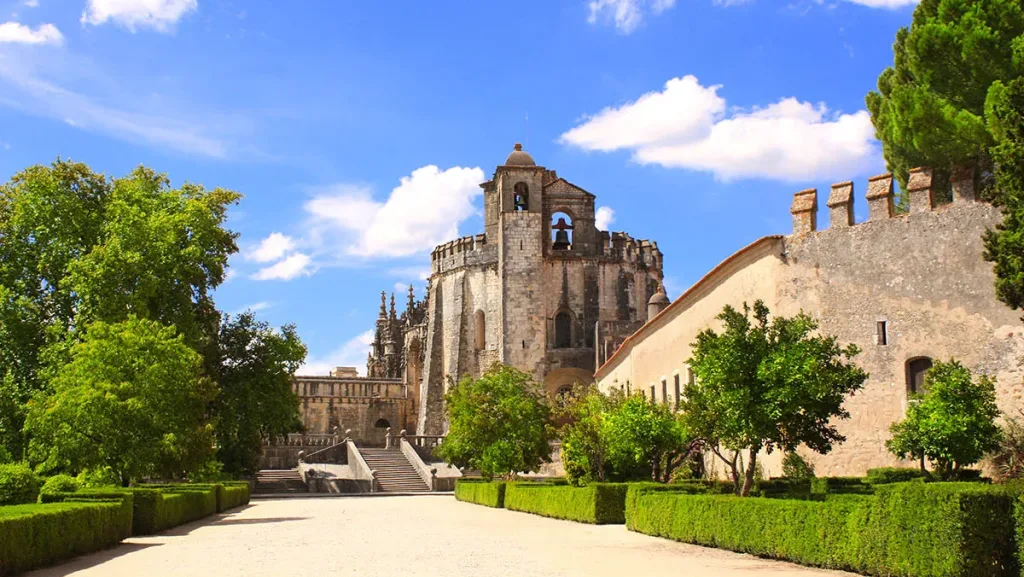
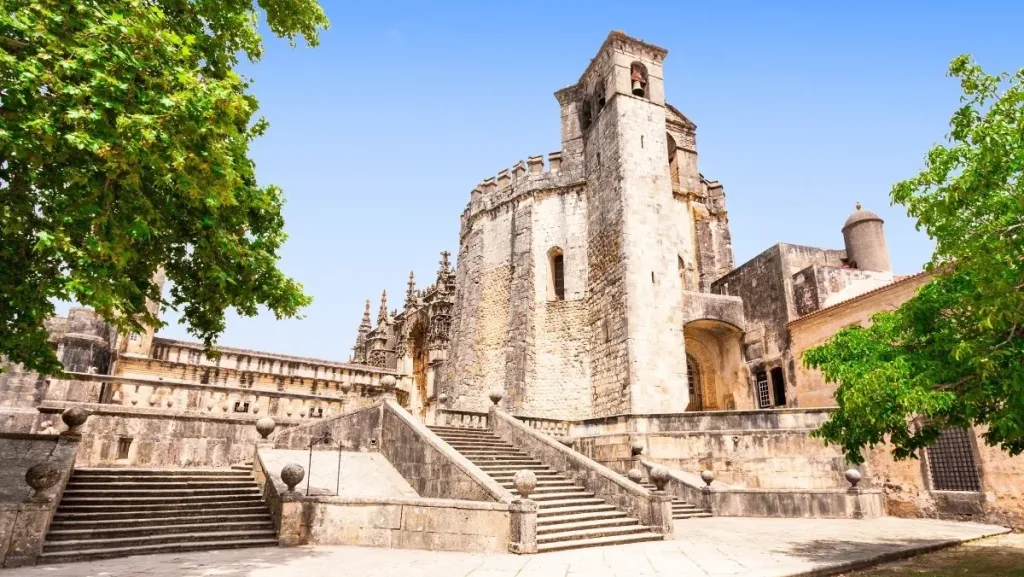
Convento de Cristo – Patrimonio de la Humanidad de la UNESCO
El Convento de Cristo es el monumento con mayor riqueza arquitectónica de Portugal, ya que contiene elementos románicos, góticos, manuelinos, renacentistas y manieristas construidos a lo largo de cinco siglos. Entrada: 15 €/adulto (museusemonumentos.pt). Entrada gratuita los domingos y festivos hasta las 14:00. Entrada gratuita para menores de 12 años.
La Charola (Rotonda Templaria): La estructura más antigua del complejo, construida alrededor 1162–1165, La Charola es una rotonda diseñada como referencia directa a la Iglesia del Santo Sepulcro en Jerusalén. Los templarios consideraban la forma circular la expresión arquitectónica apropiada para lo sagrado: los soldados debían cabalgar alrededor del altar central, permaneciendo montados durante la misa. La Charola contiene frescos del siglo XII y pinturas renacentistas posteriores, encargadas durante el período de la Orden de Cristo.
Nave principal y sala capitular (1510–1514): Cuando Manuel I encargó la ampliación del convento a principios del siglo XVI, los arquitectos João de Castilho y Diogo de Arruda crearon la nave principal que conecta la Charola con la nueva sala capitular. La nave es una sola sala con bóveda manuelina, que integra la Charola en la disposición convencional de una basílica cristiana.
La ventana del capítulo (Janela do Capítulo): Construido entre 1510 y 1513, Diseñada por Diogo de Arruda, la imagen emblemática de la arquitectura manuelina portuguesa. La ventana enmarca una puerta en la pared de la Sala Capitular y está incrustada con un programa de piedra tallada que incorpora: coral, algas y cuerdas (expansión marítima); la Cruz de la Orden de Cristo (autoridad político-religiosa); esferas armilares (dispositivo personal del rey Manuel y instrumento de navegación de la Era de los Descubrimientos); raíces de alcornoque (el paisaje ibérico); y figuras humanas. La ventana mide aproximadamente 4 metros de ancho y 7 metros de alto.
Ocho claustros: El convento contiene 8 claustros Construido en diferentes épocas. El claustro principal fue diseñado por el arquitecto español Juan de Castillo y se completó entre 1557 y 1591 en estilo renacentista. De dos plantas: columnas dóricas en la planta baja e jónicas en la planta superior.
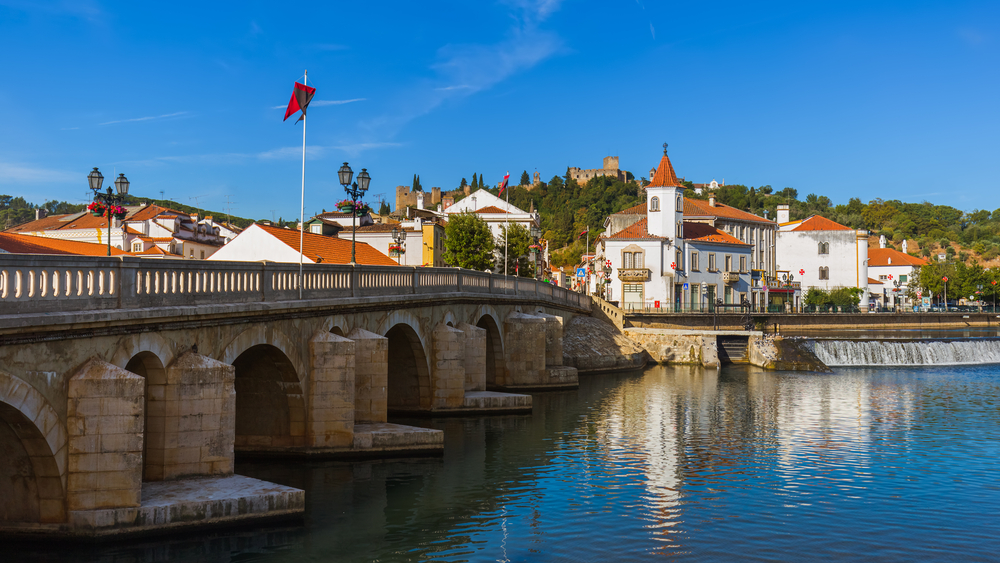
Centro de la ciudad de Tomar y río Nabão
Tres de los edificios medievales más importantes de Tomar se encuentran a menos de 10 minutos a pie uno del otro y de los restaurantes de la Plaza de la República: la única sinagoga medieval intacta de Portugal (1430-1460), el lugar de enterramiento de los Grandes Maestres Templarios (siglo XIII) y una iglesia con un portal manuelino y un tríptico de Gregório Lopes de 1538.
Iglesia de Santa María del Olivar (Siglo XIII): Gótico, lugar de sepultura de Gualdim Pais y de los posteriores Grandes Maestros Templarios.
Sinagoga de Tomar: Construido 1430–1460, Actualmente es el Museo Luso-Hebraico Abraão Zacuto. Es la única sinagoga medieval intacta de Portugal; su interior con bóveda gótica de cuatro columnas se conserva. La comunidad judía fue expulsada en 1496 bajo el reinado de Manuel I.
Plaza de la República e Iglesia de São João BaptistaSiglos XV-XVI. Portal y tríptico manuelino pintados por Gregório Lopes alrededor del siglo XVI. 1538.
El Acueducto Pegões es visible en la carretera de acceso a Tomar. Construido 1593–1614 (algunas fuentes: 1593–1619) para abastecerse de agua dulce desde el manantial de Pegões, a 6 km de distancia. 180 arcos, alcanza una altura máxima de aproximadamente 30 metros.

Santuario de Fátima
El Santuario de Fátima recibió 6,2 millones peregrinos en 2024 – el total anual más alto en la historia registrada del Santuario. Es el sitio católico más visitado de la Península Ibérica. La entrada a todos los sitios religiosos del complejo del Santuario es gratis.
Capilla de las Apariciones (Capelinha das Aparições): Construido entre el 28 de abril y el 15 de junio, 1919, La capilla fue construida por el cantero Joaquim Barbeiro en el mismo lugar donde se produjo la primera aparición (13 de mayo de 1917). Fue destruida por fuerzas anticlericales en octubre de 1922 y reconstruida. Se celebra misa de forma continua durante todo el día.
Basílica de Nuestra Señora del Rosario: La construcción comenzó 1928. Consagrada el 7 de octubre de 1953. Arquitecto: Gerardus Samuel van Krieken (holandés). Torre de 65 m de altura, coronada por una corona de bronce de 7000 kg. Cuenta con 15 altares laterales para los 15 misterios del Rosario. El Papa Pío XII le otorgó la categoría de Basílica Menor en 1954.
Basílica de la Santísima Trinidad Inaugurado el 12 de octubre de 2007 (90.º aniversario de las apariciones). Arquitecto: Alexandros Tombazis (griego), seleccionado en un concurso internacional en 1997. Planta circular, 125 m de diámetro, capacidad para 9000 personas (8633 asientos). Ganador del Premio IABSE a la Estructura Destacada 2009.
Los tres niños que relataron las apariciones: Lúcia dos Santos (n. 1907, f. 2005), Francisco Marto (n. 1908, f. 1919, canonizado en 2017) y Jacinta Marto (n. 1910, f. 1920, canonizada en 2017) eran del pueblo de Aljustrel, a 2 km al sur del Santuario. Francisco y Jacinta fueron los primeros niños no mártires canonizados en la historia de la Iglesia Católica.

Regreso a Lisboa
Tras un día lleno de leyendas, devoción y descubrimientos significativos, regresamos a Lisboa. Durante el trayecto, disfruta de una última vista de la belleza rural que define el centro de Portugal.
Este itinerario está cuidadosamente diseñado para una experiencia inolvidable — pero la elección es siempre tuya.
Déjate guiar por la grandeza de Tomar y Fátima, donde la historia y la fe cobran vida.
Yellow Cab TT Tours – siempre a su servicio, con el cuidado y la calidad que nuestros clientes conocen y en los que confían.
Qué incluye
- Duración del tour: 8 horas
- Furgoneta privada climatizada para su grupo (hasta 8 pasajeros)
- Recogida y regreso en hotel/apartamento en Lisboa, Sintra, Cascais, Estoril o en cualquier lugar de la Costa del Estoril
- Seguro obligatorio
- Combustible, peajes de autopista y aparcamiento en todas las paradas
No incluido
- Comidas y bebidas
- Entradas a monumentos
- Propinas
Precios de los tours
Los precios son por vehículo privado (no por persona)
-
Hasta 2 personas €350
-
3 a 4 personas €450
-
5 a 8 personas €570
Cancelación hasta 24 horas antes de la salida. Las cancelaciones dentro de las 24 horas no son reembolsables.
Contáctenos y reserve
Mejor época del año para este tour
Preguntas frecuentes
¿A qué distancia está Tomar de Lisboa?
¿Necesito comprar las entradas para el Convento de Cristo con antelación?
¿Qué es la ventana de capítulos y por qué es famosa?
¿Cuál es la diferencia entre esta excursión y la excursión a Tomar y Almourol?
¿Pueden los no católicos disfrutar de la parte de Fátima de esta excursión?
¿Hay que pagar entrada en Fátima?
¿El tour incluye el Castillo de Ourém?
¿Podemos asistir a misa en Fátima?
¿Deberíamos evitar visitarlos el 13 de mayo o el 13 de octubre?
¿Qué idiomas habla el guía?
¿Cuál es la política de cancelación?
Lo que dicen nuestros huéspedes
También te puede interesar
Tour privado de Tomar desde Lisboa: Convento de Cristo, Almourol y Santarém
Un día completo en Tomar: Convento de Cristo + Castillo de Almourol (fortaleza insular, 1171) + Santarém, capital gótica. Para una visita más completa a Tomar, se incluyen Almourol y Santarém.
Tour de Fátima, Batalha, Nazaré y Óbidos
Circuito Norte: Santuario de Fátima + Monasterio de Batalha (UNESCO 1983) + Nazaré + Óbidos.

Tour privado a Tomar y Sintra
Convento de Cristo (UNESCO 1983) + Paisaje Cultural de Sintra (UNESCO 1995). Dos sitios declarados Patrimonio de la Humanidad por la UNESCO en un día. Desde 350 € por vehículo.