
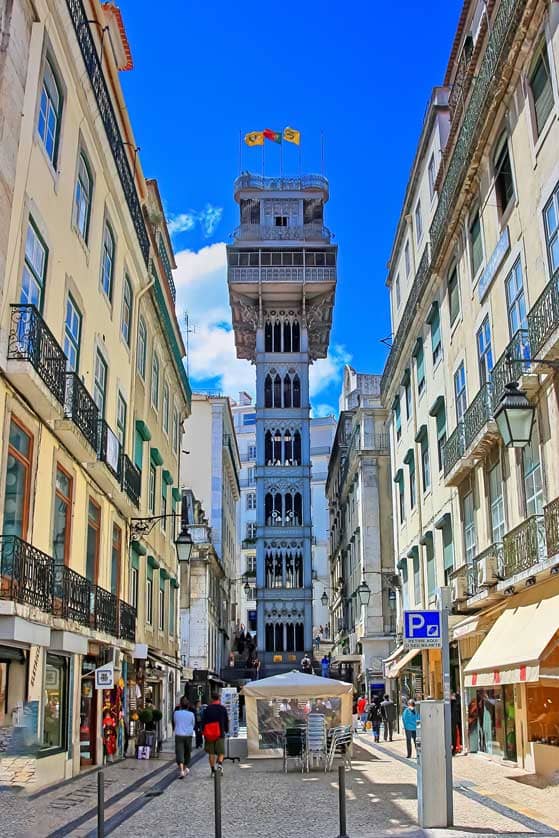

Most people who visit the Santa Justa Lift queue to ride it up. The smarter move is to walk up from Chiado and use it to ride down — or skip it entirely and get the same view for free. I’ve been taking clients past this structure for twenty years, and the queue on Rua do Ouro is almost always longer than it needs to be, because most people don’t know the upper platform is accessible from the street.
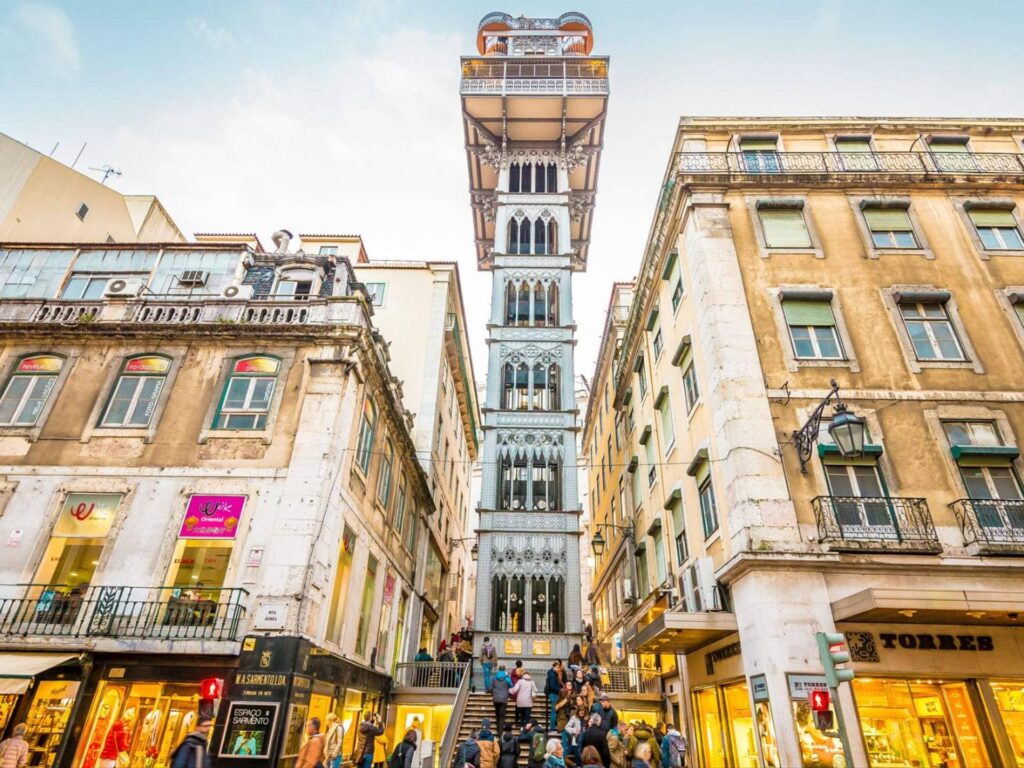
That said, the lift itself is worth understanding before you decide what to do with it. Opened on 10 July 1902, it is a 45-metre iron tower that runs on a counterbalance system first designed around steam and water rather than motors. The ride takes 30 seconds. On its first day of operation, it sold 3,000 tickets. The cabins held 24 people.
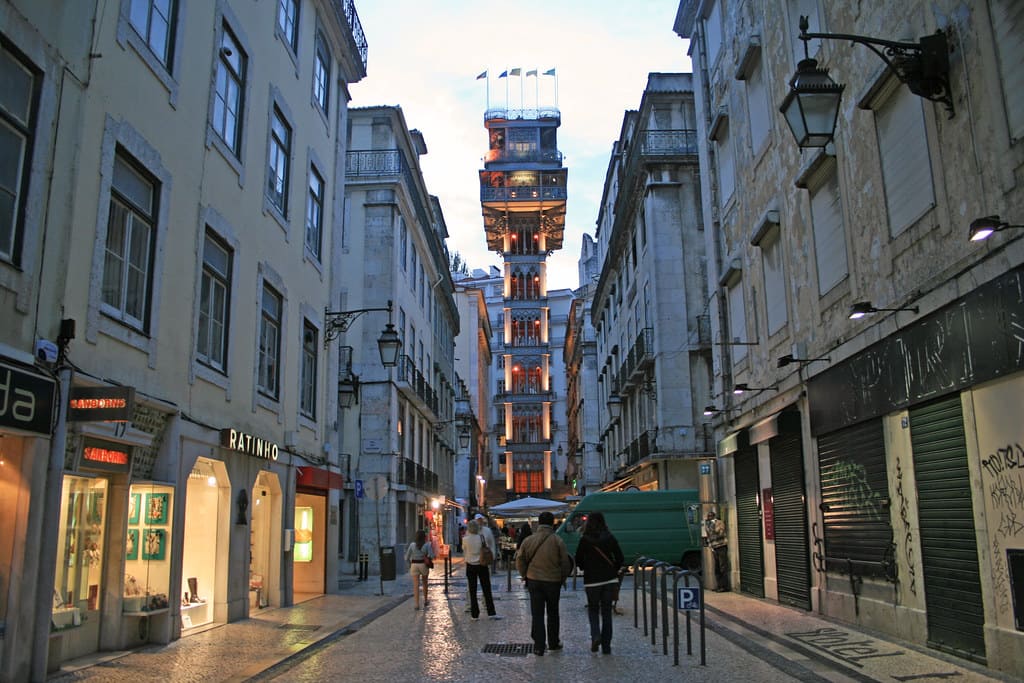
I’ve pointed at this lift from the street below more times than I can count. The clients who arrive from Largo do Carmo first — walking down from Chiado — are usually more impressed than the ones who paid €5.30 to ride up. The view is the same. The direction of surprise is different.
In this article: what the lift actually is, how it works, what happened to the Eiffel connection that every guide repeats, the current status of the observation deck renovation, and the exact walking route from Chiado that lets you skip the queue altogether.
Why Lisbon built a vertical elevator instead of another funicular
By 1892, Lisbon had three funiculars — Lavra (1884), Glória (1885), Bica (1892). All three worked on the same principle: a car on rails at an angle, pulled by a cable, fixed to the hillside. They solved the problem of connecting the lower city to the upper city where the hillside was broad enough to lay track diagonally.
The Santa Justa problem was different. The site was in the middle of Baixa, Lisbon’s flat downtown grid, with no hillside to lean against. The only option was a vertical shaft tall enough to reach the level of Rua do Carmo, 30 metres above. You cannot build a funicular in the middle of a city block. You build a tower.
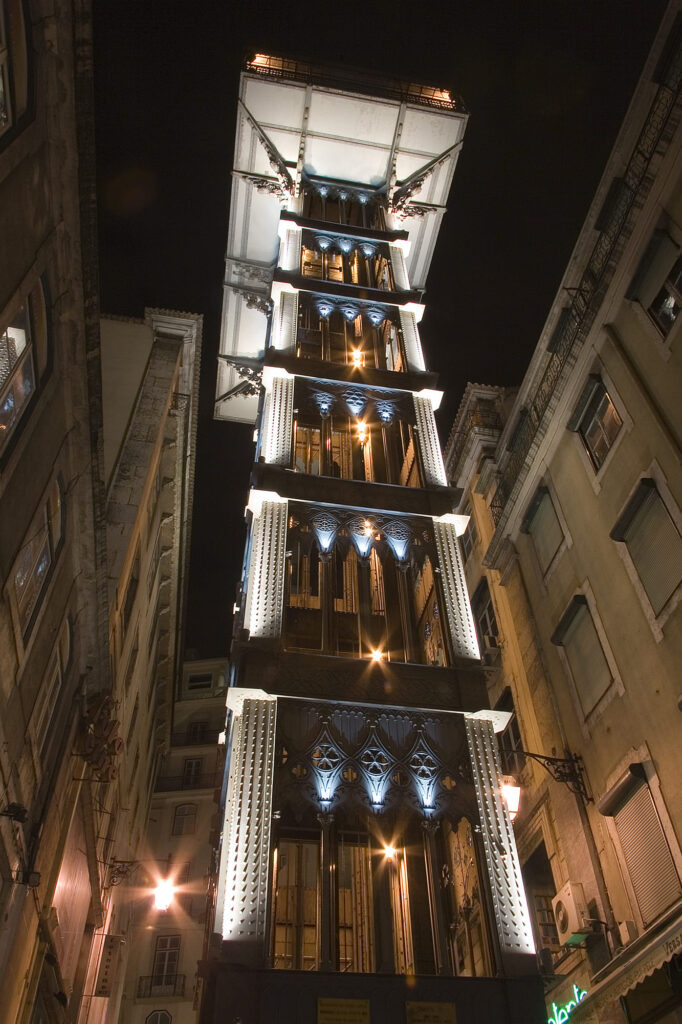
The solution was a freestanding iron structure, 45 metres high — roughly fifteen storeys — standing on the street between Rua do Ouro and Rua de Santa Justa. The engineering constraint was stability: a tower that height, in an exposed urban setting, with two moving cabins inside, needs to resist wind load and remain plumb as the counterbalance shifts weight continuously. The Neo-Gothic iron cladding is not ornament for its own sake — it is also structural casing.
Construction started in 1900. King Carlos I inaugurated the bridge and upper awning on 31 August 1901. The cabins started running on 10 July 1902. In 2002, exactly one hundred years later, it was designated a National Monument — in the same batch as the three funiculars it was designed to complement.
How it actually moved: the steam-and-water counterbalance
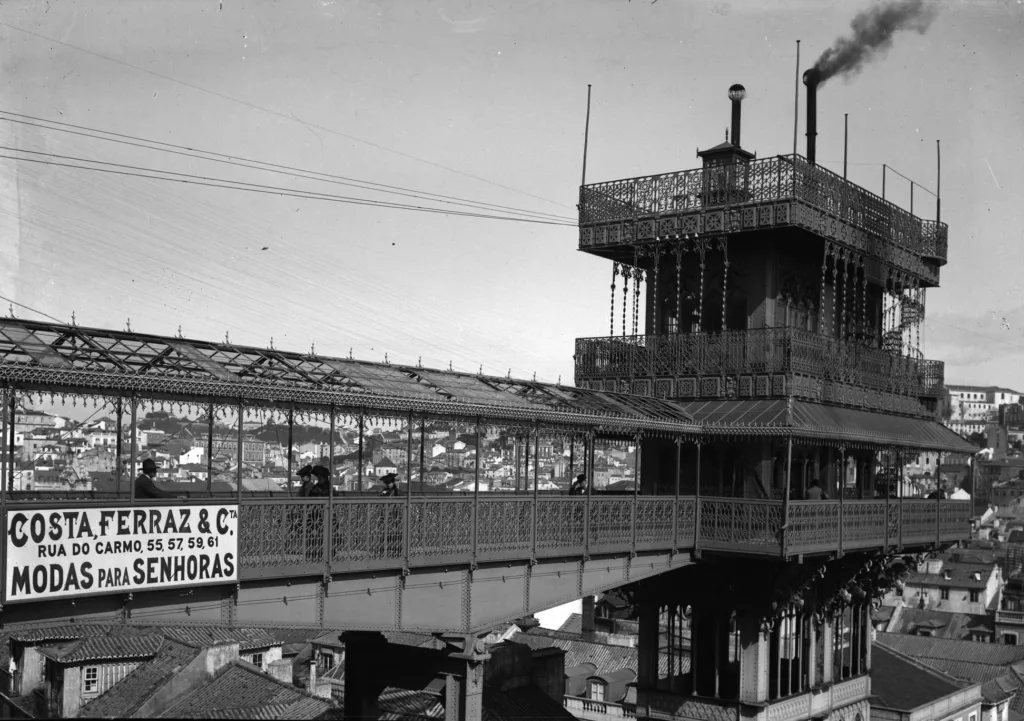
For its first five years, the lift ran on steam. The way it moved is less obvious than it sounds.
The steam engine did not push or pull the cabins directly. It pumped water into tanks mounted below each of the two cabins. The cabins were connected by a single steel cable over a pulley at the top of the tower. When water filled the tank below the upper cabin, that cabin became heavier, descended, and pulled the empty lower cabin up. Speed was controlled by mechanical brakes, not by varying engine output. The system was a counterbalance on variable ballast — the water was the variable.
In 1907, British company R. Waygood converted the lift to electric power. The counterbalance principle remained; the steam boiler and water tanks did not. The cabins were rated for 24 passengers at opening, later updated to 29. The interiors — wood panelling, mirrors, large windows — have not changed since.
Every time a client asks me why the ride is only 30 seconds, I explain that you are covering seven storeys of vertical height in a counterbalance that has been doing this since 1902. There is no reason to go faster, and no mechanism designed to do so.
The designer, and the Eiffel myth that won’t die
Every guide in Lisbon, every tourist website, and at least half the plaques near the lift describe Raoul Mesnier du Ponsard as “a student of Gustave Eiffel.” Some say “apprentice.” Some say “disciple.”
His Wikipedia biography — sourced from Portuguese engineering archives — contains no mention of Gustave Eiffel at any point. None. The two men were contemporaries: Eiffel’s tower opened in Paris in 1889, thirteen years before the Santa Justa Lift. The visual resemblance in ironwork is genuine and obvious. The professional relationship has not been documented anywhere I have been able to find, and I have been asked about it enough times to have looked.
Mesnier du Ponsard (2 April 1848 – 26 May 1914) was born in Porto to French parents. He studied mathematics at the University of Coimbra and completed engineering apprenticeships in France, Germany, and Switzerland. His actual record in Portugal is substantial enough without the Eiffel attribution: he designed the Santa Justa Lift, the Ascensor da Glória, the Ascensor da Bica, the Ascensor do Lavra, and directed construction of the Bom Jesus do Monte Funicular in Braga — the oldest operating funicular on the Iberian Peninsula.
He died in Inhambane, Mozambique, in May 1914, working on colonial port infrastructure. The Eiffel story is a better ending. It is also not documented.

The free route: Largo do Carmo from above
The lift connects Rua do Ouro in Baixa to a walkway at the top that leads directly to Largo do Carmo in Chiado. That walkway — and the terrace beside the roofless shell of the Carmo Convent — is accessible from the Chiado side on foot, at no cost.
The route: exit Baixa-Chiado metro, walk up Rua Garrett about 150 metres, turn left onto Rua Ivens, continue to Largo do Carmo. You arrive on the same terrace the lift deposits you on. The view over Baixa and the Tagus is the same view. The ticket requirement is not.
The Carmo Convent ruins behind you are worth ten minutes: the roof collapsed in the 1755 earthquake and was never rebuilt, which gives the nave an outdoor quality that no other building in Lisbon has. The Museu Arqueológico do Carmo inside is small and rarely crowded.
The observation deck at the very top of the iron tower — a separate circular platform one level above the walkway — has been closed since 2025 for renovation. When it reopens, access requires a separate €1.50 ticket. The closure does not affect the walkway, the lift, or the Largo do Carmo terrace.
If you specifically want the experience of riding the lift — the 30-second vertical ascent through the iron shaft — the €5.30 round trip is the ticket. If you want the view, walk up from Chiado.
2026 Status: What’s Open, What’s Closed, What It Costs
| Item | Status |
|---|---|
| Lift | Operational ✅ |
| Observation deck (Miradouro) | Closed for renovation since 2025 ⚠️ — check visitlisboa.com before your visit for reopening updates |
| Walkway and Largo do Carmo terrace | Accessible from street at no cost ✅ |
Tickets
| Ticket | Price |
|---|---|
| Lift ticket (round trip) | €5.30 — purchased at the ground-floor office on Rua do Ouro |
| Observation deck ticket | €1.50 — currently unavailable |
| Lisboa Card | Includes lift access |
Opening Hours
| Period | Hours |
|---|---|
| May to October | 07:00 – 23:00 |
| November to April | 07:00 – 22:00 |
The lift opens at 07:00 because it is part of Carris’s public transport network — Lisbon residents use it to commute between Baixa and Chiado, not just to queue with tourists. That is also why the early morning window is genuinely uncrowded: the people on it at 07:30 are going to work.
When to go and how long the queue actually takes
The queue on Rua do Ouro looks worse than it is. Both cabins run continuously, each carries 29 people, and the ride is 30 seconds each way. In July and August at peak hours, the wait is typically 15–25 minutes. In spring and autumn it is usually under ten.
The genuinely quiet windows: 07:00–09:00 (commuters, not tourists) and after 18:00 (tourist traffic drops sharply after dinner hour). Midweek mornings in May, June, September, and October are the most reliable for short waits without sacrificing weather.
My standard advice when a queue is visible: walk up to Largo do Carmo first. Look at the convent ruins, have a coffee, see the view. Walk back down. The queue will be shorter, and you will have done something with the 20 minutes instead of standing on a pavement watching it.
Explore Lisbon with a Private Guide
The Santa Justa Lift sits at the junction between Baixa and Chiado — two of the three areas I cover on every Lisbon city tour. On a guided day, we plan the route so the lift, the Carmo Convent terrace, and the Alfama viewpoints connect without backtracking. The sequence matters more than the individual sites.
Private Lisbon City Tour — Baixa, Chiado, Alfama and the viewpoints in one planned route. Departs from your accommodation.
Sintra and Cascais Full Day — If you have Lisbon planned and want a full-day excursion from the capital.
FAQ
How much does the Santa Justa Lift cost in 2026?
Is the Santa Justa Lift observation deck open in 2026?
Is there a free way to access the top level?
What are the Santa Justa Lift opening hours?
Who designed the Santa Justa Lift?
Was the Santa Justa Lift designed by a student of Gustave Eiffel?
How long does the Santa Justa Lift ride take?
Where does the Santa Justa Lift connect to?
When was the Santa Justa Lift built?
Is the Santa Justa Lift a National Monument?

Founder & Director of Yellow Cab TT Tours. Guiding in Portugal for 20+ years.
Founded Yellow Cab TT Tours in 2013. 3,372 five-star reviews on Tripadvisor.