


Azenhas do Mar is famous, more than anything else, for a swimming pool that for nine months you couldn’t actually swim in. The white-washed village clings to a cliff on the Sintra coast, 30 km northwest of Lisbon, and its ocean pool — a stone structure at the cliff base, filled by the Atlantic tide — closed on 27 August 2025 after inspectors found structural problems serious enough to call them a safety risk. It reopened in mid-May 2026, after nine months of repair work. Most articles about this village describe the pool as a simple, permanently-open attraction. For most of its history that was true. It wasn’t true for nine months recently, and almost nothing written about the place mentions it.
The village itself predates the pool by centuries, though probably not by as many as some accounts claim. Its name — “watermills of the sea” — comes from tide-powered grain mills that once worked a stream at the site, possibly since the Islamic period. The settlement that grew up around them has documented roots going back to the late 1500s, not the 12th century some tourism sites assert without a source.
This is what’s actually in Azenhas do Mar right now: the village, the pool’s current status, the viewpoint, and the wine region next door.
The Village: What “Azenha” Actually Means
Azenhas do Mar sits at 38°50’26″N, 9°27’36″W, on the Atlantic cliff of the Sintra coast, within the civil parish of Colares and the municipality of Sintra — about 30 km northwest of Lisbon, within the Sintra-Cascais Natural Park, less than 2 km north of Praia das Maçãs. Recorded population is small: around 450 as of the most recent published figures.
The name translates as “watermills of the sea.” An azenha is a tide- or stream-powered grain mill, and a cluster of them once worked the Ribeira do Cameijo, the stream that reaches the ocean at this exact point. Some of the mill remnants may date to the Islamic period, well before Portugal existed as a kingdom — but that’s a fact about the mills, not the village. The settlement itself has a documented history starting later: the Chapel of São Lourenço, the village’s oldest still-standing building, was completed in the late 16th century. Several tourism sites describe Azenhas do Mar as a 12th-century village; no primary source found in researching this article supports that specific date for the settlement, as opposed to the stream-powered mills that may predate it.
For most of its documented existence, Azenhas do Mar was a working fishing and milling hamlet, not a destination — it doesn’t appear in an 1876 guide to Portuguese beaches written by the journalist Ramalho Ortigão, a fairly reliable sign that nobody outside the parish was visiting yet. That changed in the 20th century. The Sintra tramway was extended from Praia das Maçãs to Azenhas do Mar in 1930, and the village began attracting wealthy Lisbon families building summer houses on the cliff — among them a 1920 holiday house designed by architect Raul Lino in his own interpretation of traditional Portuguese style. The tram line itself didn’t last: it closed in 1955, a casualty of the same shift toward cars that ended a lot of Portugal’s rural tram lines around that time.
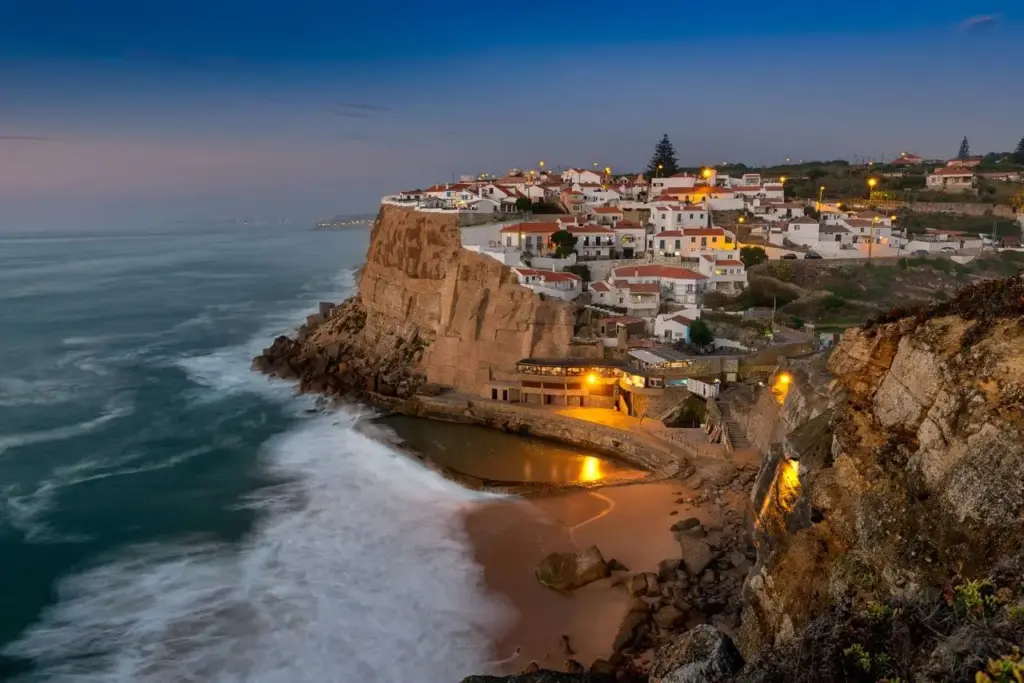
The Ocean Pool — And Why It Was Closed Until May 2026
The pool at the base of the cliff is the reason most people have heard of Azenhas do Mar at all — a rectangular stone structure built into the rock in the 1950s, filled naturally by the incoming Atlantic tide and emptied again as the tide recedes. It isn’t a natural rock formation in the way it’s sometimes described; it’s a constructed pool that uses the tide instead of a pump, which is a meaningfully different thing and worth knowing before you plan a swim around it. In 2022, Condé Nast Traveller listed it among the world’s more photogenic pools — the kind of recognition that turns a village pool into a genuine trip motivator.
Here’s what most articles about this pool don’t mention: municipal inspections in June and August 2025 found specific, named problems — drainage failures, degraded access stairs, and missing protective barriers on parts of the pier — serious enough that the pool was closed to the public on 27 August 2025, on safety grounds. It stayed closed for almost nine months while corrective works were carried out before reopening to visitors on 19 May 2026.
As of this writing, the pool is open. That’s worth stating plainly, because a fair amount of what’s published about Azenhas do Mar was written during the closure, or before it, and simply hasn’t been updated either way. If you’re planning to swim, check current status before you go — pools built into an eroding Atlantic cliff face don’t stay problem-free indefinitely, and this is now the second time in recent memory that safety concerns have taken it offline.
The tide matters regardless of the pool’s open/closed status: it fills at high tide and empties at low tide, so arriving at the wrong point in the cycle means looking at an empty stone basin rather than a pool.
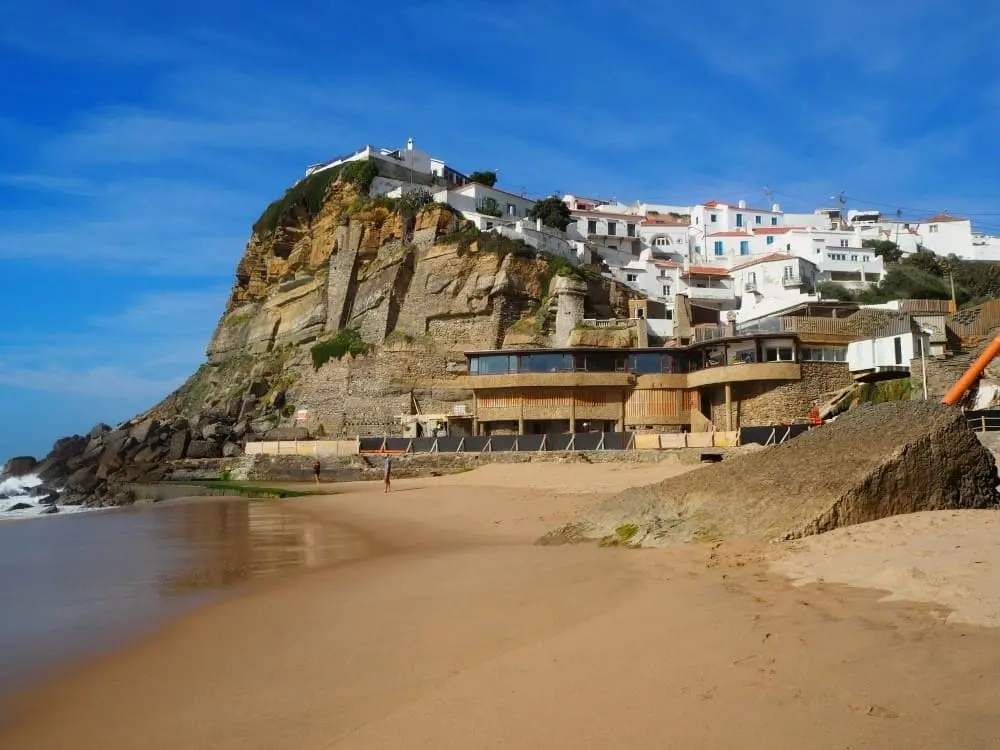
The Beach and the Viewpoint
Below the village, a small beach forms at the base of the cliff alongside the pool — its size genuinely depends on the tide and season, since sand accumulates and disperses around the pool wall rather than sitting on a fixed shoreline. It’s a working beach in the practical sense: modest in size, cliff-sheltered, and secondary to the pool and the village itself rather than a destination in its own right.
The village’s miradouro — its clifftop viewpoint — is what actually earns Azenhas do Mar its reputation among photographers, more than the pool does. The white-washed houses with blue trim step down the cliff face in tiers, and the late-afternoon Atlantic light catches the whitewash directly, which is why so many photographs of this village look similar: they were taken from the same spot, in the same hour before sunset. It’s a two-minute walk from the main parking area, no ticket, no gate.
I’ve stood at that viewpoint at 5pm in August with fifteen other people doing the same thing I was doing. It’s worth it anyway.

Colares, Next Door: Portugal’s Sand-Grown Wine
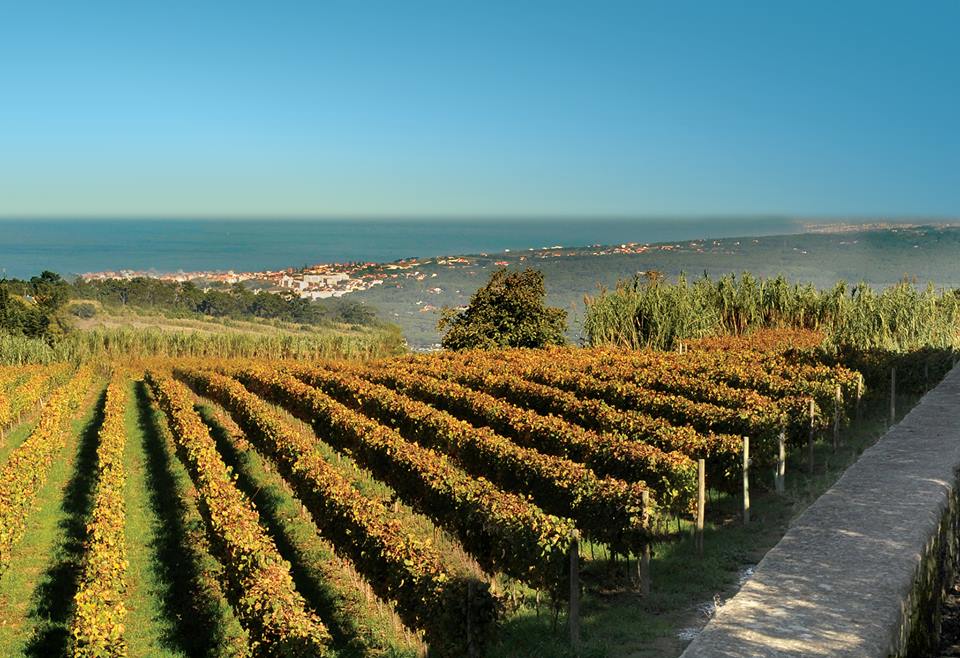
Azenhas do Mar sits inside the civil parish of Colares, which gives its name to one of Portugal’s smaller and more unusual wine appellations. Colares DOC is one of the few wine regions in Europe where vines grow directly in coastal sand on their own, ungrafted rootstock — a peculiarity of the sandy soil that kept the phylloxera louse, which destroyed most of Europe’s vineyards in the 19th century, from reaching the roots. Fewer than 50,000 bottles are produced in the region per year, which is a small enough number that most of the world has never tasted one.
When to Visit
Spring (March–May)
Mild temperatures, green surrounding landscape, and — as of 2026 — the pool newly reopened after its repair works, which likely means less crowding than a fully “rediscovered” summer season would bring.
Summer (June–August)
The busiest window.
Warm weather, the pool at its most in-demand, and the viewpoint parking area filling by mid-afternoon.
Arrive before 11:00 or after 16:00 if a quiet visit matters to you.
Autumn (September–October)
Fewer visitors, water still swimmable most days, Atlantic light at its most dramatic for late-afternoon photography.
Winter (November–February)
The quietest months by a wide margin.
Swimming is unlikely regardless of pool status — Atlantic winter swell makes the coast considerably rougher.
This is when the village looks most like it did before it became a photograph.
Visiting Azenhas do Mar from Lisbon
Azenhas do Mar is a stop, not a day trip on its own — most visitors spend 30–45 minutes at the viewpoint and pool before moving on to Sintra, Cabo da Roca, or the rest of the coast. It sits at the far end of the Sintra-Cascais coastal route, which is why it’s typically the last or near-last stop on a full-day itinerary rather than a standalone destination.
I run this stretch of coast as the closing leg of a private 4×4 route that also covers Peninha, Cabo da Roca, and Adraga Beach — the kind of day where Azenhas do Mar earns the golden-hour light it’s usually photographed in, rather than the midday crowd.
- Sintra Jeep Tour → Land Rover Defender, 10 stops incl. Azenhas do Mar, from €330/vehicle.
FAQ
What does "Azenhas do Mar" mean?
Is the Azenhas do Mar ocean pool open?
How old is the village of Azenhas do Mar?
How far is Azenhas do Mar from Lisbon?
Is Azenhas do Mar the same as Colares?
Is the pool at Azenhas do Mar natural or man-made?
Can you swim in the sea at Azenhas do Mar?
What is the best time to visit Azenhas do Mar?
Is Azenhas do Mar worth visiting?
Is Azenhas do Mar part of a natural park?

Founder & Director of Yellow Cab TT Tours. Guiding in Portugal for 20+ years.
Founded Yellow Cab TT Tours in 2013. 3,372 five-star reviews on Tripadvisor.