
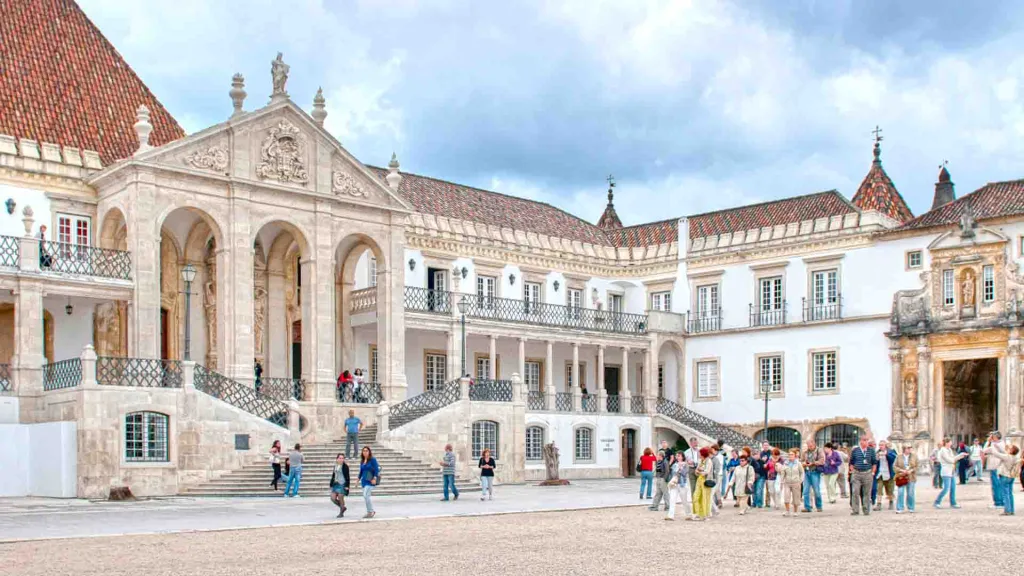

The University of Coimbra has been in continuous operation for 736 years. It was founded in 1290 — more than two centuries before Columbus reached the Americas, a century before the Black Death reached Lisbon. It has occupied the same hilltop in Coimbra since 1537, and it currently enrols approximately 26,000 students from over 80 countries.
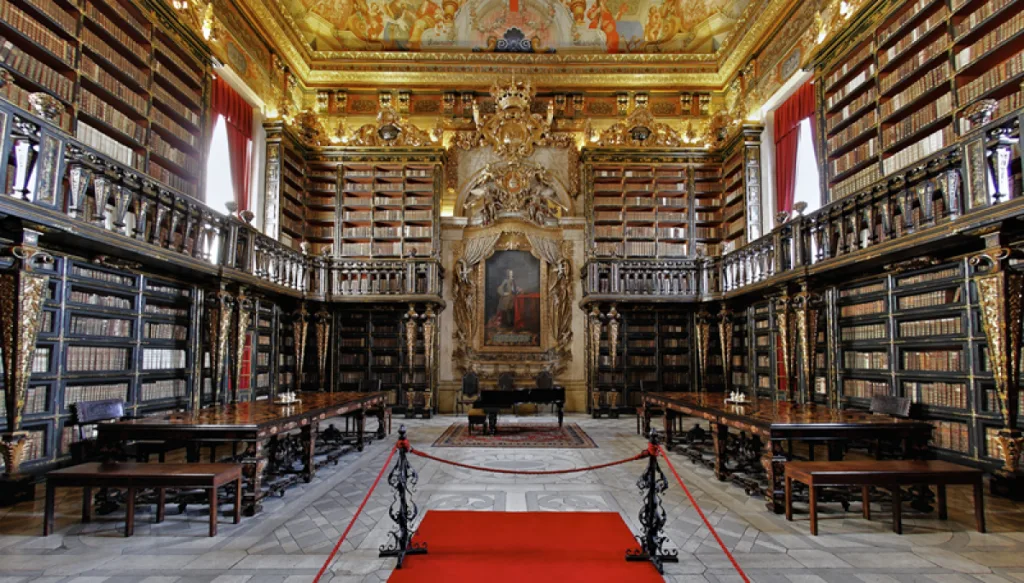
Most visitors come for one reason: the Joanine Library. The library holds approximately 70,000 volumes in three Baroque halls lined with gold-leafed jacaranda and rosewood shelving commissioned by King João V. It is also home to a resident bat colony that has been providing pest control for at least two centuries. Every evening the bats emerge to eat the insects that would otherwise damage the books. Library staff lay leather mats on the reading tables each night to protect them. The arrangement works.
Visiting the University of Coimbra well — meaning the Joanine Library, the Sala dos Capelos, the Via Latina, and Saint Michael’s Chapel, in the right sequence, with a timed entry slot that doesn’t evaporate — requires more advance planning than most travel guides suggest.
This guide covers everything needed to plan a university of coimbra tour: the full history, what each section contains, 2026 ticket prices verified from the official source, practical logistics from someone who has done this route more times than can comfortably be counted, and how to visit all of it in a single day from Lisbon.
Founded in 1290: How the University Ended Up on a Hill in Coimbra
King Dinis I and the Original Lisbon Campus: 1290
The University of Coimbra was not always in Coimbra.
King Dinis I founded it in Lisbon in 1290, by papal bull authorised under Pope Nicholas IV. It was the first university in Portugal and among the earliest in the Iberian Peninsula — the University of Salamanca (founded 1218) and the University of Valladolid (founded c. 1241) preceded it, but only just. The founding faculty covered theology, civil law, canon law, logic, and medicine.
For the following 250 years, the university moved between Lisbon and Coimbra five separate times. Portuguese kings relocated it according to political circumstance, proximity to the court, and the availability of suitable buildings. This back-and-forth continued for two and a half centuries, which is either a reflection of medieval institutional pragmatism or a very long argument about real estate, depending on how you look at it.
King João III Moves the University to Coimbra: 1537
In 1537, King João III made the move permanent. He transferred the university to the hilltop above Coimbra, installing it in the former royal palace — the same building that had been the principal residence of the kings of Portugal during the period when Coimbra served as the country’s capital (1131–1255).
The choice of the royal palace was deliberate. It placed the university in a building with existing ceremonial authority, on a site that commands a view of the entire lower city and the Mondego River 80 metres below. The buildings you visit today are the result of continuous construction and modification from the 16th through the 18th century, each successive king adding or refacing according to the architectural fashions of his reign.
The university has remained in Coimbra without interruption since 1537. It has survived Napoleonic occupation (1808–1811), the abolition of the monarchy (1910), the Estado Novo dictatorship (1933–1974), and a revolution (April 1974). It currently enrols approximately 26,000 students across faculties that include law, medicine, science, engineering, arts, and economics.
The Paço das Escolas — What You Actually Visit
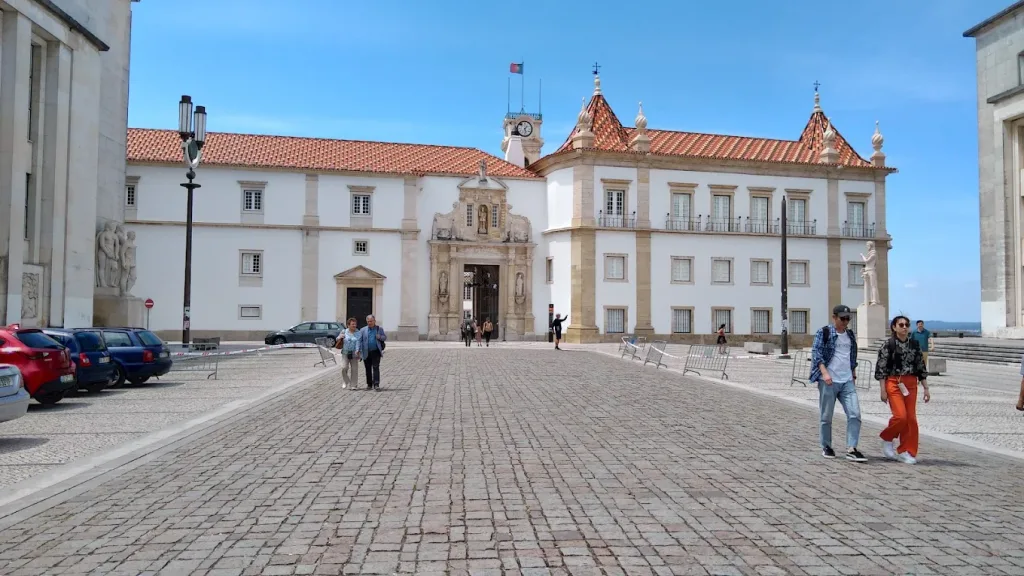
The Paço das Escolas — “Palace of the Schools” — is the formal historic core of the university: the hilltop complex of ceremonial buildings organised around a central courtyard with a long view over the Mondego. It is what most visitors mean when they say “the university.”
The courtyard itself is open to anyone. Entry to the buildings requires a ticket purchased at visit.uc.pt or at the kiosk on site.
The Sala dos Capelos (Great Hall of Acts)
The Sala dos Capelos — “Hall of the Hoods” — is the university’s principal ceremonial room. The name refers to the black academic capes (capelos) worn by students. It is the room where doctorates are conferred, rectors are invested, and the academic year is officially opened.
The room has been here considerably longer than the university. Before 1537, this was the Throne Room of the royal palace — the room where King João I was proclaimed King of Portugal in 1385, after the Battle of Aljubarrota confirmed Portuguese independence from Castile. The ceremony that transformed a disputed succession into a dynasty happened here. Students today receive their degrees in the same room.
The current interior design dates from 1655. The wooden ceiling is divided into 172 carved panels depicting grotesque motifs: sea monsters, mermaids, figures from the Americas, and plant forms. The walls are lined with portraits of all Portuguese kings from Afonso Henriques — first king, died 1185 — to Manuel II, who abdicated in 1910. One group is absent: the Philippine dynasty (1580–1640), the period when Portugal was under Spanish rule. The portraits are present for every other period. The Habsburg kings are not.
The Via Latina
The Via Latina is the formal ceremonial corridor running through the interior of the royal palace. In the 17th and 18th centuries it was the institutional spine of academic life — the passageway through which formal processions moved, through which degrees were solemnly conferred, through which the university conducted its public rituals.
The architecture reflects its ceremonial function: painted ceilings, azulejo tile panels, and a carved stone portal that marked the boundary between the administrative and the academic. Much of what is visible today dates from the period of King João V’s renovations in the early 18th century, the same campaign that produced the Joanine Library.
Saint Michael’s Chapel (Capella de São Miguel)
The chapel is dedicated to the patron saint of the university. The foundations are older, but the interior as visitors see it today is largely a 17th-century construction. The most notable features are the 18th-century gilded Baroque organ, which is still functional and used for occasional performances, and the azulejo tile panels that cover the walls floor to ceiling — approximately 6,000 individual tiles installed between 1701 and 1703.
The organ is worth stopping for. Most visitors move through the chapel in five minutes. I generally plan 20–25 minutes here when guiding groups, because the tile panels are more detailed and varied than they appear at first glance, and the iconography is worth reading slowly if you have the interest.
The Joanine Library — Bats, Books and Baroque
The Joanine Library is the reason most people visit the university. It deserves a section of its own.
Construction began in 1717 and was completed in 1728. It was commissioned by King João V — the Baroque patron who also funded the Mafra Palace Convent and the aqueduct that still supplies Lisbon today — using revenue from Brazilian gold and diamond mines. Construction was directed by João Carvalho Ferreira and completed under Gaspar Ferreira.
The library is divided into three interconnected halls corresponding to three disciplines of early 18th-century scholarship: theology in the upper hall, philosophy and law in the middle, medicine and natural sciences in the lower. The shelving is original — built from jacaranda and rosewood imported from Brazil, decorated throughout with gold leaf and lacquerwork. The painted ceilings were executed by the Lisbon artists António Simões Ribeiro and Vicente Nunes. The exterior walls measure 2.11 metres thick; the building functions as a vault, maintaining a constant internal temperature of 18–20°C and humidity around 60% regardless of Coimbra’s summer heat, which can reach 35°C in August.
The collection holds approximately 70,000 volumes, covering works from the 16th, 17th, and 18th centuries across theology, law, philosophy, natural sciences, geography, and history. The library holds a first edition of Os Lusíadas (1572) — Luís de Camões’s epic of the Portuguese Age of Discovery.
The bat colony
Every evening, a colony of bats emerges inside the library to hunt the insects — primarily moth larvae and silverfish — that would otherwise feed on the paper and leather of the books. Library staff place leather mats on the reading tables each night to catch the guano. The mats are removed each morning before opening. The arrangement has been documented in library records since the early 19th century; the colony has likely been in residence longer.
This is not a charming detail invented for tourists. It is the library’s actual pest management system, and it has been working, without modification, for at least 200 years. In a building where the books are 300 years old, the pest control is handled by animals that predate the books, and nobody has improved on it. This is the sort of institutional conservatism that, in retrospect, looks like wisdom.
Timed entry is mandatory. The library admits no more than 60 visitors per 20-minute slot. From June through September, available slots sell out days to weeks in advance. Book at visit.uc.pt before you leave for Coimbra — not on arrival. This is the single most common logistical failure for independent visitors.
If you arrive without a booking and all slots are taken, your ticket still gives access to the Royal Palace, Sala dos Capelos, Via Latina, Saint Michael’s Chapel, the Chemistry Laboratory, the Academic Museum, and the Cabinet of Curiosities. The library is the only element that requires a timed slot. It is, however, the element most people came for.
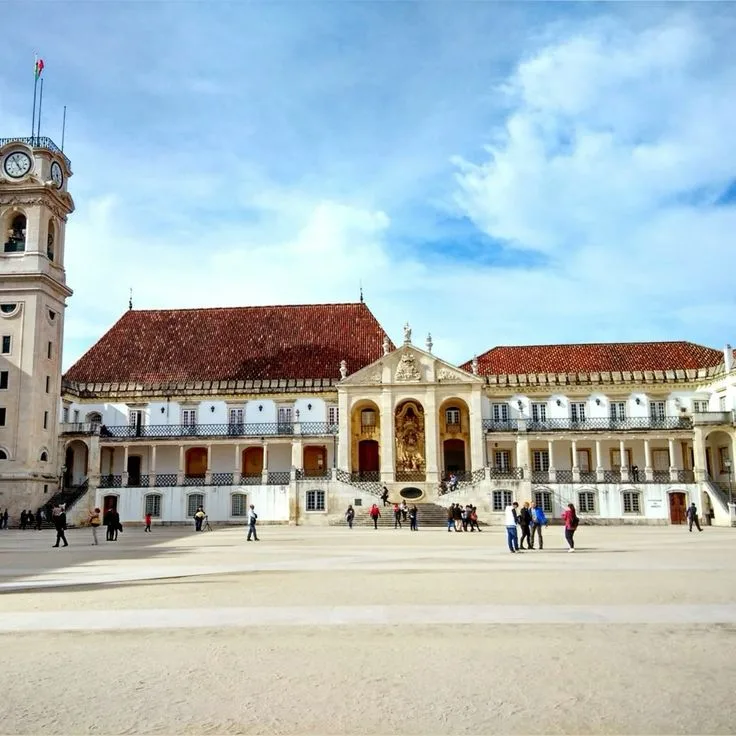
The Clock Tower (Torre da Universidade)
The Clock Tower was completed in 1728 as part of the same Baroque construction campaign that produced the Joanine Library. The bells were cast in 1733. Students call the tower “A Cabra” — The Goat — because of the sound the bell makes. At approximately 34 metres, it is the dominant vertical element in Coimbra’s skyline from any approach.
For 2026 visitors: the tower is currently closed to public access. The official visit.uc.pt information page lists it as inaccessible. Before including a tower visit in your plans, verify the current status at visit.uc.pt or contact turismo@uc.pt directly. The closure is not advertised prominently and has caught visitors off guard.
What the UNESCO Inscription Actually Covers
The University of Coimbra — Alta and Sofia was inscribed as a UNESCO World Heritage Site on 22 June 2013. It was Portugal’s 15th UNESCO designation. UNESCO World Heritage listing.
The inscription is broader than most visitors realise. “Alta” refers to the historic upper city — the university buildings, the Sé Velha cathedral (founded 1164), the Arco de Almedina medieval gate, and the network of medieval streets around the Paço das Escolas. “Sofia” refers to the lower academic precinct along Rua de Sofia, where the original 16th-century university colleges were built after the 1537 move from Lisbon — a different architectural layer of the same institutional history.
The inscription covers six criteria. The sixth criterion is what distinguishes Coimbra from most other UNESCO university designations: the World Heritage Committee recognised Fado de Coimbra — the musical tradition of the university — as “directly and tangibly associated” with the site’s outstanding universal value. It is one of only five universities in the world inscribed as a World Heritage Site.
The Paço das Escolas represents the sixth criterion in architectural form — a building that has been continuously adapted to the intellectual needs of successive centuries, each period leaving a visible layer. The Baroque library and the 17th-century Sala dos Capelos interior sit inside a building that was once a 12th-century royal palace. Very few institutions in the world can offer that kind of stratigraphic reading to a visitor with a two-hour ticket.

Fado de Coimbra: The Musical Tradition of the University
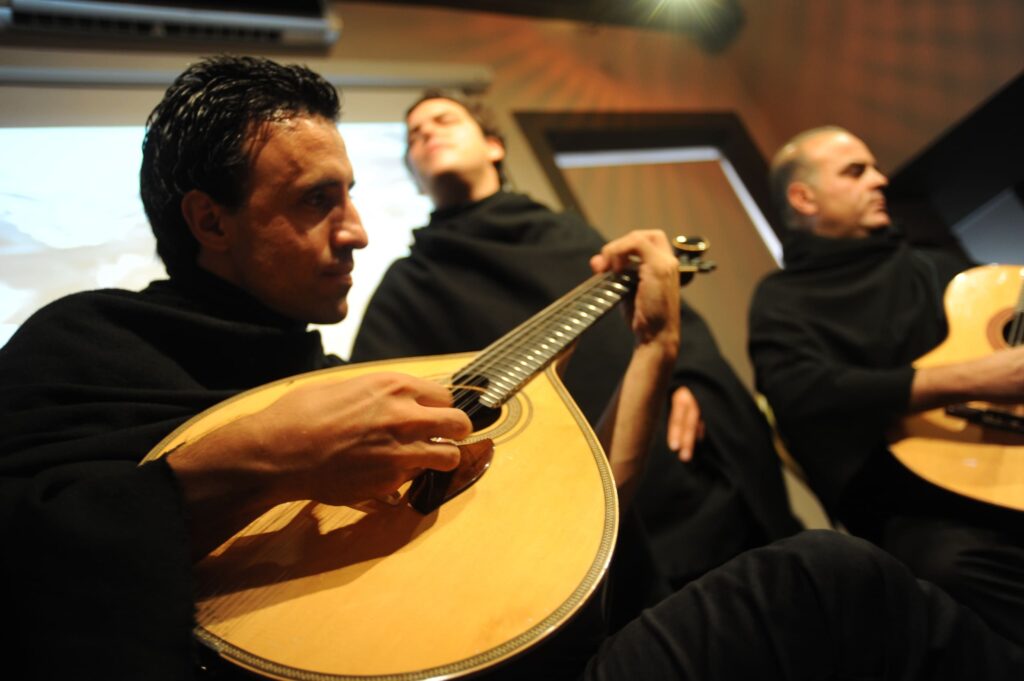
Fado de Coimbra is not the same as Lisbon Fado. The two share instrumentation — the Portuguese guitarra (a 12-string instrument derived from the Renaissance cittern) and the viola baixo (bass guitar) — but in practice they are distinct traditions with different origins, different repertoires, and different contexts.
Lisbon Fado is a genre of urban melancholy, associated with working-class neighbourhoods like Alfama and Mouraria, sung by both men and women in informal settings. Coimbra Fado is a university tradition: sung exclusively by men, performed in academic dress — black cape, toga, and the distinctive capelo hood — and rooted in a repertoire that draws on medieval troubadour conventions and Romantic-era literary Portuguese.
It is traditionally performed as serenade: standing outside a window, at night, without amplification, for a single recipient. It is not performed for applause and it is not performed for money. Whether this tradition has survived modernity entirely intact is a question the practitioners answer differently depending on which generation you ask.
Fado as a whole was inscribed on the UNESCO Intangible Cultural Heritage list on 27 November 2011. Fado de Coimbra received additional specific recognition through the university’s World Heritage inscription in 2013, where it was cited as a living cultural tradition of outstanding universal significance directly associated with the site.
The best opportunity to encounter Fado de Coimbra during a visit is the Queima das Fitas, the annual end-of-year student festival held each May. For one week, processions in academic dress with live Fado de Coimbra serenades fill the Alta’s streets nightly. Daytime monument access is unaffected.
Outside May, the Casa das Caldeiras — a 19th-century industrial building converted into a cultural venue — hosts scheduled Fado de Coimbra performances during the academic year (October–June). Check the schedule in advance; performances are not daily.
If your visit falls in July or August and you want to hear Fado de Coimbra performed live, scheduled shows at the Casa das Caldeiras are the most reliable option.
Practical Visiting Guide: Tickets, Hours and Logistics in 2026
Tickets (verified at visit.uc.pt, prices valid January–December 2026)
| Ticket | Includes | Adult price |
|---|---|---|
| With Joanine Library | Baroque Library (timed entry), Royal Palace, Saint Michael’s Chapel, Chemistry Lab, Academic Museum, Cabinet of Curiosities | €16.50 |
| Without Joanine Library | Royal Palace, Saint Michael’s Chapel, Chemistry Lab, Academic Museum, Cabinet of Curiosities | €12.50 |
| Guided Tour — Palace of Schools | All of the above with guide-led interpretation | €25.00 |
Buy tickets at visit.uc.pt before your visit. On-site purchase is possible at the kiosk (opens 08:45), but Joanine Library slots for that morning are typically exhausted by 10:00 in summer. Non-guided tickets are valid for two days following purchase, except the library timed slot which is fixed.
Opening Hours (March–October)
- Ticket office and main buildings: 09:00–18:00 (last entry 17:45).
- Ticket office kiosk opens: 08:45.
- Botanical Garden: 09:00–20:00 (April–September); 09:00–17:30 (October).
Opening Hours (November–February)
- Main buildings: 09:00–13:00 and 14:00–17:00 — summer 2026 schedule shows. 09:00–18:00 daily
- Botanical Garden: 09:00–17:30.
Getting to the Paço das Escolas
The university sits at the top of the Alta, approximately 80 metres above the Mondego. From the train station (Coimbra-A), Santa Cruz Monastery, or the Baixa, it is a 600-metre uphill walk on cobblestone streets — steep in parts, uneven throughout.
Alternative: the Elevador do Mercado, the funicular connecting the Baixa to the Alta since 1923. It runs from Praça do Comércio in the lower city. The funicular ticket is separate from the university entrance ticket.
What to Wear and Carry
Flat, closed-toe shoes. The Alta’s cobblestone streets are steep and uneven. The Joanine Library has polished stone floors. Carrying a light bag rather than a large rucksack makes the library visit more comfortable given the timed-slot system.
Time Allocation
With the Joanine Library: allow a minimum of 2.5–3 hours for the Paço das Escolas alone. For a full day in Coimbra combining the university with the Sé Velha cathedral (5-minute walk from the Paço das Escolas) and Santa Cruz Monastery (600 metres downhill in the Baixa): plan 4–5 hours on site.
Summer Heat
Coimbra sits 197 km inland and runs consistently 4–6°C hotter than Lisbon in July and August, regularly reaching 35°C. Schedule the university visit for the morning. The Joanine Library’s interior is maintained at a constant 18–20°C — one of the more comfortable spaces in the city on a hot day, incidentally.
The Botanical Garden
The university’s Botanical Garden, located adjacent to the Paço das Escolas, covers approximately 13.5 hectares and was founded in 1772 as part of the Marquis of Pombal’s educational reforms. It is one of the oldest university botanical gardens in Portugal and currently maintains over 1,200 plant species. Entry is separate (€10 guided tour, or included in some combination tickets — check at visit.uc.pt). It is largely ignored by visitors who come for the library, which means it is rarely crowded.
How to Visit the University of Coimbra from Lisbon
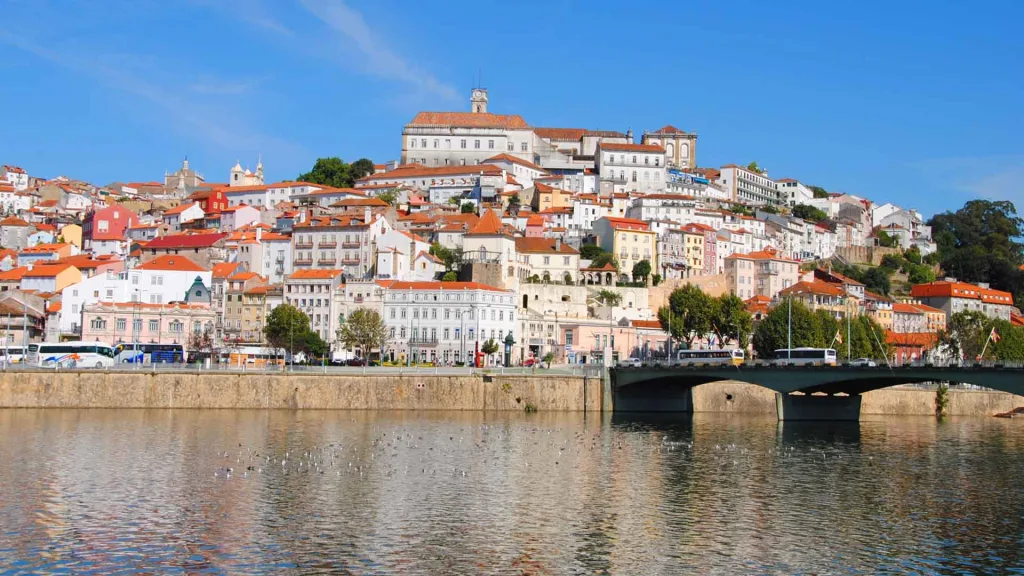
The University of Coimbra is 197 km north of Lisbon on the A1 motorway — approximately 2 hours by car each way. By Alfa Pendular train from Lisboa Oriente, the journey takes 1 hour 30 minutes to 1 hour 45 minutes and costs approximately €11–13 per person each way.
By train, you arrive at Coimbra-B station (the main intercity station), then transfer to Coimbra-A in the Baixa — a 5-minute regional train connection. From Coimbra-A, the Paço das Escolas is a 600-metre uphill walk.
The Planning Challenge
The logistical difficulty is not the travel to Coimbra — it is the coordination once you arrive. The Joanine Library requires a timed entry slot booked in advance. The Alta and Baixa are at different elevations and 600 metres apart. Covering Santa Cruz Monastery, the Paço das Escolas, and the Sé Velha in a single day requires a sequencing that the train timetable does not care about. If the library slot is at 12:30 and the return train is at 16:45, the geometry of the day becomes very specific.
A Private Day Tour from Lisbon
We run a private Coimbra day trip from Lisbon that covers all four main sites — Santa Cruz Monastery (founded 1131, tombs of Portugal’s first two kings), the Paço das Escolas, the Joanine Library with timed entry coordinated in advance, and the Sé Velha cathedral (begun 1164) — in an 8-hour day. Departure 08:30–09:00 from Lisbon, return 17:30–18:00.
The tour is 100% private: your group, your vehicle, your guide. We do not run a group tour to Coimbra. The private format is the only way to guarantee the library entry slot, build the rest of the day around it, and have a guide who adjusts the pace to what your group wants to see. From €360 per vehicle.
If you want to combine Coimbra with Fátima Sanctuary in a single day, we also offer a Fátima & Coimbra Tour — two major central Portugal destinations in one day from Lisbon, with a shorter visit at each.

FAQ
How much does it cost to visit the University of Coimbra in 2026?
Do you need to book the Joanine Library in advance?
What is the best time of year to visit the University of Coimbra?
How long does a visit to the University of Coimbra take?
Is the Clock Tower open to visit?
What is the Joanine Library bat colony?
Who founded the University of Coimbra and when?
What does the UNESCO World Heritage inscription cover?
Can I visit the University of Coimbra independently, without a guided tour?
How far is the University of Coimbra from Lisbon?

Founder & Director of Yellow Cab TT Tours. Guiding in Portugal for 20+ years.
Founded Yellow Cab TT Tours in 2013. 3,372 five-star reviews on Tripadvisor.