
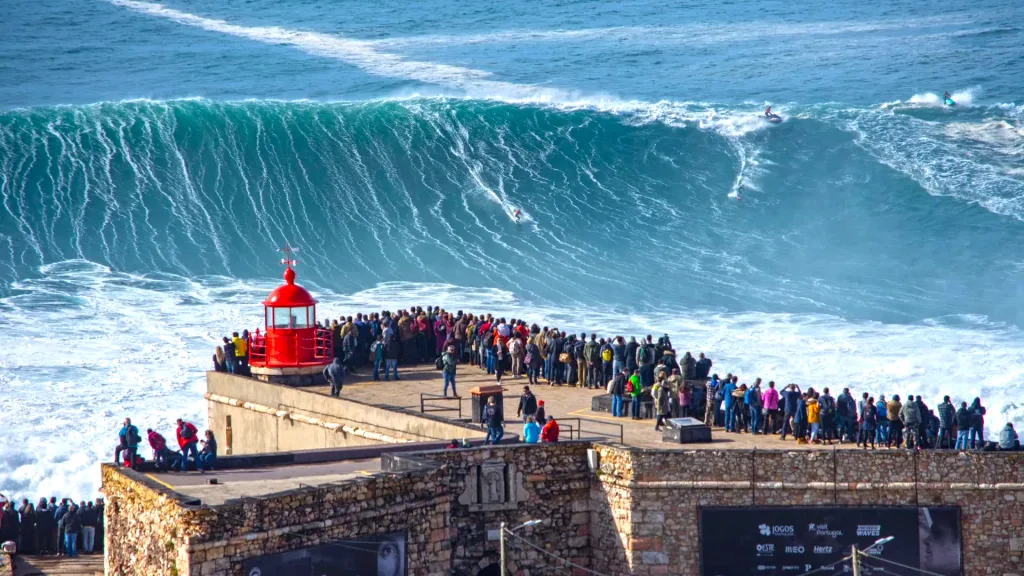

The largest wave ever surfed was 26.21 metres high. That is approximately the height of an eight-storey building. Sebastian Steudtner rode it at Praia do Norte, Nazaré, Portugal, on 29 October 2020. Guinness World Records confirmed the measurement in 2022.
The wave did not exist because of unusual weather that day. It existed because of a geological structure that formed millions of years ago on the floor of the Atlantic Ocean – and happens to end directly below a small fishing beach 122 kilometres north of Lisbon.
I have been bringing clients to Nazaré since 2013. Most of them arrive expecting a large beach. What they find instead is a canyon. In this article I will explain how the Nazaré underwater canyon creates waves that do not exist anywhere else on the planet, when the wave season runs, where to watch from, and what the WSL competition calendar looks like if you want to time your visit around a contest. The science is simpler than it looks.
Table of Contents
The Nazaré Canyon: Europe’s Grand Canyon Under the Atlantic
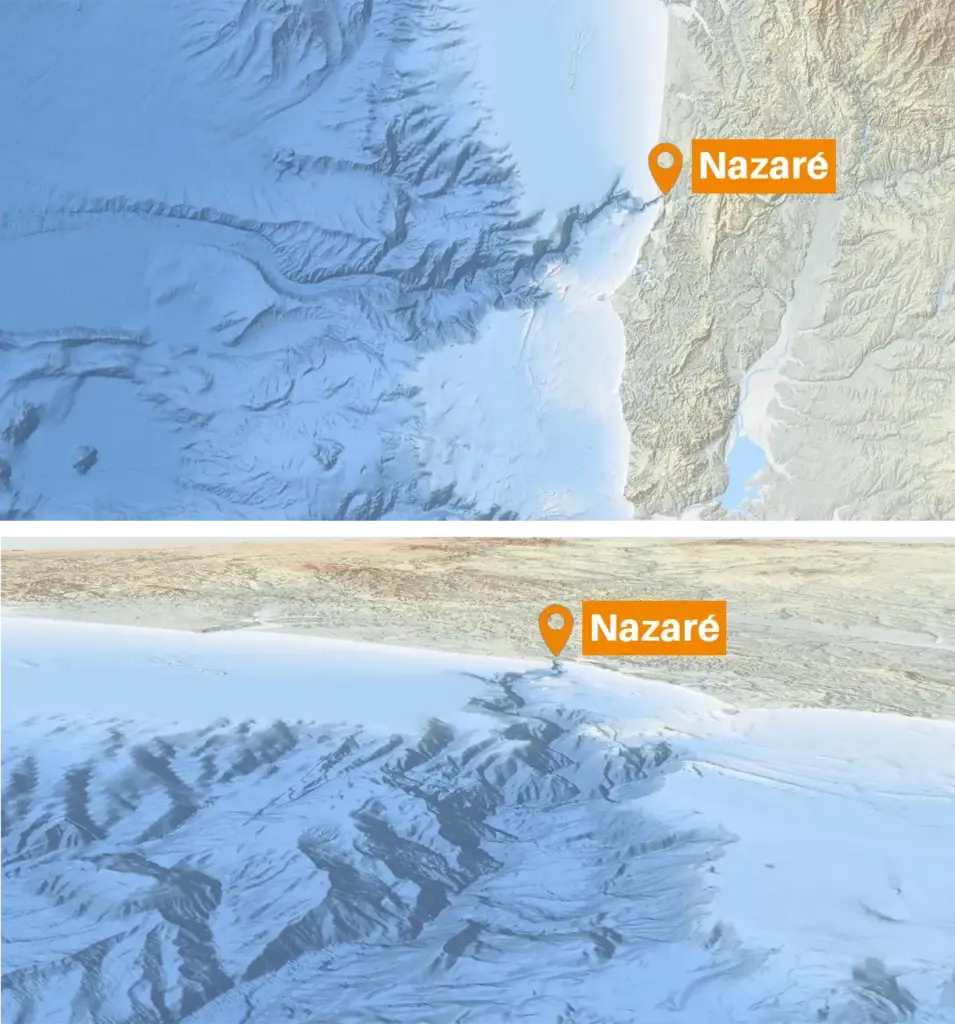
The Nazaré Canyon is the largest submarine canyon in Europe. It stretches approximately 230 kilometres along the floor of the Atlantic, beginning less than one kilometre from the Portuguese coastline and descending to depths of around 5,000 metres at its deepest point. For comparison, the Grand Canyon in Arizona reaches a maximum depth of 1,857 metres. The Nazaré Canyon is nearly three times deeper.
The canyon was formed by a reactivated geological fault zone and shaped over millions of years by ancient landslides, debris flows, and sediment transport. Unlike most submarine canyons, it is not connected to a major river system — it was created entirely by tectonic activity. The canyon starts so close to the coast that at Praia do Norte, the seabed drops from 10 metres depth to several hundred metres within a very short horizontal distance.
That proximity to the shore is everything. In most of the world’s oceans, waves arriving from deep water gradually lose energy as they move across progressively shallower seabed before reaching the coast. At Praia do Norte, the canyon channels deep-water energy directly to the breaking point with almost no energy loss. The result is a wave that arrives with everything it had in the middle of the Atlantic.
Scientists have studied the Nazaré Canyon extensively for its ecology, sediment dynamics, and role in ocean circulation. The fact that it happens to generate world-record surf is, from a geological perspective, incidental.
How the Canyon Creates Giant Waves
The Nazaré waves are not caused by local weather. They originate from Atlantic storms that form hundreds of kilometres offshore — frequently near Greenland, Iceland, or the Canadian Maritime provinces during the winter months. Those storms generate swells that travel south across the open ocean.
When a swell reaches the northern Atlantic coast of Portugal, most of it dissipates across the continental shelf. At Nazaré, the canyon cuts through the shelf and acts as a direct conduit — wave energy travels through deep water all the way to the coast with minimal friction.
There is a second mechanism that matters specifically at Praia do Norte. The canyon is positioned to the north of the beach. Waves that travel down the canyon arrive at the shore from a different angle than waves arriving from the open ocean to the west. When these two wave trains converge at Praia do Norte, they stack. A swell that measures 10 metres offshore can stand up into a 26-metre wall of water within seconds of reaching the shoaling zone at the canyon’s mouth.
The conditions required for a record-sized wave are specific: the right wind direction, the right swell period (typically 16–22 seconds for the largest waves), and a propagation distance long enough for the swell to organise. That combination occurs reliably between October and March, which is when surfers and photographers arrive.
What does not occur is predictability within that window. A forecast showing potential record conditions gives 48 to 72 hours of warning at best. Locals check the buoy data daily.
Wave Records at Nazaré: From McNamara to Steudtner
Nazaré was not a recognised surf destination before 2010. The waves existed — the canyon has always been there — but no surfer had attempted to ride them. The location was identified by American big wave surfer Garrett McNamara, who was invited to Nazaré by the town authorities and local surfer Dino Casimiro.
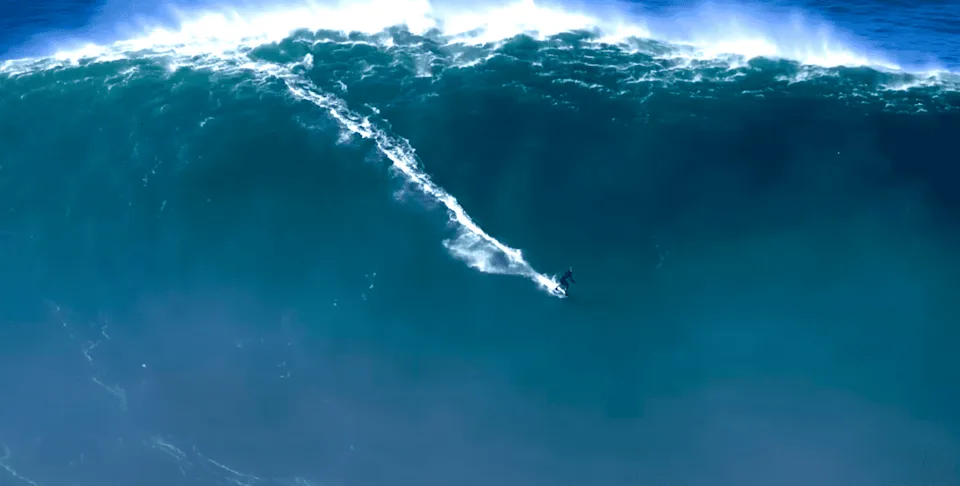
On 1 November 2011, McNamara rode a wave at Praia do Norte measured at 23.8 metres (78 feet). Guinness World Records certified it as the largest wave ever surfed at the time. The footage circulated globally and Nazaré went from a regional fishing town to a name known in every surfing market. The town’s entire infrastructure around big wave tourism — viewing areas, media access, the lighthouse viewpoint — developed in the decade that followed.
The record stood until Sebastian Steudtner, a German big wave surfer, rode a wave measured at 26.21 metres (86 feet) at Praia do Norte on 29 October 2020. Guinness certified the record in 2022 after an independent panel measured still and video footage. The ride was awarded the Biggest Tow Award at the 2021 Red Bull Big Wave Awards.
Steudtner has since ridden waves estimated at 28.57 metres (93.7 feet) — which would represent a further record — though official Guinness certification of that measurement is pending as of mid-2026.
The three largest authenticated wave rides in surfing history all took place at the same beach, Praia do Norte in Nazaré.
Nazaré Big Wave Season: When to Go
Wave Season — October to March
The Nazaré big wave season runs from October through March, driven by North Atlantic storm patterns. During these months, low-pressure systems track across the North Atlantic, generating long-period swells that reach the Portuguese coast with enough energy and organisation to produce record-scale waves.
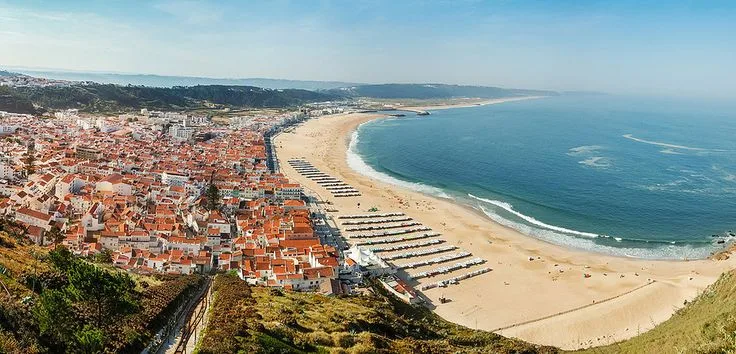
The most reliable months for large swells are December through February. October and March are active but less predictable — the storms that generate the largest swells tend to follow more consistent tracks in deep winter. The summer months, April through September, produce calm conditions. Praia do Norte in summer is a family beach with modest surf. Praia da Nazaré, on the southern side of the headland, is a calmer beach year-round and operates as a normal seaside resort.
A practical note on planning: the largest waves are not a daily event even in season. A month in Nazaré might include three or four significant swell events, each lasting one to three days. Visitors who arrive specifically to see large waves need either a flexible itinerary or a reliable forecast source. The WSL and Magicseaweed both publish Nazaré swell forecasts.
Best Time for a Day Visit
For visitors coming from Lisbon on a day trip, the question is whether a large swell is running, not what month it is. A November day with no swell produces smaller waves than a calm October day with a passing system. My recommendation: book a Nazaré tour between October and March, monitor the swell forecast for the week before your visit, and if conditions are flat, adjust your expectations — the canyon, the lighthouse, the Sítio district, and the traditional fishing culture are worth the trip regardless.
I have had clients fly from New York specifically to see giant waves, arrive on the one calm day in January, and watch a 40-year-old fisherman drying octopus on a wooden rack near the beach. They were not entirely disappointed — the octopus was impressive — but it is fair to say their expectations required adjustment.
Where to Watch the Waves
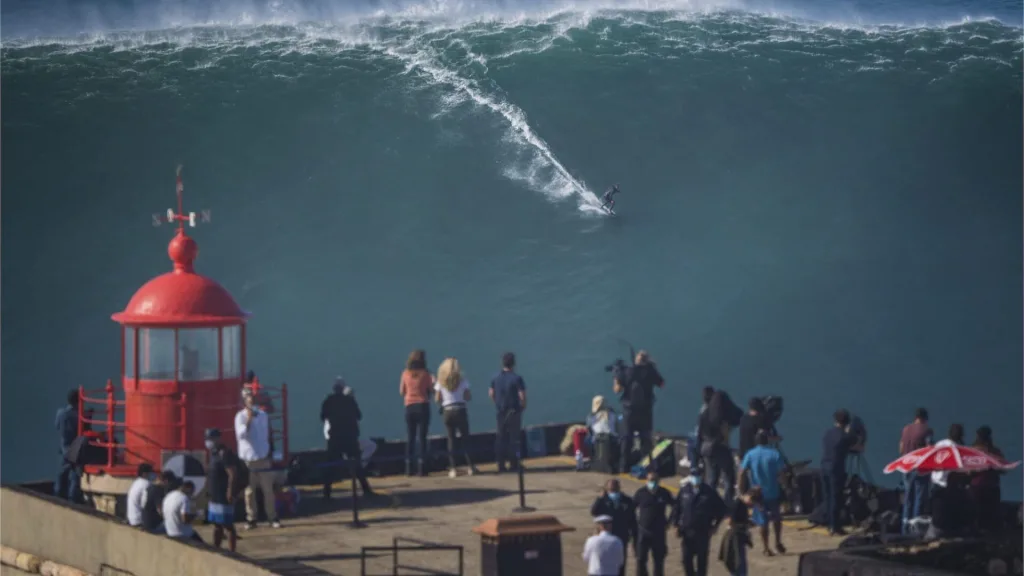
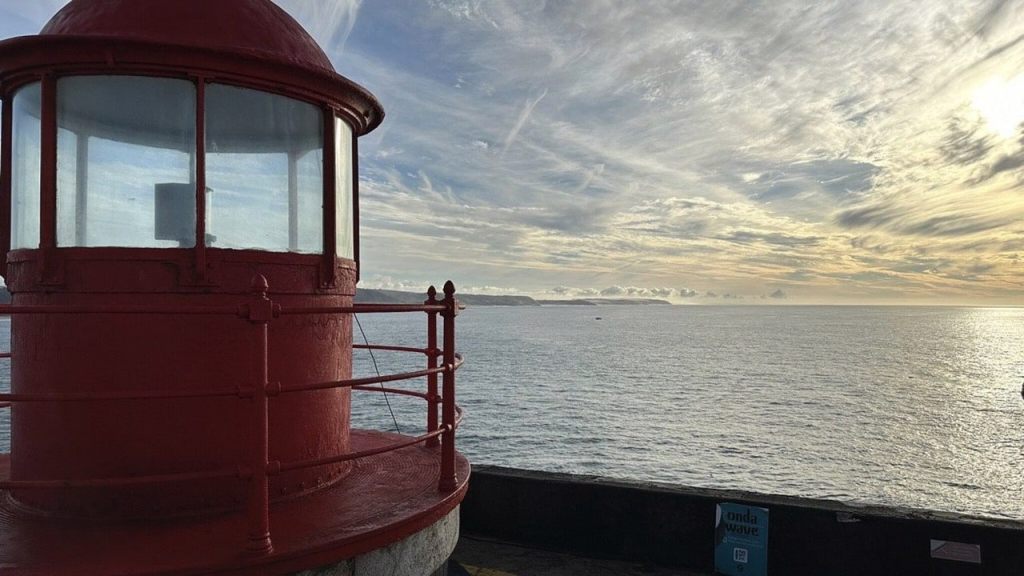
The primary public viewpoint is the Forte de São Miguel Arcanjo, the historic fortress at the northern end of Sítio headland, at 110 metres above sea level. The lighthouse (Farol de Nazaré) is integrated into the fortress. During major swell events, the WSL and local authorities often open the fort’s terrace and surrounding walls as an official viewing area. Access to the viewing platforms is generally free.
The lighthouse area gives a clear view down to Praia do Norte at the base of the cliffs. On days with large swells, the perspective is vertiginous — the waves visible from above look significantly smaller than they are. A 20-metre wave from 110 metres of elevation looks like competent surf. It is not until you see a jet ski towing a surfer into one that the scale registers.
A second viewing option is from the beach promenade at the foot of the Sítio headland, closer to sea level. The waves appear larger from this angle but the full face is harder to read. Crowds during major events concentrate at both locations.
During WSL contest windows, the lighthouse area operates with formal press access, media towers, and organised spectator zones. For non-contest large swells, viewing is informal — arrive early on a forecast big day, the area fills up by mid-morning.
Practical note: the cliff path between the lighthouse and the lower beach requires care on wet days. Stay behind barriers during any swell above 10 metres — waves have reached the fort’s lower terrace during exceptional events.
The WSL Tudor Nazaré Big Wave Challenge
The World Surf League runs the Tudor Nazaré Big Wave Challenge as part of its annual Big Wave Tour. The event operates on an “on-call” window — the WSL designates a period (typically November 1 through March 31) during which the contest can be activated when conditions are predicted to produce waves of 15 metres or larger. A 24-to-48-hour activation notice goes out when a qualifying swell is forecast.
The event is invitation-only. Approximately 20–24 surfers — a mix of men’s and women’s competitors — are invited each season based on WSL rankings and big wave credentials. Both a men’s and women’s field competed at Nazaré in recent seasons, with the women’s division surfing some of the largest waves ever ridden by women in competition.
For spectators, the on-call format means there is no fixed date to book around. Visitors planning a trip specifically around the contest should monitor the WSL calendar from late October onward and keep travel arrangements flexible. The WSL publishes swell watch notices on its website and app.
The 2025/26 edition of the contest ran across the window from November 2025 through March 2026. The next edition is expected to run November 2026 through March 2027.
Booking a flight to watch the WSL Nazaré contest requires roughly the same strategic flexibility as booking flights to a country where the weather determines whether anything happens. Which is to say: budget airlines are not the right tool for this trip.
Can You Surf at Nazaré?
Not at Praia do Norte during big wave conditions. The waves during the October–March season at Praia do Norte are tow-in waves — surfers cannot paddle into them independently. The standard method is jet ski tow-in, where a personal watercraft accelerates the surfer into the wave face at matching speed. Independent access to Praia do Norte is restricted or prohibited by local authorities during significant swell events.
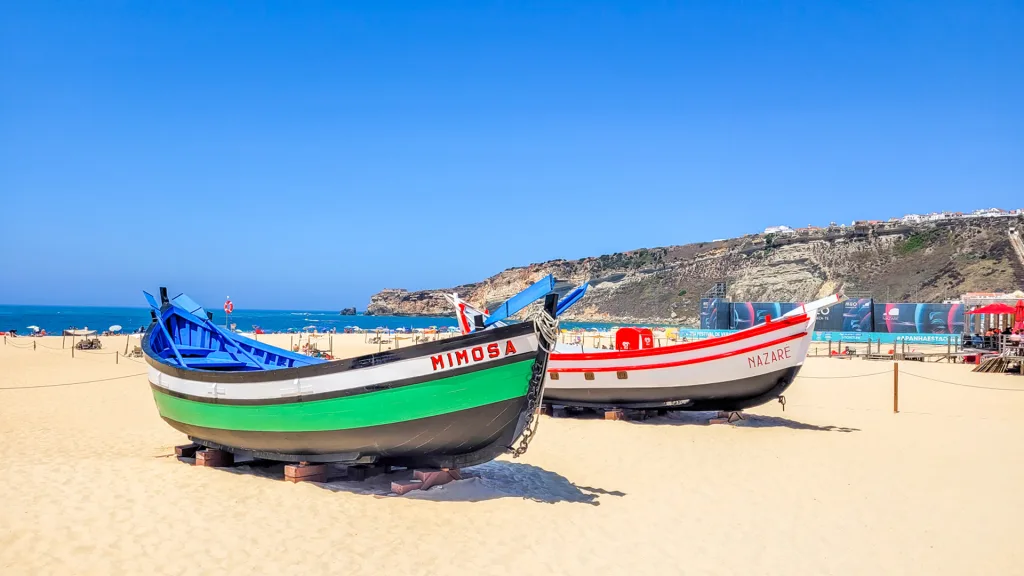
Praia da Nazaré, the main town beach on the southern side, is a calmer beach. It sees normal surf conditions and is suitable for recreational swimmers and beginning surfers in the summer months.
If surfing is part of your Portugal trip, the Algarve and the beaches around Ericeira (a World Surfing Reserve, 45 km from Lisbon) are more appropriate destinations for intermediate-level surfers. Nazaré is a spectator destination for big wave events, not a surfing destination for visitors.
The exception: during summer, local surf schools operate on the town beach with standard conditions. But if you are reading this article, you are almost certainly not here for summer surf lessons.
Every few months I get an enquiry from someone who wants to “try surfing the big waves at Nazaré.” The short answer is no. The longer answer involves a 26-metre reference point and a rethink of the question.
Visit Nazaré on a Day Tour from Lisbon
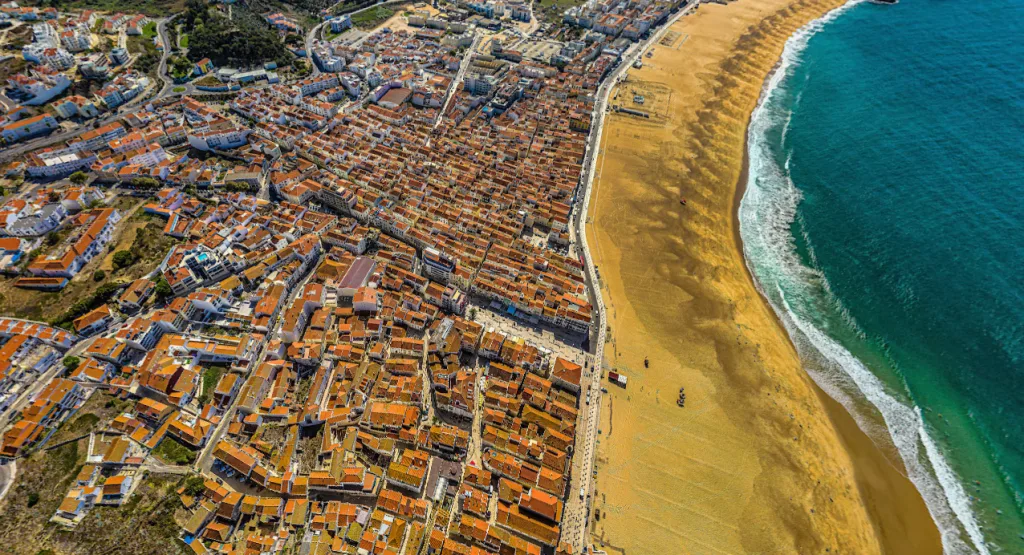
Nazaré is 122 kilometres from Lisbon — close enough for a full day and far enough that having a private vehicle makes the difference between seeing Praia do Norte and spending 40 minutes finding a parking spot. We depart early to reach Nazaré by mid-morning, which matters both for waves and for crowds at Sítio.

FAQ
How big are the waves at Nazaré?
Why are Nazaré waves so big?
When is Nazaré wave season?
Where is the best place to watch the Nazaré waves?
Can tourists surf at Nazaré?
Who holds the Nazaré wave world record?
When is the WSL Nazaré Big Wave Challenge?
How far is Nazaré from Lisbon?
Is Nazaré worth visiting without big waves?
Are the Nazaré waves dangerous for spectators?

Founder & Director of Yellow Cab TT Tours. Guiding in Portugal for 20+ years.
Founded Yellow Cab TT Tours in 2013. 3,372 five-star reviews on Tripadvisor.