


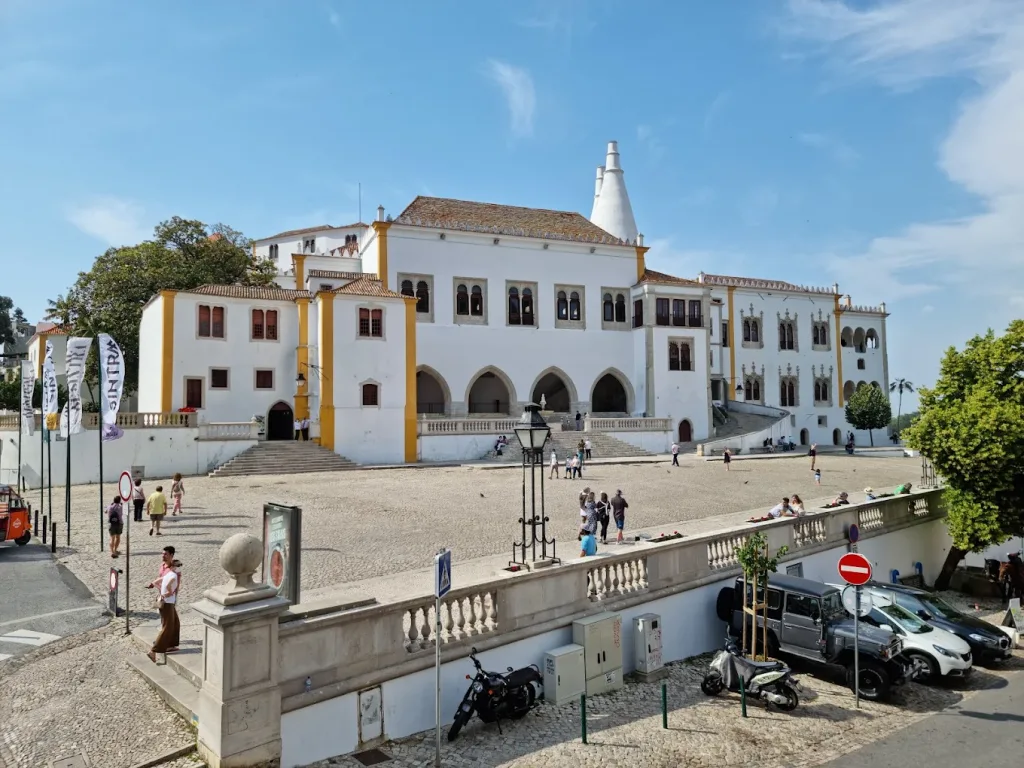
The National Palace of Sintra — Palácio da Vila, the Town Palace — has been occupied as a royal residence continuously from the 13th century to 1910. A Moorish alcazar stood on this site in the 9th century. King Dinis of Portugal built the first stone palace here in the late 13th century. By the time King Manuel I completed his Manueline additions in the early 16th century, the building had accumulated six centuries of construction, each layer added by a different monarch with different political purposes.
On October 5, 1910, the Portuguese revolution ended the monarchy. The royal family left the same day — from this palace and from Pena Palace. The state has maintained the interior largely as they left it.
The palace sits in Sintra’s historic centre: a 10-minute walk from Sintra station via the Volta do Duche road. Adult ticket: €13. No advance booking required.
- Full name: Palácio Nacional de Sintra (Palácio da Vila).
- Location: Largo Rainha Dona Amélia, Sintra historic centre.
- Distance from Sintra Station: Approximately 10 minutes on foot (no bus required).
- Opening hours: Daily, 09:30–18:30 (last admission at 18:00).
- Adult ticket (18–64): €13.
- Youth ticket (6–17): €10.
- Senior ticket (65+): €10.
- Family ticket (2 adults + 2 youths): €35.
- Advance booking: Not required.
- Recommended visit duration: 60–90 minutes.
Table of Contents
History in Brief
Moorish Origins to King Dinis (9th–13th Century)
Sintra was under Moorish rule as part of Al-Andalus from the 8th century. The original structure on this site was a military alcazar — a palace-fortress — built by Moorish governors during that period. After King Afonso I (Afonso Henriques) captured Sintra in 1147 — during the same military campaign that took Lisbon — the site passed to the Portuguese Crown.
King Dinis (r. 1279–1325) commissioned the first permanent stone palace here in the late 13th century, incorporating the foundations of the Moorish structure. Dinis built a royal chapel (the Palatine Chapel), residential quarters, and a walled garden. The building was modest by the standards of what came next.
João I: The Palace Takes Shape (1415–1430)
The National Palace as it appears today is primarily the work of King João I (r. 1385–1433). Between approximately 1415 and 1430, João I commissioned the royal kitchens with the twin conical chimneys, the Sala dos Cisnes (Swan Room), the Sala das Pegas (Magpie Room), and the central courtyard. The timing was not coincidental: in 1415, João I had just ordered the expedition to Ceuta — Portugal’s first conquest in Africa, launched on August 21, 1415. The planning councils for that campaign were held within these walls.
João I was married to Philippa of Lancaster (1360–1415), daughter of John of Gaunt, Duke of Lancaster. The Lancastrian connection explains the swans in the Sala dos Cisnes: the golden collar is a Lancastrian heraldic symbol, and the Order of the Swan was a chivalric institution associated with the House of Lancaster.
Manuel I: The Manueline Layer (1495–1521)
King Manuel I (r. 1495–1521) added Manueline decorative elements to the palace — twisted stone columns, maritime motifs (ropes, coral, armillary spheres), and elaborately carved stonework that became the signature architectural style of Portugal’s Age of Discovery. His most significant addition was the Sala dos Brasões (Coat of Arms Room), completed approximately 1515–1518: a political declaration about the hierarchy of Portuguese nobility at the height of imperial expansion.
What You Can See
The Twin Chimneys and Royal Kitchen
The palace’s most recognisable external feature is the pair of conical chimneys — 33 metres tall, visible from across Sintra town, from the hilltops around the Serra de Sintra, and from the road approaching from Lisbon. They are the symbol of Sintra.
They are kitchen exhaust ducts. The Portuguese are matter-of-fact about this.
The royal kitchen beneath is intact and accessible during the visit. The original granite hearths and the scale of the medieval cooking infrastructure are visible — built to handle whole boar roasting for a court numbering in the hundreds. The chimneys were constructed in the early 15th century under João I and have not been substantially altered since.
Sala dos Cisnes — Swan Room
The Sala dos Cisnes was completed under João I in the early 15th century. The ceiling is painted with 27 swans, each wearing a golden collar — a Lancastrian heraldic reference, tied directly to João I’s marriage to Philippa of Lancaster. The room is octagonal, with ribbed vaulting and 15th- and 16th-century blue-and-white azulejo tilework on the lower walls.
The Sala dos Cisnes was used for formal court functions, including the reception of foreign ambassadors. Its size — the largest room in the palace — reflects its ceremonial purpose.
Sala das Pegas — Magpie Room
The Sala das Pegas takes its name from the magpies painted across its ceiling. Each magpie holds a rose and a scroll inscribed with “Por bem” — meaning “For good reason.” The room dates from João I’s reign, and the story behind its decoration is documented in Portuguese court sources.
João I was observed kissing a lady-in-waiting by members of the court. Rather than address the gossip directly, he ordered the ceiling painted with magpies — one for each lady of the court — each holding the motto “Por bem,” implying that his actions had a legitimate reason. The number of magpies varies by source: some accounts record 136, equal to the number of court ladies; others treat it as symbolic. The room is small, with original arched windows and carved stonework.
In my experience, the Sala das Pegas holds visitors longer than its size would suggest. It is one of the few palace rooms in Portugal where a specific, named event is embedded in the architecture itself.
Sala dos Brasoes — Coat of Arms Room
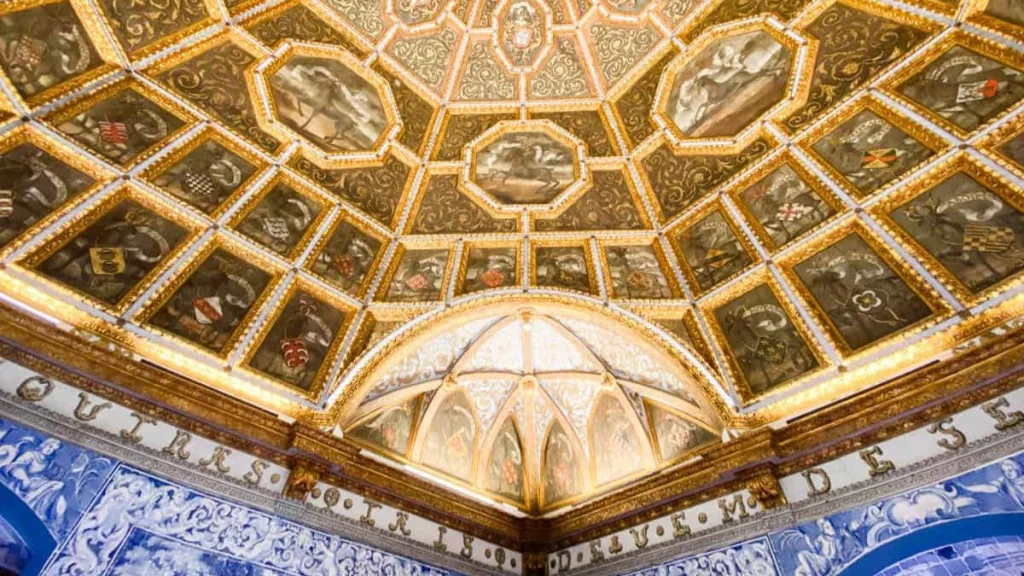
The Sala dos Brasões was completed under Manuel I, approximately 1515–1518. The ceiling is an octagonal wooden dome displaying 72 coats of arms of Portuguese noble families, arranged in strict hierarchical order with the royal arms at the centre. The carved and gilded woodwork is considered among the finest examples of Manueline decorative work in Portugal.
Eight of the 72 crests are displayed face-down. In 1515, several noble families were implicated in a conspiracy against Manuel I. As punishment, their coats of arms were reversed. They have remained face-down for more than five centuries.
The families whose crests were reversed have had more than five centuries to reflect on the consequences of conspiracies against Portuguese kings. The crests have never been corrected.
Arab Room and Palatine Chapel
The Arab Room (Sala dos Árabes) contains azulejo tilework from the 1400s — among the oldest ceramic tilework surviving in Portugal. At the centre of the room is a small fountain, typical of Moorish domestic architecture. The water supply for the fountain traces back to the original Moorish alcazar — the channel has been maintained and updated but the basic routing is unchanged.
The Palatine Chapel (Capela Palatina) is the oldest surviving part of the palace, built under King Dinis in the early 14th century on the foundations of the Moorish prayer space. The interior features Mudéjar decorative work — a combination of Christian architectural form with Islamic geometric ornament and arabesque stonework, typical of buildings constructed in the Iberian Peninsula during the transition from Moorish to Christian rule. The chapel is considered one of the best-preserved examples of Mudéjar latticework in Portugal.
Practical Information
Getting there: 10-minute walk from Sintra station along the Volta do Duche road, descending into the historic centre. The twin chimneys are visible from the road. No bus required.
Tickets: Purchase at the entrance — walk-up availability is reliable throughout the year. Unlike Pena Palace, no 30-minute timed-entry slot is required.
Visit timing: Busiest 11:00–14:00. If you visit between 15:00 and 18:00 on a weekday, you will have the Sala dos Cisnes largely to yourself.
Duration: 60–90 minutes for the full sequence of rooms following the numbered route.
Combination with other monuments: The National Palace is 700 metres from Quinta da Regaleira (12-minute walk) and in the town centre near several cafés and lunch options. Both can be visited in one day without using Bus 434.
For all transport options from Lisbon: How to Get from Lisbon to Sintra.
Is the National Palace Worth Visiting?
The National Palace of Sintra is the oldest surviving palace in Portugal. It contains rooms with documented dates from the 15th and 16th centuries, an intact medieval kitchen, the most politically layered interior of any monument in Sintra, and the only palace in Portugal where specific named events — a court gossip scandal, a noble conspiracy, a conquest planning council — are embedded in the decoration of the rooms where those events occurred.
The ticket costs EUR 13 — EUR 7 less than Pena Palace or Quinta da Regaleira. It requires no advance booking. It generates none of the Bus 434 queuing that defines a visit to Pena Palace in July and August. It is a 10-minute walk from the train station.
The most common thing I hear from visitors who skip this palace: “We didn’t know it was so different from Pena.”
It is not Pena Palace. Pena Palace is dramatic exterior colour and royal interiors photographed by four million visitors per year. The National Palace is six centuries of Portuguese court life in the building where it happened. For anyone interested in how power was organised, displayed, and occasionally challenged in medieval and early-modern Portugal, this is the more interesting monument.
Our Sintra Tours from Lisbon
Yellow Cab TT Tours has operated Sintra day tours from Lisbon since 2013, under RNAAT licence No. 119/2013.




Private Sintra Photo Panoramic 4x4 Tour (Land Rover)
FAQ
How much does the National Palace of Sintra cost?
Adult (18–64): EUR 13. Youth (6–17) and seniors (65+): EUR 10. Family (2 adults + 2 youth): EUR 35. Garden entrance is complimentary and included. Prices confirmed at parquesdesintra.pt, June 2026.
Do you need to book tickets in advance for the National Palace of Sintra?
No. Unlike Pena Palace, the National Palace of Sintra does not require a timed-entry booking. Tickets can be purchased at the entrance on the day. Walk-up availability is reliable throughout the year, including July and August.
How long should I spend at the National Palace of Sintra?
60 to 90 minutes for a complete visit following the numbered room sequence. If you want to spend time reading the detailed room descriptions on-site, allow 90 minutes. The palace is not large by European standards, but the level of historical detail in each room rewards slower visits.
Who built the National Palace of Sintra?
The palace was built over six centuries. A Moorish alcazar occupied the site from the 9th century. King Dinis built the first stone palace in the late 13th century. King João I (r. 1385–1433) commissioned the royal kitchens, the twin chimneys, the Swan Room, and the Magpie Room between approximately 1415 and 1430. King Manuel I (r. 1495–1521) added the Coat of Arms Room and Manueline decorative elements in the early 16th century.
Why are 8 coats of arms face-down in the National Palace?
In 1515, several noble families were implicated in a conspiracy against King Manuel I. As punishment, Manuel I ordered their coats of arms in the Sala dos Brasões reversed. The 8 crests have been displayed face-down since 1515 — more than five centuries — and have never been corrected.
What is the Sala dos Cisnes?
The Sala dos Cisnes (Swan Room) is the largest ceremonial hall in the National Palace of Sintra, built under King João I in the early 15th century. Its ceiling is painted with 27 swans wearing golden collars — a heraldic reference to the House of Lancaster, linked to João I’s marriage to Philippa of Lancaster (1360–1415). The room was used for formal court functions and diplomatic receptions.
What is the Sala das Pegas?
The Sala das Pegas (Magpie Room) is a chamber in the National Palace decorated under King João I with painted magpies, each holding a rose and the motto “Por bem” (For good reason). According to court records, João I ordered the ceiling painted after court gossip about his conduct — each magpie represents a court lady. The room contains approximately 136 magpies.
Is the National Palace of Sintra worth visiting?
Yes, particularly for visitors interested in Portuguese medieval history. The palace is the oldest in Portugal still standing in its original form, contains rooms decorated with documented historical events, and costs EUR 13 — EUR 7 less than Pena Palace. No advance booking is required and crowds are significantly lower than at Pena Palace or Quinta da Regaleira. It is a 10-minute walk from Sintra station.
How do I get from Sintra station to the National Palace?
Walk 10 minutes along the Volta do Duche road, descending from the station into the historic centre. The twin conical chimneys (33m) are visible from the road as you approach. No bus is required. The route is signposted.
What is the best time to visit the National Palace of Sintra?
Weekday afternoons (15:00–18:00) have the fewest visitors. Morning visits before 10:30 are also manageable. The busiest period is 11:00–14:00. Unlike Pena Palace, the National Palace does not have seasonal crowd peaks severe enough to affect entry — walk-up tickets are available year-round.

Written by Fábio Mendes
Founder & Director of Yellow Cab TT Tours. Guiding in Portugal for 20+ years.
Founded Yellow Cab TT Tours in 2013. 3,372 five-star reviews on Tripadvisor.
Founder & Director of Yellow Cab TT Tours. Guiding in Portugal for 20+ years.
Founded Yellow Cab TT Tours in 2013. 3,372 five-star reviews on Tripadvisor.