
Nazaré, Portugal: Big Waves, Atlantic History & Day Tours from Lisbon
Nazaré is a coastal town in the Leiria District of Portugal, 122 km north of Lisbon on the Atlantic coast. The municipality has 14,881 residents (2021 census) spread across 82.43 km². The town occupies two distinct zones: the beach district (Praia) at sea level and Sítio, a headland 110 metres above the ocean, connected to the beach by a funicular railway operational since 1889.
Nazaré operates on two seasonal identities. From June to September it is a working fishing village and beach destination on Portugal’s Silver Coast (Costa de Prata). From October to March, the underwater Nazaré Canyon – the largest submarine canyon in Europe, approximately 230 km long and up to 5,000 metres deep – transforms Praia do Norte into the principal venue for big wave surfing on the planet. The current Guinness World Record for the largest wave ever surfed was set here: 26.21 metres (86 feet), by Sebastian Steudtner on 29 October 2020.


A Brief History of Nazaré
The name Nazaré derives from the city of Nazareth in present-day Israel. According to documented tradition, a polychrome statue of the Virgin Mary was brought from Nazareth to the Iberian Peninsula by the Greek monk Cyriacus in the 5th century, eventually reaching the monastery of Cauliniana near Mérida. Following the Umayyad conquest of Hispania in 711 – the forces of the Muslim Caliphate won the Battle of Guadalete and the Visigoth king Roderic fled – the monk Frei Romano and Roderic reportedly escaped Cauliniana with the statue, settling at Monte São Bartolomeu near the present site of Nazaré. Frei Romano lived as a hermit there until his death and was buried on the cliff.
The event that established Nazaré as a pilgrimage site took place on 14 September 1182. Dom Fuas Roupinho, alcalde of Porto de Mós, was hunting on the Sítio promontory in heavy fog when his horse galloped toward the cliff edge at 110 metres above the Atlantic. According to the account, he prayed to the statue in the nearby grotto; the horse stopped at the brink. Dom Fuas Roupinho subsequently built the Ermida da Memória (Chapel of Memory) at the site, which still stands on the cliff edge today.
Pilgrimage to Nazaré grew through the 13th and 14th centuries. In 1377, King Fernando I of Portugal ordered the construction of the Sanctuary of Nossa Senhora da Nazaré at Sítio, formally establishing Nazaré as a royal pilgrimage site. The sanctuary was substantially rebuilt between 1680 and 1691 in the Baroque style it retains today.
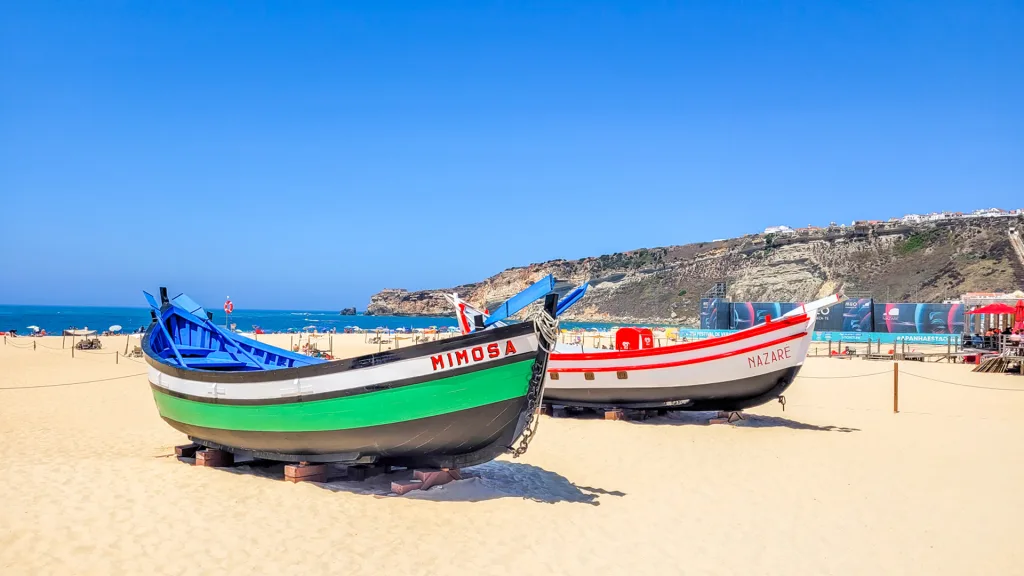
The fishing community below the headland, in the area now known as Praia, is documented from the 13th century. The distinctive narrow, high-bowed fishing boats of Nazaré are said to reflect Phoenician hull-design principles, though the documented history of the community begins only with medieval records.
The Sítio District - Nazaré's Clifftop Quarter
Sítio occupies the top of the Promontório do Sítio at 110 metres above the Atlantic. Three historic sites directly connected to the founding legend stand within 100 metres of each other: the enclosed grotto of Frei Romano, the Ermida da Memória on the cliff edge, and the Sanctuary of Nossa Senhora da Nazaré fifty metres inland. The Sítio headland also houses the Farol de Nazaré lighthouse, which functions as the primary public viewpoint for Praia do Norte during big wave events.
Sanctuary of Nossa Senhora da Nazaré (1377 / 1680–1691)
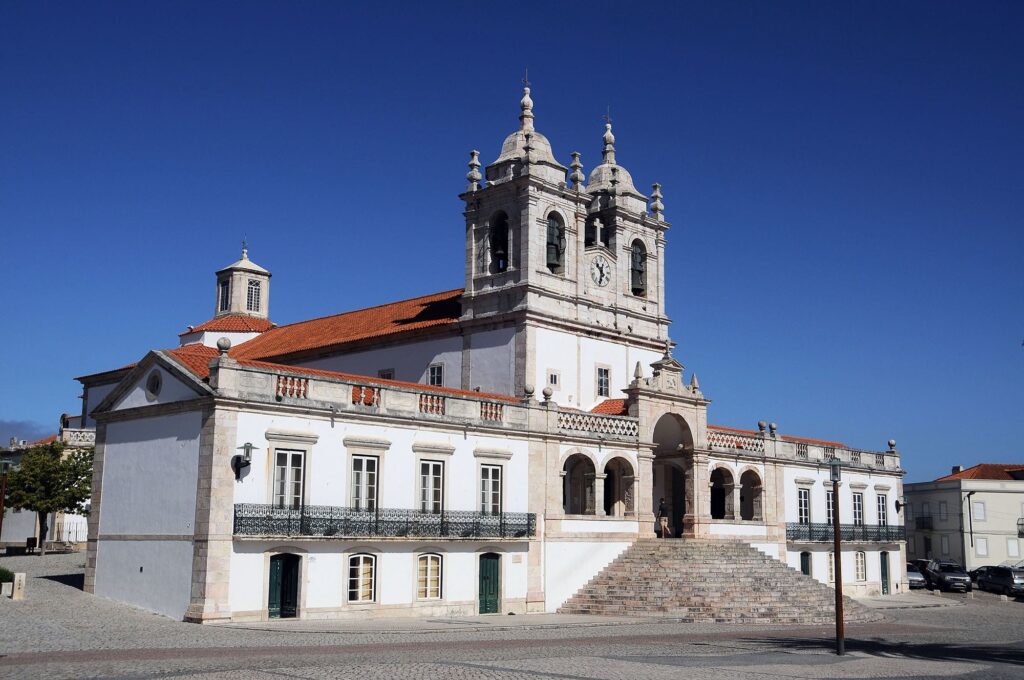
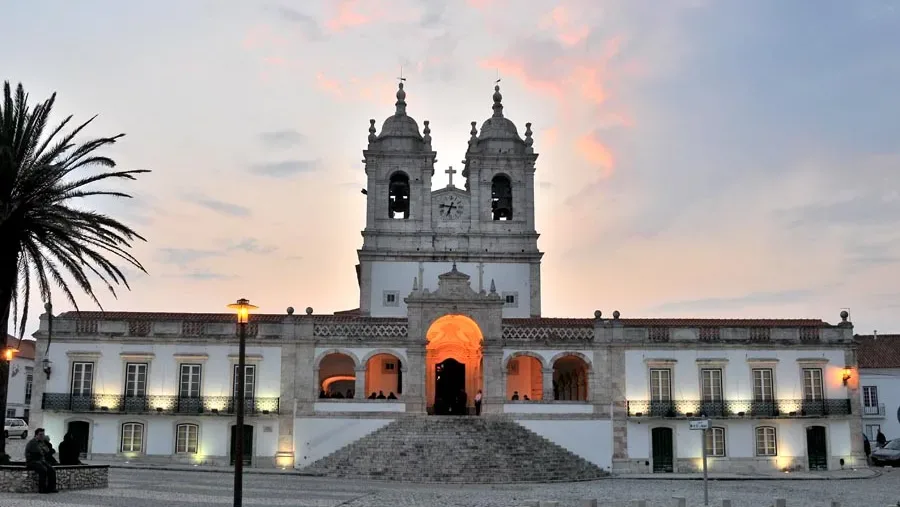
The sanctuary occupies the site of a church founded by King Fernando I in 1377 to house the statue of Our Lady of Nazaré and receive the growing number of pilgrims. The current Baroque structure dates from a major rebuilding between 1680 and 1691. The facade is flanked by two symmetrical bell towers and opens through a Baroque porch at the top of a semicircular staircase. The interior has a single nave with a gilded main altar featuring Solomonic columns. The upper walls of the transept are lined with early 18th-century azulejos painted by the Dutch master W. Van Kloet, depicting scenes from the Old Testament. The original polychrome statue of Nossa Senhora da Nazaré is kept in the main chapel.
Ermida da Memória - Chapel of Memory (1182)
The Ermida da Memória stands on the cliff edge, within a few metres of the point where Dom Fuas Roupinho’s horse stopped on 14 September 1182. Built by Dom Fuas Roupinho as an ex-voto following that event, it is one of the oldest surviving structures in Nazaré. The chapel occupies the site of the original grotto where the statue was venerated between the arrival of Frei Romano and the founding of the sanctuary in 1377. Its cliff-edge position offers an unobstructed view of Praia do Norte and the open Atlantic from 110 metres.

Praia do Norte and the Nazaré Canyon
Praia do Norte is a beach north of the Sítio headland, accessible on foot from Nazaré town centre (approximately 20 minutes) or by road. From October to March, it operates as an active surfing venue and spectator site during big wave events. Swimming is not possible at Praia do Norte; the beach has no infrastructure.
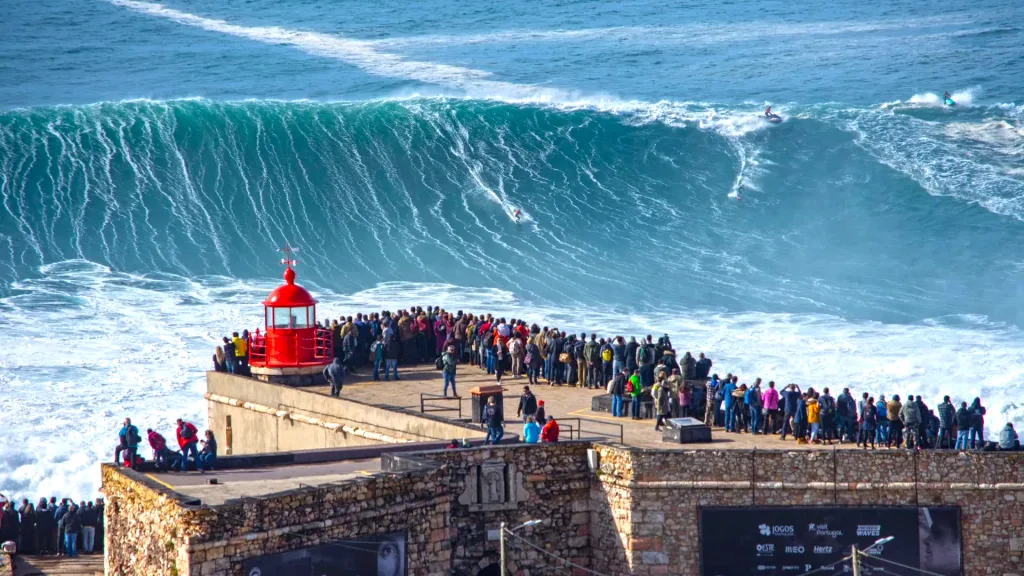
The waves are generated by the Nazaré Canyon – the largest submarine canyon in Europe. The canyon begins approximately 1 km offshore and extends approximately 230 km into the Atlantic to depths of around 5,000 metres (4,970 m measured at the deepest point, 211 km from the headland). Rather than dispersing Atlantic swell energy across the continental shelf, the V-shaped canyon channels and concentrates it toward the coast, amplifying wave height up to three times the wave height predicted for the Nazaré area.
Big wave records at Praia do Norte:
November 2011 | Garrett McNamara | USA | 23.8 m (78 ft) | First Guinness World Record for Nazaré;
8 November 2017 | Rodrigo Koxa | Brazil | 24.4 m (80 ft) | Guinness World Record;
29 October 2020 | Sebastian Steudtner | Germany | 26.21 m (86 ft) | Current verified Guinness World Record;
February 2024 | Sebastian Steudtner | Germany | 28.57 m (93.73 ft) | Submitted to Guinness – ratification pending.
The big wave season runs from October to March, with November, December, and January the most reliable months for significant swell. The annual TUDOR Nazaré Tow Surfing Challenge is held at Praia do Norte during the winter season, with dates determined by swell forecasts. The Farol de Nazaré lighthouse at the tip of the Sítio headland is the standard spectator viewpoint during swell events. During forecast big wave days, it is open to the public; arrival before 08:00 is advisable on days with swell in excess of 15 metres.
The Ascensor da Nazaré - Funicular Railway (1889)
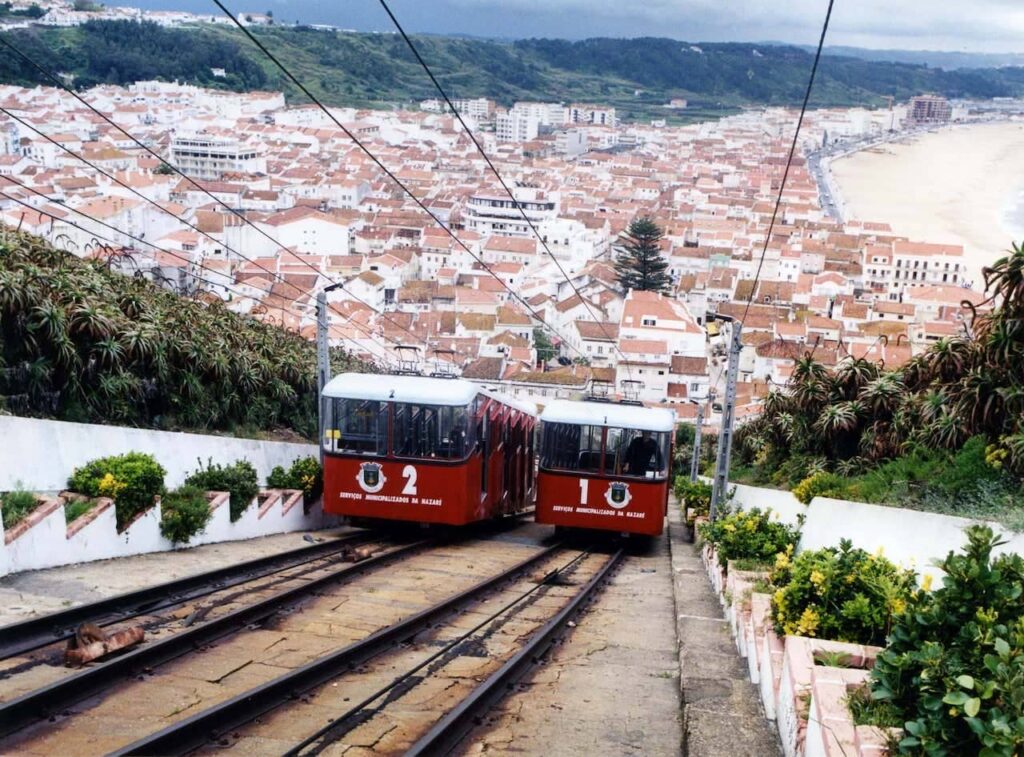
The Ascensor da Nazaré connects Praia (beach level) to Sítio (110 metres elevation) via a funicular railway 318 metres long with a 42% gradient. It opened in 1889 and was designed by Raoul Mesnier du Ponsard, a Portuguese engineer who trained under Gustave Eiffel and is also known for designing the Santa Justa Lift in Lisbon, completed in 1902. The funicular carries approximately one million passengers per year. The journey from Praia to Sítio takes approximately 4 minutes.
The ascensor runs daily throughout the year. Tickets are purchased at the lower station; the current fare and schedule should be confirmed at the Nazaré municipal website or on arrival.
Traditional Fishing Culture
Nazaré’s fishing heritage is expressed in two visible cultural forms: the seven-skirt tradition and the design of its fishing boats.
The seven-skirt tradition belongs to the women who historically waited on the beach for fishing boats to return. Women in traditional dress wear seven layers of coloured skirts – one for each day of the week, each colour of the rainbow, and each wave in a standard breaking set. The tradition is maintained as a cultural practice: women in full traditional dress, including a predominantly black headscarf and wooden clogs (tamancos), are a regular presence in the old town and Sítio. The association of Nazaré with this costume has made it one of the most photographed traditional dress codes in Portugal.
The Nazaré fishing boats — narrow hull, high curved prow, decorated with geometric patterns – are said to reflect a Phoenician hull-design tradition adapted over centuries for the Atlantic coast swell. The town’s fishing fleet is smaller than in past centuries but remains active.

When to Visit Nazaré
June–September: Main beach season. Praia de Nazaré is busy with Portuguese and European visitors. Average temperatures 22–28°C. No big wave events at Praia do Norte. The town centre and beach road become congested in July-August; arrival before 09:00 or after 17:00 reduces parking difficulty significantly.
October–March: Big wave season. November, December, and January have the most consistent swell. Water temperature 14–17°C; air temperatures 12–20°C. The town is much less crowded; accommodation is easier to find and prices are lower. The Praia do Norte lighthouse and the ascensor viewpoints are the main draws.
April–May: Transition period. Occasional swell events possible into April. Weather mild (16–22°C). Fewer crowds than summer. A practical time for combining Nazaré with Óbidos or Batalha, which are 12 km and 26 km away respectively.
Getting to Nazaré from Lisbon
By car: 122 km via the A8 motorway north toward Leiria, exiting at Caldas da Rainha, then west on the IC9 to Nazaré. Driving time approximately 1 hour 30 minutes in normal traffic conditions. Parking in the centre is available but limited; the main beach road (Avenida da República) reaches capacity by mid-morning in summer.
By bus: Rede Expressos operates daily services from Lisbon Sete Rios bus station to Nazaré. Journey time approximately 1 hour 50 minutes–2 hours. Verify current schedule and prices at rede-expressos.pt.
By private tour: Yellow Cab TT Tours operates private day tours from central Lisbon to Nazaré, typically combined with Óbidos, Batalha, or Sintra in the same itinerary.
Day Tours to Nazaré from Lisbon
Yellow Cab TT Tours has operated day tours from Lisbon to central Portugal since 2013, with a Tripadvisor rating of 5.0 across 3,364 reviews and a 2025 Travelers’ Choice Best of the Best award. All tours depart from central Lisbon in private air-conditioned vehicles.


What we don't miss in Nazaré
Sanctuary
Nazaré Waves
Sítio da Nazaré
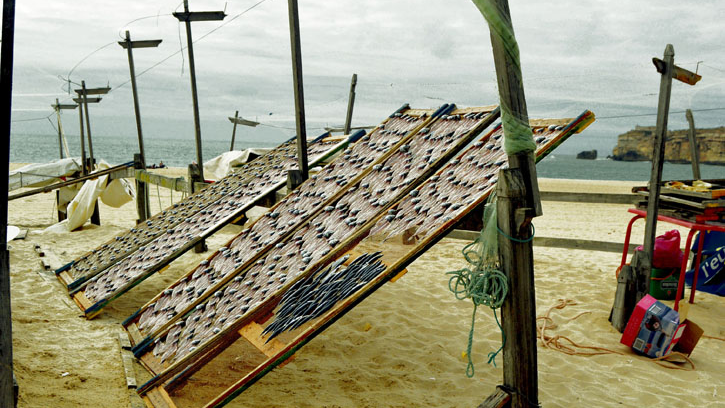
Dried Fish
FAQ
How far is Nazaré from Lisbon?
Nazaré is 122 km north of Lisbon via the A8 motorway. Driving time is approximately 1 hour 30 minutes. By bus from Lisbon Sete Rios station, journey time is approximately 2 hours. By private tour from Lisbon, the journey is direct with no transfers.
What is the Nazaré Canyon?
The Nazaré Canyon is the largest submarine canyon in Europe. It begins approximately 1 km offshore and extends approximately 230 km into the Atlantic to depths of around 5,000 metres. Rather than allowing Atlantic swell energy to disperse across the continental shelf, the canyon channels it toward the coast, amplifying incoming wave height up to three times the regional prediction.
What is the world record for the largest wave surfed at Nazaré?
The current verified Guinness World Record is 26.21 metres (86 feet), set by German surfer Sebastian Steudtner at Praia do Norte on 29 October 2020 during Hurricane Epsilon. Previous records were held by Rodrigo Koxa (24.4 m, November 2017) and Garrett McNamara (23.8 m, November 2011), who first put Nazaré on the surfing map. In February 2024, Steudtner rode an estimated 28.57 m (93.73 ft) wave at the same location; this claim is pending Guinness ratification.
When is the best time to see big waves in Nazaré?
The big wave season runs October–March. November, December, and January are the most consistent months. Wave events are swell-dependent and cannot be scheduled in advance. Local websites such as nazarewaves.com publish forecasts and alerts several days before major swell events. The Sítio headland lighthouse is the standard public viewpoint.
What is the Sítio district in Nazaré?
Sítio is the older of Nazaré’s two districts, on a clifftop 110 metres above the beach. It contains the Sanctuary of Nossa Senhora da Nazaré (founded 1377, rebuilt 1680–1691), the Ermida da Memória (1182), the grotto of Frei Romano, and the Farol de Nazaré lighthouse. Sítio is accessible by the Ascensor da Nazaré funicular (1889) or by road.
What is the Sanctuary of Nossa Senhora da Nazaré?
The Sanctuary of Nossa Senhora da Nazaré is a Baroque church in the Sítio district, founded by King Fernando I of Portugal in 1377 as a pilgrimage site. The current building dates from a major reconstruction between 1680 and 1691. Its interior features a single-nave Baroque layout, a gilded altar with Solomonic columns, and early 18th-century azulejos by Dutch painter W. Van Kloet.
What is the Ermida da Memória?
The Ermida da Memória (Chapel of Memory) is a small chapel on the edge of the Sítio cliff, built by Dom Fuas Roupinho in 1182 following his reported near-accident — his horse stopped at the cliff edge 110 metres above the Atlantic on 14 September 1182. It is one of the oldest surviving structures in Nazaré and occupies the site of the original grotto where the statue of Nossa Senhora da Nazaré was venerated before the sanctuary was built.
How do I get from the beach to Sítio?
The Ascensor da Nazaré funicular connects the beach district (Praia) to Sítio. It runs 318 metres at a 42% gradient and takes approximately 4 minutes. The ascensor has been in operation since 1889 and was designed by Raoul Mesnier du Ponsard, who also designed Lisbon’s Santa Justa Lift. There is also a road (Rua do Elevador) for vehicles.
Can I combine Nazaré with Óbidos in one day from Lisbon?
Yes. Óbidos, a medieval walled town, is 12 km south of Nazaré and approximately 89 km north of Lisbon. Yellow Cab TT Tours runs a combined Nazaré and Óbidos day tour from Lisbon. The itinerary covers approximately 280 km and allows 3–4 hours in Nazaré and 1–2 hours in Óbidos.
Is Praia de Nazaré safe for swimming?
Yes. Praia de Nazaré (the main central beach) is Blue Flag designated and has lifeguards during the summer season. Praia do Norte, the big wave beach north of the headland, is not suitable for swimming at any time of year due to the unpredictable Atlantic swell amplified by the canyon.