
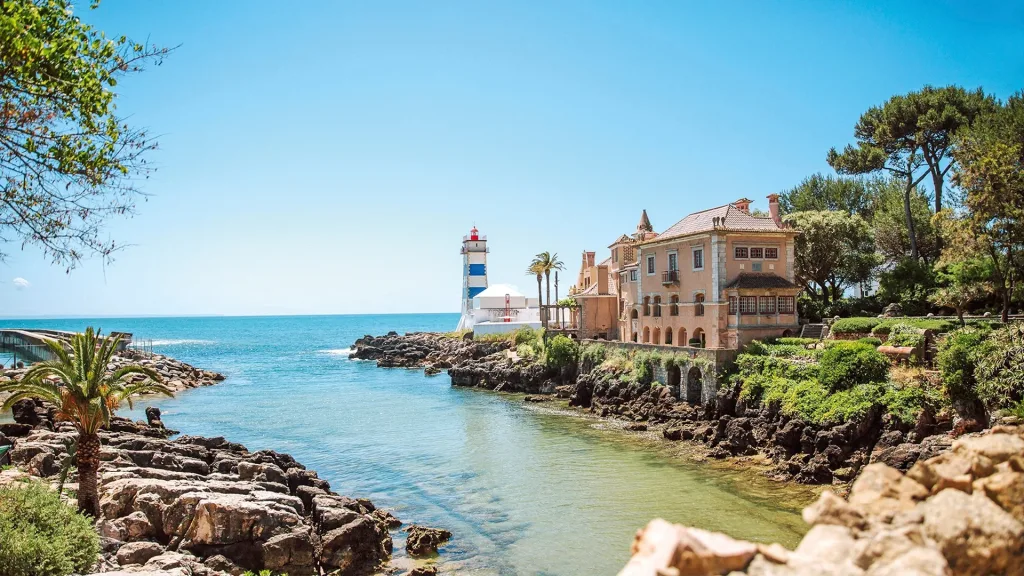

If you are based in Cascais, the geometry of Portugal changes considerably.
Sintra – which gets 4 million visitors per year and the majority of them arrive from Lisboa – is 15 kilometres from Cascais by road. I pick up clients in Cascais regularly, and I spend the 20-minute drive to Sintra watching them recalibrate their expectations about what is reachable in a single day.
The answer is: quite a lot. Fátima is 110 km away. Évora is 155 km. Nazaré e Óbidos together take a single long day with a reasonable schedule. Arrábida – where the water turns turquoise and the limestone drops 501 m straight into the Atlantic – is 85 km south across the Tagus. None of these require you to go through Lisbon first. The most common question I get from clients staying in Cascais is whether they need to route back through Lisbon to reach anything worth visiting. They don’t. Most travel guides are written from a Lisbon-centric perspective. This one is not.
This is what I recommend, in order of distance.
Table of Contents
Cascais as a Base – Better Than You Think
Lisbon is the obvious base for exploring western Portugal. But Cascais has underrated advantages.
It is 15 km closer to Sintra than Lisbon is. It is 14 km from Cabo da Roca – the westernmost point of continental Europe – which from Lisbon involves 40 km of driving or an awkward bus connection. Cascais itself has three beaches you can walk to in the morning before your car is even out of the parking garage. And it is quieter than Lisbon in the evenings, which matters on the fifth night of a trip.
The practical point: all the day trips below are accessible from Cascais. We offer pickup at your hotel there for any of our tours, with a €35 surcharge over our standard Lisbon pickup price. For every route below, I give you the approximate driving time from Cascais specifically.
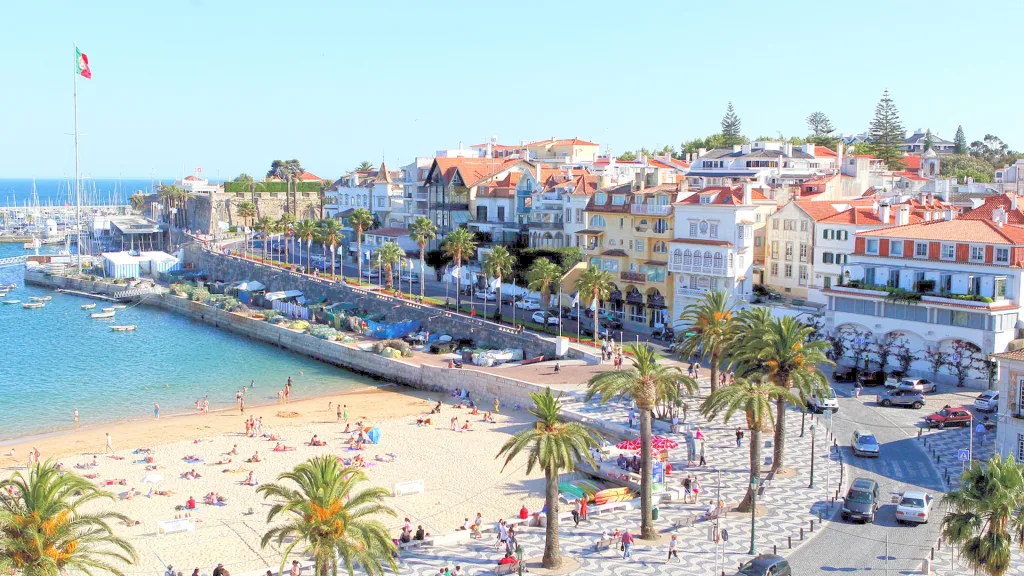
Day Trip 1 – Sintra, 15 km (the Most Obvious Choice, for Good Reason)
Getting from Cascais to Sintra
By car or private tour: 15 km, approximately 20 minutes via the EN9-1 road through the Sintra-Cascais Natural Park.
De autocarro: Buses 1620, 1621, 1623, and 1624 run directly from Cascais station (Terminal Rodoviário de Cascais) to Sintra without going through Lisbon. Journey time: approximately 45 minutes. Departures are not as frequent as the Lisbon train connection – usually one bus per route per hour. Check the schedule on Google before relying on this option.
Why the private tour option wins: Bus 1624 (Carris Metropolitana) runs the full Cascais → Cabo da Roca → Sintra (Portela terminal) corridor — so combining both stops by bus is possible. The journey takes approximately 74 minutes with 76 stops along the coast. Buses 1620, 1621, and 1623 reach Sintra in about 45 minutes but bypass Cabo da Roca entirely. Our Sintra + Cascais Private Tour covers the same Cascais → Cabo da Roca → Sintra direction in a dedicated vehicle: hotel pickup, no fixed timetable, and options to add Guincho Beach or Peninha viewpoint that no bus route serves. Pickup from Cascais: +€35 over standard Lisbon price.
What to See and How Long You Need
Minimum: 4–5 hours for Sintra alone. A full day if adding Cabo da Roca and the coast. Sintra has been a UNESCO World Heritage Cultural Landscape since 1995. The main sites:
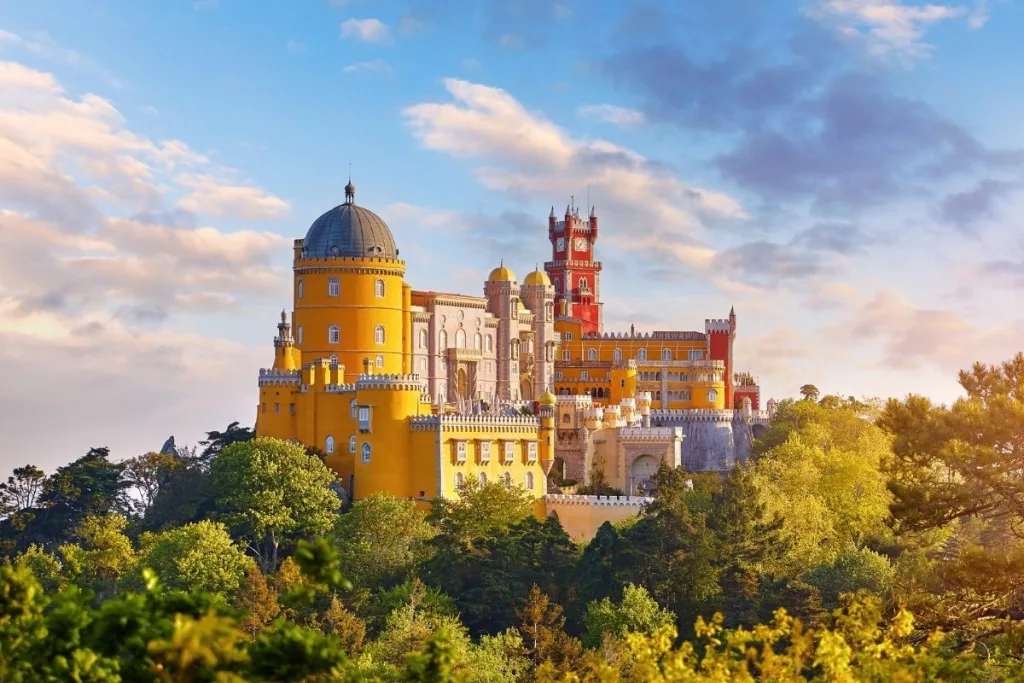
Pena Palace: built 1842–1854 by King Ferdinand II at 529 m elevation. Four architectural styles in one building (Neo-Gothic, Neo-Manueline, Neo-Islamic, Neo-Renaissance). In July and August, timed-entry tickets sell out 3–4 weeks ahead – book via parquesdesintra.pt before your visit.
Quinta da Regaleira: completed 1910. Features the Initiation Well (Poço Iniciático), an inverted tower descending 27 metres underground. Classified as a National Monument in 1997. Current admission at regaleira.pt.
Moorish Castle (Castelo dos Mouros): built 8th–9th century at 412 m, walls extend 450 m along the ridge. Current admission at parquesdesintra.pt.
Sintra National Palace: the best-preserved medieval royal palace on the Iberian Peninsula. Twin chimneys 33 m tall, built 14th century.
Tip from 20 years of guiding: plan your palace before you leave Cascais. Every season I see groups arrive in Sintra at 10:30, discover that Pena Palace tickets are sold out, and spend 45 minutes rearranging their day. Book online the week before – it saves the itinerary and, usually, the friendship.
Most clients who contact us about Sintra have researched Pena Palace, Quinta da Regaleira, and Cabo da Roca. The first two are correct priorities. Cabo da Roca is on every travel list and needs no promotion from me. What fewer have considered: the Peninha viewpoint at 486 m, where the Serra da Sintra ridge meets the Atlantic in a panorama that consistently surprises people who thought they already knew what the area looked like; the cliff village of Azenhas do Mar built directly into the rock face above the water; the coastal backroads between Guincho and Adraga that — based on 20 years of client feedback — appear in photographs significantly more often than in pre-trip itineraries. These require a car, which is, I will be transparent, why I mention them here.
Sintra + Cascais Private Tour – from €285 per vehicle, pickup from Cascais +€35.
Sintra Panoramic 4×4 Tour – full day (8 hours) in a Land Rover Defender. Itinerary: Estoril Coast → Cascais bay → Guincho Beach → Peninha viewpoint (Sintra-Cascais Natural Park) → Cabo da Roca → Adraga Beach → Azenhas do Mar. From €330 per vehicle (max 6 passengers). Departure: 08:30–09:00. Pickup from Cascais: +€35.
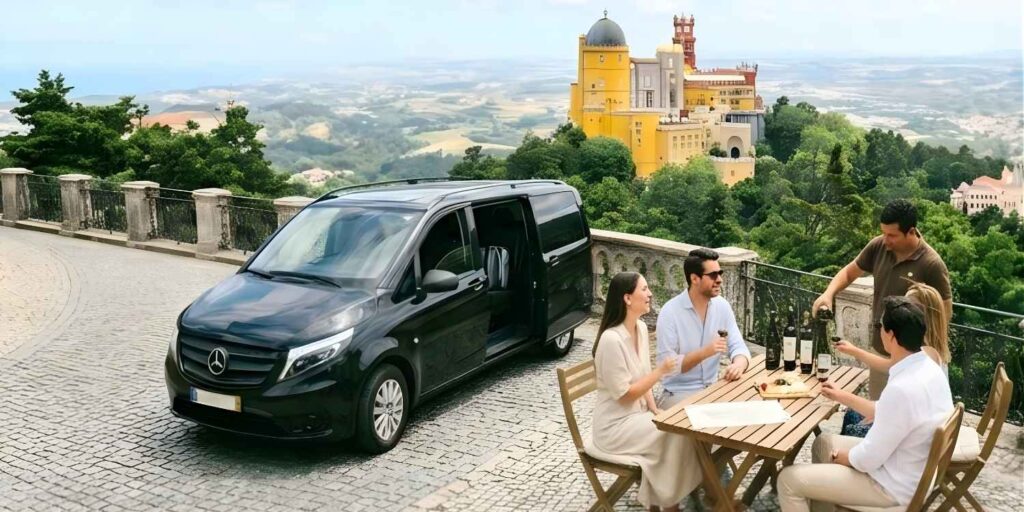
Sintra Wine Experience – private tour combining the Sintra region with local wine tasting. Three options: wine shop tasting + pastry (+€35/person), wine cellar + tapas + pastry (+€55/person), or cellar + port wine + tapas + pastry (+€85/person). Vehicle from €285 (1–3 passengers). Pickup from Cascais: +€35.
Day Trip 2 – Mafra + Ericeira, 50 km (Palace and Europe’s Only Surf Reserve)
Getting from Cascais to Mafra and Ericeira
By car: Mafra is 50 km from Cascais via the A5 and A8 motorways, approximately 45 minutes. Ericeira is 55 km, approximately 50 minutes. The two towns are 10 km apart and work well as a single day.
By public transport: no practical direct connection from Cascais. Reaching Mafra or Ericeira by public transport requires transit through Lisbon (train + bus), adding 2+ hours each way. A car or private arrangement is strongly recommended.
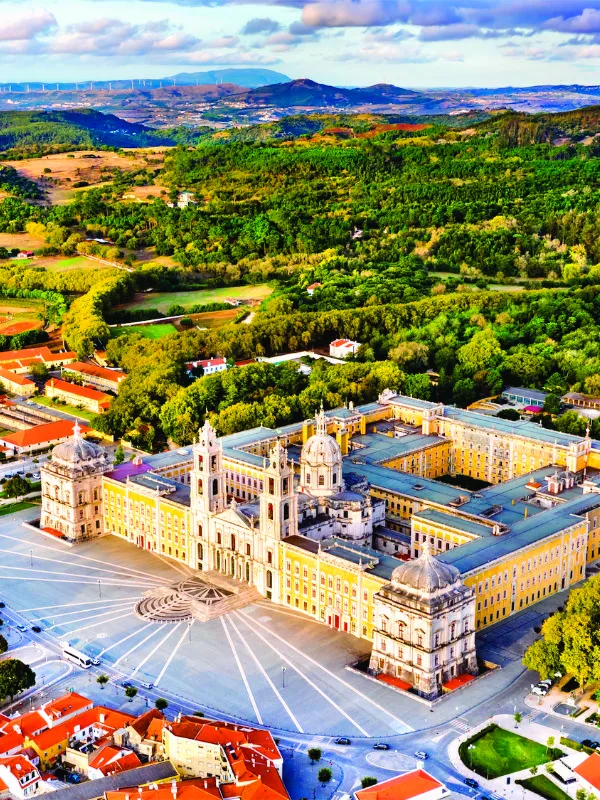
Mafra National Palace
Mafra National Palace is one of the largest Baroque complexes in the world. Construction began in 1717 on the orders of King João V – a vow made when his wife became pregnant with their first child – and took 13 years to complete, employing up to 50,000 workers at peak construction. The complex contains:
The Royal Palace: 1,200+ rooms across 40,000 m² of floor space.
The Basilica: nave 58 m long, twin bell towers each 68 m tall, carillon of 92 bells – one of the largest carillons in the world.
The Mafra Library: 36,000 volumes from the 17th and 18th century, housed in Baroque shelving carved from Brazilian jacaranda wood. Current admission at museusemonumentos.pt. Mafra Palace was inscribed as a UNESCO World Heritage Site in 2019, as part of “Royal Building of Mafra – Palace, Basilica, Convent, Cerco Garden and Hunting Park (Tapada).”
José Saramago’s novel *Baltasar and Blimunda* (1982) is set during the construction of Mafra and is among the most-read Portuguese novels internationally. Visiting after reading it is a different experience entirely. Visiting without reading it first is also perfectly valid – the palace does not appear to hold this against anyone.
Visiting time: 2–2.5 hours.
Ericeira
Ericeira is 10 km from Mafra and 55 km from Cascais. In 2011, it became the only World Surfing Reserve in Europe – one of seven globally, certified by Save The Waves Coalition for the quality and consistency of its surf breaks: Ribeira d’Ilhas, Reef, Coxos, and Pedra Branca. The Ribeira d’Ilhas break hosts the MEO Surf World Championship regularly. Ask any three Portuguese surfers which break is better – Coxos or Ribeira d’Ilhas – and expect at least four opinions.
The town (population approximately 14,000) has retained its whitewashed fishing village character alongside a restaurant scene increasingly recognized internationally. The fish market at the harbour opens daily from 07:00.
Combined day from Cascais: depart 08:30–09:00 → Mafra Palace (2.5 hours) → Ericeira (lunch + cliffside walk, 2.5 hours) → return to Cascais by 17:00–17:30. We do not currently offer a standard private tour to Mafra and Ericeira. Contacte-nos if you want a custom private itinerary covering both stops.
Day Trip 3 – Arrábida Natural Park, 85 km (the Coast South of the Tagus)
Getting from Cascais to Arrábida
By car or private tour: 85 km from Cascais via the A5 motorway, Ponte 25 de Abril bridge over the Tagus, and the A2 toward Setúbal. Driving time: approximately 1 hour 20 minutes without traffic. The southbound toll on Ponte 25 de Abril is €1.85 per car. Traffic from Cascais through Lisbon during morning rush hour can add 20–30 minutes – plan an 08:00–08:30 departure.
By public transport: not practical for Arrábida’s beaches from Cascais. No direct connection exists.
Summer access note: from June 7 to September 15 (the “Arrábida O2” programme, approved annually by the Setúbal municipality), private cars are prohibited on the coastal road sections leading to Portinho da Arrábida between 07:00 and 19:00 daily. Shuttle buses from Setúbal city operate during this period. Licensed tour operators, taxis, and TVDE vehicles are permitted on the restricted road with advance municipal authorisation. We apply for access as a licensed operator and can reach the park’s beaches during restricted hours – confirm availability when booking between June and September.
What to See in Arrábida
Serra da Arrábida is a limestone mountain range running 35 km along the coast south of Lisbon, reaching 501 m at its highest point (Nossa Senhora do Cabo). Arrábida Natural Park was established in 1976 and covers 10,800 hectares, including a marine protected area – one of only two marine reserves in mainland Portugal. Key sites:
Portinho da Arrábida: the main beach. Sheltered by limestone cliffs, water temperature reaches 22–24°C in July–August. Water clarity is exceptional by Atlantic standards due to the absence of river runoff from the Sado Estuary.
Convento da Arrábida: Franciscan convent built 1542, integrated into the cliff face at 250 m elevation. Still inhabited by Franciscan friars. Accessible only by guided visit through the Natural Park authority.
Palmela Castle: Moorish fortress rebuilt by the Order of Santiago in the 12th century, at 233 m above Palmela village. Views across the Sado Estuary to Setúbal.
Azeitão wine area and Moscatel de Setúbal: the Setúbal peninsula produces Moscatel de Setúbal, a fortified white wine made from Muscat grapes, with documented production since the 16th century. The José Maria da Fonseca winery (founded 1834, the oldest continuously operating wine company in Portugal) offers cellar tours and tastings in Azeitão.
Arrábida Wine Tour – Palmela Castle, Azeitão vineyards, wine tasting. From €310 per vehicle. Pickup from Cascais: +€35.
Arrábida + Lisbon Tour – Arrábida in the morning, Alfama + Belém in the afternoon. From €330 per vehicle. Pickup from Cascais: +€35.

Day Trip 4 – Fátima, 110 km (Worth Every Kilometre)
Getting from Cascais to Fátima
By car or private tour: 110 km, approximately 1 hour 15 minutes via the A8 and A1 motorways.
By public transport: no practical direct connection from Cascais. You would need to take the train to Lisbon (40 minutes), then a bus or train from Lisbon to Fátima (2+ hours). Total: 3+ hours each way. Not a realistic day trip independently. This is where a private tour from Cascais makes the most straightforward argument: door-to-door, 75 minutes of driving, arrive by 10:00, back by 19:00.
What to See in Fátima
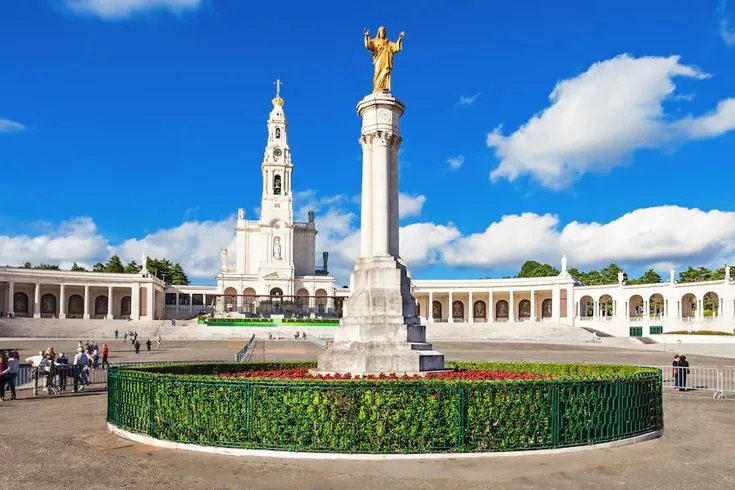
Fátima is one of the most visited Catholic pilgrimage sites in the world, receiving approximately 6 million visitors per year. The apparitions of the Virgin Mary occurred on 13 May 1917 and on five subsequent dates – the 13th of each month through October. On 13 October 1917, an estimated 70,000 people gathered and reported witnessing the “Miracle of the Sun.” The Sanctuary of Fátima occupies a vast esplanade larger than St. Peter’s Square in Rome:
Chapel of the Apparitions (Capelinha das Aparições): marks the exact site of the apparitions. Built 1919, rebuilt 1921 after an explosion, restored 1927. The spiritual centre of the sanctuary.
Basilica of Our Lady of the Rosary: construction began 1928, consecrated 1953. Tower 65 m tall. The tombs of the three seers (Lúcia, Francisco, Jacinta) are inside.
Basilica of the Holy Trinity: inaugurated 2007. Capacity: 8,633 people – one of the largest churches in the world by seating capacity. Designed by Greek architect Alexandros Tombazis.
Practical note: Fátima is not exclusively for religious visitors. The historical events of 1917 and their documented impact – including papal visits (John Paul II visited three times: 1982, 1991, 2000) and the diplomatic significance of neutral Portugal during WWII – make this a historically compelling destination for secular travelers as well. I have guided both religious pilgrims and secular historians through the same sanctuary. The questions are different. The quiet at the end is the same.
Fátima Private Tour – pickup from Cascais +€35.
Fátima + Sintra + Cascais Tour – Fátima, Sintra palaces, and Cascais coast in one day, pickup from Cascais +€35.
Fátima + Lisbon Tour – Fátima in the morning, Alfama and Belém in the afternoon, pickup from Cascais +€35.
Passeio religioso a Fátima – deeper focus on the sanctuary, the three seers, and pilgrimage history, pickup from Cascais +€35.
Fátima + Coimbra Tour – combine Fátima with Tomar (legacy of the Templar Knights), pickup from Cascais +€35.
Fátima + Tomar Tour – combine Fátima with Universidade de Coimbra (founded 1290, UNESCO), pickup from Cascais +€35.
Visita em grupo a Fátima – fixed departure from Lisbon, max 8 passengers (ask about Cascais pickup availability).
Day Trip 5 – Nazaré + Óbidos, 95 km (Two Destinations in One Day)
Getting There from Cascais
By car or private tour: Cascais to Óbidos: 80 km, approximately 55 minutes via A8. Cascais to Nazaré: 95 km, approximately 1 hour 10 minutes via A8. The two are 15 km apart — easily combined in one day.
By public transport: complicated from Cascais. Train to Lisbon (40 minutes), then bus to Óbidos or Nazaré from Lisbon. Total transit: 2.5–3 hours each way. Not recommended for a day trip.
Nazaré
Nazaré is a fishing town divided into two distinct levels:
Praia (the beachfront) and Sítio (the clifftop village at 110 m elevation), connected by a funicular built in 1889.
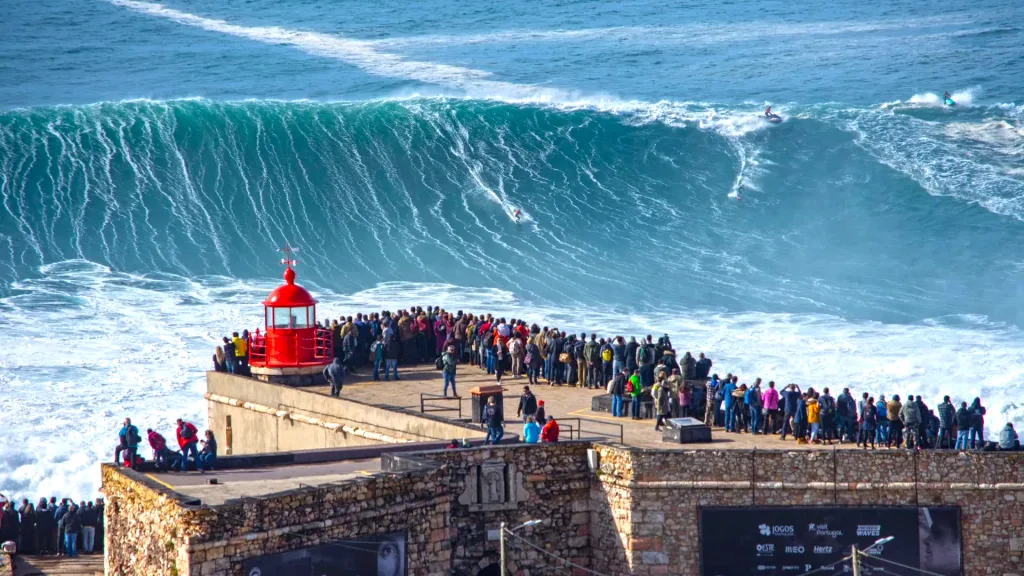
The beach at Praia do Norte, north of the town, is where big-wave surfer Garrett McNamara broke the world record for the largest wave surfed in 2011 (an estimated 23.77 metres), and where Rodrigo Koxa surfed a 24.38-metre wave in 2017 – the current official record as certified by Guinness World Records. The waves are generated by the Nazaré Canyon, an underwater geological formation extending 5,000 m below sea level and 230 km in length – the longest submarine canyon in Europe.
The town’s historic fishing culture (women in traditional seven-petticoat dress, black-salted bacalhau drying on wooden racks) remains visible, though primarily in the morning market and the Sítio neighbourhood.
Time needed: 2.5–3 hours, including the funicular and a walk along the cliffs.
Óbidos
Óbidos is a medieval walled town with 2.8 km of intact 12th-century walls walkable in their entirety. The castle at the centre was converted into a palace by King Dinis I in the 13th century and gifted by King João II to his wife Queen Leonor in 1484 – establishing the tradition of Portuguese queens owning Óbidos, which continued until 1834. The town is best known for:
Ginjinha d’Óbidos: sour cherry liqueur served in edible chocolate cups. Sold from small shops on the main street (Rua Direita), approximately €2–4 per cup. One is sufficient. Most people have two. Nobody admits to three.
Óbidos Medieval Market: held annually in July; one of the largest medieval recreation events in Portugal.
Livraria de Santiago: a bookshop inside a 12th-century church, consistently listed among the most beautiful bookshops in the world.
Time needed: 1.5–2 hours is sufficient to walk the walls and the main street.
Combined day: depart Cascais 08:30 → Óbidos (1.5–2 hours) → Nazaré (2.5–3 hours, including lunch) → return to Cascais by 17:00–17:30.
Nazaré + Óbidos Private Tour – pickup from Cascais +€35.
Nazaré + Óbidos + Lisbon Tour – add a Lisbon stop to the day, pickup from Cascais +€35.
Nazaré + Óbidos + Sintra Tour – combine with Sintra for a full cultural day, pickup from Cascais +€35.
Day Trip 6 – Évora, 155 km (the Alentejo in a Full Day)
Getting There from Cascais
By car or private tour: 155 km, approximately 1 hour 50 minutes via A2 and A6 motorways.
By public transport: no practical connection from Cascais. Lisbon to Évora by bus takes approximately 1.5 hours from Sete Rios terminal. From Cascais you add 40–50 minutes of transit to Lisbon first. Total each way: 2.5+ hours. Doable but tiring for a day trip. Évora is a full-day commitment from Cascais. Depart by 08:30 for a 10:00–10:30 arrival, and plan for a 17:30–18:00 return. The route is entirely on motorway – A2 south from Lisbon, then A6 east toward Évora.
What to See in Évora
Évora’s historic city centre has been a UNESCO World Heritage Site since 1986. With 57,000 residents in the municipality and a well-preserved Roman-to-Baroque urban fabric, it is the most intact historic city in Portugal after Lisbon.
Roman Temple of Évora: built 1st–2nd century AD, likely dedicated to the imperial cult of Emperor Augustus. Fourteen Corinthian columns remain standing – one of the best-preserved Roman temple ruins on the Iberian Peninsula.
Chapel of Bones (Igreja de São Francisco): built 16th century by Franciscan monks using the bones of approximately 5,000 people exhumed from Évora’s cemeteries. The inscription at the entrance reads: “Nós ossos que aqui estamos, pelos vossos esperamos” – “We bones that are here, for yours we wait.” The Franciscans knew what they were doing.
Évora Cathedral (Sé de Évora): construction began 1186. At 78 m long, it is the largest Romanesque cathedral in Portugal. The cloister dates to the 14th century.
Giraldo Square (Praça do Giraldo): the historic central square, named after Geraldo Sem-Pavor (“Gerald the Fearless”) who captured Évora from the Moors in 1165. Surrounded by 16th-century arcades designed by Francisco de Arruda.
Wine note: the Alentejo region produces 47% of Portugal’s bottled wine exports and is home to over 260 producers. A lunch in Évora with a regional Alentejo red (Aragonês, Alicante Bouschet, or Trincadeira grapes) is, in my experience, the most reliable food-and-wine pairing in Portugal. This is not a modest claim – Portugal has good food-wine pairings everywhere. Évora has the best ones.
Time needed: 5–6 hours to cover the main sites comfortably.
Évora Private Tour – pickup from Cascais +€35.
Évora + Lisbon Tour – Évora in the morning, Lisbon Alfama and Belém in the afternoon, pickup from Cascais +€35.
Évora + Reguengos Tour – Évora with a wine estate visit in the Alentejo, pickup from Cascais +€35.
Évora + Setúbal Tour – Évora and the Setúbal peninsula combined, pickup from Cascais +€35.

Day Trip 7 – Lisbon, 33 km (Use the Train)
Lisbon is 33 km from Cascais. The Linha de Cascais train covers this in 40 minutes for €2.55. If you are staying in Cascais and want to see Lisbon independently, the train is the correct answer. I am a private tour operator saying this – which should tell you how good the train is. The case for a private tour from Cascais to Lisbon is narrower but real: if you want to cover Alfama, Belém, the Jerónimos Monastery (founded 1501), the Tower of Belém (1514), and the miradouros in a single structured day without navigating public transport between neighborhoods, our city tour makes sense. Your guide picks you up in Cascais and returns you there in the evening.
Lisbon Private City Tour – pickup from Cascais +€35.

How We Run Day Trips from Cascais
We are based in Lisbon, but we operate pickups throughout the Lisbon region. All tours listed above are available with pickup at your Cascais hotel or apartment. Surcharge: €35 per vehicle, confirmed at time of reservation.
Summary of tours available from Cascais:
Sintra + Cascais Tour | Sintra · Cabo da Roca · Cascais | Private · from €285/vehicle.
Sintra Panoramic 4×4 Tour | Sintra · Guincho · Cabo da Roca · Azenhas do Mar | Private · €330–€490/vehicle · max 6 pax.
Sintra Wine Experience | Sintra + wine cellar tasting | Private · from €285/vehicle.
Arrábida Wine Tour | Palmela · Azeitão · wine tasting | Private · from €310/vehicle.
Arrábida + Lisbon Tour | Arrábida · Alfama · Belém | Private · from €330/vehicle.
Fátima Private Tour | Fátima Sanctuary | Private.
Fátima + Sintra + Cascais | Fátima · Sintra · Cascais | Private.
Fátima + Lisbon Tour | Fátima · Alfama · Belém | Private.
Passeio religioso a Fátima | Fátima (pilgrimage focus) | Private.
Fátima + Coimbra Tour | Fátima · Coimbra | Private.
Visita em grupo a Fátima | Fátima Sanctuary | Group · max 8 pax.
Nazaré + Óbidos Tour | Nazaré · Óbidos | Private.
Nazaré + Óbidos + Lisbon | Nazaré · Óbidos · Lisbon | Private.
Nazaré + Óbidos + Sintra | Nazaré · Óbidos · Sintra | Private.
Évora Private Tour | Évora UNESCO city | Private.
Évora + Lisbon Tour | Évora · Alfama · Belém | Private.
Évora + Reguengos Tour | Évora · Alentejo wine estate | Private.
Évora + Setúbal Tour | Évora · Setúbal peninsula | Private.
Lisbon City Tour | Alfama · Belém · Miradouros | Private.
All private tours: dedicated vehicle, licensed driver-guide, English / Spanish / French / Portuguese, max 8 passengers.
Private Tour or Group Tour – What Is the Difference?
Yellow Cab TT Tours runs both formats. Here is how they compare.
Private tour: you travel with your own group in a vehicle exclusively for you. Hotel pickup in central Lisbon or Cascais (+€35). The itinerary is adjustable on the day – if you want more time at one palace and want to skip another stop, that is your call. Maximum 8 passengers. Private tours start from €285 per vehicle.
Small-group tour: fixed itinerary, fixed departure time, designated meeting point in Lisbon. Maximum 8 passengers, guided in English. Prices from €69 per person.
The maths worth doing: a group of four on the small-group tour pays €276 total (4 × €69). A private tour for four costs €340 – €64 more for the entire group, or €16 per person. For that difference you get hotel pickup, a vehicle to yourselves, and a flexible schedule.
The comparison that matters more is against large-group bus tours, which typically carry 20 to 40 passengers and run to fixed times regardless of what is happening at each site. Our small-group format – maximum 8 people – was a deliberate decision. A guide speaking to 8 people can answer questions and adjust pace. A guide with a microphone and 40 people cannot.
One observation that does not appear in tour brochures: on a group tour, the itinerary moves at the pace of the slowest member of the group. On a private tour, it moves at yours.
For solo travellers and couples, the group tour remains the efficient choice – and for many, meeting fellow travellers is part of the value. For families, groups of three or more, or anyone with a child who needs a lunch break at a specific hour, the per-person premium for private has a way of becoming invisible by 14:00.
Perguntas frequentes
What are the best day trips from Cascais?
The best day trips from Cascais, in order of distance: Sintra (15 km, 20 min), Mafra + Ericeira (50 km, 45 min), Arrábida Natural Park (85 km, 80 min), Fátima (110 km, 75 min), Nazaré and Óbidos (95 km, 70 min, combinable in one day), Évora (155 km, 110 min), and Lisbon (33 km, 40 min by train).
Is there a direct bus from Cascais to Sintra?
Yes. Buses 1620, 1621, 1623, and 1624 (Carris Metropolitana) run directly from Cascais station (Terminal Rodoviário de Cascais) to Sintra without going through Lisbon. Buses 1620, 1621, and 1623 take approximately 45 minutes. Bus 1624 takes a longer coastal route – Cascais → Cabo da Roca → Sintra (Portela terminal) – in approximately 74 minutes, covering both stops in one trip. Frequency: roughly one departure per route per hour.
Can I do Fátima as a day trip from Cascais?
Yes, by car or private tour. The drive is approximately 110 km via the A8 motorway, taking around 1 hour 15 minutes. By public transport it requires transit through Lisbon and takes 2.5–3 hours each way – possible but tiring.
How far is Sintra from Cascais?
15 kilometres by road. Driving time: approximately 20 minutes via the EN9-1 road through the Sintra-Cascais Natural Park. Direct buses (1620, 1621, 1623, 1624) from Cascais station take approximately 45 minutes.
Do you offer pickup from Cascais hotels?
Yes. All our tours are available with pickup from Cascais. A surcharge of €35 per vehicle applies. Contact us when booking to confirm your hotel address.
How far is Arrábida from Cascais?
Approximately 85 km via the A5 motorway and Ponte 25 de Abril bridge, around 1 hour 20 minutes without traffic. From June 7 to September 15 (the “Arrábida O2” programme), private cars are prohibited on the coastal road sections leading to Portinho da Arrábida between 07:00 and 19:00. Shuttle buses from Setúbal city operate during this period. Licensed tour operators and TVDE vehicles are permitted with municipal authorisation – confirm with us before booking a summer visit. We offer the Arrábida Wine Tour and the Arrábida + Lisbon Tour with Cascais pickup (+€35).
Can I visit Mafra and Ericeira from Cascais in one day?
Yes. Mafra is 50 km from Cascais (45 min via A5+A8), Ericeira is 55 km (50 min). The two are 10 km apart. A realistic day: depart Cascais 08:30–09:00, visit Mafra Palace (2.5 hours), lunch and a walk in Ericeira (2.5 hours), return by 17:00–17:30. No direct public transport from Cascais – a car is required.
Can I do Nazaré and Óbidos in the same day from Cascais?
Yes. Óbidos is 80 km from Cascais (55 minutes); Nazaré is 95 km (70 minutes). The two towns are 15 km apart. A typical day runs: Cascais 08:30 → Óbidos (1.5–2 hours) → Nazaré (2.5–3 hours including lunch) → Cascais by 17:00–17:30.
How far is Évora from Cascais?
Approximately 155 km by road, via the A2 and A6 motorways. Driving time: approximately 1 hour 50 minutes without traffic. This makes Évora a full-day trip – recommended departure from Cascais no later than 08:00.
Is Cascais a good base for exploring Portugal?
Yes – more than most visitors expect. Cascais is 15 km closer to Sintra than Lisbon is, 14 km from Cabo da Roca, and 50 km from Mafra Palace (UNESCO 2019). The Linha de Cascais train reaches Lisbon in 40 minutes. Most day trips to central Portugal are 10–20 minutes shorter from Cascais than from Lisbon.
Planning a day trip from Cascais? We pick up from your hotel in Cascais. All tours available with Cascais pickup (+€35 per vehicle). → WhatsApp us: +351 965 856 169 → Or use the contact form.

Founder & Director of Yellow Cab TT Tours. Guiding in Portugal for 20+ years.
Founded Yellow Cab TT Tours in 2013. 3,372 five-star reviews on Tripadvisor.