


The Convent of Christ in Tomar is, in my experience, the most consistently underestimated monument in Portugal. That is a high bar to clear in a country where nearly every town has a castle, a dramatic back-story, and someone to tell you both. Tomar is 136 km from Lisbon. Clients arrive expecting a castle and a famous window. What they find is a complex built across five centuries — eight cloisters, a 12th-century Templar rotunda intact since 1190, and a carved stone window that architect Diogo de Arruda spent three years completing, a window that has no obvious equivalent in Europe. None of this fits in two hours. Almost every group I guide asks, somewhere around 14:00, whether there is any way to stay longer. I always plan for that.
I have been running this circuit since founding Yellow Cab TT Tours in 2013. This guide covers what the Convent actually contains, how to sequence the visit, what to prioritise if time is short, and what the rest of Tomar offers beyond the hilltop.
Table of Contents
At a glance:
Location: 136 km northeast of Lisbon via A1 + IC9, approximately 1 hour 30 minutes by car.
Founded: 1160 (Knights Templar); UNESCO World Heritage Site since 1983.
Ticket: €15 adults; €7.50 for ages 13–24 and 65+; free under 12.
Time: 2–3 hours for the Convent; 5–6 hours for the full Tomar circuit.
Best months: March–May and September–October.
What Is the Convent of Christ?
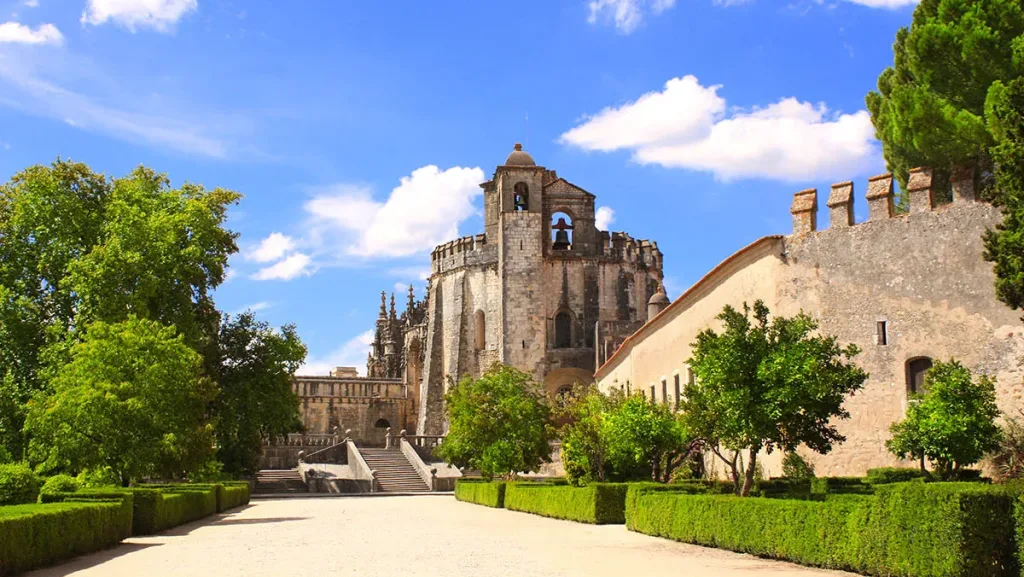
The Convent of Christ (Convento de Cristo) is a combined castle-fortress and religious complex covering approximately 5 hectares on a hilltop above Tomar. Construction began in 1160 and continued across four centuries. The result is one of the few sites in Portugal where Romanesque, Gothic, Manueline, Renaissance, and Mannerist architecture appear within the same walls — not through later reconstruction, but through genuine sequential building phases.
The complex contains:
- The original Templar castle with perimeter walls.
- The Charola — a 12th-century round Templar oratory.
- A Manueline nave added to the Charola between 1510 and 1515.
- Eight cloisters spanning five centuries.
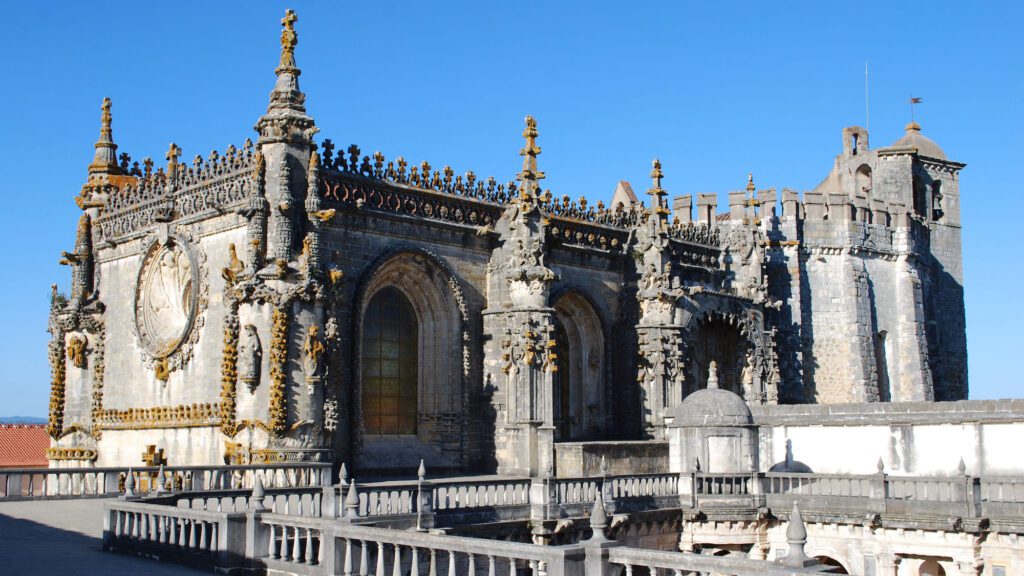
- The Chapter House Window (Janela do Capítulo) by Diogo de Arruda, 1510–1513.
The site is managed by Museus e Monumentos de Portugal, the state body responsible for national monuments. For current ticket prices and seasonal opening hours, verify at museusemonumentos.pt before visiting.
History — Knights Templar, Order of Christ and the Age of Discovery
1160 — The Templar Fortress
In 1160, Gualdim Pais — a veteran of the Second Crusade and the fourth Grand Master of the Knights Templar in Portugal — chose a hilltop above the Nabão River to construct a castle. The position was strategic: it controlled a river crossing on the road between Santarém and Coimbra, with clear sightlines across the Ribatejo plain.
Pais laid the first stones of the Charola, the round Templar oratory, at the same time. He died in 1195 and is buried at the Church of Santa Maria do Olival in Tomar — his tomb slab, dated to that year, remains visible inside.
1312–1319 — Dissolution and Reinvention
Pope Clement V dissolved the Knights Templar at the Council of Vienne in 1312, largely under pressure from the French crown, which sought to seize Templar assets across Europe. In Portugal, King Dinis I refused to hand over Templar properties and personnel to foreign powers.
His solution: in 1319, in agreement with Pope John XXII, he established the Order of Christ as the Templars’ Portuguese successor. The new Order inherited the Templar properties, obligations, and personnel in Portugal. The Convent of Tomar officially became its seat in 1357.
1417–1460 — Henry the Navigator and Maritime Expansion
Henry the Navigator, third son of King João I, served as Grand Master of the Order of Christ from 1417 until his death in 1460. He directed Order revenues toward the systematic exploration of the African coast, the Canary Islands, and the Atlantic archipelagos. Under his administration, two new cloisters were begun and the Chapel of São Jorge was started in 1426.
The connection between Tomar and Portugal’s Age of Discovery is direct: when Vasco da Gama sailed from Lisbon to India in 1497–1498, his ships carried the red cross of the Order of Christ on their sails — the same cross that appears on the Charola’s altar.
Henry the Navigator also gave Tomar its street layout. The geometric chessboard grid he established in the town below the hill was later used as the planning model for the reconstruction of Lisbon’s Baixa district after the 1755 earthquake.
1510–1515 — The Manueline Expansion
King Manuel I ordered the construction of a full Manueline nave attached to the Charola in 1510. The lead architect was Diogo de Arruda, who also designed the Chapter House Window between 1510 and 1513. João de Castilho completed the nave in 1513–1515.
The result was the most ambitious application of Manueline architectural decoration to a military-religious complex in Portugal — a style that fused late Gothic structure with maritime iconography drawn from Portugal’s global expeditions.
What to See Inside the Convent of Christ
The Charola — Templar Round Church (12th Century)
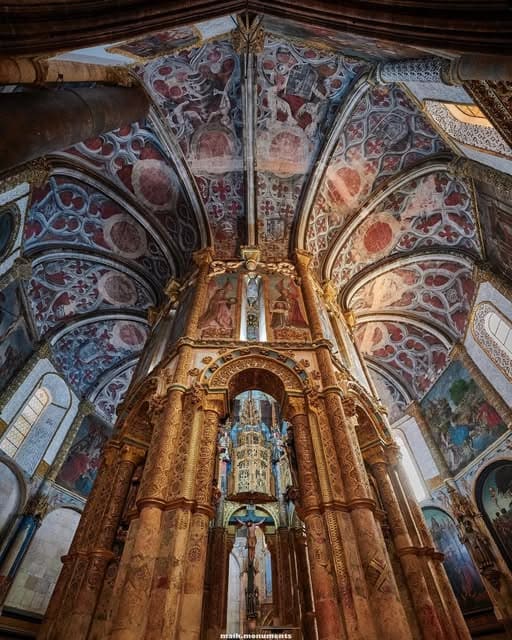
The Charola is the oldest structure in the complex and the focal point of the entire visit. Built in the second half of the 12th century, it is a Templar oratory modelled on the Rotunda of the Church of the Holy Sepulchre in Jerusalem — the site the Knights Templar had been founded to protect.
The structure follows a polygonal plan of 16 bays. The central octagonal choir is surrounded by a double ambulatory — a circular walkway wide enough for a mounted procession. Tradition holds that Templar knights attended religious services on horseback within the rotunda; the building’s proportions make this plausible. The walls retain fragments of late-Gothic paintings and gilded decorative panels added in later centuries.
What most visitors notice first: the Charola is not a ruin. It is a fully intact structure, its dome complete, its ambulatory walkable. At this scale, comparable Templar sites elsewhere in Europe are either ruined or extensively restored.
The most common question I get here is whether Templar knights really attended Mass on horseback inside the rotunda. The honest answer: nobody knows for certain. What we do know is that the central ambulatory is exactly wide enough for a mounted horse, and that the Templars were not known for accidental architecture. I usually answer “probably” — which is not a satisfying answer, but it is considerably more accurate than anything you will find printed on a laminated information board.
Visiting tip: Allow at least 20 minutes here. The detail in the wall paintings and the spatial logic of the circular plan take time to understand.
The Chapter House Window (1510–1513)
The Chapter House Window (Janela do Capítulo) is visible from outside the Convent — a carved limestone composition approximately 8 metres tall built into the exterior wall of the chapter house. Architect Diogo de Arruda carved it between 1510 and 1513.
The iconographic programme is dense: twisted anchor chains, cork bark, armillary spheres, coral branches, the Cross of the Order of Christ, and knotted ropes are woven into a composition that covers the entire opening and its surrounding frame. It is the most-photographed element of the Convent and one of the most-reproduced images of Portuguese architecture.
Photography tip: Approach the window from the courtyard below before entering the complex. The exterior view — the one most photographs show — is best lit in mid-morning, when sunlight hits the carved stonework from a useful angle. It is also when every other visitor arrives to take the same photograph. Arrive before 10:00 in summer if you want a version without someone else’s arm in it.
The Eight Cloisters
The Convent contains eight cloisters, each built in a different century and a different architectural style. The two most significant:
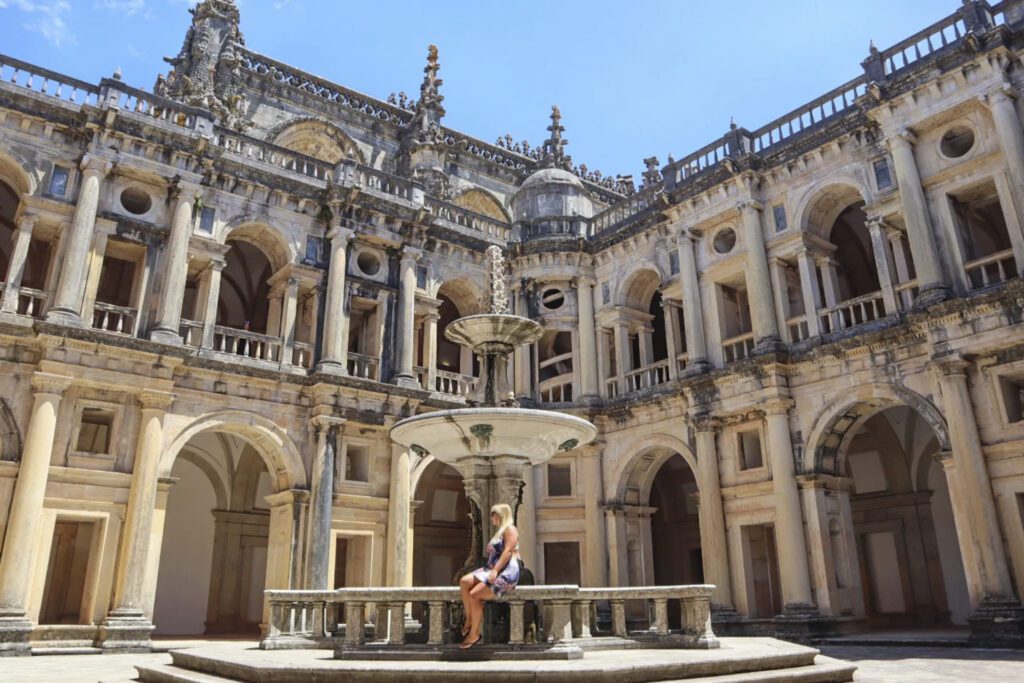
Main Cloister (Claustro Principal): Designed by Diogo de Torralva in 1557–1562 and completed by Italian architect Filippo Terzi. Two stories of Renaissance arcades with undecorated balusters on the upper gallery. This is considered one of the finest examples of Portuguese Renaissance architecture and the most spatially coherent space in the entire complex. It is also where most visitors begin to understand the full scale of what they are looking at.
Cemetery Cloister (Claustro do Cemitério): 15th century, Gothic arches and a central well. Used for funeral processions of the Order’s friars.
The remaining cloisters — Claustro da Lavagem, Claustro dos Corvos, Claustro de Santa Bárbara, and others — were built between the 15th and 17th centuries. Not all are fully accessible on the standard visitor circuit.
How to Plan Your Visit
Tickets – Adults: €15.00 – Ages 13–24 and 65+: €7.50 – Under 12: free Verify current prices at museusemonumentos.pt – prices change seasonally.
Opening Hours – The Convent is generally open from 09:00 to 17:00 in winter and until 18:00 in summer. Closed on: 1 January, Easter Sunday, 1 May, 25 December.
How Long You Need – Charola + Chapter House Window + two cloisters: 1 hour 30 minutes – Full circuit including all accessible cloisters and castle walls: 2 hours 30 minutes to 3 hours – Full Tomar day — Convent + Santa Maria do Olival + Synagogue + Aqueduct: 5–6 hours.
When to Arrive – Tomar receives far fewer visitors than Sintra — crowds at the Convent are manageable outside of August. For summer visits, arriving before 10:00 avoids both the midday heat and the coach groups that typically arrive mid-morning. The complex involves substantial outdoor walking in unshaded areas; July and August temperatures in Tomar regularly reach 35°C.
Sequence – The standard instinct when entering the outer grounds is to head directly to the Chapter House Window — it is the most-reproduced image of the Convent and straightforward to find. I suggest doing the opposite: go to the Charola first. The Window is the most photographed thing here; the Charola is the reason the entire complex exists. Start where the history starts, and the architecture of everything that came after makes considerably more sense.
What to Wear – The visit requires walking across uneven stone surfaces, exterior grounds, and interior staircases. Comfortable shoes with grip are necessary. The site has limited accessibility provisions for wheelchairs throughout.
Photography – Permitted throughout the complex. No flash restriction is typically imposed. The exterior of the Chapter House Window is best photographed in mid-morning light.
How Much Time Does the Convent Need?
The honest answer: more than most people plan for. This is technically true of almost everything in Portugal, but here it genuinely matters.
The standard visitor error is arriving at 11:00, spending 90 minutes, and leaving having seen the Charola and the Chapter House Window but nothing else. The cloisters are where the complexity of the site becomes apparent, and they take time to absorb. Nobody who has spent 30 minutes in the Main Cloister has ever said they wished they had left earlier.
Realistic time allocations
- Charola + Chapter House Window only — 1 hour.
- Charola + Chapter House Window + Main Cloister + Cemetery Cloister — 1 hour 30 minutes.
- Full circuit (all accessible cloisters + castle walls) — 2 hours 30 minutes to 3 hours.
- Full Tomar day (Convent + town monuments) — 5–6 hours.
If time is limited, the recommended priority is:
Charola → Chapter House Window (exterior first, then interior view) → Main Cloister
These three highlights cover the most important architectural features of the complex and can be visited in about 90 minutes.
If you have 3 hours, also include the Cemetery Cloister, the castle walls, and the viewpoint overlooking the Nabão Valley. A walk along the walls takes approximately 20–25 minutes and helps explain the defensive role of the original Templar fortress.
The Convent is generally much less crowded than the Pena Palace in Sintra. Outside the peak summer season, arriving around 09:30 is usually early enough to avoid tour groups. During July and August, arriving at 09:00 is recommended, as the complex offers limited shade and afternoon temperatures above 35°C can make longer visits uncomfortable.
Beyond the Convent: The Rest of Tomar in Brief
The Convent accounts for most of what draws visitors to Tomar, but the city has three additional monuments within 15 minutes’ walk of the hilltop that change the character of the visit considerably.
The Synagogue of Tomar (built 1430–1460) is the only intact medieval synagogue in Portugal — a National Monument now housing the Abraham Zacuto Museum.
The Church of Santa Maria do Olival (12th century) is the burial church of the Knights Templar Grand Masters and was designated by papal bull in 1455 as the Mother Church of all Portuguese overseas parishes.
The Pegões Aqueduct (1593–1614, 6.223 km, 180 arches, 30 metres at maximum height) was designed by the same Filippo Terzi who completed the Main Cloister above. For full descriptions of all four Tomar monuments with visiting logistics, see Things to Do in Tomar: Complete Guide.
How to Get to Tomar from Lisbon
De carro: 136 km northeast of Lisbon via the A1 motorway (direction Porto), then the IC9 toward Tomar. Journey time approximately 1 hour 30 minutes without significant traffic. Paid parking is available in the town centre; free parking exists at the base of the Convent hill.
By train: From Lisboa Oriente or Lisboa Santa Apolónia, trains to Tomar require a change at Entroncamento. Total journey approximately 2 hours. The Tomar train station is 1.5 km from the Convent of Christ — a 20-minute walk uphill, or a 5-minute taxi ride. Current schedules at cp.pt.
By private tour from Lisbon: Hotel pickup included, direct transport, and a guide throughout. Private tours allow you to combine Tomar with Fátima (45 km south), Castelo de Almourol (30 km south along the Tagus), or Coimbra (73 km north) in the same day.
Private Tours to Tomar from Lisbon
Yellow Cab TT Tours has been running private tours to Tomar from Lisbon since 2013. The Convent of Christ alone requires 2 to 3 hours to cover thoroughly. Combined with the full Tomar circuit — Synagogue, Santa Maria do Olival, and the Aqueduct — a full day is the realistic format. Tomar also pairs well with Fátima or Almourol if you prefer a combined itinerary.
All private tours include hotel pickup from Lisbon, a licensed guide, and an adjustable itinerary.
Available tours from Lisbon:
Tour Templário em Tomar

Tomar – Convento de Cristo – Almourol – Santarém
Tomar + Fátima Tour

História, fé e património UNESCO num só passeio
Tomar + Coimbra Tour

História templária e charme académico
Tomar + Lisbon
Cavaleiros, património e vida urbana vibrante.

FAQ — Visiting the Convent of Christ in Tomar
What is the Convent of Christ in Tomar?
The Convent of Christ (Convento de Cristo) is a UNESCO World Heritage Site (1983) founded in 1160 by Gualdim Pais, the fourth Grand Master of the Knights Templar in Portugal. The complex contains eight cloisters, a 12th-century Templar round church (the Charola), and the Manueline Chapter House Window (1510–1513) by Diogo de Arruda. It served first as the Templar headquarters in Portugal, then as the seat of the Order of Christ from 1357, and is one of the best-preserved Templar sites in Europe.
How much does it cost to enter the Convent of Christ?
Adult entry is €15. Visitors aged 13–24 and over 65 pay €7.50. Entry is free for children under 12. Prices are set by Museus e Monumentos de Portugal and should be verified at museusemonumentos.pt before your visit as they may change seasonally.
How long does it take to visit the Convent of Christ?
Allow 2 to 3 hours to cover the Charola, Chapter House Window, Main Cloister, and castle walls. Visitors exploring all eight cloisters and the full castle perimeter should allow 3 hours. If you plan to visit other Tomar monuments — the Synagogue, Santa Maria do Olival, and the Pegões Aqueduct — allow 5 to 6 hours for the full circuit.
What is the Charola in Tomar?
The Charola is the original Templar oratory — a round church built in the second half of the 12th century, modelled on the Rotunda of the Church of the Holy Sepulchre in Jerusalem. It has a 16-bay polygonal plan with an octagonal central choir. It is one of the few surviving Templar rotundas in Europe and the oldest structure in the complex.
What is the Chapter House Window (Janela do Capítulo)?
The Chapter House Window is a Manueline window carved in limestone by architect Diogo de Arruda between 1510 and 1513. Approximately 8 metres tall, its stonework depicts symbols of Portugal’s Age of Discovery — anchor chains, armillary spheres, coral, and the Cross of the Order of Christ. It is considered one of the finest examples of Manueline architectural decoration in Portugal.
What is the Order of Christ and how is it connected to Tomar?
The Order of Christ was established in 1319 by King Dinis I and Pope John XXII as the successor to the Knights Templar, which had been dissolved at the Council of Vienne in 1312. The Convent of Tomar became the Order’s seat in 1357. Henry the Navigator served as Grand Master from 1417 until his death in 1460 and directed Order resources toward Portugal’s maritime expeditions. Vasco da Gama’s ships carried the Order of Christ’s cross on their sails when he reached India in 1498.
Is there more to see in Tomar beyond the Convent?
Yes. The Synagogue of Tomar (built 1430–1460) is the only intact medieval synagogue in Portugal and a National Monument. The Church of Santa Maria do Olival (12th century) is the burial church of the Knights Templar Grand Masters in Portugal. The Pegões Aqueduct (1593–1614) is 6.223 km long and reaches 30 metres in height. Together these four sites justify a full day in Tomar.
Can I visit Tomar as a day trip from Lisbon?
Yes. Tomar is 136 km northeast of Lisbon — approximately 1 hour 30 minutes by car or 2 hours by train with a change at Entroncamento. Most visitors allow 5–6 hours in the city. Yellow Cab TT Tours offers private day tours from Lisbon with hotel pickup and a licensed guide.
When is the best time to visit Tomar?
March to May and September to October offer the most comfortable visiting conditions: temperatures from 14°C to 24°C and lower visitor volumes. July and August temperatures in Tomar regularly reach 35°C. The Convent complex involves substantial outdoor walking; afternoon visits in summer are physically demanding. In 2027, the Festa dos Tabuleiros — held every four years in July — will bring large crowds and requires advance accommodation booking.
What is the Festa dos Tabuleiros in Tomar?
The Festa dos Tabuleiros is a festival held every four years, rooted in 14th-century devotion to the Holy Spirit associated with Queen Isabel of Portugal. The centrepiece is a 5 km parade during which hundreds of women carry tabuleiros — towers of 30 loaves of bread equal in height to the woman carrying them, decorated with paper flowers and topped with a crown. The last edition was June–July 2023; the next is scheduled for 2027.
Planning a day trip to Tomar? We pick up from your hotel in Lisbon or Cascais → WhatsApp us: +351 965 856 169 → Or use the contact form.

Founder & Director of Yellow Cab TT Tours. Guiding in Portugal for 20+ years.
Founded Yellow Cab TT Tours in 2013. 3,372 five-star reviews on Tripadvisor.