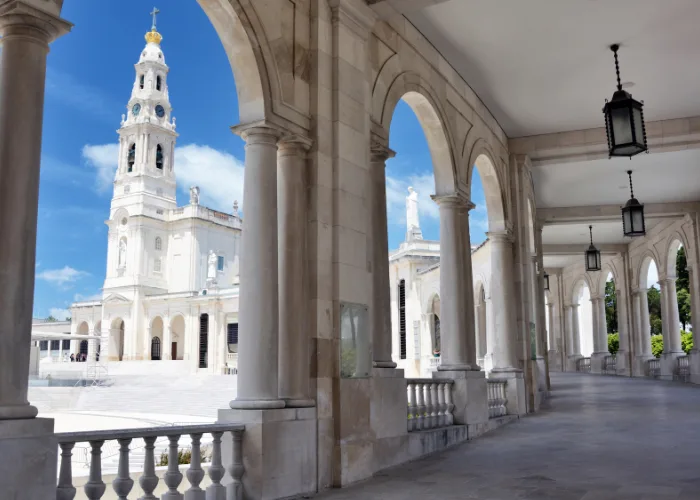
Private Full-Day Tour: Fátima, Sintra & Cascais from Lisbon
3 iconic destinations in one full-day private tour with a local driver-guide
- Travel in a private vehicle with a dedicated local driver-guide, exclusively for your group (up to 8 people).

Duration
8 Hours
Tour Type
Private
Group Size
Máx. 8px/Van
Pickup & Drop-off
Lisbon city centre (outside centre on request)
Main highlights
Fátima Sanctuary, Sintra historic centre, Cascais bay
Price
From €350 per private vehicle (see pricing below)

Rated 5/5 on TripAdvisor.
based on +3.000 reviews
Tour Overview
This private tour covers the three most requested day-trip destinations from Lisbon in a single eight-hour journey: Fátima (142 km north, six Marian apparitions 1917, 6.2 million visitors/year), Sintra (25 km west, UNESCO Cultural Landscape 1995, Pena Palace at 528 m altitude), and Cascais (30 km west, former Portuguese royal summer residence since 1870). The route also passes Cabo da Roca – coordinates 38°47’N, 9°30’W, the westernmost point of continental Europe – and the wild Atlantic beach of Guincho. Total driving distance: approximately 340 km.
Conducted in a private air-conditioned vehicle with a licensed driver-guide in English, Spanish, French or Portuguese. Up to 8 passengers. The vehicle is exclusive to your group – no other travellers join. From €350 per vehicle. 28 Tripadvisor reviews, 5.0/5.
Why Choose This Private Tour
Most travellers visiting Portugal face a version of the same choice: Fátima or Sintra. Both destinations require approximately 90 minutes of driving from Lisbon in opposite directions – Fátima 142 km north, Sintra 25 km west. A shared coach cannot cover both in one day without cutting one short. A private vehicle, with a guide managing the timing, can.
This tour runs Fátima in the morning (90 minutes on site, free entry), then drives south to Sintra (90 minutes on site), west to Cabo da Roca for the Atlantic cliffs, along the coastal road past Guincho, and into Cascais for the final free-time stop before returning to Lisbon. The sequence is logistically efficient – the route avoids backtracking.
For a group of four, the per-person cost is approximately €113 – roughly €30 more than a standard Sintra & Cascais private tour, for the addition of Portugal’s most visited religious monument, 6.2 million visitors/year, free entry.
This is not the tour for travellers who want a deep dive into either destination. It is the tour for travellers with three days in Portugal who want to see Fátima, Pena Palace, and the coast in one full day. For a more complete Fátima experience with Batalha, Nazaré, and Óbidos, the Fátima Private Tour covers those four destinations in detail.
Tips For This Tour
No ticket purchase needed at Fátima. Entry to all three sanctuaries is free: Chapel of the Apparitions (built 1919, on the exact location of the apparitions), Basilica of Our Lady of the Rosary (consecrated 1953), and Basilica of the Holy Trinity (inaugurated 2007, capacity 9,000). There is nothing to book or pre-pay at Fátima – the guide handles the visit logistics on arrival.
Dress code at Fátima. The sanctuaries are active places of worship. Shoulders and knees must be covered to enter the basilicas. Scarves are available at the sanctuary entrance for those who need them.
Sintra: book palace tickets before the tour if entry is a priority. Pena Palace (1842–1854, €20/person Palace+Park) and Quinta da Regaleira (1904–1910, €20/person) both require timed entry tickets in peak season (May–September). Moorish Castle: €12/person. On this tour, time at Sintra is 90 minutes – enough for the historic centre, the view of Pena Palace from the village, and a Travesseiro pastry at Casa Piriquita (founded 1862). Entering a palace reduces time for everything else. Decide in advance and book at parquesdesintra.pt (Pena Palace, Moorish Castle) or regaleira.pt (Quinta da Regaleira) after speaking with.
Avoid 13 May and 13 October if crowds concern you. These are the principal pilgrimage dates at Fátima — the anniversary of the first and last apparitions (13 May 1917 and 13 October 1917). Attendance on these dates reaches 500,000–1,000,000 people. The sanctuary esplanade (540 m long, twice the size of St. Peter’s Square) can accommodate the numbers, but access roads, parking, and restaurants are at capacity for the full day. Any other date in the year has a fraction of that traffic.
Certificate of the westernmost point. The tourist office at Cabo da Roca issues personalised certificates confirming that the holder has visited 38°47’N, 9°30’W – the westernmost point of continental Europe. Cost €11. A minor item, but routinely requested. If you want one, mention it to the guide before the Cabo da Roca stop.
Sample Itinerary (Flexible)
This is a suggested plan. Exact timing may vary depending on traffic, weather and your preferences.
- 08:30–09:00 — Pickup in Lisbon (city centre).
- Fátima Sanctuary (free time to visit the basilicas and Chapel of the Apparitions).
- Sintra historic centre (walk, viewpoints, local pastries such as Travesseiros).
- Cabo da Roca viewpoint & lighthouse area.
- Scenic coastal drive via Guincho Beach + free time in Cascais.
- 17:00–17:30 — Return to Lisbon / drop-off.
Tour Details
Fátima
After pick-up in Lisbon, we begin by heading to Fátima, one of the most visited pilgrimage sites in the world.
Fátima is a town in the municipality of Ourém, Santarém district, 142 km north of Lisbon – approximately 1 hour 20 minutes by car via the A1 motorway. The Shrine of Fátima recorded 6.2 million visitors in 2024, making it one of the most visited Catholic pilgrimage sites in the world, after Lourdes and the Vatican.
The site marks the location where three shepherd children – Lúcia dos Santos (age 10), Francisco Marto (age 9), and Jacinta Marto (age 7) — reported six apparitions of the Virgin Mary between 13 May and 13 October 1917. The apparitions occurred at the Cova da Iria, a hollow of grazing land outside their home village of Aljustrel, approximately 2 km from the current sanctuary. The Diocese of Leiria officially recognised the apparitions on 13 October 1930 – thirteen years after the final event.
The Miracle of the Sun – the culminating event of 13 October 1917 – was witnessed by an estimated 70,000 people. Witnesses, including secular journalists from the newspaper O Século, reported the sun spinning, changing colours, and appearing to plunge toward the earth for approximately ten minutes.
Chapel of the Apparitions (Capelinha das Aparições): A small chapel built in 1919 on the exact site of the apparitions – the location of the original holm oak tree where the Virgin Mary appeared. This is the devotional centre of the sanctuary; the spot the children stood is marked. Free entry.
Basilica of Our Lady of the Rosary (Basílica de Nossa Senhora do Rosário): Consecrated 7 October 1953. Classical Baroque Revival style with a 65 m bell tower. The basilica houses the tombs of all three Fátima visionaries: Francisco Marto and Jacinta Marto – canonised by Pope Francis on 13 May 2017 in a ceremony attended by approximately 500,000 people – and Lúcia dos Santos, whose remains were transferred from the Carmelite convent in Coimbra on 19 February 2006 (died 13 February 2005, aged 97). Free entry.
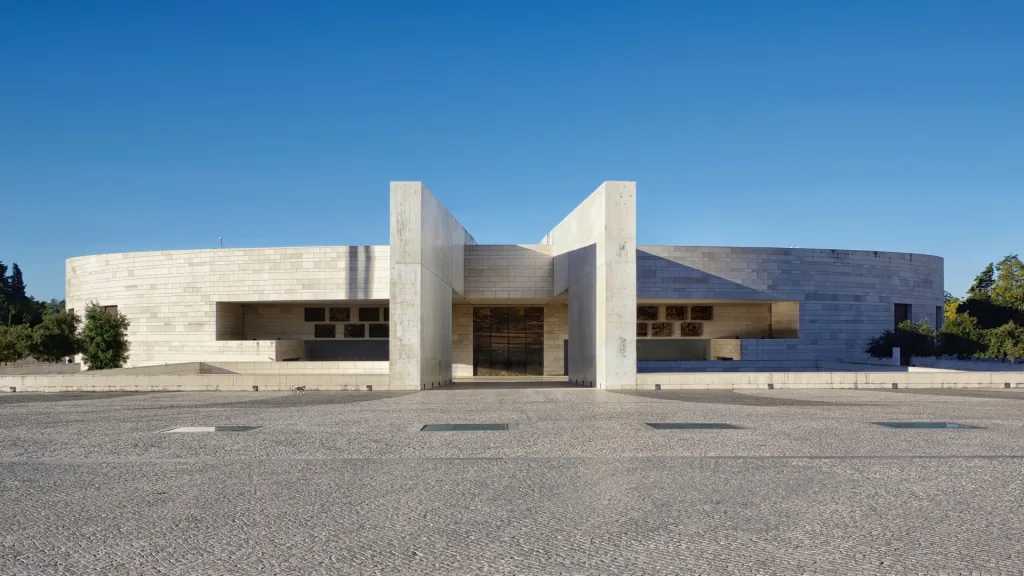
Basilica of the Holy Trinity (Basílica da Santíssima Trindade): Inaugurated 12 October 2007. Modern in design; capacity 9,000 people, making it one of the largest Catholic churches in the world. The exterior walls are faced with 1.7 million pieces of mosaic. Free entry.
Esplanade: The sanctuary esplanade is 540 m long – approximately twice the length of St. Peter’s Square in Vatican City. On ordinary days, it functions as a large public space; on pilgrimage dates (13 May, 13 October), it fills entirely.


Sintra
Next, we drive to the magical town of Sintra.
Sintra is a town in the municipality of Sintra, 25 km west of Lisbon by car (approximately 40 minutes via the A37 or IC19). The Sintra Cultural Landscape – including the historic centre, surrounding palaces, and the Serra de Sintra – was designated a UNESCO World Heritage Site in 1995.
The Serra de Sintra rises to 528 m at its highest point. The unusual microclimate – created by Atlantic moisture condensing against the granite ridge – makes Sintra significantly cooler and more humid than Lisbon even in summer. This made it attractive as a royal retreat from the 15th century onward.
National Palace of Sintra (Palácio Nacional de Sintra): The most prominent building in Sintra’s historic centre. Medieval origins; significantly expanded in the 15th and early 16th centuries under King João I and King Manuel I. The two large conical white chimneys (26 m tall) are the defining visual marker of the town. Used as the primary royal palace of Portugal until the early 17th century.
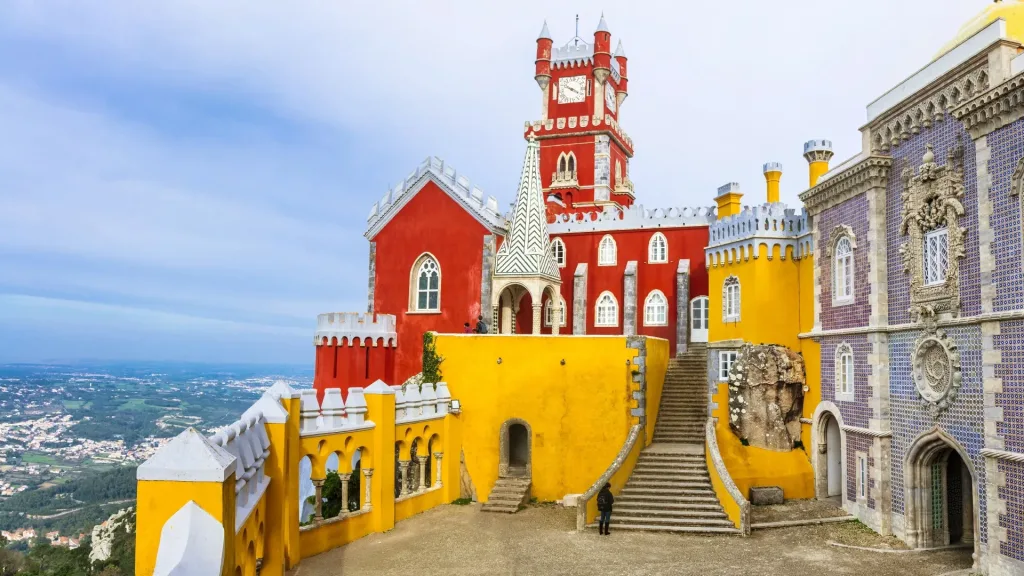
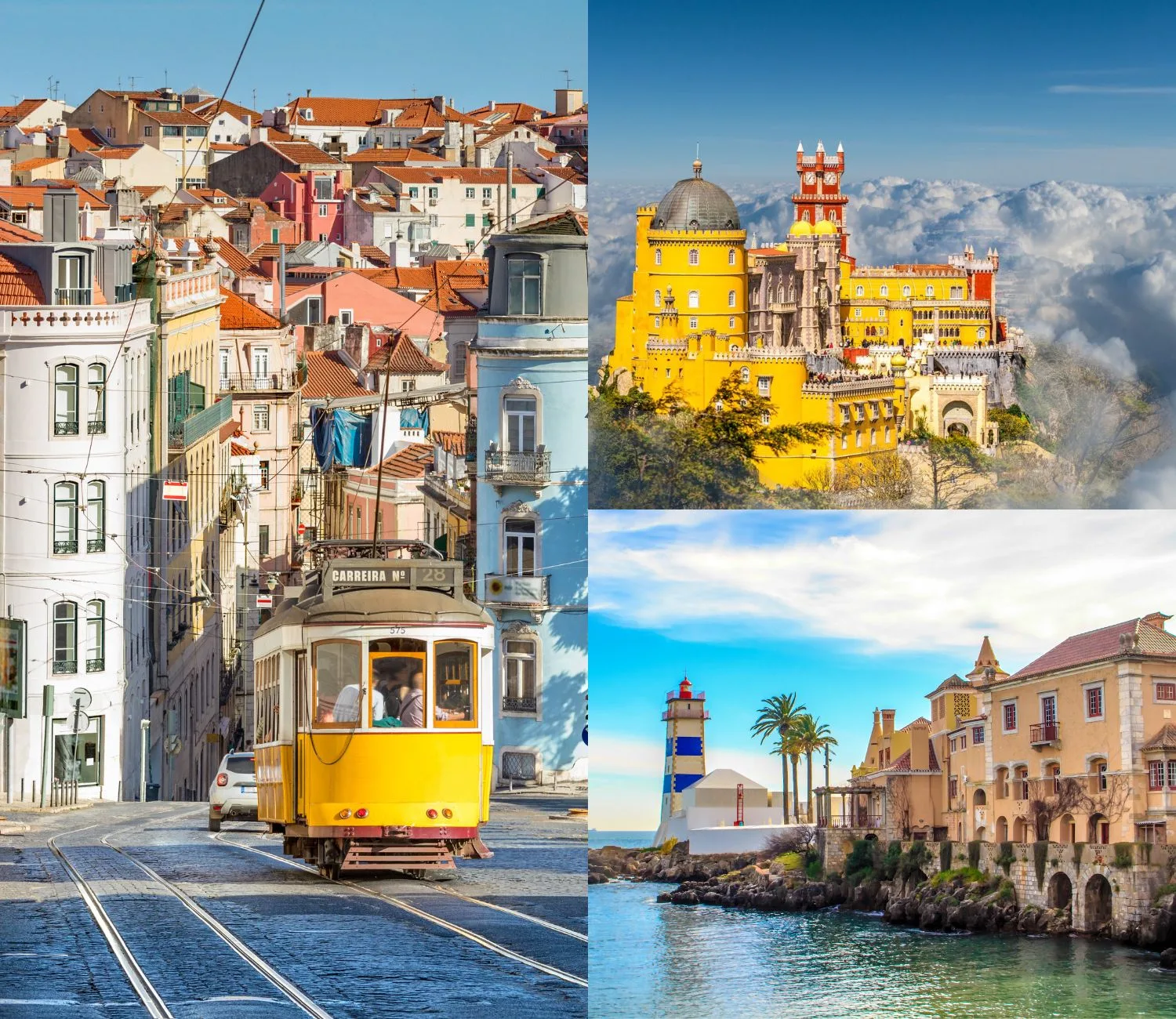
Pena Palace (Palácio da Pena): Built 1842–1854 by King Ferdinand II (Ferdinand of Saxe-Coburg and Gotha), consort of Queen Maria II. Romanticist eclectic style incorporating Manueline, Moorish, Gothic, and Renaissance elements in vivid red, yellow, and ochre. Located at 528 m altitude, the highest point of the Serra de Sintra. Now one of the most visited monuments in Portugal. Entry €20/person.
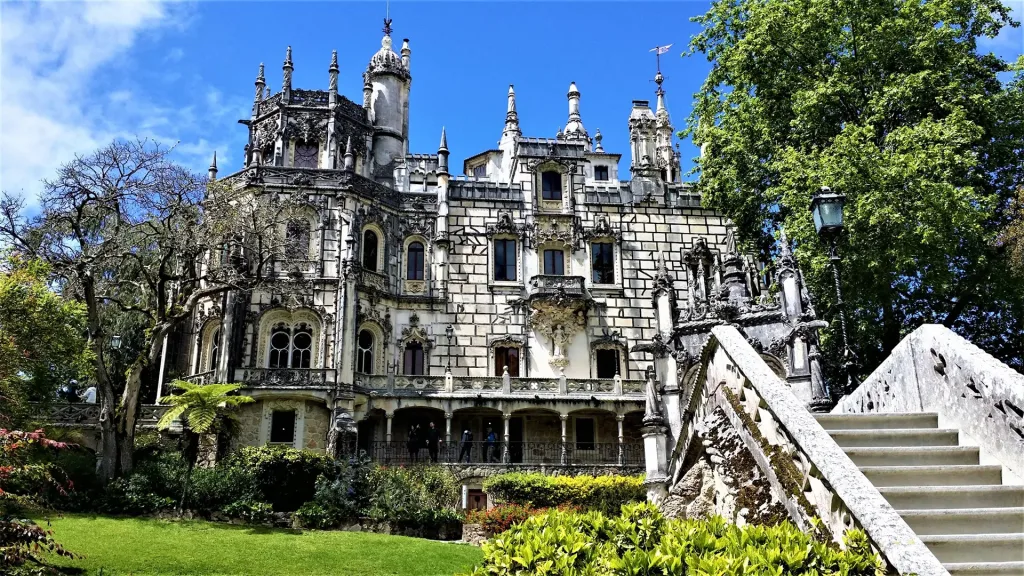
Quinta da Regaleira: Built 1904–1910 by millionaire António Augusto Carvalho Monteiro, designed by architect Luigi Manini. The estate features Romanticist Gothic architecture and elaborate esoteric garden symbolism. The Initiation Well (Poço Iniciático) – a 27 m inverted tower descending underground, with nine spiral landings – is the most photographed structure. Entry €20/person.
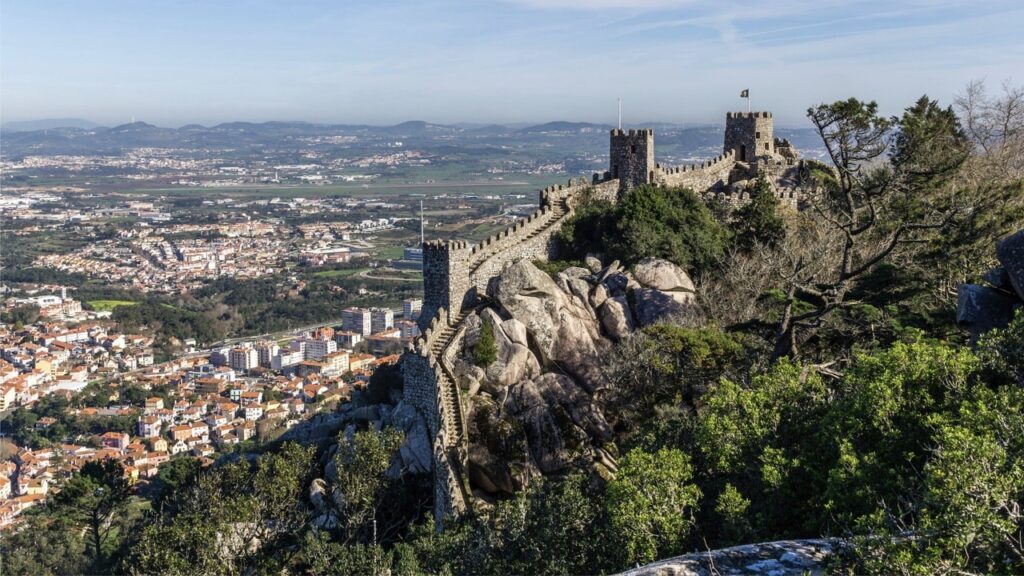
Moorish Castle (Castelo dos Mouros): Granite fortification built by the Moors in the 8th–10th centuries. Captured by King Afonso Henriques in 1147 during the Christian Reconquista. The walls follow the ridge of the Serra and are visible from Pena Palace above. Entry separate.
Travesseiros de Sintra: A pastry specific to Sintra – an elongated puff pastry filled with egg cream and almond. Produced by Casa Piriquita, founded 1862 in the village centre. One of two or three essential stops in Sintra’s historic centre

Cabo da Roca
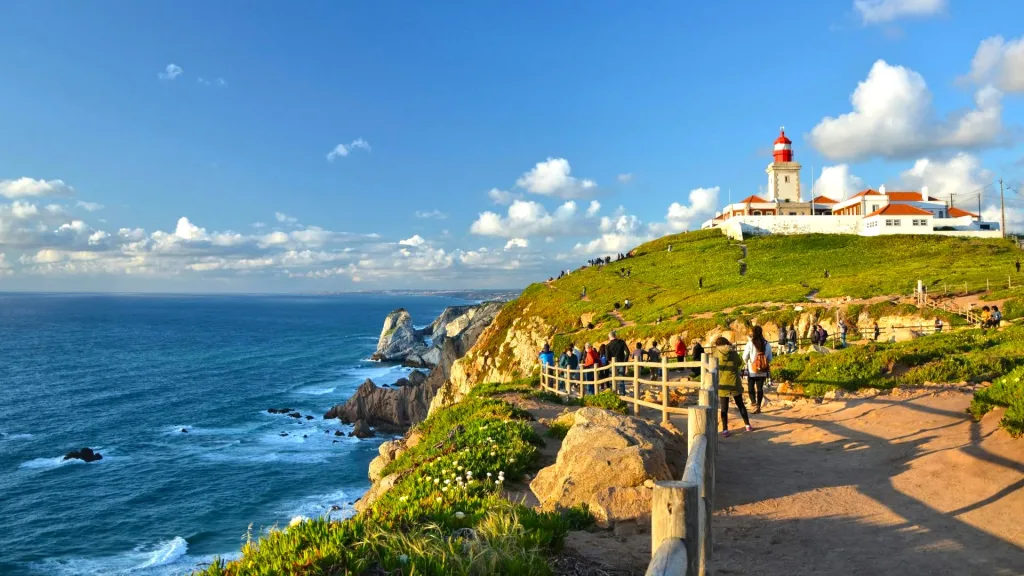
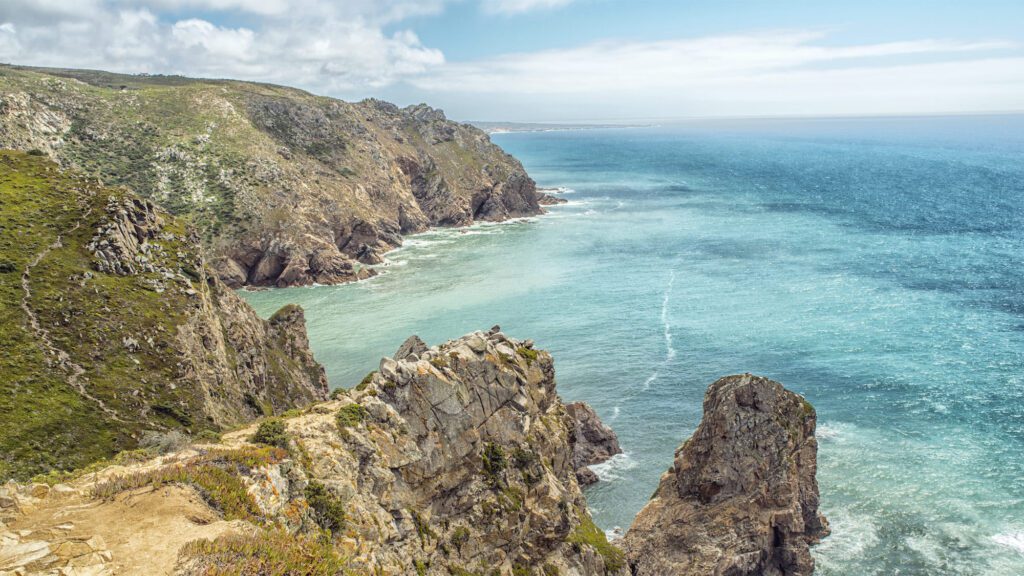
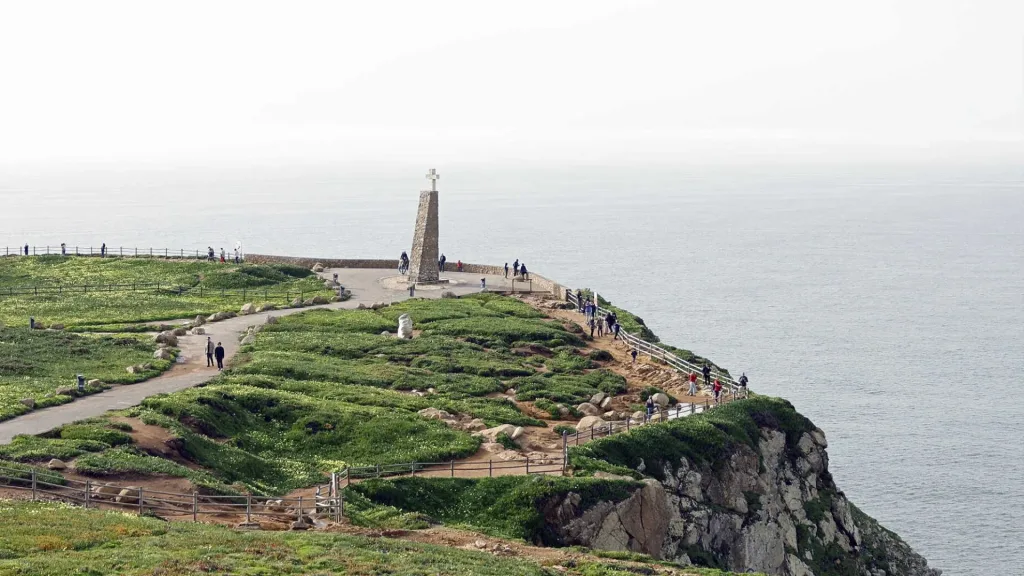
Cabo da Roca (Cape Roca) lies at coordinates 38°47’N, 9°30’W – the westernmost point of continental Europe and of mainland Eurasia. The cliffs rise 165 m above sea level. On clear days, the Atlantic horizon extends without interruption to the west; the nearest landmass in that direction is North America.
The lighthouse at Cabo da Roca was established in 1772, making it one of the oldest operational lighthouses on the Portuguese Atlantic coast. It stands 16.2 m tall and sits at 164 m altitude; the light is visible 26 nautical miles (48 km) at sea.
The stone pillar at the cape bears a verse by the Portuguese poet Luís de Camões (1524–1580): “Aqui… onde a terra se acaba e o mar começa” – “Here… where the land ends and the sea begins.”
Tourist office: Issues personalised certificates of the westernmost point in Europe. The certificate states the holder’s name and confirms coordinates 38°47’N, 9°30’W. Cost €11. Valid as a tangible record of the visit.
Guincho Beach & Cascais
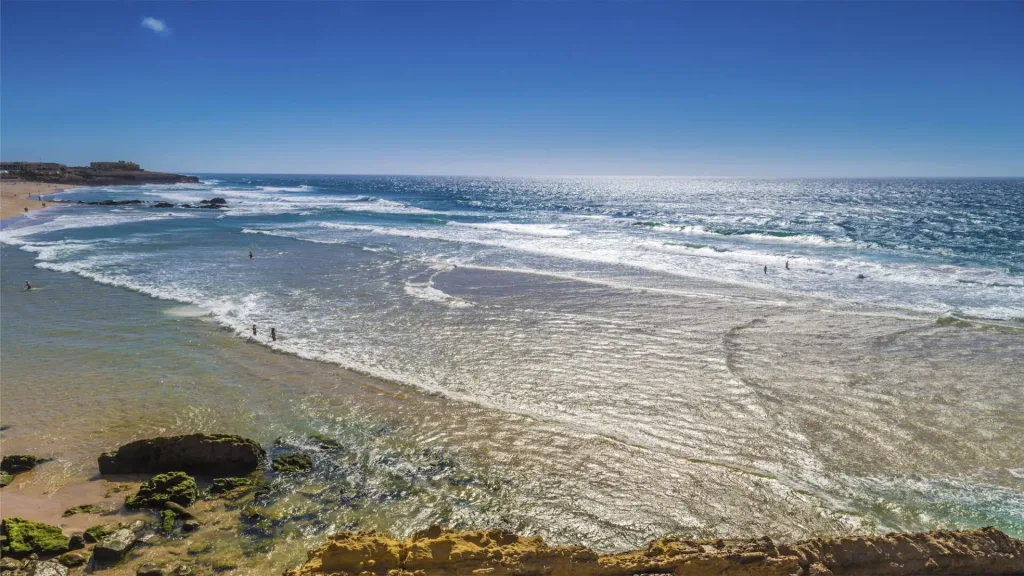
Guincho Beach (Praia do Guincho): Located 6 km northwest of Cascais, within the Sintra-Cascais Natural Park (established 1981). The beach faces the open Atlantic without shelter – consistent southwest wind makes it one of the premier windsurfing and kitesurfing locations on the Portuguese coast. The Guincho hosted the PWA World Windsurfing Championship multiple times. The coastal road from Cabo da Roca to Cascais passes directly behind the dunes.
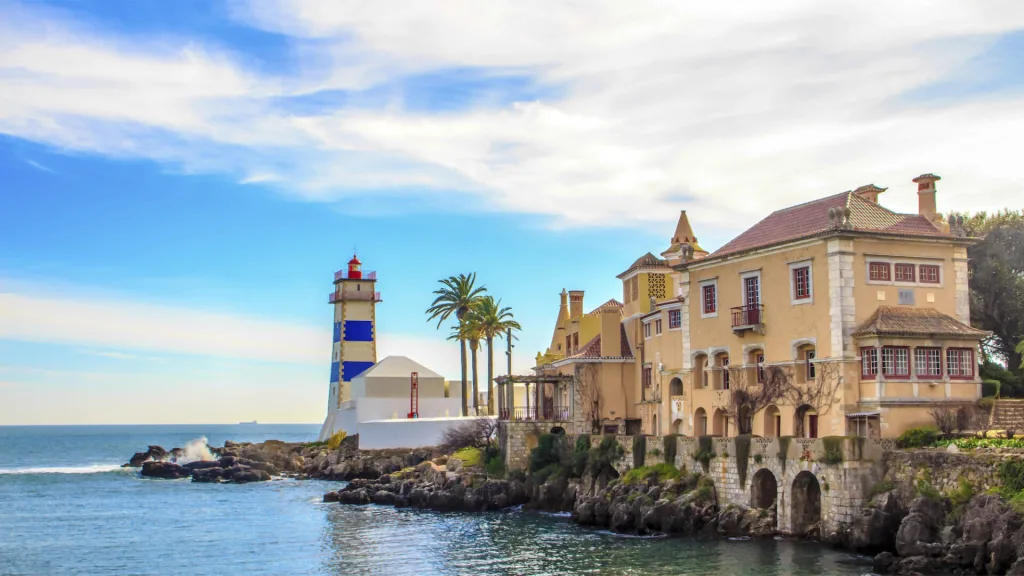
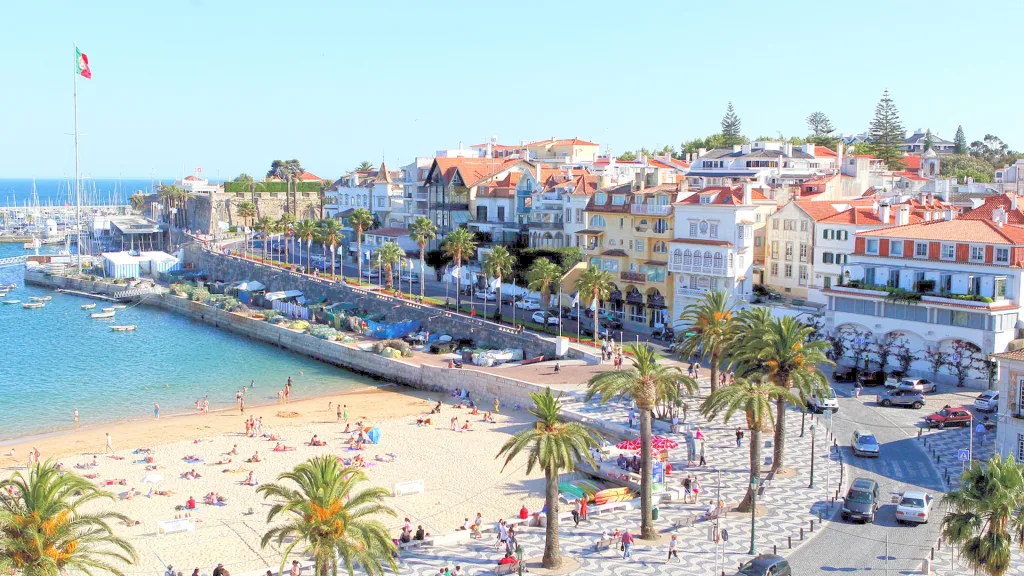
Cascais: A coastal municipality 30 km west of Lisbon. In 1870, King Luís I (r. 1861–1889) chose Cascais as his summer residence, establishing the town as a destination for Portuguese nobility and foreign dignitaries. The town centre preserves its character as a fishing village: whitewashed houses, a working harbour, the fish market (Mercado da Vila). The Cascais marina, opened in the 1990s, holds 650 berths.
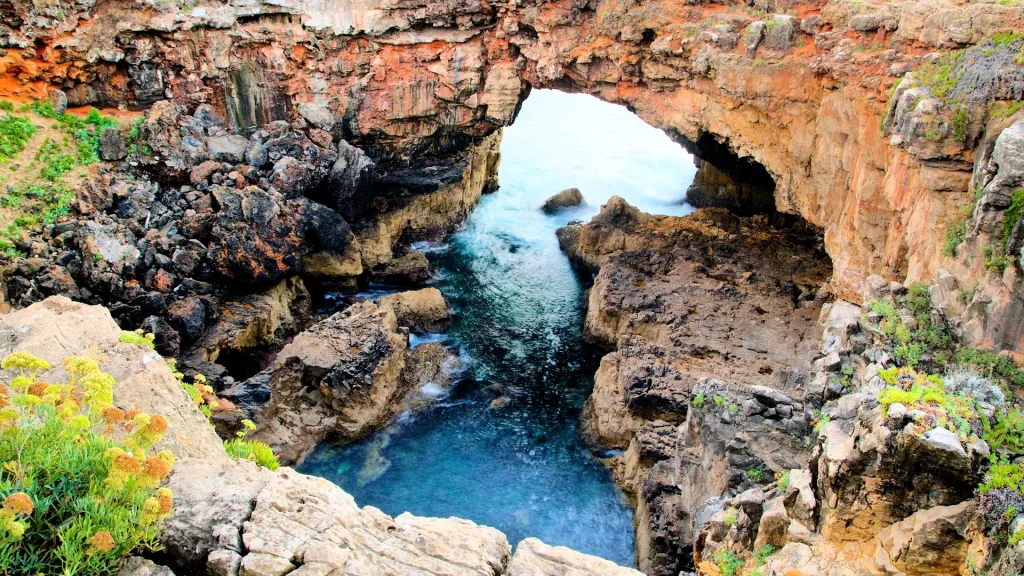
Boca do Inferno (Hell’s Mouth): A sea arch and cave eroded into the cliff approximately 1.5 km west of Cascais town centre. The name derives from the thundering sound of waves driven into the cavity during Atlantic storms. In October 1930, the occultist Aleister Crowley staged his own disappearance here – leaving behind a note and his cap – as a publicity stunt for his poetry. He was found alive in Berlin several weeks later.
Estoril: 1 km east of Cascais. The Casino Estoril, opened in 1931 (first stone laid 16 January 1916; expanded in the 1960s), is one of the largest casinos in Europe. During World War II (1939–1945), Estoril’s neutrality made it a hub for Allied and Axis spies, exiled royalty, and refugees. British naval intelligence officer Ian Fleming visited Hotel Palácio Estoril on a wartime mission in May 1941, shadowing double agent Duško Popov. He is widely believed to have drawn on Casino Estoril when writing Casino Royale (published 1953), the first James Bond novel.
Return to Lisbon
Finally, we return to Lisbon through the scenic countryside, filled with lasting memories and stunning views. This tour is carefully crafted for a well-balanced and enriching day—but the pace and focus can adapt to your preferences.
The suggestions are ours, but the experience is yours.
Customise Your Tour
This is a private tour — the itinerary adapts to your priorities. Confirm preferences when booking:
More time at Fátima: Extended visit including the Way of the Cross, the Chapel of the Trinity, and the Valinhos site (~2 km from the sanctuary, where the August 1917 apparition occurred after the children’s detention).
Palace entry in Sintra: Pena Palace (€20/person, Palace+Park) or Quinta da Regaleira (€20/person); the guide adjusts Sintra timing to accommodate entry.
Skip Cascais, add Óbidos: The medieval walled town of Óbidos (walls intact, 12th century) lies 20 km north of Fátima; adds ~45 min to the tour.
Add Batalha: The Batalha Monastery (1386–1517, UNESCO 1983) is 20 km north of Fátima; the guide can incorporate a 30-min stop en route.
What’s Included
- 8 Hours Tour
- Private air-conditioned vehicle
- Local driver-guide
- Pick-up / Drop-off at the place you are staying in Lisbon city centre (outside of Lisbon city centre requires analysis)
- Mandatory Insurance
- Fuel, tolls and parking costs
Not included:
- Meals and drinks
- Entrance tickets to monuments or palaces
- Tips (optional)
Tour Prices
Prices are per vehicle, not per person.
-
Up to 2 Pax €350
-
3 to 4 Pax €450
-
5 to 8 Pax €570
Pickup outside Lisbon city centre is available on request and may require an additional fee (confirmed before booking).
Free cancellation up to 24 hours before the scheduled departure. Cancellations with less than 24 hours’ notice are non-refundable.
Contact Us and Book Your Tour
Best Time of Year for This Tour
March–May (recommended): Temperatures 16–22°C. Serra de Sintra is deep green from spring rainfall; Pena Palace gardens are in bloom. Fátima has normal visitor numbers except on 13 May (first apparition anniversary — up to 1 million pilgrims; avoid this specific date or plan for significant crowds). Cabo da Roca is accessible with spring Atlantic light. Book Sintra palace tickets 1–2 weeks in advance.
June–August (peak season): Temperatures 25–30°C along the coast. Sintra palace queues peak in July–August; book Pena Palace and Quinta da Regaleira tickets 3–4 weeks in advance for timed slots. Guincho and Cascais beaches are crowded on weekends. Cabo da Roca wind conditions are strong (prevailing northwest). 13 June: Not a pilgrimage date at Fátima – normal visit conditions. Best departure time in summer: 08:00 to arrive Fátima before 09:30, ahead of coach groups.
September–October (second recommended window): Temperatures 20–26°C. Crowds drop sharply from August peak. Sintra palace tickets available within 1–2 days. Autumn light is ideal for photography at Cabo da Roca and Pena Palace. 13 October (last apparition anniversary) — same logic as 13 May; 300,000–500,000 attend. Avoid or book weeks in advance.
November–February (low season): Temperatures 10–17°C; rain possible. Sintra in winter is uncrowded; palace tickets available on the day. Fátima on ordinary winter days has near-zero queues. The Serra microclimate is cloudier and wetter than Lisbon – Pena Palace in mist is atmospheric but plan for weather. Cascais and Guincho are dramatically empty.
FAQ
Is this a private tour?
Yes. Only your group travels in the vehicle – up to 8 passengers. No other travellers join at any point during the day.
How far is Fátima from Lisbon?
142 km north of Lisbon via the A1 motorway – approximately 1 hour 20 minutes by car. The sanctuary is in the municipality of Ourém, Santarém district. It recorded 6.2 million visitors in 2024.
Do you need tickets for Fátima?
No. Entry to all three sanctuaries is free: Chapel of the Apparitions (1919), Basilica of Our Lady of the Rosary (1953), and Basilica of the Holy Trinity (2007, capacity 9,000). There is nothing to book or pre-pay.
Can we visit Pena Palace during this tour?
You can enter Pena Palace if you book tickets in advance (€20/person for Palace+Park at parquesdesintra.pt). The Sintra stop is approximately 90 minutes. Entering a palace reduces time for the village, the Travesseiros pastry, and the views from the street. Decide before the tour and mention it at booking so the guide can plan the timing.
Is Fátima appropriate for non-Catholics?
Yes. The site is a place of Catholic worship, but it welcomes all visitors. The sanctuaries are historically and architecturally significant regardless of religious affiliation. The esplanade (540 m long) is open public space. The only requirement is respectful dress — shoulders and knees covered in the basilicas.
How long is the tour?
8 hours. Standard pickup 09:00, return approximately 17:00–17:30. Total driving approximately 340 km.
What is the price and is it per person?
Pricing is per vehicle: up to 2 passengers €350; 3–4 passengers €450; 5–8 passengers €570. For a group of 4 the per-person cost is approximately €113 – covering four major destinations in a private vehicle.
Is this tour suitable for people with limited mobility?
Fátima Sanctuary is largely flat and wheelchair-accessible. Sintra historic centre has cobblestone streets and uphill sections. Cabo da Roca has a short level path to the viewpoint. Cascais town centre is flat. Guests with limited mobility should mention this at booking — the guide can adjust stops accordingly.
What languages does the guide speak?
English, Spanish, French, and Portuguese. Tell us about your preferences while booking.
Is lunch included?
No. The itinerary includes approximately 40–50 minutes for lunch – either in Fátima (restaurant options in the sanctuary area) or in Sintra (village centre). The guide can advise based on the group’s preferences and pace.
Is this tour suitable for children?
Yes. Child seats are available on request – state the child’s age and weight when booking. Fátima’s open esplanade and Cascais harbour are well-suited to children. Sintra involves uneven cobblestone streets.
What time is pickup?
Standard pickup is 09:00 at your accommodation in Lisbon city centre. The earlier start ensures arrival at Fátima before coach groups and maximises time at each stop. Alternative start times can be discussed at booking.
What is the best time of year for this tour?
March–May and September–October offer mild temperatures (16–24°C), manageable crowds, and advance Sintra palace tickets available within 1–2 weeks. Avoid 13 May and 13 October at Fátima (major pilgrimage dates, 500,000–1,000,000 attendees). July–August has longest queues at Sintra palaces – book 3–4 weeks in advance.
What is the cancellation policy?
Free cancellation up to 24 hours before the scheduled departure. Cancellations with less than 24 hours’ notice are non-refundable.
What Our Guests Say
Yes. The site is a place of Catholic worship, but it welcomes all visitors. The sanctuaries are historically and architecturally significant regardless of religious affiliation. The esplanade (540 m long) is open public space. The only requirement is respectful dress — shoulders and knees covered in the basilicas.
You may also be interested in:
Private Sintra & Cascais Tour
Private tour dedicated entirely to the Sintra UNESCO Landscape: Pena Palace, Cabo da Roca, Guincho, Cascais, Estoril. From €285 per vehicle.

Best Solution Tour - Private Lisbon, Cascais & Sintra
Combines Lisbon city highlights with the Sintra–Cascais coast in one day.
Fátima, Batalha, Nazaré & Óbidos Group Tour
Small-group format (max 8 passengers): Fátima Sanctuary + Batalha Monastery (UNESCO 1983, 1386–1517) + Nazaré clifftop + Óbidos medieval walls. €84/person — best value for solo or duo travellers.