Sintra Day Trip from Lisbon: Palaces, Practical Guide & Tours
Sintra is a municipality located 28 km northwest of Lisbon, accessible by direct train from Rossio Station in approximately 40 minutes. The cultural landscape of Sintra was inscribed as a UNESCO World Heritage Site in 1995 – the first European site to be listed specifically as a Cultural Landscape.
The municipality of Sintra has a population of approximately 380,000 and covers 319 km². The Serra de Sintra, a forested ridge running east – west, reaches a maximum elevation of 529 m at Cruz Alta. The Atlantic microclimate of the Serra creates conditions significantly cooler and wetter than Lisbon throughout the year, which historically made Sintra the preferred summer residence of the Portuguese royal family.
In 1809, the English poet Lord Byron visited Sintra and later described it in Childe Harold’s Pilgrimage (1812). Sintra received approximately 4.7 million visitor arrivals in the pre-pandemic peak years, concentrated primarily between April and October.
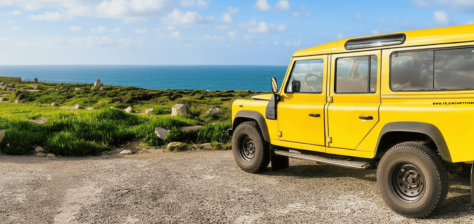
Yellow Cab TT Tours offers 9 Sintra-related itineraries departing daily from Lisbon: 7 private tours, 1 group tour, and 1 4×4 Land Rover tour. Prices start at €56 per person (private).
Main Attractions in Sintra
Palacio de Pena
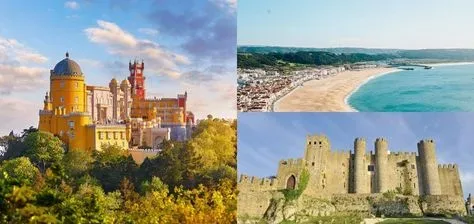
Pena Palace (Palácio da Pena) is the primary architectural landmark of Sintra, situated at approximately 500 m above sea level on the Serra de Sintra. Construction began in 1842 under King Ferdinand II (Ferdinand of Saxe-Coburg-Gotha) and was completed in 1854. The original structure on this site was a 16th-century Hieronymite monastery, largely destroyed in the 1755 Lisbon earthquake.
The architect was Wilhelm Ludwig von Eschwege, a German engineer and amateur architect. The palace combines Gothic, Manueline, Moorish, and Renaissance styles within the same building. The exterior walls are painted yellow and red – colours that have become the most reproduced image of Sintra.
The palace and its park together cover 85 hectares. Pena Palace attracts approximately 1.5 million visitors per year, making it Portugal’s most visited monument. It was classified as one of the Seven Wonders of Portugal in 2007.
Practical: Pena Palace opens at 09:30. Queues at the palace gate typically begin forming from 10:30 onwards, peaking between 11:00 and 14:00. Early arrival is strongly recommended from April to October.
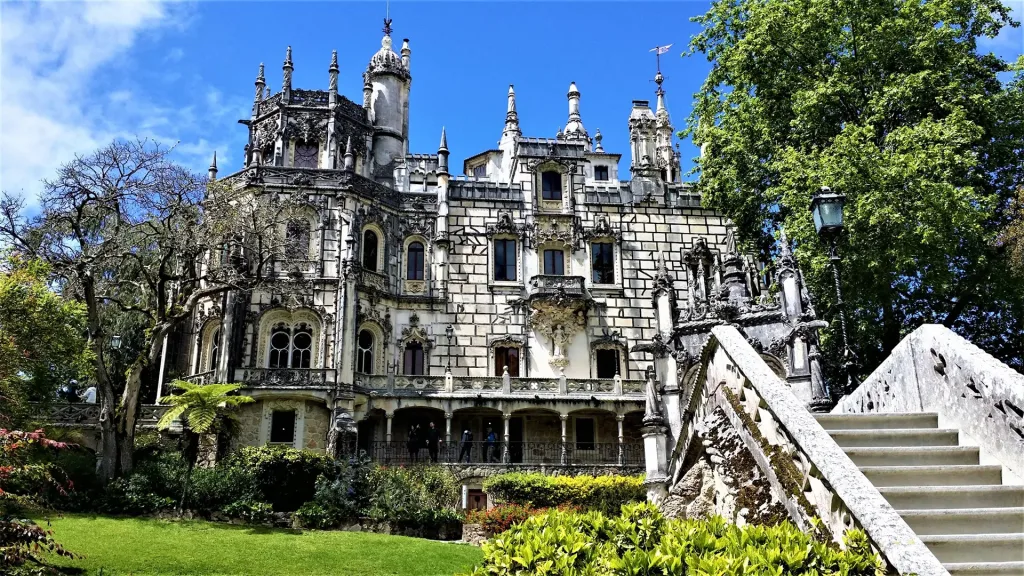
Quinta da Regaleira
Quinta da Regaleira is a palace and garden estate of approximately 4 hectares located in the historic centre of Sintra, 500 m from the National Palace. Construction took place between 1904 and 1910 under the patronage of António Augusto Carvalho Monteiro, a Brazilian-Portuguese millionaire who made his fortune in the Brazilian coffee and diamond trade.
The palace and gardens were designed by Luigi Manini, an Italian architect and opera set designer. The overall aesthetic draws on Templar Knights symbolism, Freemasonry, Rosicrucianism, and Romantic-era mysticism.
The most visited feature of the estate is the Initiation Well (Poço Iniciático): an inverted tower descending 27 m underground, with a spiral staircase of nine landings – referencing the nine circles of Hell described in Dante Alighieri’s Inferno (c. 1308–1320). The staircase is supported by carved stone columns and ends at a Templar cross set into the stone floor. An underground tunnel connects the well to a grotto and to other points in the garden.
Quinta da Regaleira was designated a UNESCO World Heritage Site (as part of the Cultural Landscape of Sintra) in 1995.
Castillo de los Moros
The Moorish Castle (Castelo dos Mouros) is the oldest surviving fortification in Sintra, built by North African Moors in the 9th century to control the mountain pass between Lisbon and the northern territories. The castle walls extend over 1 km along the ridge of the Serra de Sintra at approximately 400 m altitude.
In 1147, King Afonso I of Portugal captured the castle during the Reconquista – the same military campaign in which Lisbon was taken from Moorish control. The castle fell into disrepair after the 15th century and was partially restored in the 19th century under King Ferdinand II, the same monarch who commissioned Pena Palace.
The castle is connected to Pena Palace by a walking path of approximately 15 minutes within the park. Both are managed by Parques de Sintra Monte da Lua, the public company that administers most of Sintra’s monuments.
Palais National de Sintra
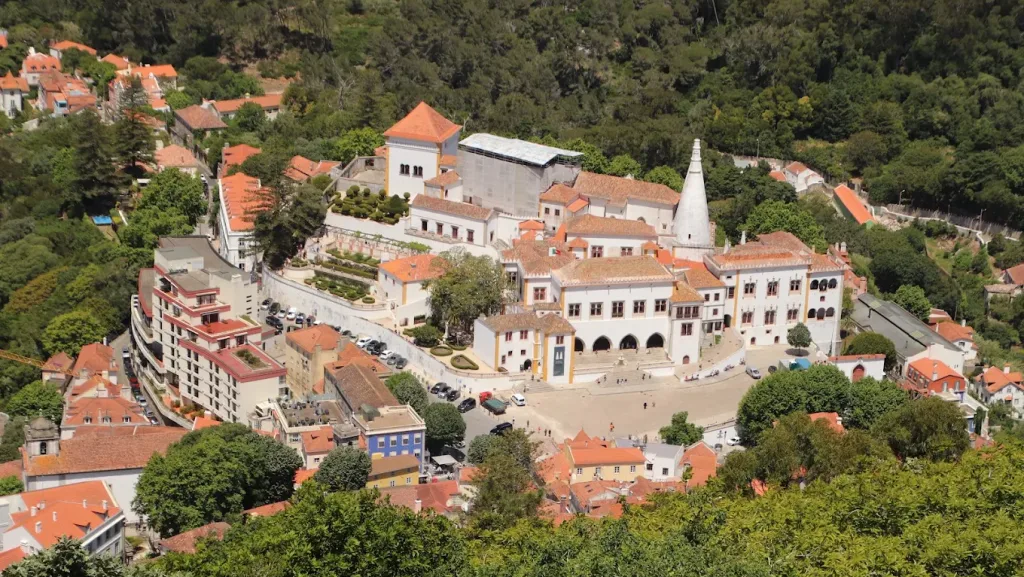
The National Palace of Sintra (Palácio Nacional de Sintra) is located in the town centre (Vila de Sintra) and is the oldest surviving royal palace in Portugal that has remained in continuous use. Its two conical chimneys — each approximately 33 m tall – are the most recognizable feature of Sintra’s skyline and are visible from much of the surrounding landscape.
The palace was substantially developed under King João I in the early 15th century and expanded under King Manuel I in the early 16th century. It served as the principal royal residence in Sintra for over five centuries, until the royal family abandoned it in 1910 following the Portuguese revolution.
The interior contains Mudéjar tilework, the Sala dos Brasões (heraldry hall with coats of arms of 72 noble families), and a kitchen with the chimneys that rise directly above the cooking area. The palace is open to visitors daily.
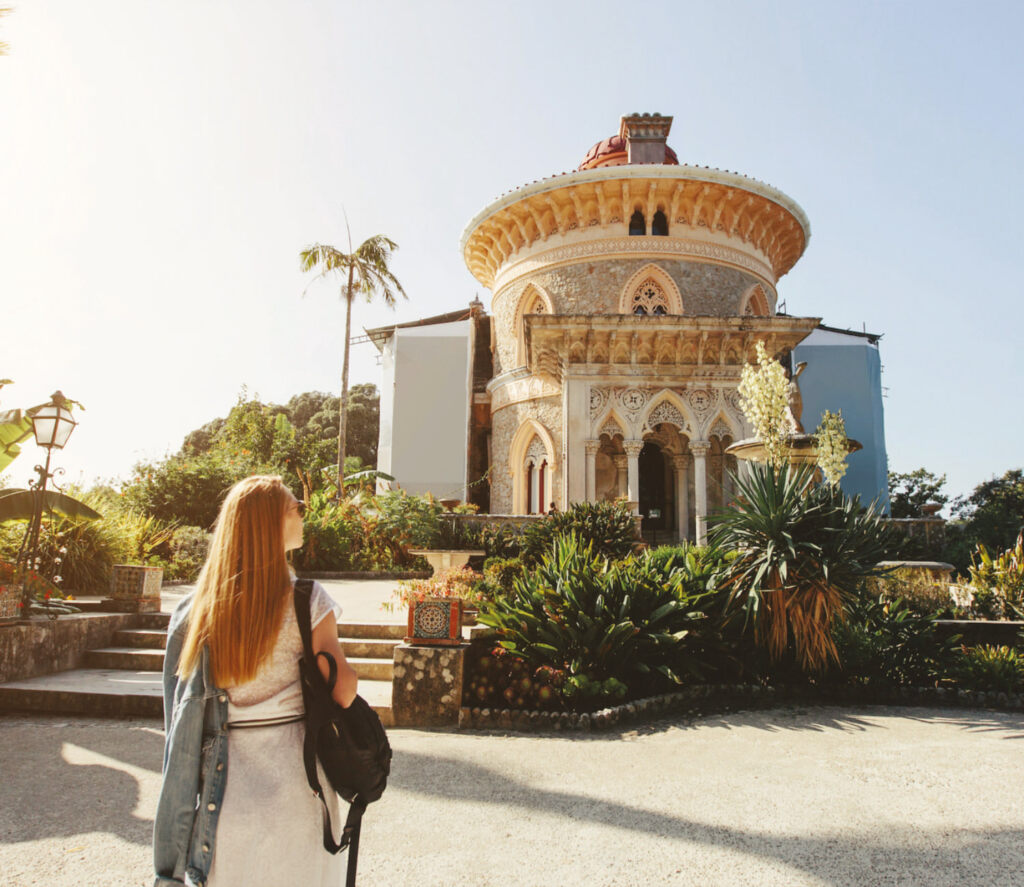
Palacio de Monserrate
Monserrate Palace is located 3 km west of Sintra’s historic centre. The current building was commissioned by Francis Cook, an English merchant, and constructed between 1858 and 1885. The architect was James Knowles Jr. The design combines Neo-Gothic, Moorish, and Indian architectural elements, with a central dome inspired by Mughal architecture.
The surrounding Monserrate Park covers approximately 30 hectares and contains plant species from more than 80 countries, collected during the 19th century when Monserrate was a private botanical estate.
Monserrate receives significantly fewer visitors than Pena Palace or Quinta da Regaleira, making it a practical alternative when the main sites are crowded.
&
What to eat in Sintra
Two pastries are specific to Sintra and cannot be authentically sourced elsewhere in Portugal.
Travesseiros de Sintra are a puff-pastry pillow filled with almond-egg cream, baked golden and dusted with icing sugar. They were created by the Casa Piriquita bakery in Sintra, established in 1862.
Queijadas de Sintra are small tarts with a filling of fresh cheese, sugar, eggs, and cinnamon, in a very thin pastry shell. The recipe dates to at least the 16th century, when they were produced in Sintra’s convents. The Fábrica das Verdadeiras Queijadas da Sapa has produced them since 1756.
Both pastries are found at Piriquita (Rua das Padarias, historic centre) and at several adjacent bakeries. A standard portion of 6 travesseiros costs approximately €4–5.
How to Get to Sintra from Lisbon
By train: Comboios de Portugal operates direct trains from Rossio Station (Lisbon) to Sintra station, journey time approximately 40 minutes. Trains depart every 20–30 minutes. Return fare on a Navegante card: €5.10 (2025 rate). Single paper ticket: approximately €2.60 per direction.
By private transfer or tour: door-to-door from Lisbon, typically 30–50 minutes depending on traffic. Private transport allows direct access to Pena Palace parking before the main visitor wave.
Sintra station is approximately 1.5 km from the historic centre and 4 km from Pena Palace. Bus 434 (Scotturb) connects the station to the palaces, departing every 15 minutes in high season.
July–August: peak season. Pena Palace queues of 45–90 minutes without advance booking are common. Parking at the palace reaches capacity before 10:00 from late June onwards.
September–October: warm, quieter than summer, vegetation at full growth.
November–March: off-peak. Prices unchanged, crowds significantly reduced. The Serra microclimate produces more rainfall and morning mist, which can obscure views from Pena Palace but adds a different character to the landscape. Temperatures rarely drop below 8°C.
Advance booking for Pena Palace and Quinta da Regaleira is recommended throughout the year. Walk-up entry without a booking is not guaranteed on weekends and public holidays, particularly from April to October
.
&
Tours from Lisbon to Sintra
Yellow Cab TT Tours operates 9 Sintra itineraries from Lisbon. Private tours depart at 08:30 and return by 18:00, timing which allows arrival at Pena Palace before the main visitor volume that concentrates between 10:30 and 14:00. All tours are private — vehicle and guide are exclusively for your group.
Sintra is 28 km northwest of Lisbon. By direct train from Rossio Station, the journey takes approximately 40 minutes. By private vehicle, the drive is 35–50 minutes depending on traffic.
How long does a day trip to Sintra take?
A full day in Sintra is typically 8–9 hours from Lisbon and back. This allows time to visit two major monuments (e.g. Pena Palace and Quinta da Regaleira) plus the historic centre. Visiting all five main palaces in a single day is not practical.
Do I need to book Sintra palaces in advance?
Yes. Pena Palace and Quinta da Regaleira require advance booking, particularly from April to October. Walk-up availability on weekends is limited. Booking online 3–7 days in advance is recommended in peak season.
What is the best palace to visit in Sintra?
Pena Palace has the highest visual impact and is the most photographed. Quinta da Regaleira offers the most complex symbolism and the Initiation Well experience. The National Palace of Sintra has the most complete medieval interior. Monserrate is the least crowded.
Can I visit Sintra and Cascais in the same day?
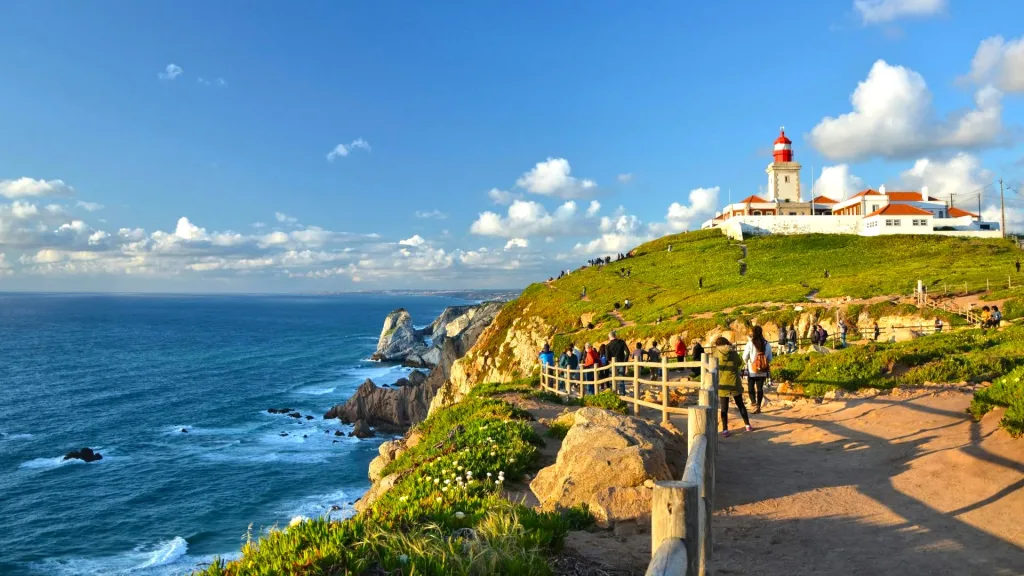
Yes. This is the most common Sintra day-trip format. The distance between Sintra and Cascais is 25 km by road (via the coast road through Guincho). One full palace visit in Sintra (2–3 hours), then Cabo da Roca and Cascais fills a standard 8-hour day.
Is Sintra worth visiting in winter?
Yes. Crowds are significantly reduced from November to February. Pena Palace and most monuments remain open. The Serra de Sintra microclimate is wetter in winter, which can produce mist - particularly in the morning - but temperatures rarely fall below 8°C.
Is the Initiation Well actually a well?
No. The Initiation Well at Quinta da Regaleira was never used to draw water. It descends 27 m underground via a spiral staircase of nine landings, referencing the nine circles of Dante's Inferno. It was designed by Luigi Manini in 1904 for ceremonial purposes connected to Templar and Masonic symbolism.
Is Sintra accessible by public transport from Lisbon?
Yes. Comboios de Portugal operates frequent direct trains from Rossio Station to Sintra Station (approximately 40 minutes, every 20–30 minutes). From Sintra Station, Bus 434 connects to Pena Palace and the historic centre. The total journey from central Lisbon to Pena Palace is approximately 1.5 hours by public transport.
What is the difference between a private tour and a group tour to Sintra?
A private tour is exclusively for your group, with a fixed itinerary and a dedicated guide. A group tour follows a set schedule with other passengers and standard stops. Private tours allow flexibility at each attraction; group tours cost less per person.
Are private tours to Sintra worth the extra cost?
Private transport allows departure at 08:30 and arrival at Pena Palace before the main crowd wave (which builds from 10:30). This alone saves 45–90 minutes of queue time during peak season. The guide can also adjust time at each stop based on the group's pace.
¿Reserva de última hora?
Utilizamos cookies para ofrecerte la mejor experiencia en nuestro sitio web.