

Above the entrance to the Chapel of Bones in Évora, there is an inscription in Portuguese: “Nós ossos que aqui estamos pelos vossos esperamos.” In English: “We bones here are waiting for yours.”
Most visitors stop when they read this. Some take a photo. A few reconsider whether to go in.
The chapel was built in the 16th century by Franciscan monks who wanted to create a space for meditation on death — memento mori — at a time when Évora’s cemeteries were overcrowded and the Church was placing intense theological emphasis on the transience of human life. The monks used the disinterred remains of approximately 5,000 people to construct the walls and columns of a small chapel attached to the Igreja de São Francisco.
This article explains what the chapel is, who built it and why, what the inscription means in full context, and what you will actually see when you visit. I have brought clients here on Évora day tours since 2013. The chapel is consistently the stop that people talk about longest on the drive home.
What Is the Chapel of Bones?
The Chapel of Bones (Portuguese: *Capela dos Ossos*) is a small ossuary chapel located in the interior of the Igreja de São Francisco (Church of Saint Francis) in Évora, in Portugal’s Alentejo region. It was built in the 16th century and measures approximately 18 metres long by 11 metres wide.
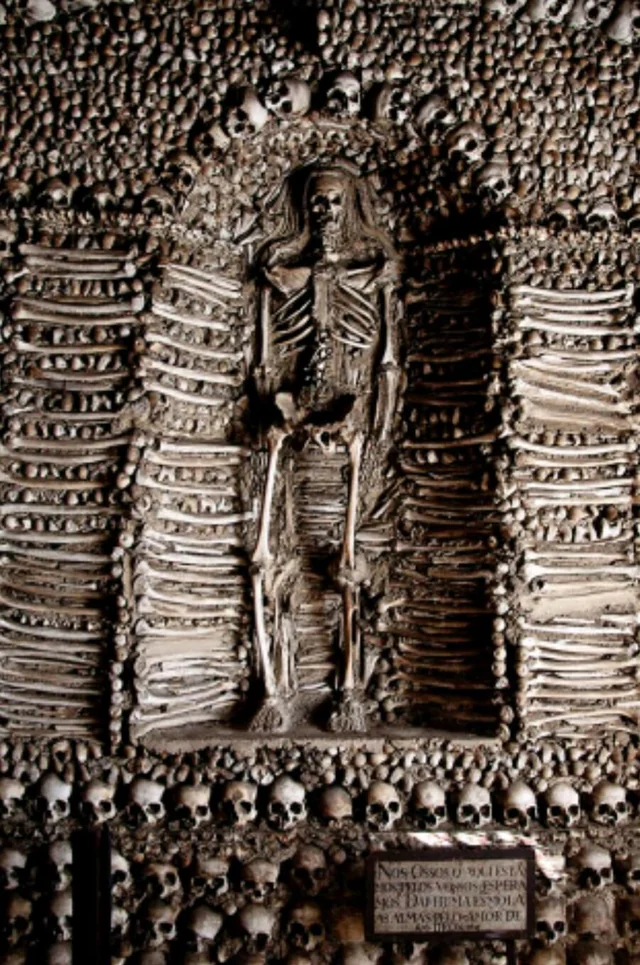
The walls, columns, and ceiling of the chapel are covered with the bones and skulls of approximately 5,000 human remains, exhumed from the Franciscan order’s cemeteries in and around Évora. These were not anonymous medieval victims. They were largely monks and members of the Franciscan community, whose remains were moved here as the cemeteries ran out of space.
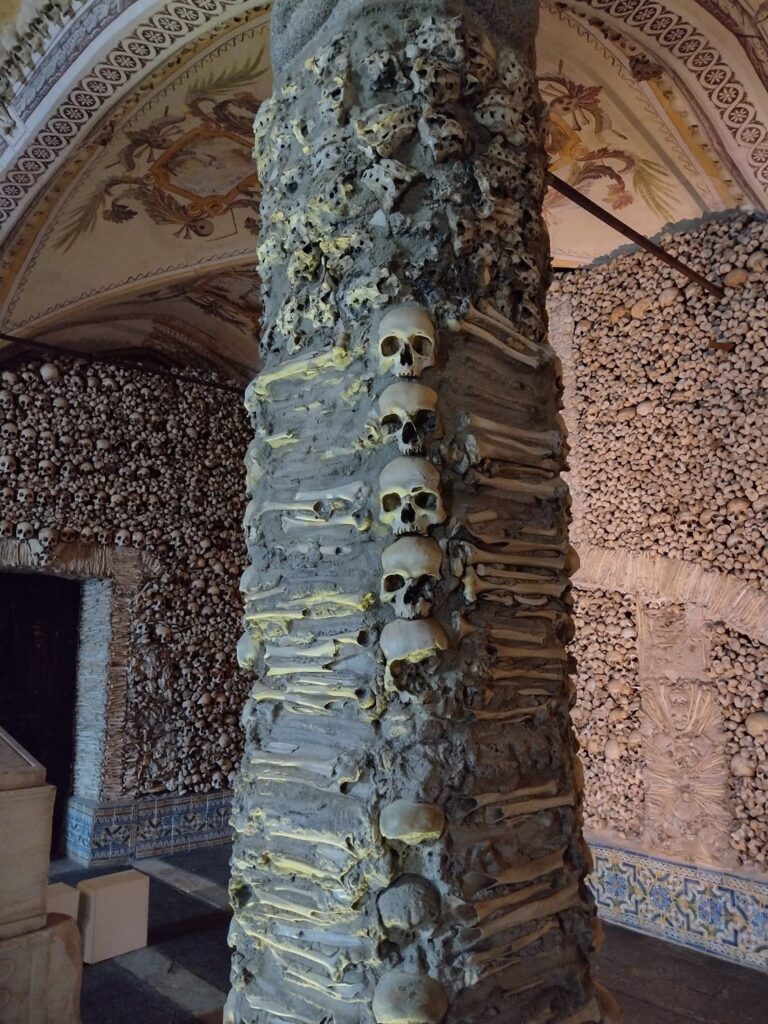
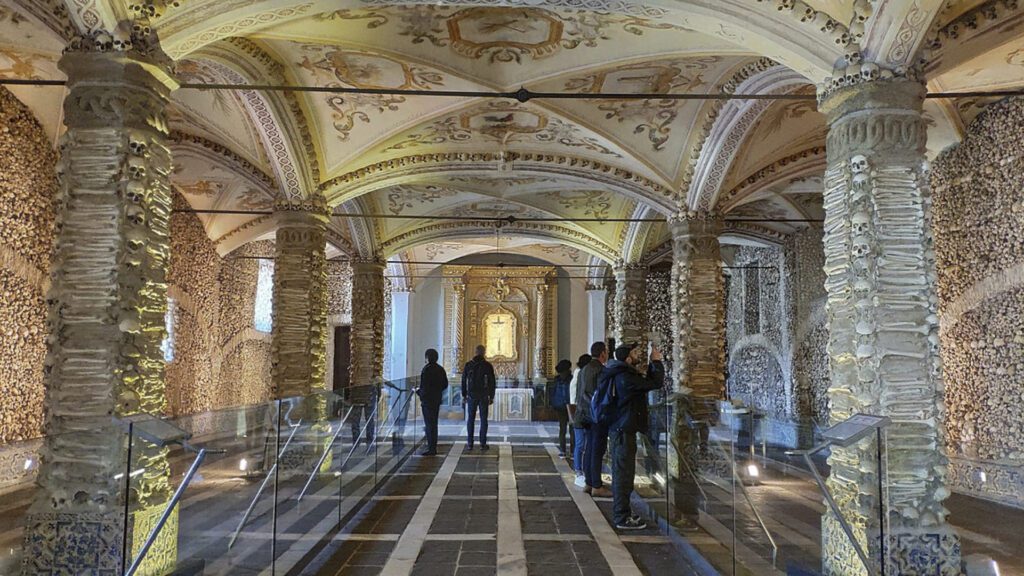
The chapel is not a crypt. It is an active place of worship — or was, historically. Visitors enter through the Igreja de São Francisco and pass through the main nave before reaching the chapel entrance. The ceiling of the chapel is painted with religious frescoes that remain partially visible, though they have faded significantly over the centuries.
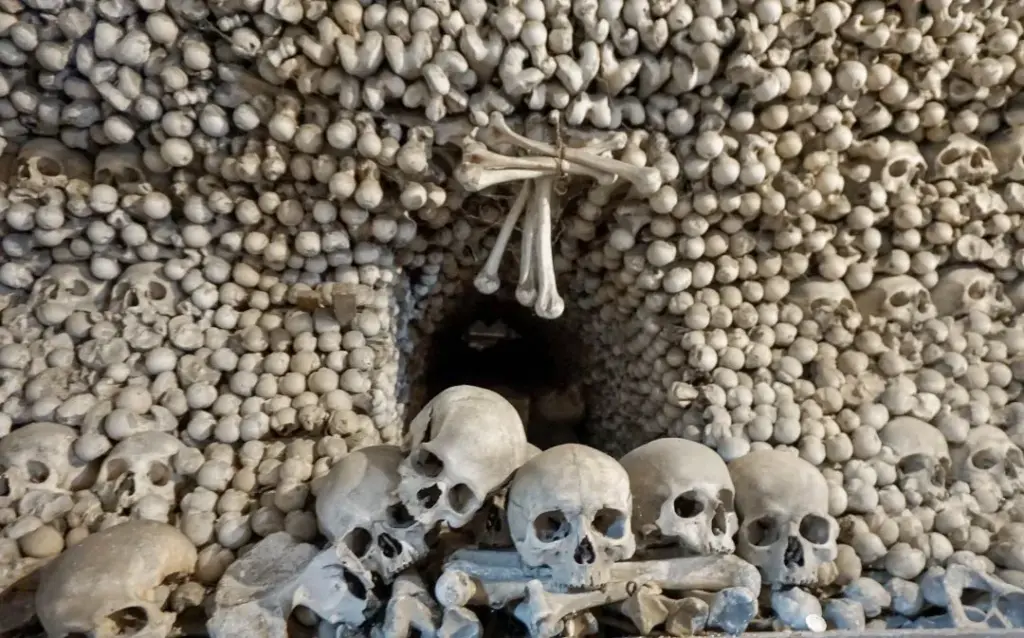
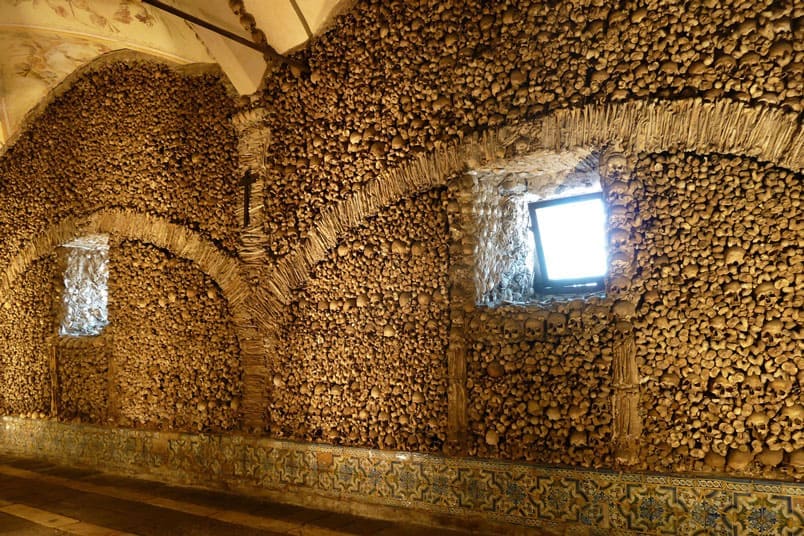
The bones are set into the plaster and mortar of the walls. Skulls alternate with femurs in repeating patterns. The effect is architectural as much as it is macabre — the monks applied the same compositional logic they would have used for any decorative element. Symmetry, repetition, hierarchy.
I find that people who come expecting a horror experience are often surprised. The chapel is quiet. It is not dramatic in the way that photographs suggest.
Who Built It and Why?
The “why” is the answer most visitors get wrong — they assume punishment or spectacle. The real reason is demographic and theological.
The chapel was constructed in the 16th century by three Franciscan monks whose names are not recorded in surviving documents. The construction took place against a specific historical backdrop: Évora was, at the time, one of the largest cities in Portugal, functioning as the secondary royal court and a major centre of Franciscan activity. The Franciscans operated multiple convents and cemeteries in the area, and by the 1500s, these cemeteries had accumulated an unsustainable number of interments — estimated at around 45 cemeteries in and around Évora alone.
The practical problem was space. The theological context was *memento mori* — the Catholic practice of keeping death visible as a discipline against pride and attachment to earthly life. The Counter-Reformation, which began formally with the Council of Trent (1545–1563), intensified this tendency. Ossuaries and bone chapels were constructed across Catholic Europe during this period: the Sedlec Ossuary in Bohemia (built 14th century, decorated 1870), the Capuchin Crypt in Rome (17th century), and the Chapel of Bones in Évora all reflect the same theological impulse, though each was built independently.
The monks who built the Évora chapel were not trying to frighten visitors. They were constructing what they understood as a devotional space — a reminder that biological life is temporary and that what follows it, in Christian theology, is not. The bones are displayed to be seen. The inscription is placed where it cannot be missed. The combination was deliberate.
The Inscription Above the Door
The inscription is the most-discussed element of the chapel. Most online sources quote the first line. The full text is more interesting — and harder to find in English.
The inscription above the chapel’s entrance reads, in full:
“Nós ossos que aqui estamos pelos vossos esperamos.”
This translates directly as: “We bones here are waiting for yours.”
The sentence is written in the first-person plural from the perspective of the dead — the bones themselves are speaking. This is a rhetorical device known as *prosopopeia* (giving voice to inanimate objects or the dead), common in medieval and early modern European literature and funerary art.
The phrase is not a threat or a curse. In context, it is an invitation to reflection: the people who made these bones were once alive; the people reading this inscription will eventually join them. The chapel frames death not as an ending but as a threshold — consistent with Franciscan theology and *memento mori* tradition.
The authorship of the inscription is unknown. It is not attributed to any specific person in Évora’s historical records. Variations of the phrase appear in other European ossuaries, suggesting it may have been a common formula rather than a local original. The earliest verified use in Évora dates to the chapel’s construction in the 16th century.
Some visitors misread the Portuguese as aggressive or morbid. Read in its intended theological register, it is closer to an acknowledgement of shared condition. Which is not necessarily more comforting, but is historically accurate.
What You Will See Inside
Ground what the visitor will actually experience — sensory and spatial.
The chapel is entered from inside the Igreja de São Francisco. After passing through the main nave of the church, visitors reach a doorway flanked by bones and topped with the famous inscription. The interior space is approximately 18 × 11 metres — small enough that a single camera position captures most of it.
The walls from floor to approximately two-thirds of the ceiling height are covered with bones set in mortar. Skulls are placed at regular intervals. Femurs, tibias, and other long bones form the bulk of the wall surface. The pattern is deliberate rather than random. In the columns and archways, bones are arranged concentrically, with skulls marking structural points.
The ceiling is vaulted and painted. The frescoes depict religious and allegorical scenes — skeletons, hourglasses, crosses — in a style consistent with 16th–17th century Portuguese religious art. The paint has faded and, in sections, flaked away, but the imagery remains legible.
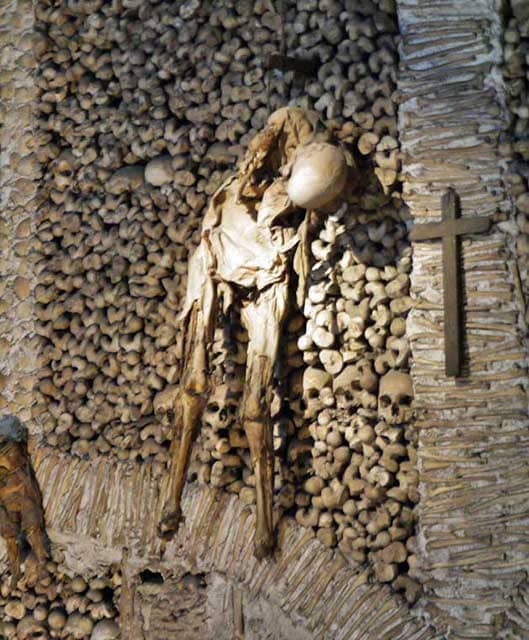
At the far end of the chapel, there are two withered human bodies suspended from the wall. These are not bones. They are desiccated corpses. One is said to be a man; one is said to be a child. Local tradition has attributed these to a curse — a story involving an alleged wife-murderer — but this attribution is not documented in verifiable historical sources. The corpses have been in the chapel for an unknown period and are displayed without formal explanation.
Natural light enters through small windows on one side of the chapel. There is no artificial lighting beyond ambient sources. The chapel is cooler than the church nave.
The Two Bodies Hanging from the Wall
This element surprises most visitors more than the bones. It deserves separate treatment because the popular story around it is largely folklore.
Of everything in the Chapel of Bones, the two suspended corpses are the element that visitors mention most frequently and about which the least reliable information circulates online.
The bodies are mummified through desiccation rather than chemical preservation. They hang from iron fixtures in the chapel wall. One is adult-sized; one is notably smaller, consistent with a child’s proportions. Interpretive materials at the chapel describe them as male and female, or as an adult and a child, depending on the source — the accounts are inconsistent.
The most widely repeated story is that the adult is a man who murdered his wife and son, and that the woman’s family placed a curse on the bodies so they would never decompose. This narrative appears in local guides, travel blogs, and tourist materials. It does not appear in documented historical sources. The corpses are real; the story attached to them is local folklore of uncertain origin.
What is documented: the bodies have been in the chapel for at least several hundred years. Their identity has not been established by modern forensic analysis. The Évora municipality and the Diocese of Évora have not released findings on the bodies’ origin.
They are displayed openly, without glass or barriers. Most visitors are not prepared for this — the shift from bone-architecture to intact bodies produces a noticeably different reaction.
I tell clients about this before we enter. Not to manage expectations, but because it is genuinely different from the rest of the chapel and deserves a sentence of preparation.
History of the Building — Igreja de São Francisco
The chapel exists within a much larger church that is significant in its own right. Understanding the building helps.
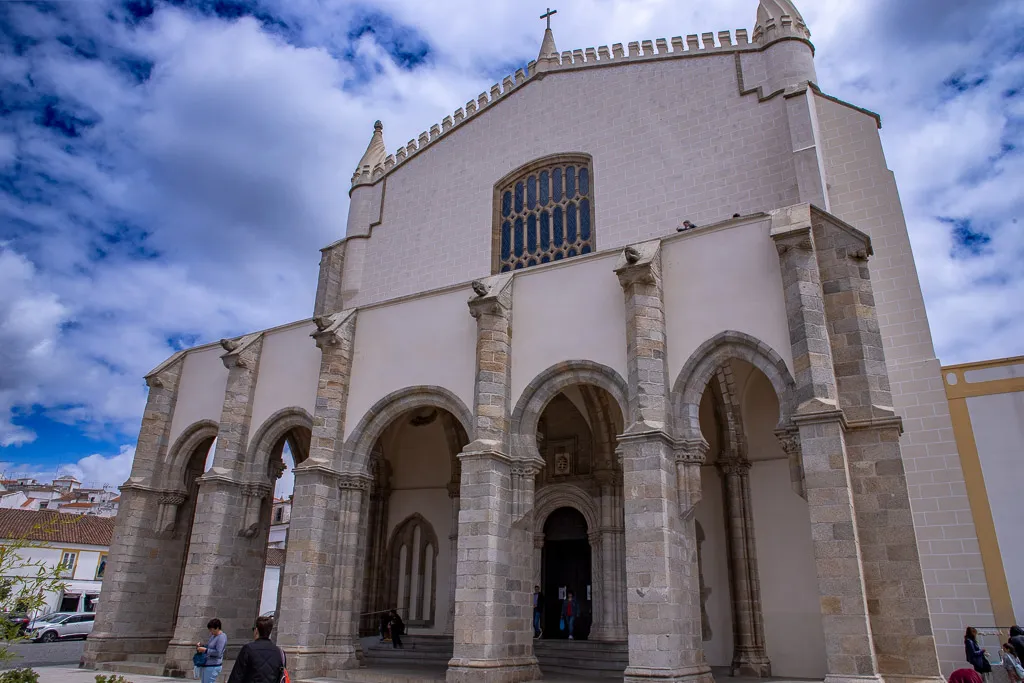
The Igreja de São Francisco is one of the most important Gothic-Manueline buildings in Portugal. Construction began in approximately 1460, during the reign of King Afonso V, and was completed in the early 16th century under King Manuel I. The church was built on the site of an earlier Franciscan convent and served as the royal chapel of the Évora court during the period when the Portuguese court was based in the city.
The exterior of the church is late Gothic in structure with Manueline decorative elements — twisted columns, maritime motifs, the armillary sphere associated with Manuel I. The main portal is flanked by Gothic towers and features the royal coat of arms of Portugal. The nave is 67 metres long and 22 metres wide, making it one of the largest Gothic interiors in Portugal.
The Franciscan order occupied the site from the 13th century. After the suppression of religious orders in Portugal in 1834, the church was transferred to diocesan control and reopened as a parish church. The Chapel of Bones was preserved through this transition and continued to receive visitors.
The chapel is accessible from the south transept of the church. Entry to the church itself is free; the chapel requires a separate ticket.
Visiting Practical Guide — Hours, Tickets, Tips
The operational facts that every article about this site needs but most bury at the bottom.
Location: Igreja de São Francisco, Praça 1 de Maio, 7000-650 Évora. The church is in the historic centre, approximately 400 metres south of the Roman Temple.
Opening hours:
- Summer (legal summer time): 09:00–18:30.
- Winter (legal winter time): 09:00–17:00.
- Sunday mornings reserved for Mass — chapel closed to visitors until 13:00.
Tickets:
- Adults: €7 (chapel only) or combined ticket with the Igreja de São Francisco.
- Reduced: €3.50 (students, seniors).
- Children under 6: free.
- Tickets are bought at the church entrance on the day. No advance online booking required or typically available.
- Per our policy: tickets are always purchased on the day with the guide. No pre-booking is offered or needed.
Photography: permitted inside. Flash is generally discouraged but not prohibited. There are no signs restricting photography as of the most recent visits.
Crowds: The chapel is small. Peak visitor density occurs between 10:30–13:00, particularly on weekends and in summer. Arriving at 09:00–09:30 or after 15:00 reduces wait time at the entrance.
From Lisbon: Évora is 140 km from Lisbon via the A6 motorway, approximately 1 hour 30 minutes by private vehicle. A dedicated private day tour allows time at the chapel plus the Roman Temple, Cathedral, and other sites without rushing.
Visit Évora's Chapel of Bones with a Guide

FAQ
What is the Chapel of Bones in Évora?
How many bones are in the Chapel of Bones?
Who built the Chapel of Bones?
What does the inscription above the door mean?
Who are the two bodies hanging in the chapel?
Is the Chapel of Bones free to enter?
What are the opening hours?
Is the Chapel of Bones appropriate for children?
How long does a visit take?
Can I visit the Chapel of Bones without a tour?

Founder & Director of Yellow Cab TT Tours. Guiding in Portugal for 20+ years.
Founded Yellow Cab TT Tours in 2013. 3,372 five-star reviews on Tripadvisor.