

The queue outside Fábrica dos Pastéis de Belém starts before the doors open. By mid-morning on a summer weekend, it wraps around the corner onto Rua de Belém and people join it without entirely knowing why — only that everyone else is doing the same. Most of them are waiting in the wrong line. The takeaway queue can stretch 40 minutes. Walk past it, step inside, and you will typically be seated within ten.
That gap between what tourists experience and what the place actually offers is a reasonable metaphor for pastel de nata itself. Everyone knows the name. Fewer people know what distinguishes a genuinely good one from a mediocre one sold at double the price in an airport.
This is not a list of the fifteen best bakeries in Lisbon. I have been guiding clients through Belém since 2005, and I have watched the pastel de nata go from a local staple to a global export that now appears on the Great British Bake Off and in matcha flavour in Tokyo. What I can offer is the history behind the tart — which is more interesting than most food guides suggest — the logic of how it is made, the actual difference between a pastel de nata and a pastel de Belém, and where to eat one that justifies the trip.
What Is a Pastel de Nata?

How the Recipe Was Born — The Monastery Story
The Jerónimos Monastery in Belém was founded in 1501 by King Manuel I, built largely on the profits of the spice trade. For three centuries it functioned as one of the most important religious houses in Portugal. It also, incidentally, produced an enormous quantity of egg yolks.
The monks used egg whites to starch their habits. This was standard practice in Portuguese convents and monasteries — egg white stiffens fabric effectively, and the Church consumed it in considerable quantities. What remained was the yolk, which had to go somewhere. The answer was pastry: rich, egg-heavy sweets that became a defining feature of Portuguese convent cuisine and gave the country a legacy of egg-yolk desserts that runs from pastéis de nata to ovos moles to barriga de freira.
The recipe for what would become the pastel de nata was developed at Jerónimos before the 18th century. The precise date is unknown, which is not unusual — monastery recipes were not published; they circulated through kitchens. What changed the situation entirely was politics.
In 1820, Portugal’s Liberal Revolution began restructuring the relationship between the state and the Church. Religious orders came under pressure. By 1834, the monasteries were formally dissolved. The monks at Jerónimos, facing closure, had already begun selling pastéis at a nearby sugar refinery to generate income. After the monastery shut, the recipe passed to the refinery owners. In 1837, Fábrica dos Pastéis de Belém opened at its current location at Rua de Belém 84–92, metres from the monastery gates. It has been operating continuously since.
The recipe remains a documented secret. Only approximately six people know the complete formula — the master bakers at the Fábrica, trained through direct apprenticeship in a room referred to as the Oficina do Segredo (the Secret Workshop). It has never been published, licensed, or replicated with confirmed accuracy. The Guardian included the Pastéis de Belém in its list of the 50 best foods in the world in 2009. The recipe remains unpublished.
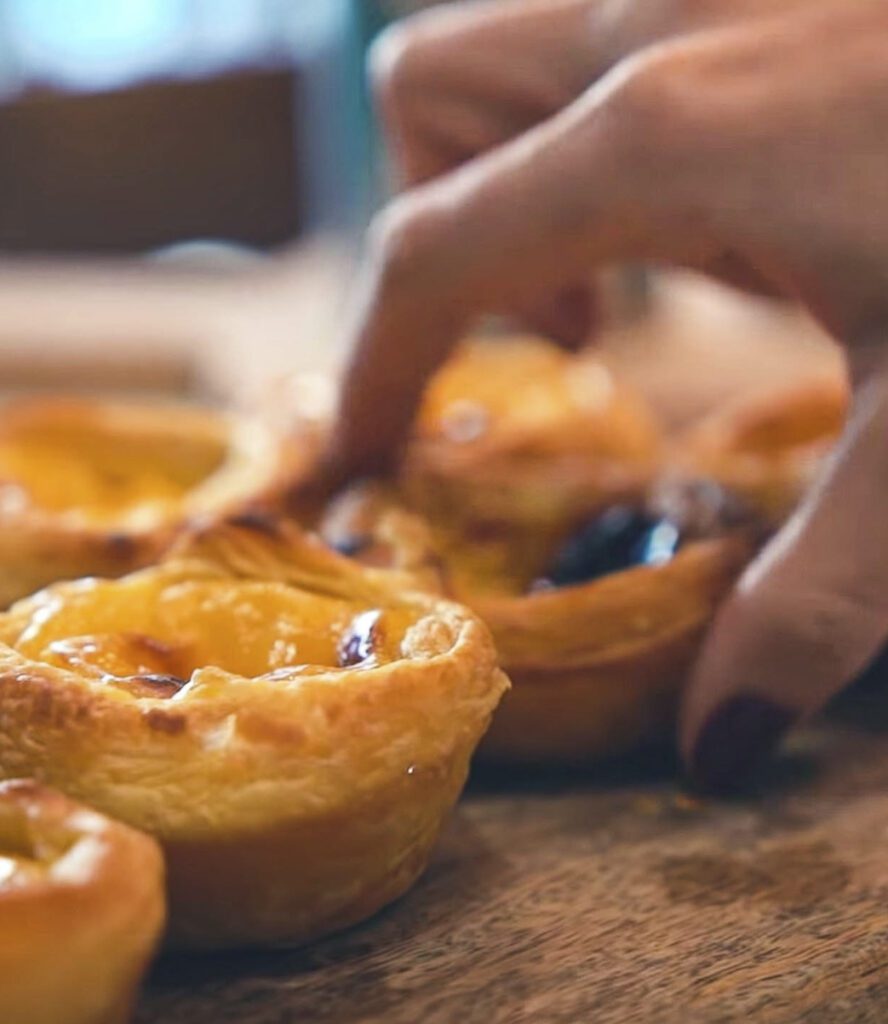
Pastel de Nata vs Pastel de Belém: Is There Actually a Difference?
Yes — legally and, most people argue, in practice.
A pastel de Belém is made exclusively at Fábrica dos Pastéis de Belém using the 1837 secret recipe. The name is trademarked. No other bakery in Portugal, or anywhere else, can legally call their product a pastel de Belém. Every other version, regardless of quality, is a pastel de nata.
In practice, the Belém version is described by most people who have compared both seriously as having a creamier, denser custard and a noticeably flakier, more layered pastry shell. The difference is real but not dramatic. Whether it justifies a 40-minute queue and a trip across the city is a personal calculation.
Here is the part guidebooks usually omit: Pastelaria Aloma, in Campo de Ourique, has won the annual blind competition for the best pastel de nata in greater Lisbon five times — in 2012, 2013, 2015, 2024, and 2025. The competition is judged by culinary professionals who taste without knowing the source. Aloma, opened in 1943 in a quiet residential neighbourhood with no tourists and no queue, has beaten the Fábrica in blind judging more times than any other bakery in the city.
This does not mean Aloma is objectively better. Blind tastings are not objective. It means the difference is smaller than the mythology suggests, and that geography and queues should not be the deciding factor if you have any interest in the actual tart.
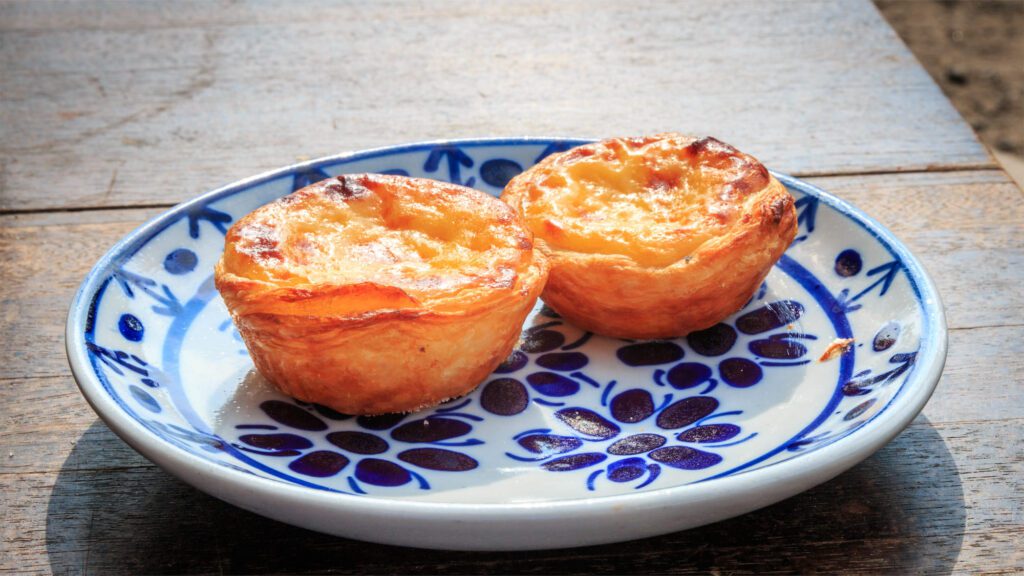
What Makes a Good One: The Four-Point Test
After years of eating these with clients, I have settled on four things worth checking:
1. The char. The top should have dark amber to near-black spots across the custard surface – not a uniform pale yellow. Absence of char means it was baked too cool. A fully blackened top means it was left in too long. The sweet spot is irregular patterning.
2. The crack. Tap the base with a fingernail. A good tart has a dry, crisp bottom that makes a faint sound. A soft, doughy base means the pastry was undercooked, which happens when the oven was not hot enough or the tart sat in a display case too long.
3. The wobble. The custard should be fully set at the edges and carry a slight softness at the centre. If it is completely rigid throughout, it was overbaked. If it slumps when you lift it, it was underbaked.
4. The spiral. Turn the tart over. A correctly made pastry shell has a visible spiral pattern at the base – the result of rolling and folding the dough correctly. A smooth or irregular base is a sign of shortcut pastry.None of this requires expertise. It takes about fifteen seconds and is considerably more useful than reading a ranking.

Where to Eat Pastel de Nata in Lisbon
Fábrica dos Pastéis de Belém
Rua de Belém 84–92 · Daily 08:00–23:00 · ~€1.50–1.60 per tart
The original and the reference point. Worth visiting at least once – for the history as much as the tart. See the section below on how to visit without losing an hour to the queue.
Pastelaria Aloma
Rua Francisco Metrass 67, Campo de Ourique · Mon–Sat 08:00–19:00, closed Sunday · ~€1.40–1.50
Five-time winner of Lisbon’s blind competition. Opened in 1943. No tourists. No queue. The tart is excellent and the neighbourhood is worth the tram ride.
Manteigaria
Rua do Loreto 2, Chiado · Daily 08:00–00:00 · ~€1.40
Founded 2014 in a former butter warehouse (the name means “the butter shop”). The production is visible through a glass window – you can watch the pastry being made, which is either reassuring or dangerously compelling depending on your self-control. Five Chiado-area locations. These tarts travel better than the Belém version if you are taking them home.
Confeitaria Nacional
Praça da Figueira 18, Baixa · Since 1829
The oldest surviving pastry shop in Lisbon. The pastel de nata is not the focus of the menu, but the building has operated continuously for nearly two centuries, which is not something Lisbon offers casually.
A note on timing: pastéis de nata are a morning food. Most serious bakeries bake in batches every 20–30 minutes starting at opening. A tart bought at 08:30 is a fundamentally different experience from the same tart at 16:00 after sitting in a display case. If you are going specifically for the tart, go early.
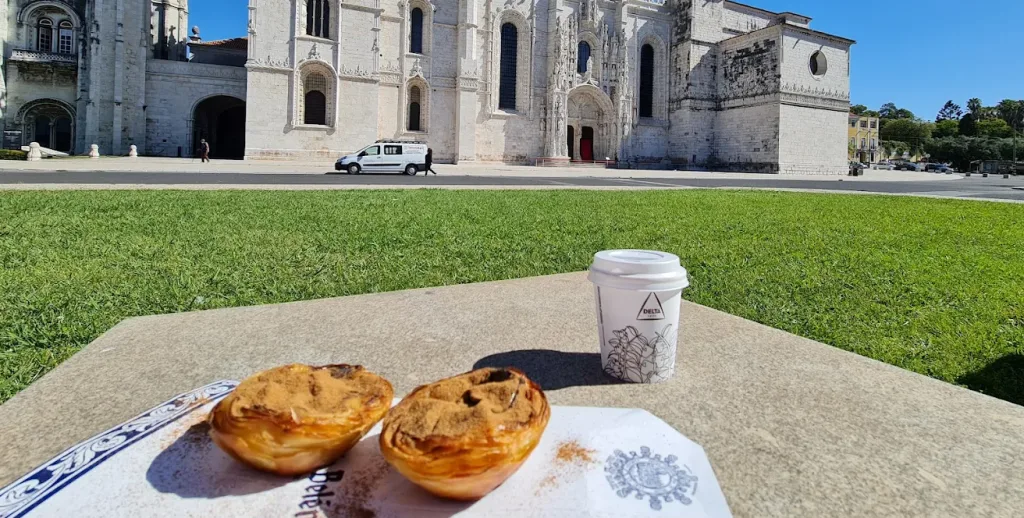
How to Visit Fábrica dos Pastéis de Belém Without Wasting an Hour
The queue that wraps around the building is almost entirely for takeaway. It can be 30–40 minutes on a busy weekend. The interior – which has over 1,000 seats across several tiled rooms – operates separately, with typical waits of under 10 minutes even at peak times.
Walk past the queue. Enter through the café door. A host will seat you. You will receive table service. The tart will arrive warm, with cinnamon and sugar on the table. The price is the same as takeaway.
The best times to visit if you want no wait at all: weekdays before 09:00, or after 18:00 any day. The building opens at 08:00.
Getting there:
- Tram 15E from Cais do Sodré → Praça Afonso de Albuquerque (stop is 400 m / 5-minute walk from the Fábrica)
- Cascais Line train from Cais do Sodré → Belém station (20 min by train, then ~10-minute walk)
- By car: parking near the Fábrica is limited; the riverside parking at Belém fills by 10:00 on weekends
If you are already visiting Belém for the Jerónimos Monastery or the Tower of Belém, the Fábrica is a 3-minute walk from both. This is the logical moment to go – not a separate trip.

Pastel de Nata Around the World
The spread of pastel de nata outside Portugal is partly historical and partly recent.
The historical part: Portugal’s colonial presence in Macau, Goa, Brazil, Mozambique, and Timor-Leste carried convent recipes with it. Macau’s pastel de nata is a direct descendant, now distinct enough to be considered a separate regional variation — a flatter, less charred version with a higher egg-yolk ratio. Goa has its own egg-custard tart tradition. These were not exports; they were transplants that evolved independently.
The recent part is more abrupt. In 2018, Lidl UK reported selling 2,000 pastéis de nata per hour across its stores — competing with doughnuts for the most purchased bakery item. That same year, the pastry appeared on The Great British Bake Off, which functions, for the British public, as the official certification of a foreign food’s arrival. Bloomberg published a piece in 2019 predicting the pastel de nata would follow the croissant’s trajectory toward global ubiquity. They were not entirely wrong.
The adaptation stage followed. In Japan, a matcha custard version was developed specifically for the market; it was subsequently exported to South Korea. Paris got Brie and Camembert fillings, which is either creative or an act of culinary vandalism depending on your position on cheese in desserts. In London, a tart that costs €1.50 in Lisbon sells for up to £3.00 in Notting Hill.
The Fábrica dos Pastéis de Belém has not franchised. There is one location, at the same address it has occupied since 1837, and the recipe has not left it. Everything else calling itself a pastel de Belém is a pastel de nata with ambition.
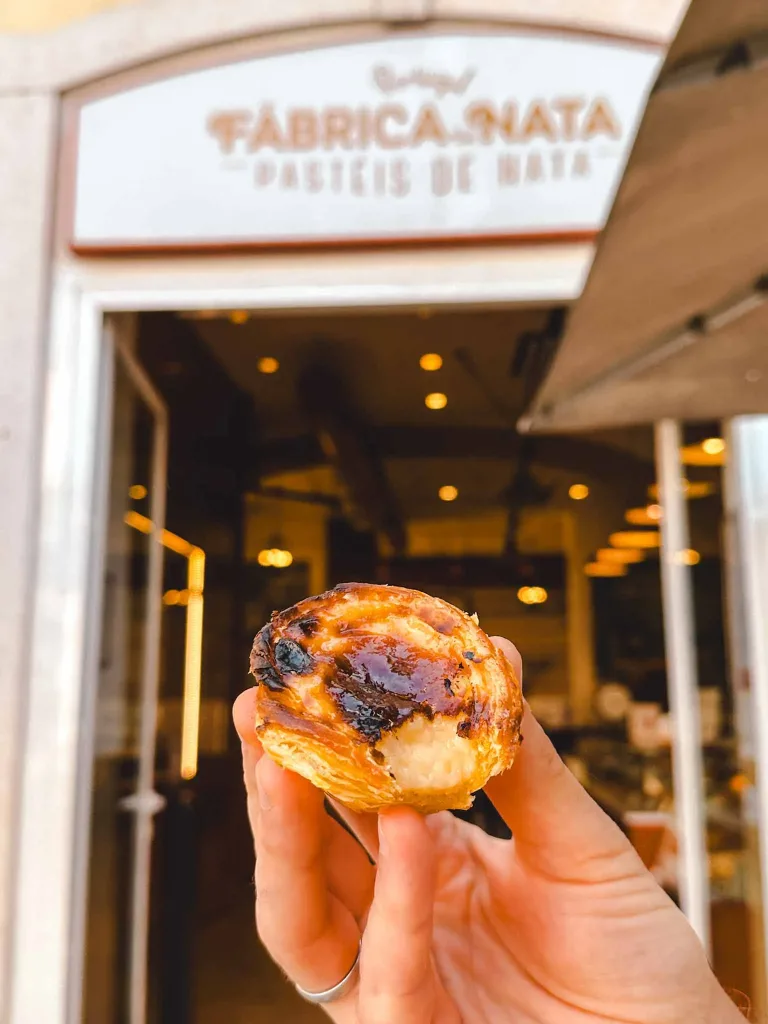
Visit Belém and Lisbon with a Local Guide
Belém is one of the most concentrated areas in Lisbon for history, architecture, and food — the monastery, the Tower, the Discoveries Monument, and the Fábrica dos Pastéis de Belém are all within walking distance of each other. Most visitors see them in isolation. On a guided tour, they form a coherent story about one of the most consequential periods in European history.
We include Belém on our private Lisbon city tours, with timing built around the Fábrica queue patterns so you walk in when the interior has space and the tarts are fresh.
- Private Lisbon City Tour — Full-day private tour including Belém, Alfama, and the historic centre. Departure time adjusted to avoid the Fábrica morning peak.
- Sintra & Cascais Private Tour — Passes through the Belém riverfront on the return route. Pastéis de nata stop included.
- Best Day Trips from Lisbon — If you want to plan your Lisbon days yourself before booking a tour.
FAQ
What is the difference between pastel de nata and pastel de Belém?
How much does a pastel de nata cost in Lisbon?
Why does pastel de nata have dark spots on top?
When is the best time to eat a pastel de nata?
Does Fábrica dos Pastéis de Belém always have a queue?
Can I buy pastel de nata to take home?
Who invented the pastel de nata?
What is the "Secret Workshop" at Fábrica dos Pastéis de Belém?
Is there a vegan or gluten-free pastel de nata in Lisbon?
Which bakery actually makes the best pastel de nata in Lisbon?

Founder & Director of Yellow Cab TT Tours. Guiding in Portugal for 20+ years.
Founded Yellow Cab TT Tours in 2013. 3,372 five-star reviews on Tripadvisor.